We built Vedain CRM around that exact frustration. At $10 per user per month with every feature included, email sync, automation, pipeline management, AI agents, we saw firsthand how much the market overcharges small teams. That experience also gave us a sharp eye for what separates genuinely affordable CRMs from ones that just look cheap on the pricing page.
So we put together this list of seven CRM tools that deliver real value without draining your budget. Each pick was evaluated on pricing transparency, core features, ease of setup, and how well it scales as your team grows. Whether you're a solo founder or managing a team of 50, you'll find an option here that fits. Let's get into it.
1. Vedain CRM
Vedain is built to solve the feature-gating problem that makes most CRMs frustrating for small teams. You get every feature on day one, with no upgrade prompts, no locked dashboards, and no surprise invoices at the end of the month. That makes it one of the strongest picks if you're searching for the best affordable CRM for small business and need predictable costs from the start.
What you get for the price
At $10 per user per month, Vedain gives you a full sales operating system. That includes two-way email sync for Gmail and Outlook, a visual Kanban pipeline, multi-step email campaigns, no-code workflow automation, lead capture forms, and a 21-day email warmup tool to protect your domain's deliverability. Most CRMs charge extra for those last two features or sell them as separate subscriptions entirely.
The platform also includes 30+ pre-built AI agents for data enrichment and content generation, LinkedIn automation, and a custom AI Studio, features you'd typically pay hundreds more per month to access on other platforms.
Beyond the AI tools, you get custom dashboards, team leaderboards, granular permission controls, and sales target tracking for monthly and quarterly goals. Setup takes under five minutes with no technical knowledge required.
Best fit for
Vedain works best for sales-focused teams of 5 to 500 users who want a complete tool without juggling multiple subscriptions. It's especially useful for teams currently overpaying on HubSpot or Pipedrive who want the same core functionality at a much lower rate.
Your team will get the most out of it if you run outbound email sequences and need reliable two-way sync with Gmail or Outlook baked in, not bolted on.
Where it can fall short
Vedain is newer to the market, so if your workflow depends on a niche third-party integration that isn't yet supported, you may hit a gap. The platform centers on sales, meaning teams that also need deep customer support ticketing or complex marketing automation may find legacy platforms like Salesforce more accommodating in those specific areas.
Pricing snapshot
2. HubSpot CRM
HubSpot's free plan gets a lot of attention because "free" is hard to argue with. But the story gets more complicated once your team grows and starts hitting feature walls that push you toward paid tiers. For small businesses weighing their options, HubSpot sits in an interesting middle ground: genuinely useful at no cost, but potentially expensive fast.
What you get for the price
The free tier covers contact management, deal pipelines, basic email tracking, live chat, meeting scheduling, and limited form builders. Those are solid starting points for a team of one or two getting organized for the first time. You can manage a small pipeline and track interactions with contacts without spending anything.
Once you need automation, email sequences, or custom reporting, you're looking at Starter or Professional plans that jump significantly in cost per user.
Best fit for
HubSpot fits best if you're just getting started and want a CRM with zero upfront cost. It also works well for teams already using HubSpot's marketing tools, since contact data flows naturally across their product suite without extra setup.
Where it can fall short
The free plan has contact limits and email send caps that a team with any real outbound motion will hit quickly. Automation and reporting, two features most small businesses need from day one, are locked behind paid tiers. If you're looking for the best affordable CRM for small business with those features included, HubSpot's paid plans can outprice simpler alternatives fast.
Pricing snapshot
3. Pipedrive
Pipedrive built its reputation on one thing: keeping sales reps focused on deals and activities rather than admin overhead. It's a pipeline-first CRM that prioritizes visual deal tracking above everything else, which makes it appealing if your team runs a structured, repeatable sales process.
What you get for the price
The Essential plan gives you unlimited deals and contacts, a visual pipeline view, activity reminders, and basic reporting. The interface is clean and fast to learn, making it one of the easier CRMs to get your team up and running on quickly. Email sync is available across all plans, though email automation sequences are locked behind the Advanced tier and above.
If your team does any serious outbound email work, you'll need to budget for an upgrade beyond the entry-level plan to unlock those features.
Best fit for
Pipedrive works well for sales teams with a clearly defined pipeline who want a focused tool built around moving deals forward. Teams that prioritize visual deal management over built-in marketing features or customer support functionality tend to get the most consistent value here.
Where it can fall short
If you're searching for the best affordable CRM for small business that bundles automation and email sequences without forcing an upgrade, Pipedrive falls short at entry level. Lead scoring, workflow automation, and email campaigns all sit behind higher-tier plans, and costs scale quickly once you start adding the features a growing team actually needs.
Pricing snapshot
4. Freshsales
Freshsales, part of the Freshworks suite, targets small businesses that want a clean interface and built-in AI features without the enterprise price tag. It positions itself as a mid-range option that balances core CRM functionality with smart automation tools baked into lower tiers.
What you get for the price
The Growth plan includes a visual pipeline, email sync, basic workflow automation, and Freddy AI, Freshworks' built-in AI assistant that scores leads and suggests next actions. You also get phone and chat integration on paid plans, which differentiates it from similarly priced tools. Most of the day-to-day features a small sales team needs are accessible without moving to the top tier.
The free plan supports up to three users but strips out most automation and reporting, making it more of a test drive than a working solution.
Best fit for
Freshsales works well for small teams that want AI-assisted lead scoring without building complex workflows from scratch. It also fits businesses already using Freshdesk or other Freshworks products, since data flows across the suite with minimal setup effort.
Where it can fall short
If you're looking for the best affordable CRM for small business with truly unlimited features at one flat rate, Freshsales gates key tools behind its Pro and Enterprise tiers. Custom reports and advanced workflow automation both require an upgrade, and per-user costs can climb quickly once your team grows beyond the basics.
Pricing snapshot
5. Less Annoying CRM
Less Annoying CRM lives up to its name by stripping away the complexity that makes most sales tools a chore to use. It targets very small businesses and solo operators who need a simple, no-frills setup without spending hours on onboarding or configuration.
What you get for the price
For $15 per user per month, you get contact management, a basic pipeline, task and event tracking, and a simple calendar view. Everything sits on one flat-rate plan with no feature tiers to navigate. You won't find advanced automation or AI tools here, but the core functionality covers the basics for a team that just needs to stay organized.
The simplicity is the point, and for the right team, that's exactly what makes it worth considering.
Best fit for
Solo founders and micro-teams of one to five people who prioritize simplicity over power get the most value here. If your sales process is straightforward and you're not running outbound email sequences or complex workflows, this tool keeps things clean and manageable without a steep learning curve.
Where it can fall short
If you're searching for the best affordable CRM for small business that grows with your team, Less Annoying CRM hits a ceiling fast. It lacks built-in email automation, reporting depth, and workflow tools that most scaling teams depend on. As your headcount grows, the per-user cost stays flat, but the feature set doesn't expand to match your needs.
Pricing snapshot
6. Zoho CRM and Bigin
Zoho offers two distinct options for small businesses: Zoho CRM, the full-featured platform, and Bigin, a lighter pipeline-focused tool designed specifically for smaller teams. Together, they cover a wide range of use cases depending on how much CRM complexity you actually need.
What you get for the price
Bigin starts at $7 per user per month and gives you a clean pipeline view, contact management, basic workflow automation, and email integration. Zoho CRM's free plan supports up to three users and includes leads, contacts, and basic deal tracking. Paid tiers on Zoho CRM unlock workflow automation, advanced analytics, and AI-powered features through their Zia assistant, though those capabilities come at a higher price point.
If you're choosing between the two, Bigin fits smaller, simpler sales operations while Zoho CRM scales better for teams with more complex requirements.
Best fit for
Bigin works well for micro-teams and solo founders who want a structured pipeline without paying for features they won't use. Zoho CRM fits better for teams that anticipate growth and want a platform that can expand with them without switching tools entirely.
Where it can fall short
If you're looking for the best affordable CRM for small business with everything included at one transparent price, both options fall short in different ways. Bigin lacks depth for teams doing serious outbound work, while Zoho CRM's most useful features sit behind higher tiers that raise the per-user cost considerably.
Pricing snapshot
Picking the right CRM this week
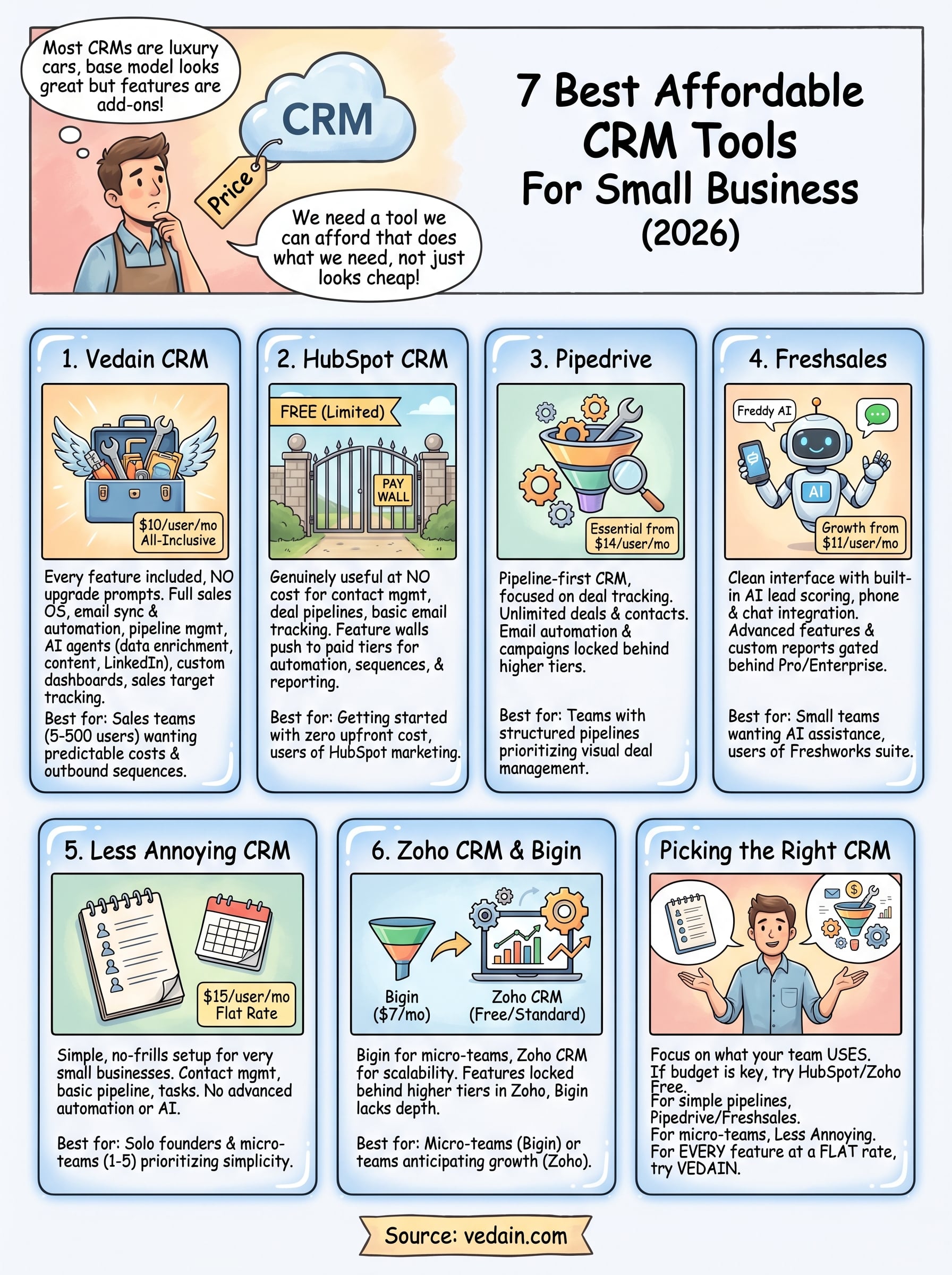
The best affordable CRM for small business comes down to one honest question: what does your team actually use every day? If you run outbound email sequences and need automation baked in from day one, a tool with a stripped-down entry plan will slow you down fast. If you're a solo founder tracking a handful of deals, a full enterprise-grade platform adds complexity you don't need yet.
Most tools on this list do something well. HubSpot and Zoho offer free starting points if budget is the only filter. Pipedrive and Freshsales bring solid pipeline tools for teams with room to grow into paid tiers. Less Annoying CRM keeps things simple for micro-teams.
But if you want every feature included at a flat rate with no upgrade pressure, Vedain is the clear starting point. Try it free today and see how fast your team gets set up: start your free Vedain CRM trial.