Most CRM platforms either price out small businesses with per-feature charges or overwhelm them with enterprise complexity nobody asked for. We built Vedain CRM specifically to solve that problem, all features included at $10/user/month, no tiers, no surprises. But we also know Vedain isn't the only option worth considering, and an honest comparison helps you make a smarter decision for your team.
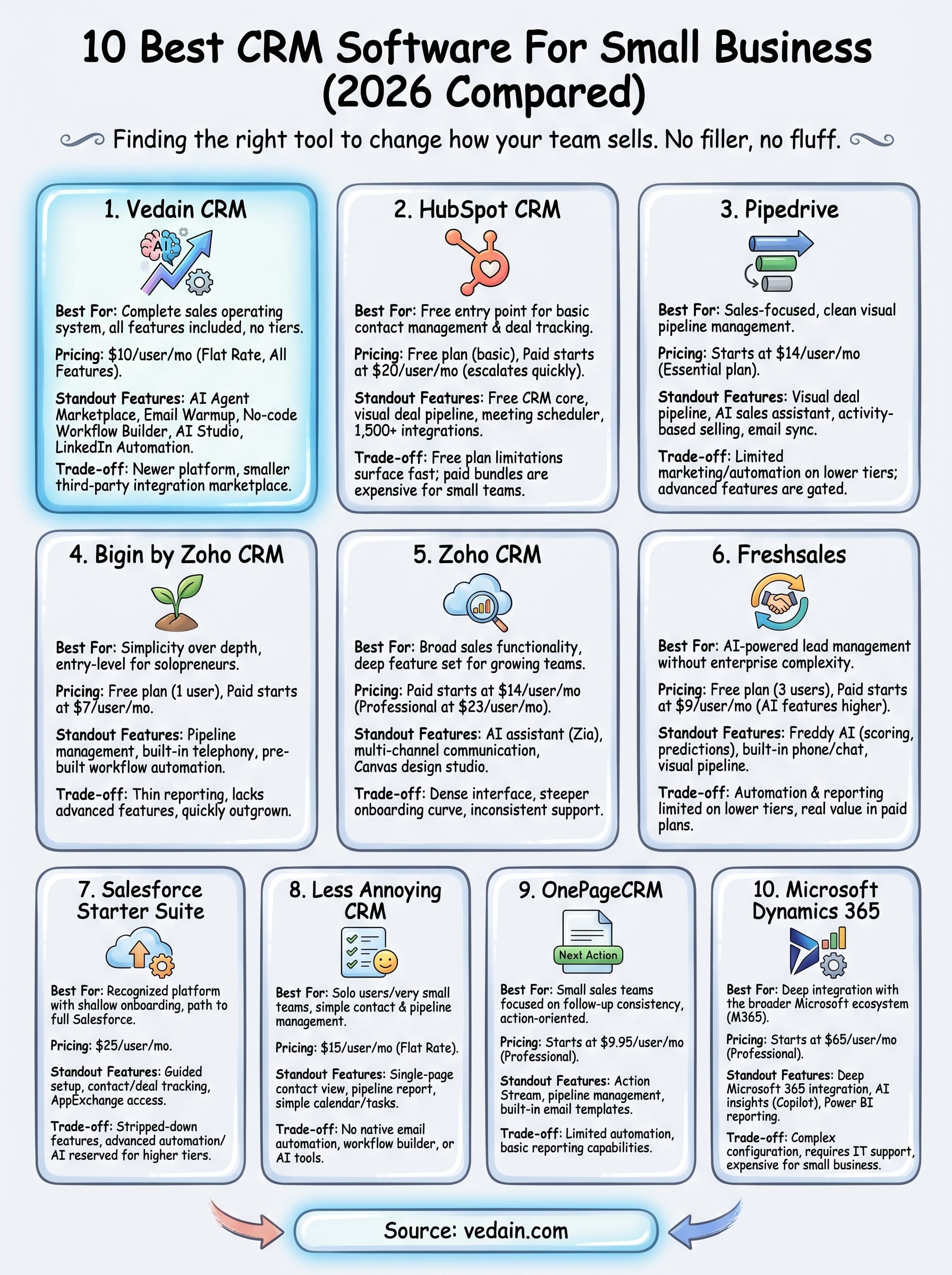
So we put together this side-by-side breakdown of 10 CRM platforms that actually make sense for small businesses in 2026. For each one, you'll get a clear look at features, pricing, strengths, and trade-offs, everything you need to pick the CRM that fits your workflow and budget. No filler, no fluff. Let's get into it.
1. Vedain CRM
Vedain CRM is a cloud-based sales platform built to give small businesses every feature they need at a single, transparent price. The platform handles the full sales cycle, from lead capture to closed deal, without hiding tools behind feature tiers or charging extra for automation.
What it does best
Vedain's core strength is delivering a complete sales operating system at a price point small teams can actually sustain. You get pipeline management, email campaigns, workflow automation, AI tools, and team reporting from the moment you sign up. That makes it one of the most practical picks when you're evaluating the best crm software for small business without wanting to negotiate a pricing plan just to unlock basic features.
Standout features
Vedain packs features that most CRMs lock behind higher tiers. Here's what separates it from the crowd:
- •AI Agent Marketplace with 30+ pre-built agents for lead enrichment and content generation
- •Email Warmup that builds your domain's sending reputation over 21 days before you launch campaigns
- •No-code Workflow Builder for automating sequences, task creation, and pipeline updates
- •AI Studio that lets you build custom CRM features by describing them in plain English
- •LinkedIn Automation for scheduling AI-generated posts directly from the platform
The AI Studio is especially practical for small teams that need specific functionality but don't have a developer available to build it.
Where it falls short
Vedain is a newer platform, so its third-party integration marketplace is smaller than what HubSpot or Salesforce offer. If your team depends on a niche or legacy tool, confirm native integration availability before switching.
Integrations and ecosystem
Vedain connects natively with Gmail and Outlook via two-way email sync, which covers most small business setups. The platform also includes built-in lead forms for website capture and a full reporting suite, so you don't need separate tools for analytics or pipeline visibility.
Pricing and plan notes
Vedain charges $10 per user per month, flat rate. Every feature, including AI tools, email automation, campaigns, and reporting, is included for every user. There are no feature tiers or hidden fees, and you can start a free trial without entering a credit card. Setup takes under five minutes.
2. HubSpot CRM
HubSpot CRM is one of the most recognized names when people search for the best crm software for small business. It started as a free contact management tool and has grown into a broad platform covering sales, marketing, and customer service under one roof.
What it does best
HubSpot excels at giving small businesses a free entry point with solid contact management, deal tracking, and basic reporting. If your team is just getting started and needs a low-risk way to bring structure to your sales process, HubSpot's free tier removes the financial barrier entirely.
Standout features
- •Free CRM core with unlimited users and up to 1 million contacts
- •Visual deal pipeline with drag-and-drop management
- •Meeting scheduler and email tracking built into the free plan
- •Live chat and basic email automation on paid tiers
Where it falls short
HubSpot's free plan limitations surface quickly as your team grows. Email sequences, workflow automation, and reporting upgrades all require paid tiers. The costs escalate fast, with Marketing Hub and Sales Hub bundles running into hundreds of dollars per month, which puts real pressure on small business budgets.
Many small teams start on the free plan and face an unexpected pricing jump the moment they need automation or more than basic reporting.
Integrations and ecosystem
HubSpot connects with over 1,500 third-party apps through its marketplace, including Gmail, Outlook, Slack, and Zapier. The ecosystem is one of the largest available, which makes it practical for teams already using multiple tools.
Pricing and plan notes
The free plan covers basic CRM features for unlimited users. Paid Sales Hub plans start at $20/user/month but can climb significantly once your team needs advanced automation or larger contact volumes.
3. Pipedrive
Pipedrive is a sales-focused CRM built around pipeline management. Unlike platforms that bolt sales features onto a broader marketing or support tool, Pipedrive keeps its focus narrow, which makes it easier to learn and faster to set up for teams that just want to manage deals.
What it does best
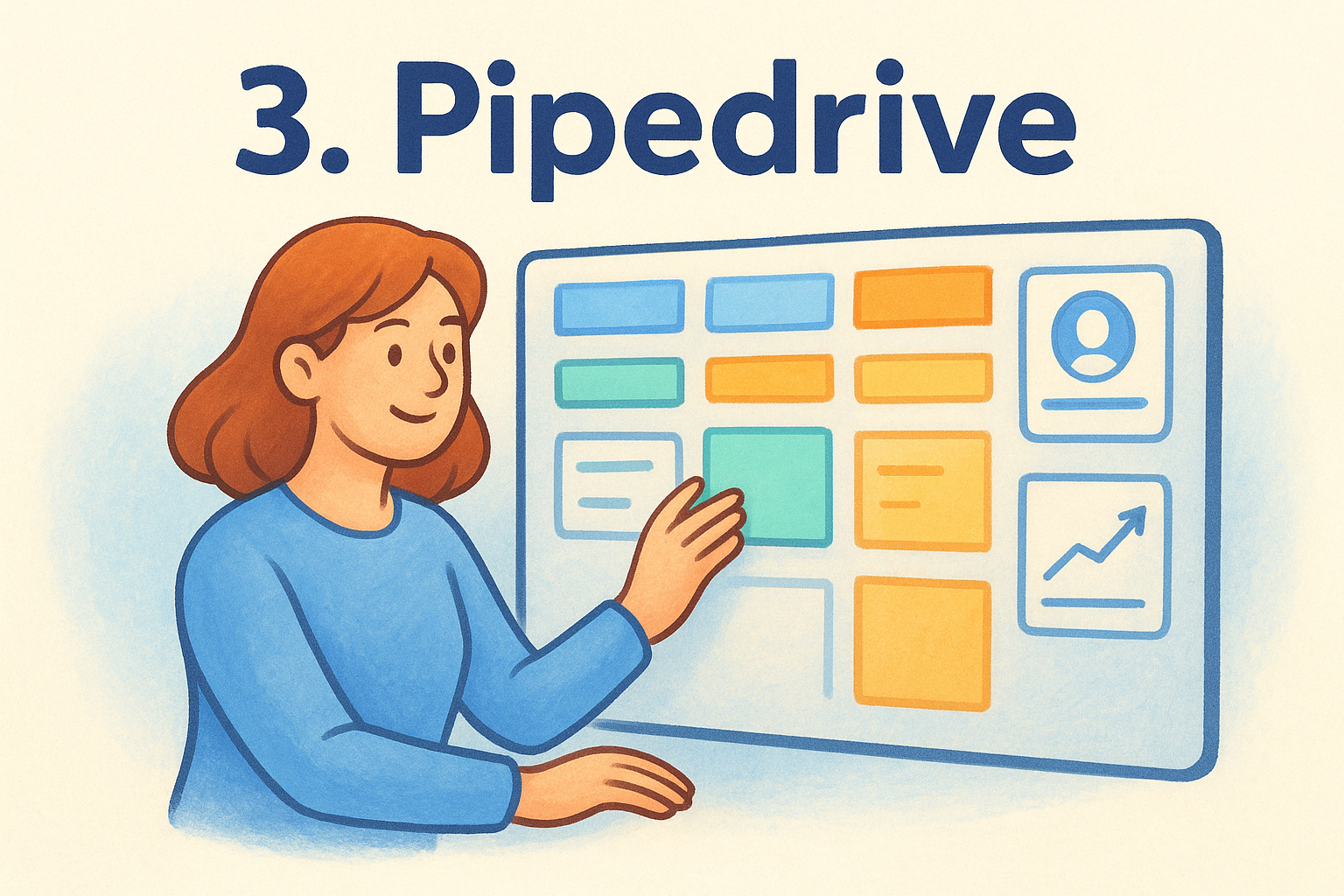
Pipedrive is strongest when your team needs a clean, visual pipeline without the overhead of a full platform suite. The drag-and-drop deal board is intuitive, and the activity-based selling model keeps reps focused on the next action rather than just the deal stage. If you're evaluating the best crm software for small business and your team is primarily focused on closing deals, Pipedrive's simplicity is a real asset.
Standout features
- •Visual deal pipeline with customizable stages and drag-and-drop management
- •AI sales assistant that surfaces deal insights and suggests next steps
- •Email sync with open and click tracking built in
- •Customizable activity reminders to prevent follow-ups from slipping
Where it falls short
Pipedrive's marketing and automation capabilities are limited on lower-tier plans. If you need multi-step email sequences or deeper workflow automation, you'll need to upgrade or connect third-party tools. Lead scoring and advanced reporting are also gated behind higher-cost plans, which adds up fast for budget-conscious teams.
Pipedrive works well as a pure sales tool but starts to feel limited the moment you need marketing or support features alongside it.
Integrations and ecosystem
Pipedrive connects with over 400 apps, including Gmail, Outlook, Slack, and Zapier, giving your team enough flexibility to build a functional sales stack without custom development work.
Pricing and plan notes
Pipedrive's Essential plan starts at $14/user/month, with higher tiers running up to $99/user/month for full automation and reporting access.
4. Bigin by Zoho CRM
Bigin is Zoho's entry-level CRM product, designed specifically for small businesses and solopreneurs who find full-scale CRM platforms too complex. It strips the Zoho CRM feature set down to the essentials, giving you pipeline management, contact tracking, and basic automation in a clean, approachable interface.
What it does best
Bigin focuses on simplicity over depth. If your team is moving off spreadsheets for the first time and needs something lightweight to track deals and contacts, Bigin lowers the learning curve significantly. It's one of the more accessible starting points when you're searching for the best crm software for small business and don't want to spend days on onboarding.
Standout features
- •Pipeline management with multiple pipeline support across different product lines or regions
- •Built-in telephony for logging and making calls directly from the platform
- •Pre-built workflow automation to handle routine tasks like stage updates and follow-up reminders
- •Mobile apps for iOS and Android with solid offline support
Bigin's multi-pipeline feature is especially useful for small businesses selling more than one product or service without needing a full enterprise CRM.
Where it falls short
Bigin's reporting capabilities are thin compared to most competitors at a similar price point. You also won't find advanced features like email campaigns, AI tools, or deep customization here, which means your team will outgrow it quickly as the business scales.
Integrations and ecosystem
Bigin connects with Zoho's broader app suite, including Zoho Books and Zoho Desk. Outside that ecosystem, it supports Gmail, Outlook, and Zapier for flexibility.
Pricing and plan notes
Bigin offers a free plan for a single user, with paid tiers starting at $7/user/month. Feature access remains limited until you move into higher plans.
5. Zoho CRM
Zoho CRM is the full-featured counterpart to Bigin, built for small businesses that are ready to handle more complexity. Where Bigin keeps things minimal, Zoho CRM gives you a deeper feature set covering sales automation, multi-channel communication, and advanced analytics, all within a platform that scales as your team grows.
What it does best
Zoho CRM gives you broad sales functionality at a competitive price, which makes it a strong candidate when you're evaluating the best crm software for small business and need more than basic pipeline tracking. The platform covers lead management, deal tracking, workflow automation, and email integration in a single tool without requiring you to stitch together multiple products.
Standout features
- •AI assistant (Zia) for lead scoring, deal predictions, and activity suggestions
- •Multi-channel communication including email, phone, live chat, and social media
- •Custom modules and fields to tailor the CRM to your specific sales process
- •Canvas design studio for building a personalized CRM layout without coding
Zia's predictive scoring is a standout for small teams that want data-backed prioritization without hiring a dedicated analyst.
Where it falls short
Zoho CRM's interface feels dense, especially for new users. The volume of settings and configuration options creates a steeper onboarding curve than simpler alternatives. Customer support response times have also been flagged as inconsistent across user reviews.
Integrations and ecosystem
Zoho CRM integrates with Gmail, Outlook, Slack, and the broader Zoho suite, including Zoho Books, Campaigns, and Desk, giving teams a connected stack if they go all-in on Zoho.
Pricing and plan notes
Paid plans start at $14/user/month, with the most useful automation and AI features available on the Professional plan at $23/user/month.
6. Freshsales
Freshsales is a sales CRM from Freshworks that targets small to mid-sized teams who want AI-powered lead management without the complexity of enterprise platforms. It sits in a competitive middle ground between simple pipeline tools and full-featured suites, making it worth evaluating when you're comparing the best crm software for small business options.
What it does best
Freshsales performs well when your team needs built-in AI lead scoring and a clean contact timeline without heavy configuration. The platform's Freddy AI layer surfaces deal insights and contact enrichment data automatically, which saves reps time they'd otherwise spend on manual research.
Standout features
- •Freddy AI for lead scoring, deal predictions, and next-step suggestions
- •Built-in phone and chat so your team can communicate with prospects without leaving the CRM
- •Visual sales pipeline with activity-based tracking
- •Auto-profile enrichment that pulls contact data from public sources
Freddy AI's deal predictions give small teams a practical advantage when prioritizing a pipeline without dedicated sales operations support.
Where it falls short
Freshsales limits workflow automation and reporting access to higher-tier plans, which pushes the effective cost up quickly for small teams. The free plan also caps users and strips out most of the AI features, meaning you see the platform's real value only after you've committed to a paid plan.
Integrations and ecosystem
Freshsales connects with Gmail, Outlook, Slack, and the Freshworks suite, including Freshdesk for support and Freshmarketer for campaigns.
Pricing and plan notes
Freshsales offers a free plan for up to three users, with paid plans starting at $9/user/month. Automation and AI features unlock at the Growth tier and above.
7. Salesforce Starter Suite
Salesforce Starter Suite is the entry-level product from the world's largest CRM vendor, positioned for small businesses that want the Salesforce name without a full enterprise contract. It bundles sales, service, and marketing tools into a single simplified package.
What it does best
Salesforce Starter Suite gives small teams a recognized, trusted platform with a shallow onboarding path compared to full Salesforce editions. If your team plans to scale and wants to stay within one ecosystem long-term, starting here keeps your data and workflows compatible with more powerful Salesforce tiers down the road.
Standout features
- •Guided setup that walks new users through configuration without admin expertise
- •Contact, account, and deal tracking in a familiar CRM layout
- •Basic email integration and activity logging
- •Access to AppExchange, Salesforce's large third-party app marketplace
The AppExchange access is one of the few genuine advantages Starter Suite holds over simpler tools at a similar price point.
Where it falls short
Starter Suite strips out a significant portion of what makes Salesforce valuable, including advanced automation, custom reporting, and AI features, which are reserved for higher-tier plans. If you're evaluating the best crm software for small business and need automation from day one, Starter Suite's limitations become a problem quickly.
Integrations and ecosystem
Salesforce connects with Gmail, Outlook, Slack, and thousands of third-party apps through AppExchange, giving you one of the broadest integration options available at any price point.
Pricing and plan notes
Salesforce Starter Suite is priced at $25/user/month, making it more expensive than most small business-focused alternatives while delivering a narrower feature set than its price suggests.
8. Less Annoying CRM
Less Annoying CRM does exactly what its name suggests. It delivers simple contact and pipeline management for small businesses that don't want configuration headaches or feature overload. If you're evaluating the best crm software for small business and your primary need is tracking contacts and following up reliably, Less Annoying CRM keeps the process straightforward.
What it does best
Less Annoying CRM performs best for solo users and very small teams that need a clean, no-frills tool to manage contacts and track follow-up tasks. The platform's entire design philosophy prioritizes getting your team operational quickly without spending hours on setup or training.
Standout features
- •Single-page contact view that shows all activity, notes, and tasks in one place
- •Pipeline report that gives a daily snapshot of where every lead stands
- •Unlimited contacts and pipelines with no feature gating
- •Simple calendar and task management for follow-up tracking
Less Annoying CRM's flat structure works especially well for businesses that have tried complex CRMs and found them overkill for their actual sales process.
Where it falls short
The platform has no native email automation, workflow builder, or AI tools, which means your team handles most tasks manually. As your sales process grows, those missing capabilities become noticeable gaps that require adding separate tools and costs.
Integrations and ecosystem
Less Annoying CRM connects with Google Calendar and Mailchimp natively, with broader connectivity available through Zapier. The integration options are limited compared to most competitors on this list.
Pricing and plan notes
Less Annoying CRM charges a flat $15/user/month with no tiers or feature restrictions. Every user gets the full product at that price.
9. OnePageCRM
OnePageCRM is a sales-focused CRM built around a single organizing principle: every contact should have a clear next action attached to it. The platform turns your contact list into an action-oriented queue, keeping your sales reps moving forward instead of digging through records to figure out what needs attention next.
What it does best
For small sales teams that struggle with follow-up consistency, OnePageCRM removes the guesswork. The platform's Action Stream queues every contact by their next scheduled action, so your team always knows who to reach out to without spending time triaging a disorganized pipeline. When you're searching for the best crm software for small business that keeps things simple without sacrificing structure, OnePageCRM's action-first approach stands apart.
Standout features
- •Action Stream that prioritizes contacts by next-action date
- •Pipeline management with deal forecasting and stage tracking
- •Built-in email templates and bulk email sending for outreach
- •One-click call logging and note capture from the contact view
The Action Stream model works especially well for teams where missed follow-ups are the primary reason deals fall through.
Where it falls short
OnePageCRM has limited automation capabilities compared to most platforms on this list. If your team needs multi-step workflows or email sequences, you'll need to add separate tools. Reporting features are also basic, which makes it harder to track team performance or identify pipeline trends as your business grows.
Integrations and ecosystem
Native connections cover Gmail, Outlook, and Zapier, which handles most small business communication setups without any complex configuration work required.
Pricing and plan notes
The Professional plan starts at $9.95/user/month, with a Business plan at $19.95/user/month that unlocks additional automation and reporting capabilities.
10. Microsoft Dynamics 365
Microsoft Dynamics 365 is an enterprise-grade CRM and ERP platform that Microsoft positions for businesses that need deep integration with the broader Microsoft ecosystem. While it's typically associated with mid-market and enterprise customers, the platform does offer smaller entry points that some small businesses consider when evaluating the best crm software for small business alongside Microsoft 365 subscriptions they already pay for.
What it does best
Dynamics 365 performs strongest when your team is already embedded in the Microsoft stack, running Teams, Outlook, and SharePoint daily. The native connections between those tools and the CRM layer reduce friction for teams that don't want to manage separate logins or data syncs across platforms.
Standout features
- •Deep Microsoft 365 integration including Outlook, Teams, and Excel sync
- •AI-powered insights through Microsoft Copilot for sales forecasting and pipeline analysis
- •Customizable dashboards and reporting built on Power BI
- •Role-based access controls with granular permission management
If your team already runs on Microsoft 365, Dynamics 365 reduces the number of separate tools you need to manage across your sales workflow.
Where it falls short
Dynamics 365 is complex to configure and typically requires IT support or a dedicated administrator to set up properly. For small teams without technical resources, the onboarding process alone can take weeks rather than minutes.
Integrations and ecosystem
The platform connects natively with Microsoft Teams, Outlook, SharePoint, and Power BI, with additional integrations available through the Microsoft AppSource marketplace.
Pricing and plan notes
Dynamics 365 Sales starts at $65/user/month for the Professional plan, making it one of the most expensive options on this list for small business use cases.
Next Steps
You've now seen how ten different platforms stack up when it comes to finding the best crm software for small business. The right pick depends on your team size, budget, and how much you need automation to carry the workload. If you're price-sensitive and want every feature available from day one, most platforms on this list will eventually push you into a higher tier to unlock what you actually need.
Vedain CRM takes a different approach. At $10 per user per month, you get the full platform, including AI tools, email automation, pipeline management, and reporting, without negotiating a plan or hitting feature walls mid-growth. Setup takes under five minutes and no credit card is required to start.
If you want to see how it fits your workflow before committing, try Vedain CRM free and put the full feature set through its paces on your own pipeline.