We built Vedain CRM specifically for teams that want full-featured sales tools without surprise invoices. At $10/user/month with every feature included, no tiers, no gates, we've seen firsthand what startups actually need from a CRM and where free plans fall short. That perspective shapes this guide. We're not just listing tools; we're breaking down what you really get for free and where the walls go up.
Below, you'll find 15 free CRM options compared across features, limitations, and real usability for early-stage teams. Each breakdown covers what's included at no cost, where the upgrade pressure kicks in, and which startups each tool fits best, so you can make a clear, informed decision without signing up for ten different platforms first.
1. Vedain CRM
Vedain CRM isn't a free plan with a paywall hiding behind it. It's a full-featured sales platform priced at a flat $10 per user per month with every tool included from day one and no feature tiers to navigate. For startups evaluating the best free CRM for startups, Vedain earns the top spot because you get more from a no-credit-card trial than most competitors offer on their permanent free plans.
What you get with Vedain from day one
Signing up gives you full access to the entire platform with no credit card required. That includes leads and contacts management with custom fields and smart filters, a visual Kanban deal pipeline, two-way email sync for Gmail and Outlook, multi-step email campaigns, a no-code workflow automation builder, and an AI agent marketplace with 30+ pre-built agents for data enrichment and content generation. On top of that, you also get email warmup for domain deliverability, website lead forms, custom dashboards, team permissions, and sales target tracking.
Most free CRM plans give you a stripped-down version of the product and save the useful parts for paid tiers. Vedain gives you the full product with no feature gates blocking anything you actually need to run a sales process.
Where Vedain fits compared to free CRMs
Free CRM plans typically cap you on contacts, automation steps, or email sends the moment you start growing. Vedain sets no record limits, includes automation at the base price, and syncs your email without requiring an upgrade.
Vedain isn't trying to be the cheapest option; it's trying to be the last CRM you need to switch away from.
When you compare total included features against tools like HubSpot or Zoho, Vedain's paid plan regularly costs less than the equivalent paid tier of a competitor whose free plan you outgrow in month three.
Best for
Vedain fits startups that want a complete sales operating system without assembling multiple tools or hitting artificial limits mid-quarter. It's a strong match for:
- •Teams on Gmail or Outlook who need real two-way email sync
- •Founders who need a setup time under five minutes with no IT support
- •Sales teams of 5 to 500+ who want automation, pipeline tracking, and email campaigns in one place
Pricing and what's free
Vedain offers a free trial with no credit card required, so you can test the full platform before spending anything. After the trial, pricing is $10 per user per month, flat, with no hidden fees, no feature tiers, and no upsell pressure.
2. HubSpot CRM
HubSpot's free CRM is one of the most well-known options for early-stage teams, and it earns that reputation partly by offering a genuinely usable product at no cost. If you're researching the best free CRM for startups, HubSpot will likely appear near the top of most lists. The real question is whether the free plan gets you far enough before you hit the ceiling.
What you get on the free plan
The free tier gives you contact and company management, deal pipelines, basic email tracking, and a meeting scheduler. You also get live chat, a shared inbox, and limited form tools for capturing leads. For a startup just getting organized, this covers the core foundation of a sales process without any initial cost.
The free plan works well enough to build habits around, but it's designed to make paid tiers feel necessary as your team grows.
Where the free plan hits limits
HubSpot gates email sequences and automation behind paid plans, which is where most growing startups run into friction fast. Reporting is also limited, and you can't remove HubSpot branding from forms or emails on the free tier. The moment your team needs to automate outreach or track performance beyond basic dashboards, you're looking at an upgrade.
Best for
HubSpot's free plan fits solo founders or very small teams who need a clean interface to log contacts and track a few deals without any automation needs yet.
Pricing and upgrade path
HubSpot's paid plans start at $20 per user per month for Starter, but full sales automation requires the Sales Hub Professional tier, which costs significantly more.
3. Zoho CRM
Zoho CRM has a free plan that supports up to 3 users, which makes it one of the more restrictive free options in terms of team size. Still, for a very early-stage founding team, the included features cover the basics you need to get organized.
What you get on the free plan
The free tier includes leads, contacts, accounts, and deals management, along with standard task and event tracking. You also get basic workflow rules limited to a small number, email templates, and a handful of standard reports. For startups just getting off the ground, these tools let you log activity and track a simple pipeline without paying anything upfront.
Zoho's free plan gives you a working CRM skeleton, but the muscles you need to actually run sales at scale sit behind a paywall.
Where the free plan hits limits
Hitting the 3-user cap is the first wall you'll encounter, and it's a hard one. Beyond that, you lose access to custom dashboards, advanced automation, mass email features, and in-depth analytics unless you upgrade. Integrations with third-party tools are also restricted, so if your startup relies on connecting multiple platforms, the free plan will feel tight quickly.
Best for
Zoho's free plan works best for co-founder pairs or solo operators who need basic contact and deal tracking without team collaboration features. It's not a strong pick if you're evaluating the best free CRM for startups with near-term growth in mind.
Pricing and upgrade path
Paid plans start at $14 per user per month for the Standard tier, with automation and advanced analytics unlocking at higher tiers.
4. Salesforce Free Suite
Salesforce is the dominant name in enterprise CRM, and the company does offer a limited free tier through select programs alongside a 30-day free trial for its core platform. If you're searching for the best free CRM for startups, Salesforce carries brand recognition, but the free offering needs closer examination before you commit time to it.
What you get on the free plan
The free access Salesforce provides comes primarily through its Trailhead learning platform and nonprofit or startup ecosystem programs, rather than a standard open-enrollment free plan. Basic access includes contact and account management, along with opportunity tracking and activity logging. For early-stage teams accepted into Salesforce startup programs, this can extend to more features, but standard users are mostly limited to the 30-day trial window.
Salesforce's free offering is closer to a product demo than a long-term operating tool for a growing startup.
Where the free plan hits limits
Without program acceptance, you hit the trial expiration wall quickly. Even within structured startup programs, the feature set you access depends heavily on eligibility criteria. Automation, advanced reporting, custom dashboards, and integrations all sit firmly behind paid plans, which are among the most expensive in the market.
Best for
Salesforce's free access fits enterprise-track startups already targeting a future Salesforce environment and using the trial period to train their team before a funded rollout. It's a poor fit for bootstrapped teams needing a working tool today.
Pricing and upgrade path
Paid plans start at $25 per user per month for Starter Suite, with most meaningful sales features requiring the Pro Suite at $100 per user per month or higher.
5. Bitrix24
Bitrix24 takes a different approach from most CRMs by bundling a free plan with an unusually wide feature set that covers sales, project management, and team collaboration in one platform. If you're comparing the best free CRM for startups and need more than just contact tracking, Bitrix24's free tier looks generous on paper. The reality inside the product takes a bit more scrutiny.
What you get on the free plan
The free plan supports unlimited users, which immediately separates Bitrix24 from competitors like Zoho that cap you at three seats. You get contact and deal management, a basic sales pipeline, task tracking, a shared calendar, and built-in group chat and video calling. Lead forms and a simple website builder are also included, giving early-stage teams a broader toolkit than most free plans offer at this stage.
The unlimited user count is Bitrix24's strongest selling point, but it comes with enough interface complexity to slow down small teams.
Where the free plan hits limits
The free plan caps online storage at 5GB and restricts access to advanced CRM automation, sales intelligence features, and custom reporting. The platform also carries a steep learning curve, and the interface feels cluttered compared to modern CRMs. Teams that need clean pipeline views and fast onboarding often find Bitrix24 harder to adopt than expected.
Best for
Bitrix24 fits larger founding teams that need unlimited seats and basic collaboration tools combined in one place, and can tolerate a more complex setup process.
Pricing and upgrade path
Paid plans start at $49 per month for up to 5 users, billed annually.
6. EngageBay
EngageBay positions itself as an all-in-one alternative to HubSpot, and its free plan reflects that ambition more than most competitors manage. If you're evaluating the best free CRM for startups, EngageBay stands out because it bundles CRM, marketing, and helpdesk tools into a single free account without splitting them into separate products.
What you get on the free plan
The free tier gives you contact management for up to 250 contacts, along with deal pipelines, email marketing, landing pages, and basic live chat. You also get a built-in appointment scheduling tool and segmentation filters for organizing your contact list. For a startup at the very early stage, this covers enough ground to run both your sales and basic marketing outreach from one dashboard.
EngageBay's free plan is one of the few that combines CRM and email marketing without requiring a separate tool for each.
Where the free plan hits limits
The 250-contact cap is the most immediate constraint, and most startups hit it faster than they expect. Beyond that, automation is limited to basic sequences, and you lose access to advanced reporting and A/B testing unless you upgrade. The branding on emails and landing pages also stays unless you move to a paid tier.
Best for
EngageBay's free plan suits pre-revenue founders who need a simple marketing and CRM combo in one place and haven't yet built a large contact list.
Pricing and upgrade path
Paid plans start at $11.04 per user per month for the Basic tier, with full automation unlocking at the Growth plan level.
7. Vtiger
Vtiger offers a free plan called One Pilot that targets small sales teams wanting a capable CRM without an upfront commitment. If you're comparing the best free CRM for startups, Vtiger earns attention because it includes features typically locked behind paid plans elsewhere, though the user cap keeps it best suited for very small operations.
What you get on the free plan
The One Pilot free plan covers up to 1 user with 3,000 records, contact and deal management, a basic sales pipeline, and built-in email integration. You also get task tracking, document storage, and a limited set of pre-built reports to monitor activity. Vtiger includes a basic email marketing tool and a web-to-contact form to capture leads directly from your website.
Vtiger packs a reasonable feature set into its free tier, but the single-user limit makes it a solo tool rather than a team CRM from day one.
Where the free plan hits limits
The 1-user cap is the most significant barrier for any startup with more than one person managing deals. Beyond that, automation workflows, advanced analytics, and third-party integrations require a paid upgrade. Storage limits and record caps also become constraints as your contact database grows through normal prospecting activity.
Best for
Vtiger's free plan works for solo founders or individual sales reps who need organized contact and pipeline management without team collaboration requirements. It suits a single operator testing whether a structured CRM workflow improves their sales process before committing to a paid tool.
Pricing and upgrade path
Paid plans start at $12 per user per month for the One Growth tier, which unlocks automation, deeper reporting, and multi-user access.
8. Freshsales
Freshsales is Freshworks' dedicated sales CRM, and it offers a free plan called Growth that gives small teams a workable starting point without charging anything upfront. If you're still comparing the best free CRM for startups, Freshsales earns a spot on your shortlist because the free tier includes features that many competitors lock behind paid plans from the start.
What you get on the free plan
The free plan covers contact and account management, a built-in phone and email tool, deal pipeline tracking, and basic activity logging. You also get Freddy AI for contact scoring, which helps you prioritize which leads to chase first, a capability that's genuinely rare at the free tier. A mobile app and basic live chat support are included as well.
Getting AI-assisted contact scoring on a free CRM plan is uncommon, and Freshsales including it gives early-stage teams a useful head start on outreach prioritization.
Where the free plan hits limits
Workflow automation and email sequences are locked behind paid tiers, so you handle repetitive tasks manually as your pipeline grows. You also lose access to custom reports and advanced dashboards, which makes tracking team performance beyond basic summaries difficult without upgrading.
Best for
Freshsales' free plan fits teams that want a starting setup combining calling, AI scoring, and deal tracking in one place:
- •Solo founders or small teams needing built-in phone tools
- •Early-stage sales reps who want AI-prioritized contact lists without extra software
Pricing and upgrade path
Paid plans start at $9 per user per month for Growth, with full automation and custom reporting unlocking at higher tiers.
9. Streak
Streak takes a fundamentally different approach from every other tool on this list. Rather than asking you to log into a separate platform, Streak lives directly inside Gmail as a browser extension, turning your inbox into a functional CRM without switching tabs. If you're evaluating the best free CRM for startups and your team already lives in Gmail, Streak is worth a close look.
What you get on the free plan
The free plan gives you pipeline management inside Gmail, including deal stages, contact tracking, and basic task logging all visible within your inbox. You also get email tracking that shows you when a recipient opens your message and basic mail merge for sending personalized outreach to a small list. For a founder who's already managing deals through Gmail threads, Streak adds structure without changing your workflow.
If your team already runs on Gmail and you want a CRM that requires zero behavior change, Streak's free plan removes more friction than almost any other option on this list.
Where the free plan hits limits
The free tier is designed for individual use only, which means team pipeline sharing and collaborative features are locked behind paid plans. You also lose access to advanced reporting, data validation, and API access unless you upgrade. As your startup adds more team members to the sales process, Streak's free plan stops scaling with you quickly.
Best for
Streak's free plan fits solo founders and individual sales reps who manage their entire pipeline from Gmail and don't yet need team-wide pipeline visibility.
Pricing and upgrade path
Paid plans start at $15 per user per month for the Pro tier, which unlocks team pipelines and shared access.
10. Capsule
Capsule is a clean, contact-focused CRM that keeps its free plan simple without overwhelming you with features you won't need in the first few months. If you're still narrowing down the best free CRM for startups, Capsule offers a straightforward starting point for teams that prioritize relationship management over complex pipeline automation.
What you get on the free plan
The free plan supports up to 2 users and includes 250 contacts, basic pipeline tracking, task management, and calendar integration. You get a clean contact record view with notes and activity history, which helps you track every interaction without building complex workflows. Capsule also includes a sales pipeline with customizable stages so you can move deals forward without extra setup time.
Where the free plan hits limits
Hitting the 2-user cap is the first friction point, and the 250-contact ceiling follows closely as your outreach picks up. Advanced reporting, custom activity types, and integrations with tools like Mailchimp are blocked on the free tier. Capsule also doesn't offer built-in automation or email marketing at any plan level, so if your startup needs those capabilities inside your CRM, this tool won't cover them regardless of what you pay.
Capsule works well as a starter contact manager, but it's not built to scale your sales process without significant manual effort.
Best for
Capsule fits early-stage founders who need a clean, uncluttered tool for tracking contacts and basic deal stages without requiring team collaboration or automation from the start.
Pricing and upgrade path
Paid plans start at $18 per user per month for the Starter tier, which expands your contact limit and unlocks third-party integrations.
11. Attio
Attio is a modern, data-model-driven CRM that has built a strong following among early-stage tech teams looking for a more flexible alternative to rigid legacy platforms. If you're comparing the best free CRM for startups with a customizable structure under the hood, Attio's free tier earns a spot in your shortlist evaluation.
What you get on the free plan
The free plan supports up to 3 seats and includes Attio's core contact and company management tools. You get access to a flexible object model that lets you build custom record types beyond standard contacts and deals, which is useful if your startup's sales process doesn't fit a conventional pipeline layout. Basic list views, filtering, and activity tracking across your contact records are included as well.
Attio's flexible data model is a genuine differentiator, but it comes with a steeper initial setup compared to more opinionated CRMs on this list.
Where the free plan hits limits
Automation workflows and email sequences sit behind paid tiers, so you handle follow-up tasks manually as your pipeline grows. The 3-seat ceiling also becomes a real friction point once your team expands beyond the founding members, and advanced analytics require an upgrade before you can track performance with any meaningful depth.
Best for
Attio's free plan fits small technical founding teams who want a highly customizable contact layer rather than a rigid, predefined pipeline structure. It works best for:
- •Technical co-founders comfortable spending time on initial configuration
- •Early-stage teams with non-standard sales workflows that don't map neatly to typical deal stages
Pricing and upgrade path
Paid plans start at $34 per user per month for the Plus tier, which unlocks automation, advanced reporting, and broader third-party integrations for growing teams.
12. Clarify
Clarify is a newer, AI-native CRM built for teams that want relationship intelligence baked into the product from the start rather than bolted on later. If you're still evaluating the best free CRM for startups, Clarify is worth looking at for its modern approach to contact management, though its free offering reflects its early-stage position in the market.
What you get on the free plan
The free tier gives you access to core contact and relationship management, including enriched contact records that pull in publicly available information to fill gaps in your database automatically. You get a basic pipeline view, notes and activity tracking, and AI-assisted summaries that surface relevant context before you reach out to a contact.
Clarify's AI enrichment on the free plan is a genuine differentiator for early-stage teams trying to qualify leads faster without manual research.
Where the free plan hits limits
The free plan restricts the number of enrichment credits you get each month, which caps how aggressively you can use the AI features for prospecting. Advanced automation and deep integrations with tools beyond basic calendar and email sync require a paid upgrade, and the platform is still maturing compared to more established options on this list.
Best for
Clarify fits tech-forward founding teams who want an AI-enriched contact layer from day one and are comfortable adopting a platform that's still actively expanding its feature set.
Pricing and upgrade path
Clarify offers a free tier for small teams, with paid plans available for growing organizations that need higher enrichment limits and expanded automation capabilities.
13. Zapier Tables
Zapier Tables is not a traditional CRM, but it earns a place in any honest list of the best free CRM for startups because it solves a specific problem well. If your team already uses Zapier to connect tools, Tables gives you a flexible, relational database layer that you can shape into a lightweight contact and deal tracker without building from scratch.
What you get on the free plan
The free tier includes up to 5 tables and 4,000 records, with the ability to create custom fields, link records across tables, and trigger Zaps directly from table data. You can build a basic contact management setup with columns for lead source, deal stage, owner, and follow-up date, then automate actions based on field changes using the broader Zapier ecosystem.
Zapier Tables works best when you treat it as a CRM building block rather than a finished CRM product.
Where the free plan hits limits
Tables has no native pipeline visualization, no email sync, and no built-in reporting. Every meaningful automation requires a separate Zap, and the free Zapier plan limits how many Zaps you can run each month. As your contact volume grows, the 4,000-record cap becomes a real constraint before you're ready to commit to a paid plan.
Best for
Zapier Tables fits technically inclined founders who want to design a custom sales tracking setup and already rely on Zapier to connect their existing tools.
Pricing and upgrade path
The Tables free plan is included with Zapier's free account, with paid Zapier plans starting at $19.99 per month for additional records and automation runs.
14. Twenty
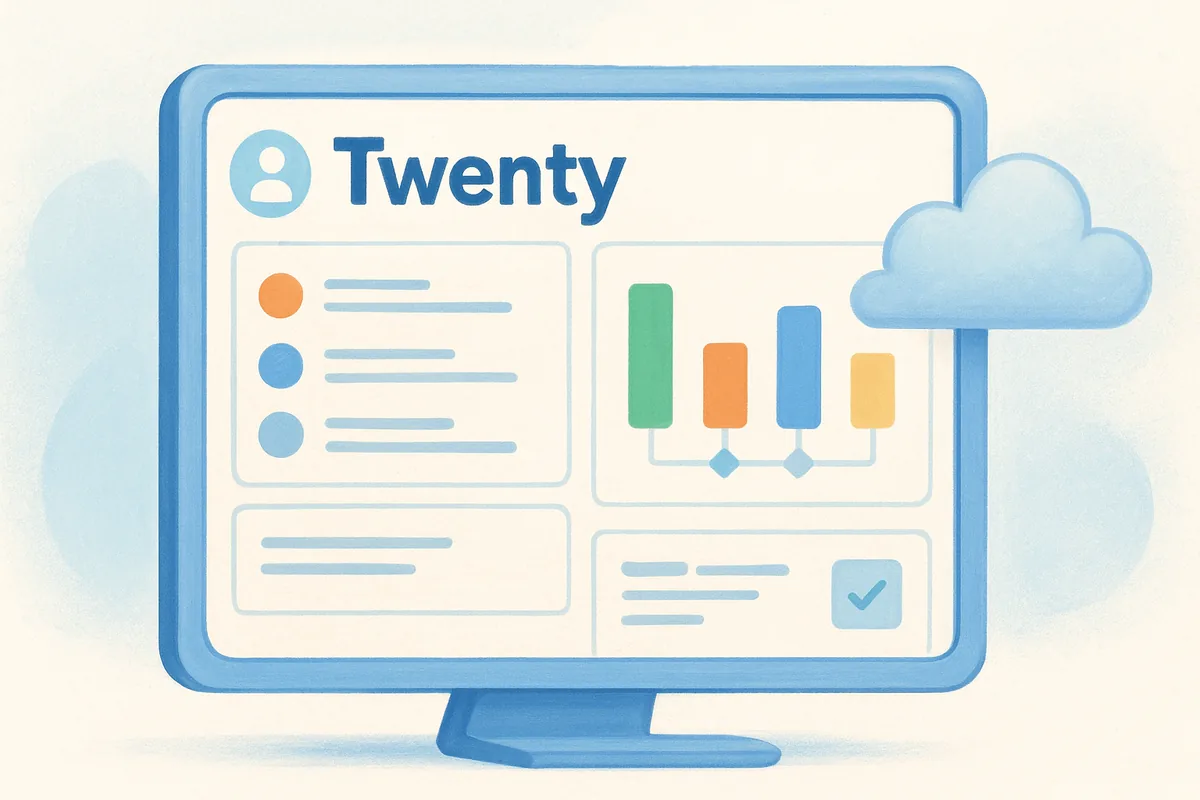
Twenty is an open-source CRM that gives startups something most tools on this list won't: full control over where your data lives. Built as a modern alternative to legacy platforms, Twenty lets you either self-host the entire product on your own infrastructure or use the hosted cloud version without paying anything upfront. If you're still narrowing down the best free CRM for startups and data ownership matters to your team, Twenty is one of the few options built with that requirement in mind.
What you get on the free plan
Twenty's free hosted plan includes contact and company management, a visual deal pipeline, notes, tasks, and a flexible custom object system that lets you extend the data model beyond standard fields. The interface draws from modern productivity tools, so navigation feels intuitive without a long onboarding process. You also get API access, which makes Twenty easier to connect with other tools in your stack than most free-tier CRMs allow.
Twenty's open-source model means you can inspect and modify the codebase directly, which is a meaningful advantage if your startup has specific data compliance requirements.
Where the free plan hits limits
The self-hosting path requires technical setup, which adds friction for non-technical founding teams. The hosted cloud version is still maturing, and some advanced workflow automation features remain in active development rather than fully released.
Best for
Twenty fits developer-led startups that prioritize data control and want an open-source foundation they can extend or self-host as they scale.
Pricing and upgrade path
Twenty's self-hosted version is free with no seat limits. The hosted cloud plan offers a free tier, with paid plans for teams needing additional support and managed infrastructure.
15. Brevo
Brevo (formerly Sendinblue) started as an email marketing platform and has since added CRM and sales pipeline tools to its free plan. If you're rounding out your evaluation of the best free CRM for startups, Brevo stands apart from every other option on this list because its primary strength is email, with CRM features built around that core rather than the other way around.
What you get on the free plan
The free tier gives you unlimited contacts and a basic deal pipeline alongside Brevo's core email tools. You can send up to 300 emails per day, manage contact lists with segmentation filters, and track deals through a simple pipeline view. The combination of contact management and a functional email engine in one free account gives early-stage teams a workable starting point for outreach without paying for a separate email marketing tool.
Brevo's free plan is most valuable when you treat the email marketing as the primary feature and the CRM pipeline as a supporting layer rather than the main event.
Where the free plan hits limits
The 300 emails per day cap becomes a real constraint the moment you start scaling outreach. Advanced automation workflows and A/B testing require a paid upgrade, and the CRM functionality is considerably thinner than the dedicated sales platforms elsewhere on this list.
Best for
Brevo fits early-stage startups that prioritize email outreach over pipeline management and want both tools inside one free account without maintaining separate platforms.
Pricing and upgrade path
Paid plans start at $9 per month for the Starter tier, which removes the daily send limit and unlocks basic automation for growing teams.
Next steps
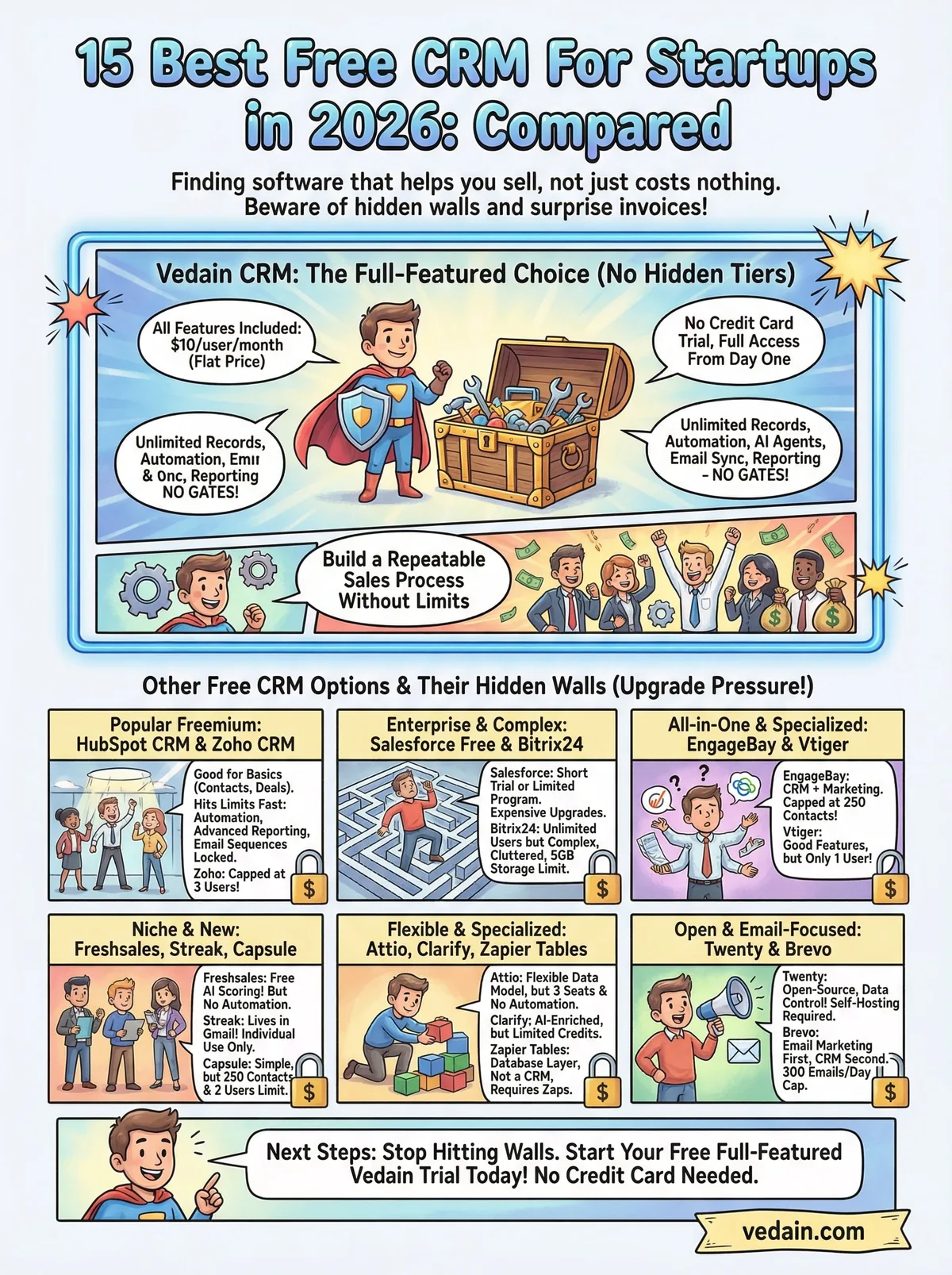
Every tool on this list offers something useful, but the best free CRM for startups depends on where your team is right now and where you expect to be in six months. If you're a solo founder managing a handful of contacts, a simple free tier gets the job done. If you're building a sales team and need automation, email sync, and pipeline tracking from day one, you'll outgrow most free plans before you finish onboarding.
That's exactly where Vedain fits. You get the full platform on a free trial with no credit card required, so you can test every feature before spending anything. No artificial limits. No feature gates. No pressure to upgrade just to send a follow-up sequence or view a real report. When your trial ends, the pricing stays straightforward at $10 per user per month, everything included. Start your free Vedain trial and see how much further a full-featured CRM takes your sales process.
Frequently Asked Questions
Which CRM has the best free plan for startups?
HubSpot has the best free CRM plan for startups in 2026: unlimited contacts and companies, basic deal pipeline, email tracking (200 notifications/month), meeting scheduling link, live chat, and basic reporting — all free forever. Zoho CRM offers a free plan for up to 3 users with basic features. Freshsales has a free plan for up to 3 users. Vedain offers a full-feature free trial. HubSpot's free plan is the strongest starting point, but budget $20-90/user/month for paid features within 6 months.
What features are missing from free CRM plans?
Free CRM plans almost always lock: (1) email sequences/automated follow-up, (2) advanced pipeline reporting and forecasting, (3) sales automation workflows, (4) AI lead scoring and insights, (5) bulk email sending, (6) custom user roles and permissions, (7) API access and integrations beyond basic connectors, (8) phone integration. These aren't optional extras — they're core to scaling sales. Most startups need them within 3-6 months of active selling.
What is the free CRM contact limit?
Free CRM contact limits vary widely: HubSpot — unlimited contacts (no cap). Zoho CRM Free — unlimited contacts, 3 users max. Freshsales Free — unlimited contacts, 3 users. Bitrix24 Free — unlimited contacts, 12 users. Pipedrive — no free plan. Salesforce — no free plan (30-day trial only). Vedain — unlimited contacts during trial, then paid plan required. HubSpot and Bitrix24 are most generous on contacts; most other free plans cap at 3 users.
Can a startup run sales entirely on a free CRM?
A startup with 1-2 founders doing early sales can run entirely on HubSpot free for 6-12 months. Once you're doing more than 20 outbound emails/day, need email sequences, or hire a dedicated sales rep, free plans become a bottleneck. The hidden cost of free CRM is time: reps spend extra hours on manual follow-ups that $20-30/user/month in automation would eliminate. For most startups beyond seed stage, paid CRM pays for itself in the first month.
Is HubSpot CRM actually free?
HubSpot's core CRM is genuinely free with no time limit — contacts, pipeline, basic email tracking, meeting links, and live chat are all included at no cost. However, HubSpot's pricing model is tiered: free → Starter ($20/user/month) → Professional ($90/user/month) → Enterprise ($150/user/month). The free plan is a deliberate land-and-expand strategy. You'll use it for free, then need paid features within 6-12 months. Know this going in — the free plan is real, but the upgrade path is steep.
What is the cheapest paid CRM for startups after outgrowing the free plan?
After outgrowing a free CRM, the cheapest paid options are: Vedain — $10/user/month (all features, no tiers). HubSpot Starter — $20/user/month (basic automation and tracking). Zoho CRM Standard — $14/user/month. Pipedrive Essential — $15/user/month (billed annually). For a 3-person team, Vedain costs $30/month vs HubSpot Starter at $60/month vs Pipedrive at $45/month. Vedain and Zoho are the most affordable first paid options.