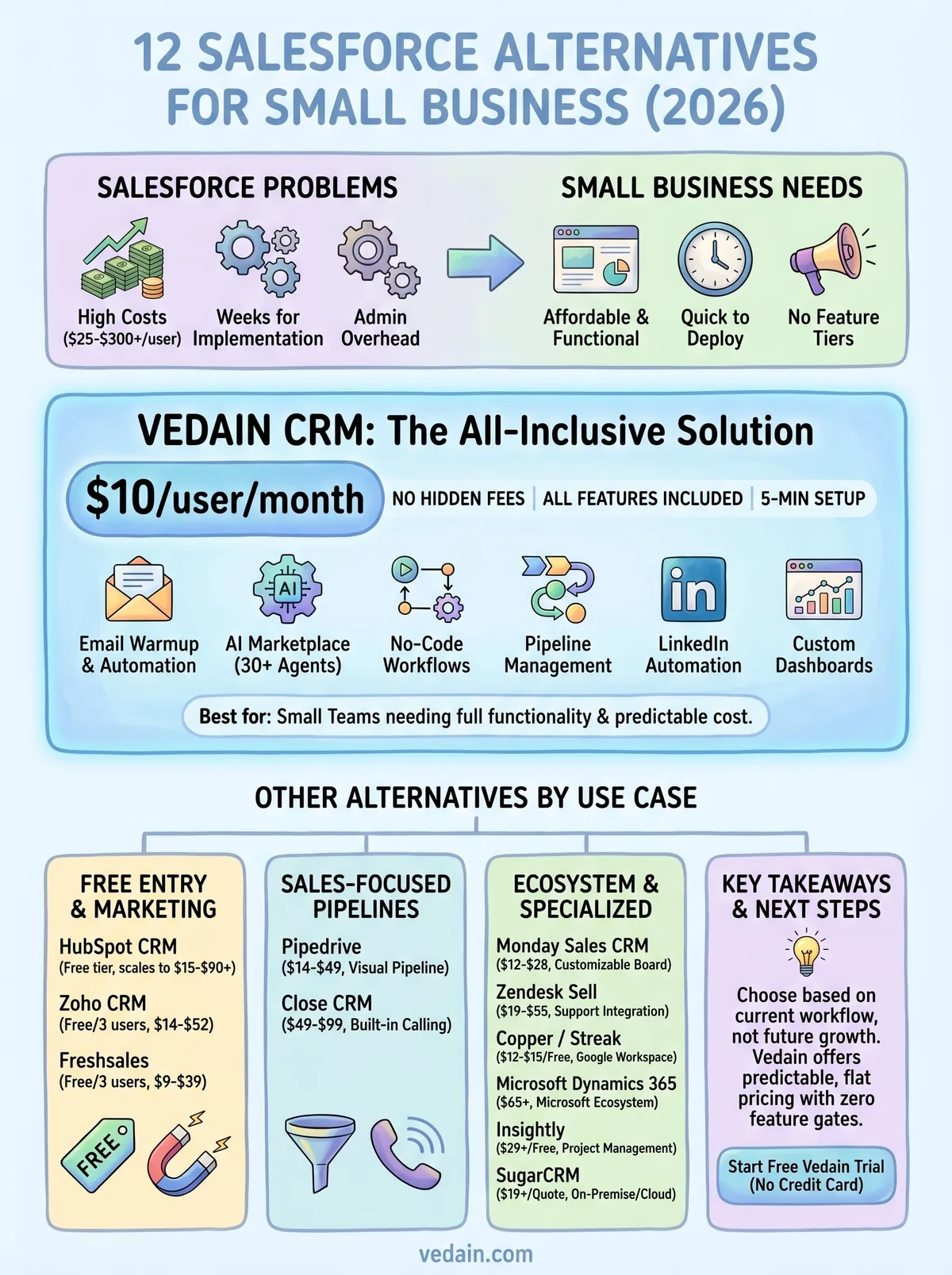
Small teams need CRMs that are affordable, quick to deploy, and fully functional on day one, without giving up pipeline management, email automation, or solid reporting. The problem is that many so-called "alternatives" still lock key features behind expensive upgrades or usage limits.
We built Vedain CRM around this exact frustration: every feature included at $10/user per month, no tiers, no hidden fees. But we also know that the right CRM depends on your team's workflow, size, and priorities, so we're not just recommending ourselves here.
This guide breaks down 12 Salesforce alternatives built for small businesses in 2026. We cover pricing, standout features, and where each tool fits best, so you can pick the CRM that actually matches your team and your budget.
1. Vedain CRM
Vedain CRM is our own product, so we want to be upfront about that from the start. We built it specifically because the most popular salesforce alternatives for small business either restrict key features on lower tiers or charge significantly more than small teams can justify for full functionality.
What it is
Vedain is a cloud-based CRM platform designed for sales teams that want a complete system without enterprise pricing. You get pipeline management, email integration, automation, AI tools, and reporting all in one place. There are no feature tiers or usage caps limiting what you can access based on your plan level.
Best for
Vedain works best for small to mid-sized sales teams that need a fully functional CRM from day one without a long implementation process. If your team runs outbound email campaigns, manages contacts through Gmail or Outlook, or wants no-code automation without hiring a developer, it fits well. Setup takes under five minutes, and no credit card is required to start a trial.
Standout features
Vedain includes capabilities that most CRMs either charge extra for or don't offer at all. The Email Warmup tool runs your domain through a 21-day deliverability process automatically, which matters a great deal if you send cold outreach at any volume. You also get a no-code workflow builder, a 30+ agent AI Marketplace for tasks like data enrichment and content generation, multi-step email campaign sequences, LinkedIn automation, custom dashboards, and sales target tracking, all included at the base rate.
Every feature ships at the same flat price, so your monthly costs stay predictable as your team grows.
Limits to know
Vedain is newer compared to tools like HubSpot or Salesforce, which means the third-party integration library is smaller. If your operations depend on a specific niche software, confirm compatibility before committing. The platform also focuses tightly on sales workflows, so teams that need robust customer support ticketing or deep project management will likely need a separate tool alongside it.
Pricing
Vedain charges $10 per user per month, all-inclusive. There are no feature gates, no storage tiers, and no surprise add-on fees. You can start a free trial without a credit card at vedain.com.
2. HubSpot CRM
HubSpot is one of the most recognized salesforce alternatives for small business, offering a free CRM tier that has attracted millions of users worldwide. It combines contact management, marketing tools, and sales pipelines in a single platform.
What it is
HubSpot CRM is a cloud-based platform that connects sales, marketing, and customer service into one system. The free plan covers basic contact and deal management, making it a common starting point for small teams exploring CRM software for the first time.
Best for
HubSpot works best for teams that want a no-cost entry point and plan to grow into paid features over time. It suits businesses running inbound marketing alongside sales, where both teams need visibility into the same contact records.
Standout features
The platform includes a visual deal pipeline, email tracking, meeting scheduling, and live chat tools even on the free plan. As you move up tiers, you unlock automation sequences, custom reporting, and deeper integrations with tools your team likely already uses.
HubSpot's free plan is genuinely functional, but most growing teams hit its limits faster than expected.
Limits to know
Costs escalate quickly once you need advanced automation or detailed reporting. Features that competitors bundle into a single flat rate often sit behind higher-tier paywalls at HubSpot, which makes total cost harder to predict as your team scales.
Pricing
HubSpot offers a free plan with basic features. Paid Sales Hub tiers start at $15 per user per month, with the Professional tier reaching $90 per user per month.
3. Zoho CRM
Zoho CRM is one of the broadest salesforce alternatives for small business in terms of raw feature count. It integrates natively with Zoho's ecosystem of 50+ business apps, which gives it a clear advantage for teams that already run other Zoho tools.
What it is
Built as a cloud-based sales platform, Zoho CRM covers contact management, pipeline tracking, workflow automation, and analytics in one place. It connects directly with Zoho Books, Zoho Desk, and Zoho Campaigns out of the box, making cross-tool workflows possible without third-party connectors.
Best for
Teams that want a feature-dense CRM at a lower price point will find Zoho compelling. It suits businesses running both sales and marketing workflows who need AI-assisted lead scoring and multichannel outreach without enterprise-level spending.
Standout features
The platform covers a lot of ground in a single subscription:
- •Zia AI assistant for lead scoring and activity suggestions
- •Multichannel communication across email, phone, and social media
- •Custom modules and fields with no developer required
- •Workflow automation and approval processes on mid-tier plans
Zoho's feature depth per dollar is hard to beat, but you earn that value by investing real setup time upfront.
Limits to know
Zoho CRM has a steeper learning curve than most other tools on this list. The interface packs in a lot of functionality, which can overwhelm new users quickly. Customer support quality has also received consistent criticism in user reviews, so factor that in if your team needs responsive help during onboarding.
Pricing
Zoho CRM offers a free plan for up to three users. Paid plans start at $14 per user per month on the Standard tier and climb to $52 per user per month on Ultimate.
4. Pipedrive
Pipedrive is a sales-focused CRM built around pipeline management. Unlike broader platforms that try to handle marketing, support, and sales under one roof, Pipedrive keeps its attention on moving deals forward, which makes it one of the cleaner salesforce alternatives for small business on the market.
What it is
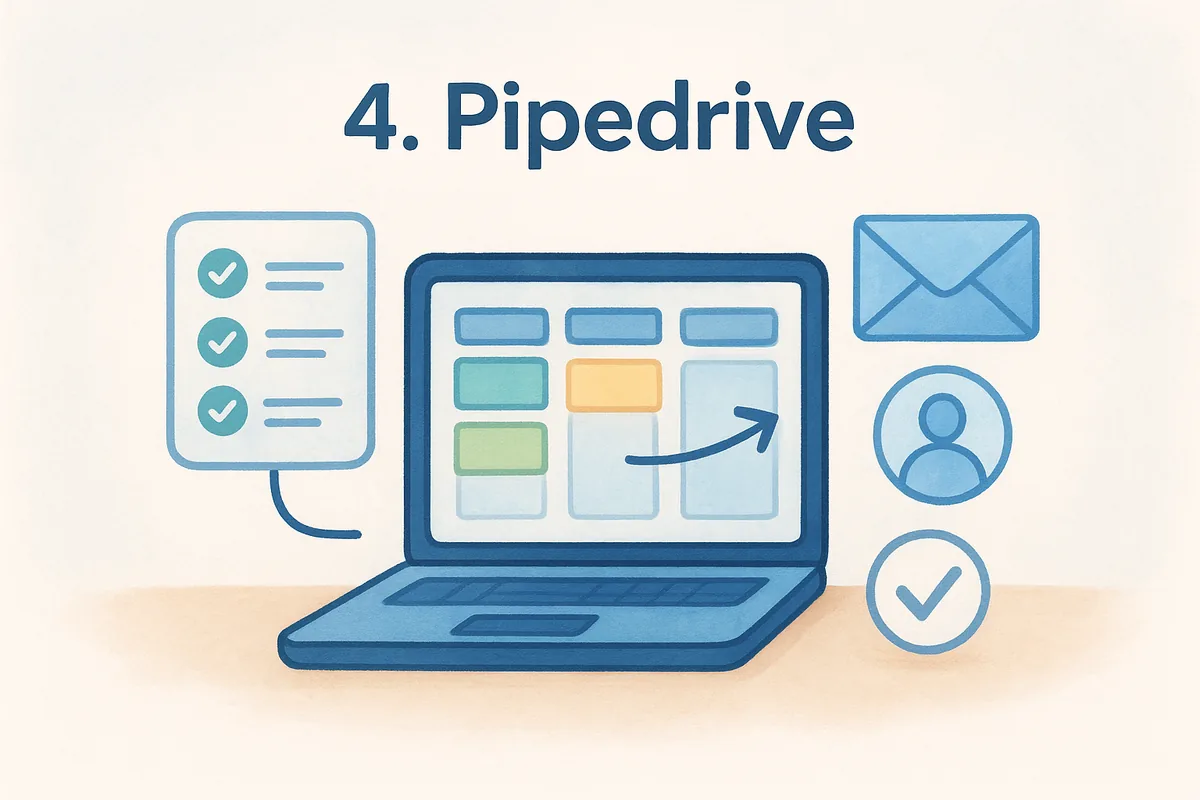
Pipedrive is a cloud-based CRM centered on visual deal pipelines and activity tracking. The platform was built by salespeople, and that focus shows in how it organizes leads, deals, and follow-up tasks around a simple drag-and-drop board.
Best for
Pipedrive suits small sales teams that run straightforward outbound or inbound pipelines and want a clean interface with minimal setup friction. If your team tracks deals through a defined set of stages and wants clear visibility into what needs action next, it fits well.
Standout features
The platform keeps deal management front and center with several useful tools:
- •Visual Kanban pipeline with customizable stages
- •Activity reminders and follow-up scheduling
- •Email sync and tracking with open and click notifications
- •Basic workflow automation on paid tiers
Pipedrive's activity-based selling model works well for teams that need structure around follow-up, not just a place to store contacts.
Limits to know
Pipedrive's reporting and marketing tools are limited on lower tiers, and you'll need to upgrade or add separate tools if you want email campaigns or deeper analytics. It also lacks a free plan, which raises the cost of entry compared to some competitors.
Pricing
Pipedrive starts at $14 per user per month on the Essential plan. The Professional tier, which includes more automation and reporting, runs $49 per user per month.
5. Freshsales
Freshsales is a CRM built by Freshworks, the same company behind Freshdesk and a suite of other business tools. It positions itself as a practical salesforce alternative for small business teams that want AI-assisted selling without the enterprise price tag.
What it is
Freshsales is a cloud-based CRM focused on contact management, deal tracking, and built-in communication tools. The platform includes Freddy AI, Freshworks' native AI engine, which surfaces lead scores, deal predictions, and next-step suggestions directly inside your sales workflow.
Best for
Freshsales works well for small to mid-sized sales teams that handle a mix of inbound and outbound leads and want built-in calling without adding a separate tool. If your team wants AI features without paying a premium add-on, it delivers solid value on the Growth tier and above.
Standout features
Freshsales packs several useful tools into a single subscription that help your team move faster:
- •Freddy AI for lead scoring and deal predictions
- •Built-in phone with call recording on paid plans
- •Visual pipeline with drag-and-drop deal management
- •Workflow automation for routine follow-up tasks
Freshsales bundles phone, email, and AI into one plan, which keeps your tool stack lean.
Limits to know
The free plan caps at three users and excludes automation, which pushes most teams onto paid tiers faster than expected. Reporting on lower tiers is fairly basic, and you'll need to upgrade for custom dashboards or deeper pipeline analytics.
Pricing
Freshsales offers a free plan for up to three users. Paid plans start at $9 per user per month on Growth, rising to $39 per user per month on Pro.
6. Monday Sales CRM
Monday Sales CRM is one of the more visually flexible salesforce alternatives for small business teams that prioritize customization over deep sales-specific features. It runs directly on top of the monday.com work management platform, which gives it a distinct feel compared to traditional CRM tools.
What it is
Monday Sales CRM is a customizable, cloud-based CRM built on monday.com's board-based interface. Your team manages contact records, deals, and activity logs using the same visual layout that monday.com applies across its other product lines, which keeps everything in a familiar environment if you already use the platform.
Best for
Monday Sales CRM suits small businesses already using monday.com for project tracking who want their sales pipeline in the same workspace. Teams that value flexible visual customization over rigid, out-of-the-box sales workflows will get the most value here.
Standout features
The platform gives your team real control over how your sales process looks and behaves:
- •Drag-and-drop board views for contacts, deals, and pipelines
- •Email sync with automatic activity logging
- •No-code automation for routine follow-up tasks
- •Custom dashboards built from your existing board data
Monday Sales CRM works best when your sales process benefits from the same visual structure you'd apply to any project.
Limits to know
The platform's project management roots show through in the sales experience. Teams running complex pipeline-specific workflows may find it less intuitive than purpose-built CRMs.
Pricing
Monday Sales CRM starts at $12 per seat per month on the Basic plan. The Pro tier, which unlocks automation and integrations, runs $28 per seat per month.
7. Close CRM
Close CRM is a sales-focused platform built specifically for inside sales teams that do a high volume of outbound calling and emailing. Among salesforce alternatives for small business, Close stands out because it keeps communication tools and pipeline management tightly connected rather than treating them as separate modules.
What it is
Close is a cloud-based CRM that centers its entire workflow around communication. Your team makes calls, sends emails, and tracks SMS messages directly from the platform without switching between tools. The built-in Power Dialer and Predictive Dialer set it apart from most CRMs that treat phone as an add-on.
Best for
Close works best for inside sales teams running high-frequency outbound sequences where call volume matters as much as pipeline visibility. If your team spends most of its day on the phone, Close removes the friction of logging calls manually.
Close is one of the few CRMs where calling feels native rather than bolted on.
Standout features
- •Built-in calling with Power Dialer and call recording
- •Multi-channel sequences combining email, SMS, and calls
- •Pipeline views with activity-based tracking
- •Smart inbox for managing all sales communications in one place
Limits to know
Close is priced higher than most alternatives on this list, and its feature set skews toward call-heavy teams. If your sales process relies more on email campaigns or marketing automation, you will likely pay for capabilities you rarely use.
Pricing
Close starts at $49 per user per month on the Startup plan. The Professional tier runs $99 per user per month.
8. Zendesk Sell
Zendesk Sell is a sales CRM built by Zendesk, the company widely known for its customer support software. Among salesforce alternatives for small business, it stands out when your team needs sales and support data living in the same ecosystem.
What it is
Zendesk Sell is a cloud-based CRM designed to give sales teams pipeline visibility, contact management, and communication tracking in one place. Because it runs on the same platform as Zendesk Support, your sales and service teams can share full customer context without switching tools.
Best for
Zendesk Sell works best for small businesses already using Zendesk for customer support who want their sales pipeline connected to existing support tickets and customer records. Teams that prioritize cross-functional visibility between sales and service get the clearest benefit here.
If your sales team and support team share customers, Zendesk Sell removes the information gap between them.
Standout features
- •Pipeline management with customizable stages and deal tracking
- •Built-in calling and email tracking with open notifications
- •Native integration with Zendesk Support for shared customer records
- •Activity reporting and sales forecasting on higher tiers
Limits to know
Zendesk Sell's marketing automation capabilities are limited compared to other tools on this list. If your team runs multi-step email sequences or needs deep workflow automation, you will likely outgrow what the lower tiers offer.
Pricing
Zendesk Sell starts at $19 per agent per month on the Sell Team plan. The Grow tier runs $55 per agent per month.
9. Insightly
Insightly takes a different approach among salesforce alternatives for small business by combining CRM and project management in a single platform. If your sales process naturally transitions into delivery or account work after the deal closes, Insightly keeps that entire lifecycle connected without adding a second tool.

What it is
Insightly is a cloud-based CRM built for small and mid-sized businesses that need sales pipeline management alongside project tracking and relationship linking. It connects contacts, organizations, opportunities, and projects so your team sees the full picture in one place.
Best for
Insightly works best for service-based small businesses where closing a deal immediately kicks off a delivery or fulfillment phase. Teams in consulting, professional services, or agencies that manage ongoing client relationships get the clearest benefit from its combined CRM and project functionality.
Insightly closes the gap between winning a deal and actually delivering on it, which most CRMs ignore entirely.
Standout features
- •Lead and opportunity routing with automatic assignment rules
- •Built-in project management linked directly to closed deals
- •Email templates and tracking with open notifications
- •Relationship linking that connects contacts, orgs, and projects
Limits to know
Insightly's marketing automation tools are sold as a separate product, Insightly Marketing, which adds cost. The reporting capabilities on lower tiers are also relatively basic compared to dedicated analytics tools.
Pricing
Insightly offers a free plan for up to two users. Paid plans start at $29 per user per month on the Plus tier.
10. SugarCRM
SugarCRM is one of the longer-standing salesforce alternatives for small business teams that want more control over their CRM environment. It offers both cloud-hosted and on-premise deployment options, which separates it from most competitors on this list.
What it is
SugarCRM is a sales and marketing platform that covers the full customer lifecycle from lead generation through account management. The platform runs on both cloud and on-premise infrastructure, giving businesses with specific data sovereignty or compliance requirements a deployment path that most CRM vendors simply do not support.
Best for
The platform works best for small businesses with specific data hosting or compliance requirements that rule out cloud-only vendors. Teams that want deeper customization at the platform level without building from scratch will find it a strong fit.
Standout features
- •On-premise and cloud deployment options for full infrastructure control
- •AI-powered lead scoring and opportunity predictions
- •Built-in marketing automation for campaigns and nurture sequences
- •Detailed reporting and custom dashboard configuration
SugarCRM gives you infrastructure flexibility that almost no other CRM on this list offers.
Limits to know
One key consideration is that SugarCRM carries a steeper setup and maintenance cost than most tools here, particularly for on-premise deployments. The interface feels dated compared to newer platforms, and onboarding your team takes more time than with simpler alternatives.
Pricing
Cloud plans start at $19 per user per month on the Essentials tier. On-premise pricing requires a direct quote from the sales team.
11. Microsoft Dynamics 365 Sales
Microsoft Dynamics 365 Sales sits at the enterprise end of the salesforce alternatives for small business spectrum. It carries significant power and deep Microsoft ecosystem integration, but those advantages come with trade-offs that matter for smaller teams.
What it is
Dynamics 365 Sales is a cloud-based CRM platform built directly into the Microsoft ecosystem. It shares native connections with Teams, Outlook, Excel, and Azure, which makes it a natural fit for organizations already running Microsoft infrastructure across their operations.
Best for
The platform works best for small businesses that operate entirely within the Microsoft 365 environment and need their CRM to behave as an extension of those existing tools. If your team already lives in Outlook and Teams daily, Dynamics reduces the friction of adding a separate system.
Dynamics 365 Sales earns its place on this list for Microsoft-first teams, but it overshoots the needs of most small businesses.
Standout features
- •Copilot AI for sales summaries, email drafting, and deal insights
- •Native Teams integration for calls and meeting notes inside the CRM
- •Pipeline forecasting with role-based dashboards
- •Deep Outlook sync for automatic activity logging
Limits to know
The platform's pricing and complexity push it toward mid-market and enterprise use cases. Small teams without a dedicated admin or Microsoft partner will find setup and configuration time-consuming, which raises the true cost beyond the listed subscription price.
Pricing
Dynamics 365 Sales starts at $65 per user per month on the Professional plan.
12. Copper CRM and Streak CRM
Copper CRM and Streak CRM represent a niche category among salesforce alternatives for small business: tools built to live inside Gmail. If your team runs its entire sales workflow through Google Workspace, either platform manages contacts and deals without requiring a separate login or interface.
What they are
Copper is a standalone CRM that syncs deeply with Google Workspace, pulling contact data and email history automatically into a clean interface. Streak takes a different approach by building a pipeline system directly inside Gmail as a browser extension, so your deals and contacts live as organized layers on top of your existing inbox.
Best for
Both tools suit small teams fully committed to Google Workspace that want minimal CRM setup friction. Streak fits freelancers and very small teams especially well, while Copper scales slightly better as your headcount grows.
Standout features
Both platforms keep your sales data inside Google's environment:
- •Automatic contact enrichment pulled directly from Gmail for Copper
- •Pipeline views built inside Gmail for Streak
- •Google Calendar and Drive sync on both platforms
If your entire team operates inside Google Workspace, Copper or Streak removes the friction of adopting a separate CRM platform entirely.
Limits to know
Both tools carry real limitations outside the Google ecosystem. Teams using Outlook or mixed email environments will find neither platform a workable fit, and reporting depth and automation capabilities fall significantly short compared to standalone CRMs on this list.
Pricing
Copper starts at $12 per user per month on the Starter plan. Streak offers a free individual plan, with paid tiers starting at $15 per user per month.
How does Vedain compare as a Salesforce alternative?
LinkedIn, WhatsApp, and AI coaching without the $80/user bill or a dedicated admin.
See Vedain vs Salesforce →Next steps
You now have a clear picture of the 12 strongest salesforce alternatives for small business available in 2026. Each tool on this list solves a real problem, but they serve different teams. Close fits call-heavy inside sales teams. Copper and Streak work for Google Workspace-only shops. HubSpot makes sense if you want a free starting point. Dynamics 365 belongs to teams already locked into Microsoft infrastructure.
If your priority is getting a fully functional CRM at a predictable, flat cost, Vedain CRM covers every feature your team needs, including email automation, AI tools, pipeline management, and email warmup, at $10 per user per month with no feature gates. You do not need a credit card to start, and setup takes under five minutes.
Pick the tool that fits your workflow today, not the one you might grow into three years from now. Start your free Vedain trial and see how fast your team gets running.
Frequently Asked Questions
What is the best Salesforce alternative for small business?
The best Salesforce alternatives for small business in 2026 are: Vedain ($10/user/month, all-in-one, no admin required), HubSpot ($20-90/user/month, best for marketing integration), Zoho CRM ($14-52/user/month, most feature-complete), and Pipedrive ($15-64/user/month, best pipeline UX). All four set up in days without consultants and cost 80-95% less than Salesforce. For teams under 50 reps, these alternatives match Salesforce's core functionality with far less complexity.
Why do small businesses leave Salesforce?
Small businesses leave Salesforce primarily for: (1) cost — $75-300/user/month in licenses plus $10,000-50,000 implementation, (2) complexity — requires a dedicated Salesforce admin at $80-120K/year salary, (3) slow setup — 3-6 months to go live, (4) poor adoption — reps find it complex and avoid logging activities, (5) over-engineering — 90% of features are unused by teams under 100 reps. The trigger to leave is usually realizing that simpler tools are faster and teams actually use them.
Can small businesses replace Salesforce with HubSpot?
Yes, small businesses can replace Salesforce with HubSpot in most cases. HubSpot covers: contact/account management, deal pipeline, email tracking and sequences, automation workflows, reporting dashboards, and basic AI insights. HubSpot's Sales Hub Professional ($90/user/month) is comparable to Salesforce's core CRM at lower cost. What HubSpot lacks vs Salesforce: complex territory management, advanced custom objects, manufacturing-specific modules, and enterprise security controls. For B2B SaaS and service businesses under 200 reps, HubSpot works well.
Is Zoho CRM as powerful as Salesforce for small teams?
Zoho CRM delivers 70-80% of Salesforce's functionality for small teams at 30-40% of the cost. Both have: custom fields/modules, workflow automation, AI insights, reporting, and integration capabilities. Salesforce advantages: larger AppExchange ecosystem, more advanced enterprise security, better handling of complex organizational hierarchies. Zoho advantages: lower price, easier setup, no dedicated admin required, native integration with Zoho's 50+ business apps. For a team under 50 reps with standard B2B sales processes, Zoho CRM is a complete Salesforce replacement.
What is the Salesforce migration process to a smaller CRM?
Salesforce migration to a smaller CRM typically takes 2-4 weeks: Week 1 — export data from Salesforce (contacts, accounts, opportunities, activity history as CSV); map fields to new CRM's schema. Week 2 — import to new CRM, configure pipeline stages and custom fields to match current workflow. Week 3 — recreate automations and email templates; parallel-run both systems. Week 4 — cut over, archive Salesforce. What gets lost: complex workflow logic, Apex triggers, custom Salesforce reports. Most small teams find the simpler CRM's built-in automation sufficient.
How much does it cost to implement Salesforce vs an alternative CRM?
Implementation cost comparison: Salesforce — $10,000-50,000 for a certified implementation partner for a small team, plus ongoing admin. Vedain/Pipedrive/Zoho — $0-5,000 total (typically self-implemented or 1-2 days of paid onboarding). The implementation cost alone often pays for 5+ years of an alternative CRM. For small businesses, the all-in first-year cost of Salesforce (licenses + implementation) vs alternatives: Salesforce = $60,000-100,000; Vedain = $1,200; HubSpot Professional = $10,800; Zoho CRM = $2,000-6,000.