
If you're comparing options, you're probably weighing pricing transparency against feature depth, and wondering if you actually need to compromise on either. The short answer: you don't. Several CRMs now pack powerful sales tools into plans that won't drain a small team's budget.
This guide breaks down 10 Pipedrive alternatives worth considering, starting with our own platform, Vedain CRM, built to give sales teams full access to every feature at $10/user/month with no tiers or hidden fees. We'll cover what each tool does well, where it falls short, and which type of team it fits best so you can make a confident switch.
1. Vedain CRM
Vedain CRM is a cloud-based sales platform that gives your team access to every feature at a flat $10/user/month with no tiers, no add-ons, and no feature gates. Unlike Pipedrive, which locks email automation, workflow tools, and AI features behind higher-priced plans, Vedain includes everything from day one. Setup takes under five minutes, and you don't need a credit card to start a trial.
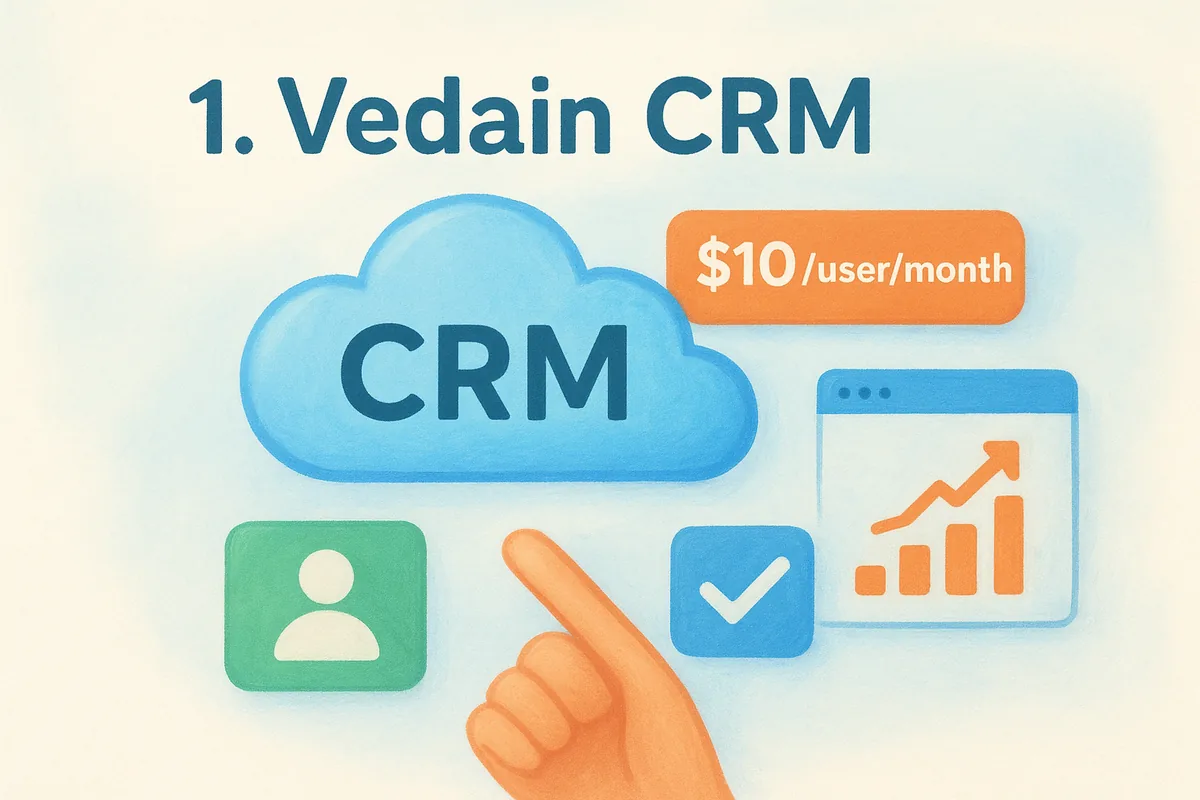
Where it beats Pipedrive
Vedain's biggest advantage over Pipedrive is all-inclusive pricing with no upsells. With Pipedrive, you often pay extra for email sync, automation sequences, and AI capabilities. Vedain bundles all of that into one flat rate, including two-way Gmail and Outlook sync, a no-code workflow builder, multi-step email campaigns, and a gradual email warmup ramp that protects your domain deliverability from day one.
Vedain's AI Agent Marketplace includes 30+ pre-built agents for data enrichment and content generation, capabilities that Pipedrive charges significantly more to access.
Add LinkedIn posting and lead capture, lead forms, custom dashboards, conversion funnel reporting, and team leaderboards, and you get a more complete sales operating system than most Pipedrive alternatives on this list.
Where it falls short
As a newer platform, Vedain's third-party app marketplace is smaller than Pipedrive's. If your team relies on niche integrations outside of Gmail, Outlook, or common sales tools, you may find some gaps. The analytics and reporting suite continues to grow, so teams with highly complex reporting requirements should verify specific capabilities before committing to a switch.
Best for
Teams that want a full-featured CRM without tiered pricing get the most out of Vedain. It's especially strong for SMBs actively using Gmail or Outlook who need email warmup, automation, and AI tools in a single affordable plan rather than paying per feature.
Pricing
The pricing is straightforward: $10 per user per month, all-inclusive. Every user on your account gets full access to the entire platform, including AI tools, automation workflows, reporting, and unlimited records with no surprise charges.
2. HubSpot CRM
HubSpot CRM is one of the most recognized Pipedrive alternatives on the market, and for good reason. It offers a genuinely free tier that covers contact management, deal pipelines, and basic email tools, which makes it appealing if your team is just getting started and wants to test a platform without upfront cost.
Where it beats Pipedrive
HubSpot's free plan includes more out-of-the-box features than Pipedrive's entry-level paid tier. You get contact management, basic deal tracking, email logging, and a meeting scheduling tool without paying anything. The platform also integrates tightly with HubSpot's marketing and service hubs, making it a strong option if you want sales and marketing data living in one place.
HubSpot's ecosystem depth is hard to match if your team needs native marketing automation connected directly to your CRM pipeline.
Where it falls short
The free plan hits its limits fast. Automation, sequences, and advanced reporting all require paid upgrades that escalate quickly per seat. Teams with 10 or more users often find HubSpot becomes one of the most expensive options on the market once you move into its Sales Hub Professional or Enterprise tiers.
Best for
HubSpot works best for small teams or solo operators who can stay within the free plan's boundaries, or for companies that already invest in HubSpot's broader marketing platform and want tight native integration.
Pricing
The free CRM tier covers basic use. Paid Sales Hub plans start at $20/user/month billed monthly ($7 on annual billing), but the features most growing teams need push costs considerably higher.
3. Zoho CRM
Zoho CRM is one of the most feature-rich options among Pipedrive alternatives, particularly for teams that need flexibility without paying enterprise-level prices. It covers everything from lead management and pipeline tracking to automation, AI-powered predictions, and a wide library of third-party integrations.
Where it beats Pipedrive
The platform packs in more customization options than Pipedrive at comparable price points. You can build custom modules, workflows, and fields without needing developer support, which makes it adaptable for teams with non-standard sales processes. Zoho also includes a built-in AI assistant called Zia that surfaces deal predictions, lead scoring, and anomaly detection across your pipeline.
Zoho's breadth of features at its mid-tier pricing makes it one of the better value options for teams that need CRM customization without an enterprise budget.
Where it falls short
Zoho's interface can feel cluttered and overwhelming for new users, especially compared to Pipedrive's clean, pipeline-focused layout. The sheer number of settings and modules means your team will likely spend more time on onboarding and configuration before seeing real productivity gains.
Best for
This platform fits mid-sized teams that need deep customization and are willing to invest time in setup. It's a particularly strong pick if you're already using other Zoho products like Zoho Books or Zoho Desk.
Pricing
Zoho CRM offers a free plan for up to 3 users. Paid tiers start at $14/user/month, with more advanced features, including AI tools and advanced automation, unlocking at higher tiers.
4. Freshsales
Freshsales is a CRM built by Freshworks, and it positions itself as a beginner-friendly option among Pipedrive alternatives that blends contact management, built-in phone and email, and AI-powered lead scoring into a single interface. The platform targets teams that want sales intelligence tools without jumping to enterprise pricing right away.

Where it beats Pipedrive
Unlike Pipedrive, Freshsales includes a built-in phone dialer and SMS messaging natively, so your team can make and log calls without setting up a third-party integration. The platform's AI assistant, Freddy AI, provides lead scoring and deal insights directly inside your pipeline, helping your reps prioritize the right opportunities without building manual filters or relying on spreadsheets.
Freddy AI's predictive contact scoring surfaces your highest-intent leads automatically, which saves your team significant manual triage time compared to Pipedrive's base feature set.
Where it falls short
Several key features are locked behind higher-priced tiers, including advanced workflow automation and custom reporting. Teams that need deep pipeline customization or complex automation sequences will find themselves pushed toward plans that close the pricing gap with Pipedrive considerably, which undercuts one of the main reasons to switch.
Best for
Inside sales teams that rely heavily on phone-based outreach get the most out of Freshsales, since the built-in dialer removes the need for a separate calling tool. It also works well for teams that are new to CRM platforms and want an approachable starting point with room to grow over time.
Pricing
Freshsales no longer lists a free plan on its plan grid. Paid tiers start at $9/user/month (Growth), though automation and advanced AI features require the Pro plan at $39/user/month or higher.
5. Salesmate
Salesmate is a sales-focused CRM that positions itself as one of the more flexible Pipedrive alternatives for teams that handle a high volume of outreach. It covers contact management, pipeline tracking, built-in calling, and text messaging, and wraps these into a reasonably priced package without forcing you into an enterprise contract.
Where it beats Pipedrive
Built-in calling and SMS come standard across all paid plans, which means your team can make calls, send texts, and log activity without adding a separate tool. The platform also gives you email sequences and automation workflows at lower price points than Pipedrive's equivalent plans, which makes it easier to scale outreach without watching your per-seat costs spike.
Salesmate's built-in communication tools cover calling, texting, and email sequences in one plan, removing the need for multiple tool subscriptions that Pipedrive often requires.
Where it falls short
The reporting and analytics capabilities in Salesmate are more limited than what you'd find in Pipedrive's higher tiers. Teams that rely on detailed pipeline forecasting or custom reports may find the dashboards insufficient without significant manual workarounds. The interface also lacks the polish of some competing platforms.
Best for
Inside sales teams that prioritize built-in calling and SMS over deep analytics get the most value from Salesmate. It fits well if you want outreach tools consolidated into a single affordable platform without paying for separate calling software.
Pricing
Plans start at $23/user/month, with higher tiers unlocking additional automation and reporting features as your team scales.
6. Close
Close is a CRM built specifically for inside sales teams that live and breathe outbound. It bundles calling, emailing, and SMS into a single platform with the idea that your reps should spend more time selling and less time switching between tools. Among Pipedrive alternatives, Close stands out for its communication-first design rather than pipeline flexibility.
Where it beats Pipedrive
Close includes a built-in power dialer and predictive dialer natively, which gives high-volume outbound teams a clear edge over Pipedrive's call-logging setup that depends on third-party integrations. The platform also includes automated email sequences and SMS outreach as standard features, keeping your reps focused on outreach without juggling multiple tools or paying for bolt-on subscriptions.
Close's all-in-one communication stack makes it a strong fit for teams that measure daily performance by call volume and outreach activity.
Where it falls short
Close is not built for complex pipeline management across multiple products or territories. Teams that need highly customizable deal stages, granular reporting, or deep workflow automation will find the platform more limiting than broader CRMs. The pricing also reflects its power-user positioning, so smaller teams or early-stage startups may struggle to justify the per-seat cost as the team grows.
Best for
Close works best for dedicated outbound sales teams that prioritize call-heavy prospecting over detailed pipeline tracking. It fits well if your reps make dozens of calls per day and need calling, email, and SMS consolidated in one place.
Pricing
Close starts at $9/user/month (Solo, billed annually), with team plans from $35/user/month and per-user pricing scaling upward based on team size and feature requirements.
7. Nutshell
Nutshell is a CRM built with simplicity and usability at its core, targeting small businesses and lean sales teams that want a clean, manageable platform without an overwhelming feature set. Among Pipedrive alternatives, Nutshell stands out for its emphasis on ease of adoption and built-in reporting tools that don't require a data analyst to interpret.
Where it beats Pipedrive
Nutshell includes email marketing and automation sequences on its paid plans without requiring separate add-ons, which keeps your overall tool cost lower than Pipedrive's equivalent setup. The platform also ships with pipeline stage automation that moves deals forward based on activity triggers, and its reporting dashboard gives your team a clear view of team performance and conversion rates without complex configuration.
Nutshell's built-in email marketing tool removes a common integration headache that Pipedrive users often encounter when trying to connect external email platforms.
Where it falls short
The platform's customization options are limited compared to broader CRMs. If your team needs custom modules, advanced workflow logic, or granular role-based permissions, Nutshell will likely feel restrictive before long. The AI and automation features also lag behind newer platforms that have invested more heavily in these capabilities.
Best for
Nutshell fits small sales teams that want an approachable CRM with solid reporting and built-in email tools. It works particularly well for teams that prioritize quick onboarding over deep customization.
Pricing
Paid plans start at $13/user/month (billed annually), with email marketing features available on the Nutshell Marketing add-on or higher-tier plans.
8. Copper
Copper is a CRM built natively inside Google Workspace, making it one of the most distinctive Pipedrive alternatives for teams that run their entire business through Gmail and Google Calendar. The platform automatically logs emails, meetings, and contacts without requiring manual data entry, which keeps your pipeline data accurate without adding extra work for your reps.
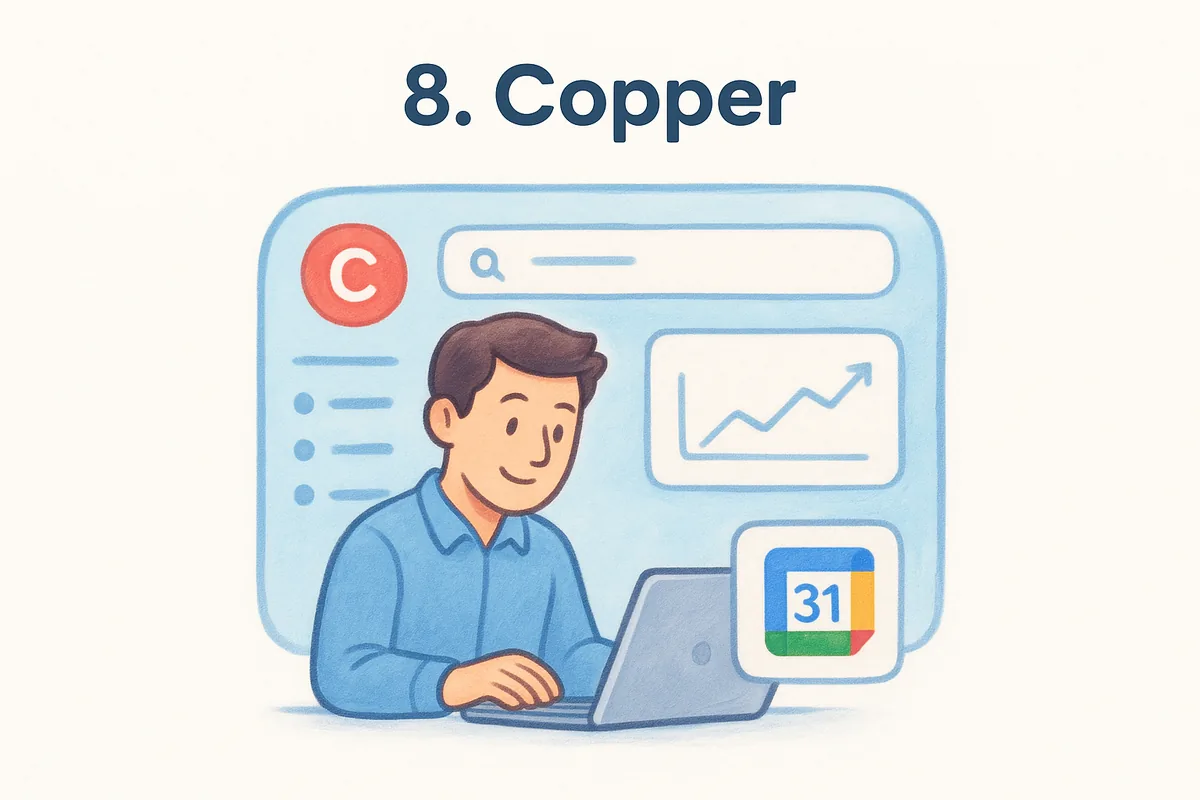
Where it beats Pipedrive
Copper's deep Google Workspace integration is its strongest differentiator. Your team can manage contacts, update deals, and track pipeline activity directly inside Gmail, which eliminates the constant context-switching that slows down reps using Pipedrive alongside a separate email client. The platform also pulls in contact and company data automatically from your Gmail history, so new leads appear in your CRM before you even think to add them manually.
Copper's native Gmail sidebar lets your reps update deals and log activity without ever leaving their inbox, which meaningfully reduces friction in high-volume email workflows.
Where it falls short
Copper's tight dependency on Google Workspace is also its biggest limitation. If your team uses Outlook, or if you run a mixed environment, Copper simply does not fit your workflow. The platform also lacks advanced automation and AI capabilities that newer CRM tools now offer as standard, so teams that need complex workflow logic or predictive lead scoring will find the feature set thin.
Best for
Copper works best for Google Workspace-native teams that want a CRM requiring minimal setup and zero manual data entry. It suits small teams running straightforward pipelines without complex automation requirements.
Pricing
Paid plans start at $23/user/month (billed annually), with workflow automation and larger contact limits unlocking on higher-tier plans.
9. Vtiger CRM
Vtiger CRM is a dual-purpose platform that serves both sales and customer support teams, making it one of the more versatile Pipedrive alternatives for companies that need both functions without separate subscriptions. The platform covers lead management, deal pipelines, helpdesk ticketing, and marketing automation under one roof, reducing tool sprawl across your sales and support workflows.
Where it beats Pipedrive
Vtiger's biggest differentiator is its built-in customer support module, which lets your sales and support teams operate from the same platform without data gaps between customer interactions. You also get email marketing and automation workflows included on paid plans, which Pipedrive often splits into separate add-ons that drive your total per-seat cost up over time.
Vtiger's unified sales and support workspace means your reps can see a customer's full history, including open tickets, before reaching out, which Pipedrive's sales-only focus cannot replicate natively.
Where it falls short
The platform's interface carries significant complexity because it tries to cover so many use cases simultaneously. Teams that only need a focused sales CRM will find Vtiger's dual-purpose design adds unnecessary noise to their daily workflow, and the initial setup and configuration time runs considerably longer than most simpler alternatives on this list.
Best for
Vtiger works well for small businesses that need both CRM and customer support without paying for two separate tools. It suits teams where sales reps and support agents share customer data and interaction history inside a single platform.
Pricing
Vtiger offers a free plan for up to 10 users with limited features. Paid plans start at $12/user/month for the sales-only tier, with the all-in-one plan available at a higher price point.
10. Trello
Trello is a project management tool built around visual Kanban boards, and while it's not a CRM, some small teams adapt it as a lightweight deal tracker when they're not ready to commit to dedicated sales software. Among Pipedrive alternatives, Trello sits at the far end of the spectrum, trading sales-specific depth for raw simplicity.
Where it beats Pipedrive
Trello's free plan is genuinely usable for solo operators or very small teams tracking a handful of deals visually. Setup takes minutes, and the drag-and-drop card interface requires zero training, making it an easy starting point if you need something running immediately without spending a dollar.
Trello's card-based layout works as a basic deal board, but you're essentially building a CRM workaround rather than using a tool designed for sales.
Where it falls short
Trello has no native CRM features at all. There's no contact database, no email sync, no activity tracking, and no pipeline reporting built in. Your team will need third-party Power-Ups for almost every sales-related function, and those integrations add cost and complexity that quickly make a dedicated CRM the smarter, cheaper choice.
Best for
Trello fits solo freelancers or very early-stage founders who track fewer than 20 active deals and don't yet need email integration, automation, or any form of reporting. Once your team grows beyond one or two people, a real CRM becomes necessary rather than optional.
Pricing
Trello's free plan covers unlimited cards. Paid plans start at $5/user/month, though the sales limitations persist regardless of which tier you choose.
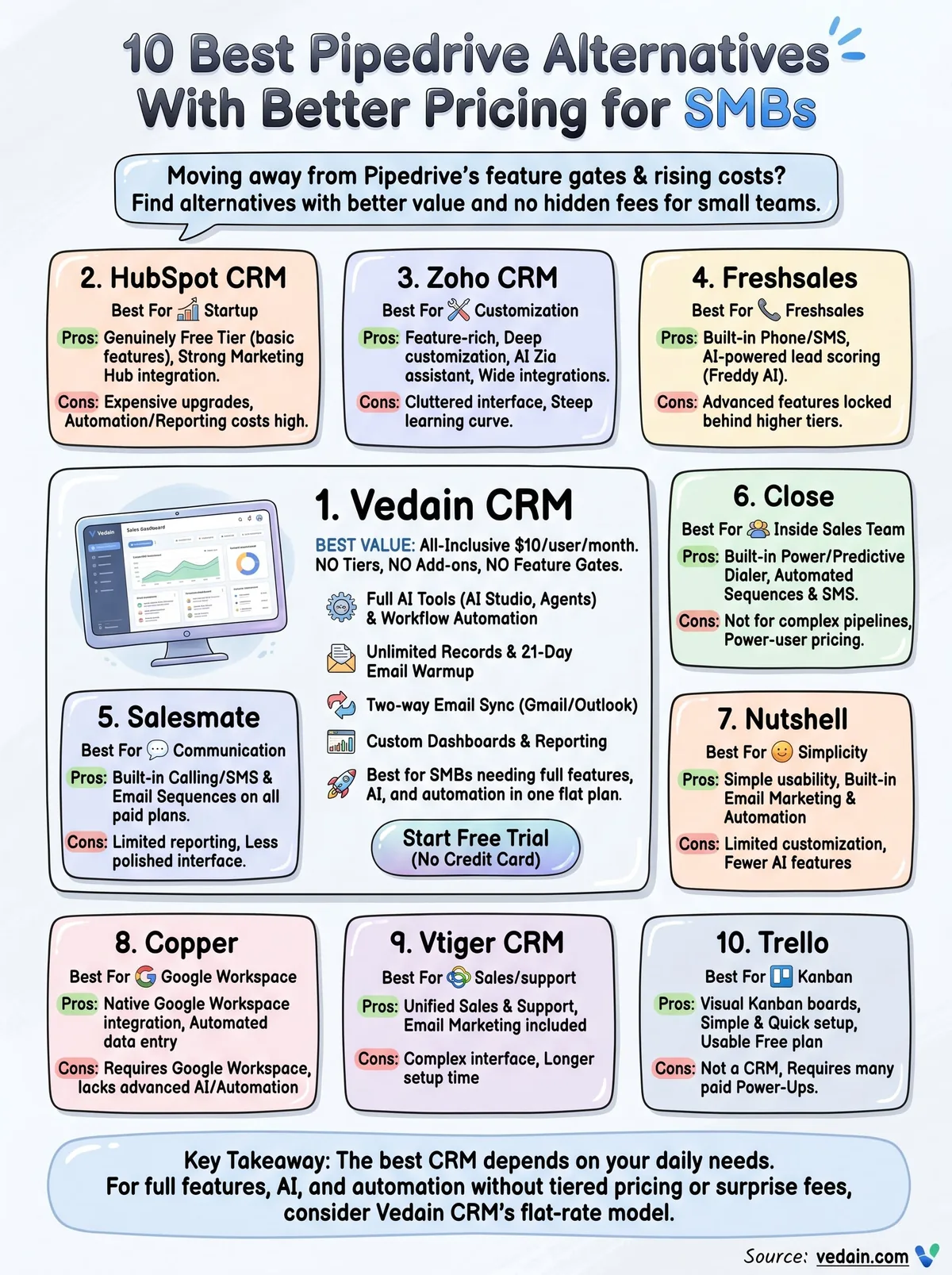
Final takeaways
The right CRM depends entirely on what your team needs day to day. Most Pipedrive alternatives on this list improve on at least one key dimension, whether that's pricing transparency, built-in communication tools, or deeper automation. But if you want a platform that covers all of those without tiered pricing or surprise fees, your options narrow quickly.
Vedain CRM gives your sales team full access to every feature at a flat $10/user/month with no hidden costs. That includes AI tools, email automation, workflow builders, and pipeline reporting. If your team currently pays more for fewer features, or keeps hitting walls that require a plan upgrade, it's worth a closer look.
Start your free trial of Vedain CRM with no credit card required and see how quickly your team can get moving with a platform built to cut the friction that slows most sales teams down.
Frequently Asked Questions
What is the best Pipedrive alternative for small business?
The best Pipedrive alternative for small business in 2026 is Vedain ($10/user/month) for all features at a lower price, HubSpot ($20/user/month) for marketing integration, and Zoho CRM ($14/user/month) for breadth of features. Pipedrive Growth costs $39/user/month (billed annually) — Vedain includes comparable features for about 75% less. The main trade-off: Pipedrive has a more polished pipeline UX, but alternatives offer better value for teams that need reporting and automation beyond basic pipeline views.
Why do businesses look for Pipedrive alternatives?
Businesses look for Pipedrive alternatives primarily because: (1) pricing — key features like email sequences and automations require the $39-59/user/month Growth or Premium tier (billed annually), (2) marketing integration — Pipedrive has no native landing pages, SEO tools, or email marketing beyond basic campaigns, (3) reporting limitations — Pipedrive's reporting is strong for pipeline but limited for custom business analytics, (4) no native phone dialer — requires $30-60/month extra for Aircall/JustCall integration.
Is HubSpot cheaper than Pipedrive?
HubSpot Sales Hub Starter ($20/seat/month billed monthly) is cheaper than Pipedrive Growth ($39/user/month billed annually) for features like email sequences and automation. However, HubSpot Professional ($90/seat/month billed annually) is significantly more expensive than Pipedrive Premium ($59/user/month billed annually). The comparison depends on which tier you need: for basic automation, HubSpot Starter beats Pipedrive. For advanced sales features, Pipedrive Premium is cheaper than HubSpot Professional by about $31/user/month.
Does Vedain CRM have the same pipeline features as Pipedrive?
Vedain CRM includes the core Pipedrive pipeline features at $10/user/month: Kanban deal board with drag-and-drop stages, activity reminders, email sync and tracking, automated sequences, and pipeline reporting. Pipedrive's advantages: more refined rotting deal indicators, activity-required enforcement, and a larger third-party integration marketplace. Vedain's advantages: lower price (about 75% less than Pipedrive Growth), built-in AI agent, and all features at one price tier with no upselling.
What CRM has better reporting than Pipedrive?
HubSpot and Salesforce have more advanced reporting than Pipedrive, with custom report builders, cross-object reporting, and revenue attribution. Zoho CRM's Analytics module (Zoho Analytics integration) also surpasses Pipedrive's reporting depth. Pipedrive's built-in reporting covers pipeline conversion rates, deal velocity, and rep activity — sufficient for most small teams. If you need to build custom dashboards that combine CRM data with other business data, HubSpot or Zoho are stronger.
Can I import my Pipedrive data into another CRM?
Yes. Pipedrive exports contacts, deals, organizations, and activity history as CSV files. Most CRMs (HubSpot, Zoho, Freshsales, Vedain) have Pipedrive import tools or standard CSV importers. What transfers well: contact records, deal pipeline with stages, notes. What doesn't transfer: Pipedrive workflow automations (must be recreated), custom activity types, email templates, and email message history (stays in Gmail/Outlook). Plan 2-5 days for migration depending on data volume and how many custom automations need recreation.