The core frustration is real: you picked Pipedrive because it was supposed to be straightforward, but now you're paying $50+ per user per month just to unlock features that should come standard. Email warmup, workflow automation, custom reports, these aren't premium add-ons in 2026. They're table stakes. SMB sales teams shouldn't have to choose between functionality and budget, and that's exactly the trade-off Pipedrive forces at scale.
We built Vedain CRM to solve this problem directly, $10 per user per month, every feature included, no tiers, no gates. But we also know one CRM doesn't fit every team. Some of you need deep integrations, others want industry-specific tools, and a few might prioritize a specific workflow over everything else.
So we put together this list of 12 Pipedrive alternatives worth evaluating in 2026. Each one is broken down by features, pricing, and where it fits best, so you can make a decision based on what your team actually needs, not what a sales page promises.
1. Vedain CRM
Vedain CRM was built around one specific frustration: feature-gating in sales software. If you've been shopping for the best Pipedrive alternatives, you've probably noticed that most tools either match Pipedrive's pricing structure or exceed it. Vedain takes a different approach, charging $10 per user per month and including every feature at that rate with no upsells attached.
Standout features
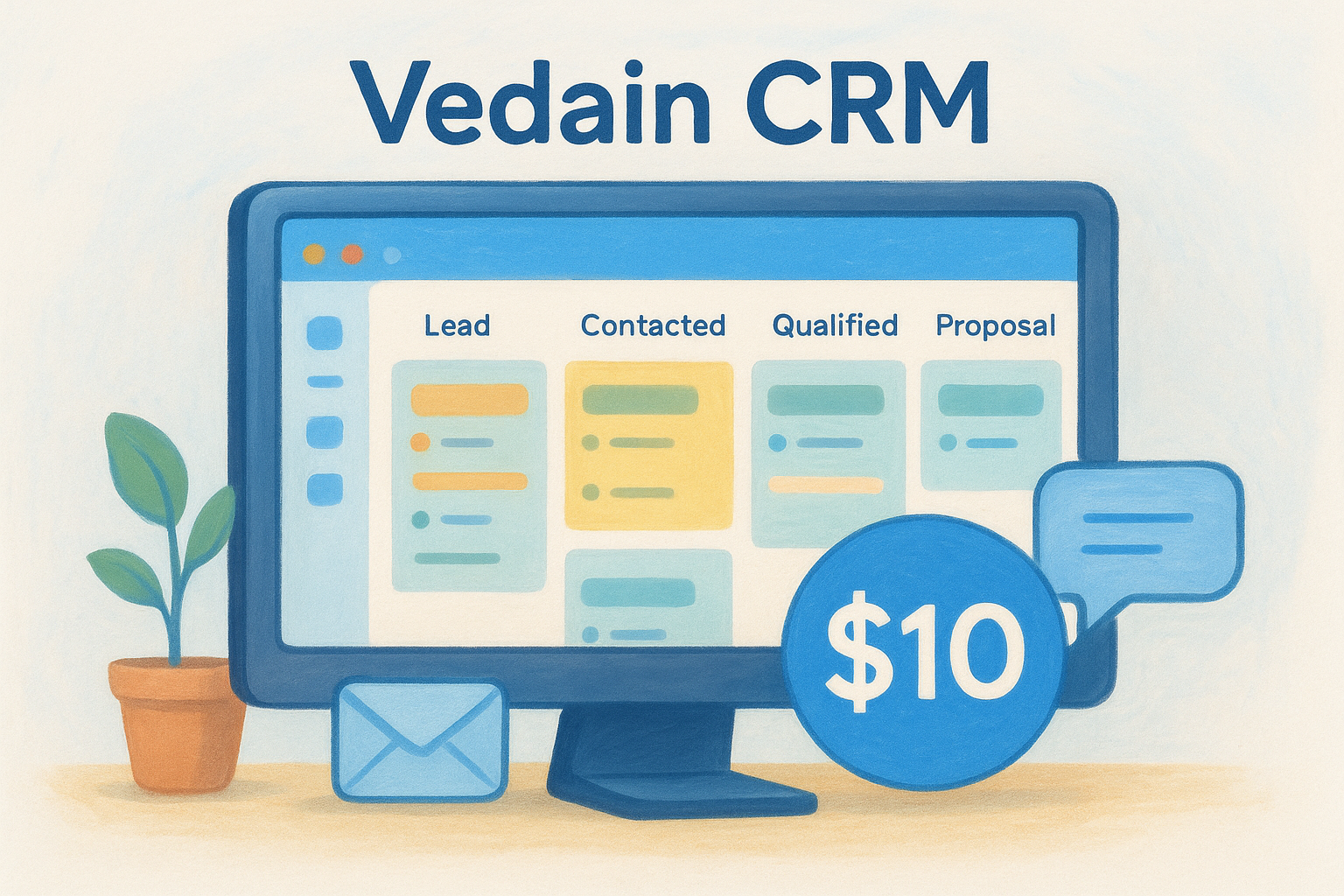
Vedain covers the full sales workflow without splitting it across tiers. The deal pipeline uses a visual Kanban board, letting your team track opportunities at a glance and move deals forward without switching between tools. Two-way email sync works with both Gmail and Outlook, so every conversation stays inside the CRM automatically.
Beyond the basics, Vedain includes tools that competitors charge extra for. Email warmup runs over 21 days to protect your domain's deliverability before you launch outreach campaigns. The no-code workflow builder handles automation without requiring technical help, and the AI Agent Marketplace gives you access to 30+ pre-built agents for data enrichment and content generation. The AI Studio lets you build custom CRM features by describing what you need in plain English.
Limitations to know
Vedain is a newer platform, which means the third-party integration library is smaller than what you'll find in HubSpot or Salesforce. If your team relies on niche integrations or a long list of connected tools, you may run into gaps. The platform is built specifically for sales teams, so if you need deep customer support workflows or advanced marketing automation beyond email sequences, you'll likely want to pair it with a dedicated tool for those functions.
Best fit
Vedain works best for SMB sales teams of 5 to 500+ users who want a complete sales operating system without paying per feature. It's a strong fit if:
- •You're switching from Pipedrive and frustrated by tier-based pricing
- •Your team uses Gmail or Outlook and wants everything synced automatically
- •You want automation, email warmup, and AI tools included from day one
- •You need a fast setup, since Vedain gets your team running in under 5 minutes
Pricing and plans
Vedain charges a flat $10 per user per month. There are no feature tiers, no hidden fees, and no gates on automation, reporting, or AI tools. Every user on your team gets the full platform, including the AI Agent Marketplace, email warmup, workflows, and custom dashboards.
At $10 per user per month with no feature limits, Vedain is one of the few CRMs where the price you see on day one is the price you pay as you scale.
You can start a trial without entering a credit card, which makes it straightforward to test the full feature set before committing. For teams that have spent time calculating upgrade costs on other platforms, the flat pricing structure removes a significant variable from the buying decision.
2. HubSpot CRM
HubSpot is one of the most recognized names when people search for the best Pipedrive alternatives, and for good reason. It offers a genuinely useful free tier that covers contact management, deal tracking, and basic email tools, making it an easy starting point for teams that aren't ready to commit to a paid plan right away.
Standout features
The free CRM includes contact and company records, deal pipelines, and a live chat tool that many competitors charge for. Where HubSpot really separates itself is the tight connection between sales and marketing workflows. If your team sends campaigns, nurtures leads, and tracks deals in the same system, HubSpot handles that overlap well. The reporting dashboards are clean and intuitive, giving sales managers a clear view of pipeline health without requiring heavy configuration.
Limitations to know
The free plan has a real ceiling. Once your team needs automation, sequences, or advanced reporting, you move into paid tiers that jump significantly in price. HubSpot's Sales Hub Starter begins at $20 per seat per month, but the Professional tier climbs to $100 per seat per month. For SMB teams watching budget closely, those numbers add up fast.
HubSpot's free plan is one of the best entry points in the market, but scaling on it costs more than most SMBs expect.
A second friction point is mandatory onboarding fees that HubSpot attaches to higher-tier plans, which raises your total cost before your team runs a single workflow. This catches teams off guard during the buying process.
Best fit
HubSpot works best for teams that need marketing and sales in one platform and have the budget to grow into paid tiers. It suits companies actively running inbound campaigns alongside their sales pipeline and want native alignment between both functions without stitching tools together.
Pricing and plans
HubSpot offers a free CRM tier with limited automation. Paid plans start at $20 per seat per month for Sales Hub Starter and scale to $100 per seat per month for Professional. Enterprise pricing requires a custom quote.
3. Zoho CRM
Zoho CRM shows up on nearly every list of the best Pipedrive alternatives because it genuinely delivers a wide feature set at a competitive price. It covers lead management, deal tracking, workflow automation, and multichannel communication within a single platform, giving sales teams more surface area than Pipedrive without a proportional jump in cost.
Standout features
Zoho CRM's strength is breadth. You get AI-powered lead scoring through its Zia assistant, which helps your team prioritize outreach based on engagement signals rather than gut instinct. The platform also supports multichannel communication, meaning your team can reach leads by email, phone, social, and live chat from within the same interface. Workflow automation is available on mid-tier plans, and custom modules let you reshape the CRM to match your specific sales process without heavy development work.
Limitations to know
Zoho's biggest challenge is its interface. The platform packs in a large number of features, and that depth comes with a steeper learning curve than most SMBs expect. New users often describe the setup process as time-consuming, and the sheer volume of configuration options can slow adoption.
Zoho CRM offers more features per dollar than most competitors, but your team should plan for a longer onboarding period before hitting full productivity.
Reporting is another area where Zoho falls short on lower tiers. Advanced analytics and custom dashboards are locked behind higher-priced plans, which means smaller teams often outgrow the free and Standard tiers quickly if they rely on data to run pipeline reviews.
Best fit
Zoho CRM fits mid-sized sales teams with technical capacity to configure the platform properly. It also works well for businesses already using other Zoho products, like Zoho Books or Zoho Desk, since the ecosystem integration is genuinely strong.
Pricing and plans
Zoho CRM offers a free plan for up to 3 users. Paid plans start at $14 per user per month for Standard, rising to $23 for Professional and $40 for Enterprise. The Ultimate tier runs $52 per user per month.
4. Freshsales by Freshworks
Freshsales is Freshworks' dedicated sales CRM, and it earns its place on any list of the best Pipedrive alternatives because of its built-in phone and email communication tools. Rather than routing your team through third-party integrations for calling, Freshsales brings voice, email, and chat into the same interface where your deals live, which cuts down the number of tabs your reps need to keep open.
Standout features
Freshsales includes AI-powered contact scoring through its Freddy AI assistant, which ranks leads based on behavior and engagement data so your reps can focus on the highest-priority prospects first. The platform also offers visual sales pipelines with drag-and-drop deal management, making it straightforward to move opportunities through stages without extra navigation. Built-in calling lets your team dial directly from contact records and log those calls automatically, removing a manual step that compounds across a full week of outreach.
Limitations to know
Freshsales gates several of its most useful features behind higher-priced tiers. Workflow automation, advanced reporting, and territory management are not available on the Growth plan, which means active sales teams will find themselves needing to upgrade sooner than the initial pricing suggests. The free plan restricts you to basic contact and account management with minimal pipeline configuration, so it works better as a test run than an ongoing solution for a team running real quota.
If your team depends on automation from day one, Freshsales' entry-level pricing will push you toward a higher tier faster than the plan comparison page makes clear.
Best fit
Freshsales works best for teams that want phone and email communication built natively into their CRM without paying for separate tools. It fits well for SMBs that run high call volumes alongside email outreach and need both activities logged automatically in one place without manual reconciliation.
Pricing and plans
Freshsales offers a free plan for unlimited users with limited features. Paid plans start at $9 per user per month for Growth, rising to $39 for Pro and $59 for Enterprise, with automation and advanced analytics requiring the Pro tier or above.
5. Close CRM
Close CRM is built specifically for inside sales teams that run high volumes of outbound calls and emails. If you're working through the best Pipedrive alternatives, Close stands out because it doesn't try to cover everything. The platform focuses on getting your reps to spend more time talking to prospects and less time logging activities manually, which makes it a very different product from a general-purpose CRM.
Standout features
Close bundles built-in calling, SMS, and email into one platform, so your team can reach out and log every touchpoint without switching between tools. The Power Dialer and Predictive Dialer are highlights for teams running high call volume, letting reps work through call lists and connect with more prospects per hour than manual dialing allows. Email sequences, activity reporting, and pipeline views are all included without requiring a plan upgrade, which keeps the feature set accessible from day one.
If your team lives on the phone and measures success by call volume, Close is purpose-built for that workflow in a way most general CRMs aren't.
Limitations to know
Close's focus on outbound calling is also its primary constraint. If your sales process is email-heavy or relationship-driven rather than call-focused, your team ends up paying for tools it rarely touches. The platform also lacks native marketing automation, so teams that blend inbound campaigns with their sales outreach will need a separate tool to cover that ground. Close is not designed to serve as a full-stack CRM for businesses that need customer support workflows, project management, or complex deal customization alongside their pipeline.
Best fit
Close works best for outbound-first sales teams where phone outreach drives most pipeline activity and reps are measured on call volume and connection rates. It suits SaaS companies and agencies running structured outbound sequences with dedicated sales development representatives who dial consistently throughout the day.
Pricing and plans
Close offers a 14-day free trial but no permanent free tier. Paid plans start at $49 per user per month for the Startup plan, rising to $99 per user per month for Professional and $139 per user per month for Enterprise.
6. Monday CRM
Monday CRM sits in an interesting position among the best Pipedrive alternatives. It grew out of Monday.com's project management roots, which means the platform brings a highly visual, customizable interface to sales pipeline management. If your team already uses Monday.com for project work, the transition to Monday CRM feels natural because the underlying structure stays the same.
Standout features
Monday CRM gives you drag-and-drop pipeline boards that are genuinely flexible. You can configure columns, stages, and views to match your exact sales process without needing a developer. The platform also supports contact and lead management alongside deal tracking, and its automation features let you build rules that trigger actions like status changes, notifications, and task assignments without writing code. Integration with tools like Gmail, Outlook, Slack, and Zoom means your team can connect the workflows it already runs daily.
Limitations to know
Monday CRM's flexibility is also its main friction point. Because the platform offers so many configuration options, getting it set up to function like a true sales CRM takes real time and effort upfront. Teams coming from a dedicated sales tool like Pipedrive often find Monday CRM requires more ongoing maintenance to keep pipelines organized. Native reporting is available, but deeper sales analytics require the higher-tier plans, which pushes the effective cost up for teams that rely on conversion data and pipeline metrics.
Monday CRM works well when your team is willing to invest setup time, but it can feel like assembling furniture without instructions if you need a ready-to-run sales system immediately.
Best fit
Monday CRM is a strong fit for teams that blend project management and sales work in the same daily workflow. It suits businesses where deals involve multiple internal stakeholders and handoffs, and where visual project-style boards feel more natural than traditional CRM layouts.
Pricing and plans
Monday CRM offers a free plan for up to 2 seats. Paid plans start at $12 per seat per month for Basic, rising to $17 for Standard and $28 for Pro, with Enterprise pricing available on request.
7. Insightly
Insightly sits in a niche that most CRMs overlook when you're searching for the best Pipedrive alternatives: the space where sales and project management overlap. After your team closes a deal, someone still has to deliver on it. Insightly connects those two stages inside one platform, which makes it genuinely useful for service-based businesses and agencies that hand off won deals directly into project delivery workflows.

Standout features
Insightly gives you a combined CRM and project management tool in one interface, letting your team manage contacts, pipelines, and post-sale project milestones without switching platforms. The relationship linking feature connects contacts, organizations, opportunities, and projects together, so your team always understands the full context of an account. Key capabilities include:
- •Visual pipeline management with drag-and-drop deal stages
- •Project templates that activate automatically when a deal is marked closed-won
- •Native integrations with Gmail, Outlook, Slack, and QuickBooks
Limitations to know
Insightly's pricing structure changes once you start adding the tools that make the platform complete. The marketing automation component is a separate paid add-on, which means the base CRM price you see upfront doesn't reflect what most teams actually spend. Reporting features are also limited on lower-tier plans, and workflow automation requires the Professional tier or above, which pushes costs higher for smaller teams watching budget closely.
Insightly's dual CRM and project management pitch is compelling, but the true cost becomes clearer once you add the features your team actually needs to run day-to-day.
Best fit
Insightly works best for professional services businesses, agencies, and consultancies where closing a deal is the starting point for a project, not the finish line. If your team manages client deliverables alongside sales pipelines, the built-in project tracking removes the need to pay for a second tool on top of your CRM.
Pricing and plans
Insightly offers a free plan for up to 2 users. Paid plans start at $29 per user per month for Plus, rising to $49 for Professional and $99 for Enterprise, billed annually.
8. Nutshell CRM
Nutshell CRM is worth your attention when evaluating the best Pipedrive alternatives, particularly if you run a small sales team that wants a clean, straightforward CRM without a steep learning curve or a complex feature matrix to decode before you can start selling. Nutshell has built a reputation among SMBs for being genuinely easy to adopt while still covering the core pipeline and communication features a sales team expects.
Standout features
Nutshell offers flexible pipeline management that lets you switch between list, board, map, and chart views depending on how your team prefers to visualize deals. That kind of view flexibility is rare at this price point and saves your reps from mentally translating data into a format that works for them. The platform also includes built-in email marketing with sequencing tools, so you can run outreach campaigns directly alongside your pipeline work without adding a separate subscription.
Nutshell's combination of multiple pipeline views and native email sequences makes it one of the more complete SMB-focused options in this price range.
Limitations to know
Nutshell's reporting and analytics capabilities are basic on lower-tier plans, which limits how deeply sales managers can inspect pipeline trends without upgrading. Teams running larger contact databases or complex multi-team structures may also find the platform's customization options restrictive compared to Zoho or HubSpot. It doesn't have a native calling tool, so phone-heavy teams will need a third-party integration to cover that gap.
Best fit
Nutshell is a strong match for small sales teams of 5 to 30 users who want a low-friction CRM they can configure and use within a day. It suits businesses that prioritize pipeline clarity and email outreach over deep analytics or advanced automation, and where the team doesn't have a dedicated CRM administrator to manage a more complex setup.
Pricing and plans
Nutshell offers a 14-day free trial with no credit card required. Paid plans start at $16 per user per month for Foundation, rising to $42 for Growth and $52 for Pro, with Business and Enterprise tiers available at higher price points.
9. Capsule CRM
Capsule CRM takes a deliberately simple approach to sales management, which is exactly what makes it stand out when you're scanning the best Pipedrive alternatives for a team that doesn't need a sprawling feature set. The platform focuses on contact management and pipeline tracking without layering in complexity that smaller teams rarely use, making it one of the cleaner options available at this price point.
Standout features
Capsule keeps its interface lean by design. You get contact and organization management with relationship tracking, so your team can see every interaction, task, and opportunity connected to an account in one place without digging through menus. The pipeline view is straightforward, letting your reps track deals by stage and probability without requiring configuration work upfront. Capsule also integrates directly with Gmail, Outlook, Mailchimp, and Zapier, which means you can connect it to tools your team already uses without rebuilding your workflow from scratch.
Capsule CRM's simplicity is its core selling point, and for teams that find most CRMs overwhelming, that focus is worth more than a longer feature list.
Limitations to know
Capsule's automation capabilities are limited compared to most platforms on this list. If your team depends on workflow triggers, multi-step sequences, or rule-based task assignments, Capsule will feel restricted quickly. The platform also lacks built-in calling, email warmup, and native campaign sequencing, which means active outbound teams will need additional subscriptions to cover those gaps. Reporting is functional but basic, so managers who run detailed pipeline reviews weekly may find the analytics too shallow to act on without exporting data manually.
Best fit
Capsule works best for very small teams or solo operators who want a clean place to track contacts and deals without learning a complex system. It suits businesses where relationships drive sales more than volume outreach, and where the primary need is organizing account information rather than automating a full sales process.
Pricing and plans
Capsule offers a free plan for up to 2 users. Paid plans start at $18 per user per month for Starter, rising to $36 for Growth, $54 for Advanced, and $72 for Ultimate, all billed annually.
10. Salesmate
Salesmate is a sales-focused CRM that competes well in the best Pipedrive alternatives conversation because it covers a broad range of outreach tools inside one platform. The product is built for teams that run calls, texts, and emails as part of the same daily sales process and want all of that activity tracked automatically without manual data entry after every interaction.
Standout features
Salesmate includes built-in calling and SMS alongside standard email, which removes the need for separate communication tools in most outbound workflows. The platform offers multi-step email sequences with automation triggers, so your team can build structured follow-up cadences that run without manual intervention between steps. A built-in meeting scheduler, shared team inbox, and deal pipeline with customizable stages round out the core feature set, giving sales reps most of what they need without leaving the platform.
Salesmate's combination of calling, SMS, email sequences, and pipeline management inside one subscription makes it a strong contender for teams running multi-channel outreach at an SMB budget.
Limitations to know
Salesmate's reporting tools are functional but not deep on lower-tier plans, which limits how much pipeline analysis a sales manager can run without upgrading. The platform also lacks native email warmup, so teams that are starting cold outreach on a new domain will need a separate tool before their campaigns land reliably. Some users note that the automation builder, while capable, has a steeper learning curve than comparable no-code tools, which can slow initial setup for smaller teams without technical support.
Best fit
Salesmate works well for small to mid-sized teams that want calling and SMS baked into their CRM alongside email sequences. It fits businesses where reps switch between phone and email outreach regularly and need one system to log all of it automatically without toggling between tools or reconciling activity data at the end of the day.
Pricing and plans
Salesmate offers a 15-day free trial with no credit card required. Paid plans start at $23 per user per month for Basic, rising to $39 for Pro and $63 for Business, all billed annually.
11. Bigin by Zoho
Bigin is Zoho's stripped-down CRM built specifically for small businesses and solo operators. When you're evaluating the best Pipedrive alternatives and your team has fewer than 10 people, most CRMs on this list will feel overpowered for what you actually need day to day. Bigin removes that friction by keeping the interface tight and the setup fast, giving very small teams a functioning pipeline without the configuration overhead of a full CRM platform.

Standout features
Bigin focuses on pipeline management and contact organization without stacking features your small team won't use. You get multiple pipeline views, including a Kanban board that works similarly to Pipedrive's visual layout, so the transition feels familiar rather than disorienting.
The platform bundles built-in calling, email sync, and basic workflow automation even at its entry-level price point, which is more than most entry-level CRMs include at this cost.
Bigin gives very small teams a CRM designed around their actual scale, rather than asking them to ignore the 80% of features they don't need yet.
Limitations to know
Bigin is intentionally limited in scope, and that becomes a real constraint as your team grows. Once your sales process requires advanced reporting, multi-team structures, or deeper automation, you'll need to migrate to full Zoho CRM, which adds cost and forces a platform transition when your team is already busy managing pipeline.
The platform also lacks email warmup, AI-powered tools, and custom dashboards, features that growing sales teams start to depend on once outreach volume increases and managers need sharper visibility into pipeline performance.
Best fit
Bigin works best for very small businesses and solo operators who need a simple pipeline tool and want something easier to adopt than a full-scale CRM. It suits freelancers, early-stage startups, and micro teams where one or two people manage the entire sales process and the primary goal is organized contact tracking rather than automated outreach.
Pricing and plans
Bigin offers a free plan for one user. Paid plans start at $7 per user per month for Express and rise to $12 for Premier, both billed annually. It's the most affordable option on this list, though the feature ceiling reflects that price point directly.
12. Bitrix24
Bitrix24 is one of the most feature-dense platforms you'll encounter when searching for the best Pipedrive alternatives. It combines CRM, project management, communication tools, and HR features into a single platform, making it a genuine option for businesses that want to consolidate multiple subscriptions rather than managing separate software for every function.
Standout features
Bitrix24 packs a wide range of capabilities into its free tier, which covers far more ground than most free CRM plans. You get contact management, deal pipelines, and task management alongside a built-in communication hub that includes chat, video calls, and a social intranet. Key features your team gets access to include:
- •Unlimited users on the free plan, which is rare among CRM tools at any price point
- •Email marketing, landing page builders, and automation on paid tiers
- •Native project and task management connected directly to your deal pipeline
Limitations to know
The breadth of Bitrix24 is also its biggest usability problem. The platform covers so much ground that navigating it as a sales-focused team requires significant upfront configuration, and new users consistently report feeling overwhelmed by the interface.
Bitrix24's free tier is genuinely generous, but the complexity your team absorbs during onboarding is real and worth factoring into your evaluation.
Mobile functionality and support quality also trail behind more focused CRM platforms, which can slow your team down if reps work in the field or need quick answers while setting up automated workflows for the first time.
Best fit
Bitrix24 works best for small businesses that need CRM, internal communication, and project collaboration in one place and want to avoid paying for separate tools to cover each function. It suits teams that have time to invest in setup and are more focused on eliminating tool sprawl than getting a sales pipeline running quickly.
Pricing and plans
Bitrix24 offers a free plan with unlimited users that includes core CRM features. Paid plans start at $49 per month for 5 users on the Basic plan, rising to $99 for Standard (50 users) and $199 for Professional (100 users), billed annually.
Next steps
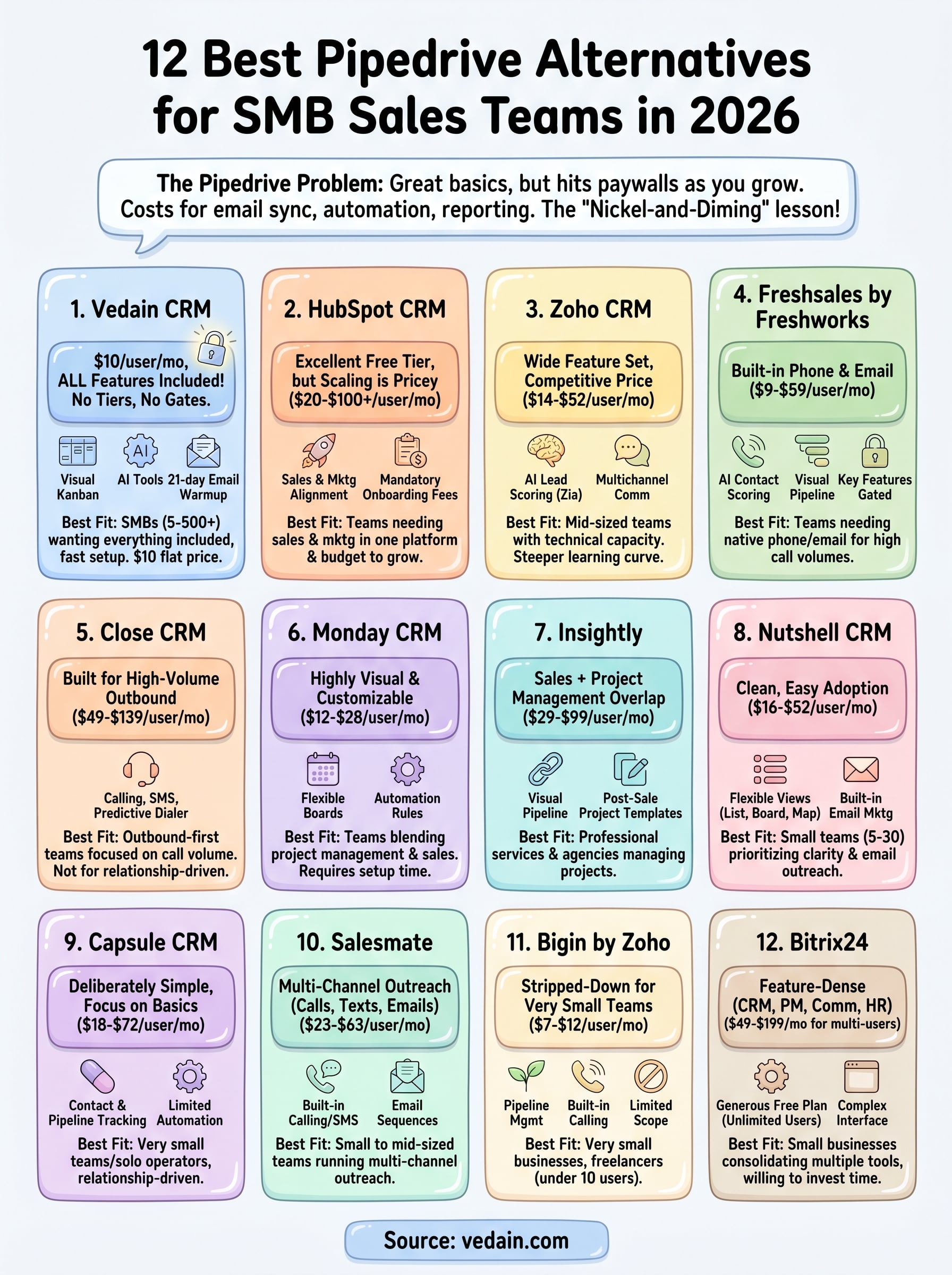
The 12 tools on this list represent the full range of the best Pipedrive alternatives worth considering in 2026, from lean pipeline tools built for solo operators to full-stack platforms that replace multiple subscriptions at once. Your choice comes down to what your team actually uses daily, what your budget supports as you scale, and how quickly you need to get productive after switching. No single platform wins for every team, so prioritize the features your reps rely on rather than the longest feature checklist.
If flat pricing and a complete feature set matter most to your buying decision, Vedain CRM is worth testing directly. Every feature is included at $10 per user per month with no tier upgrades required as your team grows. Email warmup, AI tools, workflow automation, and email sync are all available from day one, and setup takes under five minutes without a credit card to start.
Start your free trial at Vedain CRM and see how it fits your sales process.