We built Vedain CRM because we saw sales teams overpaying for features that should come standard, email sync, automation, unlimited records, only to hit a paywall at every turn. That experience gave us a sharp understanding of what matters in pipeline management software and, more importantly, what separates the good tools from the overpriced ones.
This guide breaks down 12 of the strongest sales pipeline management tools available in 2026. For each one, you'll get an honest look at features, pricing, and trade-offs so you can make a decision based on facts rather than marketing pages. Whether you're running a five-person startup or a 200-rep sales org, there's a fit on this list.
1. Vedain CRM
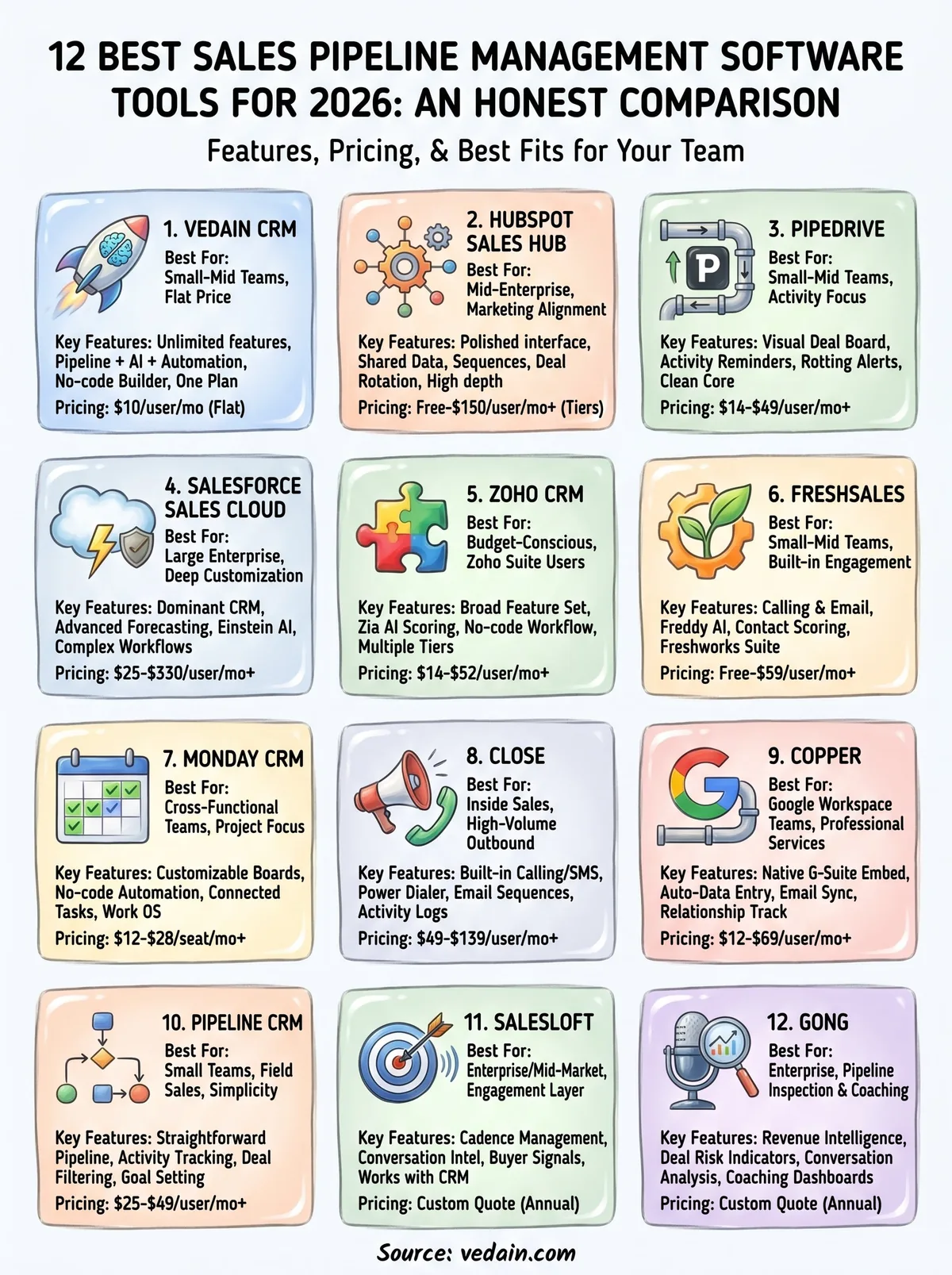
Vedain CRM is a cloud-based sales platform built around a single idea: your team should get every feature it needs without hitting a paywall at every growth stage. You get pipeline management, email automation, AI tools, and reporting all included at one flat price, with no tier upgrades required.
What it is and how it manages a pipeline
Vedain centers your entire sales process on a visual Kanban board where deals move through custom stages you define. Every deal card connects directly to a contact record, email thread, and activity notes, so your reps always see the full context of an opportunity without switching between tools.
Key pipeline and automation features
The platform covers every core workflow a sales team runs daily. You get two-way Gmail and Outlook sync, multi-step email sequences, a no-code workflow builder, and website lead capture forms. Vedain also includes 30+ pre-built AI agents for data enrichment and an AI Studio where you can build custom CRM features by describing them in plain English.
- •Visual deal pipeline with drag-and-drop stage management
- •Email warmup over 21 days for domain deliverability
- •LinkedIn automation for AI-generated post scheduling
- •Custom dashboards with drag-and-drop widgets
- •Pipeline reports, conversion funnels, and team leaderboards
What makes Vedain different at $10 per user
The pricing model is what separates Vedain from most best sales pipeline management software options on this list. At $10 per user per month, you get unlimited records, automation, email sync, and AI tools with no feature tiers or hidden fees.
Every feature Vedain ships is available to every user on every plan, because there is only one plan.
Best fit teams and use cases
Vedain works best for small to mid-sized sales teams that need a full-featured CRM without the setup complexity of tools like HubSpot or Salesforce. It also fits founders and sales leads who want fast implementation and automation without depending on IT support or outside consultants.
Limits and trade-offs to know
Vedain is a newer platform, so the third-party integration library is smaller than what legacy tools offer. If your workflow depends on niche integrations, confirm compatibility before you commit.
Pricing and trial details
Vedain charges $10 per user per month with no credit card required to start. Setup takes under five minutes, and the full feature set is live from day one of your trial.
2. HubSpot Sales Hub
HubSpot Sales Hub is one of the most widely recognized names in the CRM space, and for good reason. It combines pipeline management, contact tracking, and sales automation inside a polished interface that integrates tightly with HubSpot's broader marketing and service ecosystem.
What it is and how it manages a pipeline
Sales Hub gives you a drag-and-drop deal board where reps can move opportunities through custom stages. Each deal links to contact records, email threads, and logged activities, giving managers a clear view of pipeline health at any point in the sales cycle.
Key pipeline and automation features
The platform includes email sequences, meeting scheduling, deal rotation rules, and task automation. You also get built-in calling, a document library, and AI-assisted email writing on higher tiers.
HubSpot's depth is real, but most of its powerful automation features sit behind paid upgrades.
Best fit teams and use cases
HubSpot Sales Hub fits mid-market to enterprise teams that already use or plan to use HubSpot's marketing tools. The shared data model across hubs makes it strong for teams that need tight sales and marketing alignment in one platform.
Limits and trade-offs to know
The free tier is limited, and costs escalate quickly as you add users and unlock advanced features. Reporting customization, forecasting tools, and automation limits all push you toward higher-tier plans that can exceed $100 per user per month.
Pricing and plan notes
HubSpot Sales Hub starts free for basic features. Paid plans begin at $20 per user per month, with the Professional tier at $100 per user per month and Enterprise at $150 per user per month, billed annually. If you're comparing the best sales pipeline management software by total cost, factor in the feature tier you actually need.
3. Pipedrive
Pipedrive is a sales-focused CRM built around the idea that reps should spend time selling, not managing software. The platform keeps your deal view front and center, making it one of the more intuitive options when you're evaluating the best sales pipeline management software for a team that runs on activity-based selling.
What it is and how it manages a pipeline
The platform organizes deals through a visual pipeline board with customizable stages. Each deal card tracks contacts, activities, and notes in one place, and you can filter the board by rep, stage, or expected close date to get a quick read on pipeline health without digging through reports.
Key pipeline and automation features
Pipedrive includes email sync, activity reminders, and deal rotting alerts alongside a workflow automation builder that triggers actions based on stage changes or field updates. The platform also offers a LeadBooster add-on for web chat and lead capture if you need to pull more leads into the top of your pipeline.
Pipedrive keeps its core experience clean, but you will pay extra for features like email campaigns and lead generation tools.
Best fit teams and use cases
Pipedrive fits small to mid-sized sales teams that want a straightforward pipeline tool without the complexity of a larger platform. It works especially well for teams tracking a high volume of outbound deals that need reliable daily activity reminders to stay consistent.
Limits and trade-offs to know
Reporting stays basic on lower tiers, and advanced automation and revenue forecasting require higher-priced plans. The add-on model means your actual monthly cost can climb faster than the base price suggests.
Pricing and plan notes
Pipedrive starts at $14 per user per month billed annually on the Essential plan. The Professional plan, which unlocks more automation and reporting depth, runs $49 per user per month.
4. Salesforce Sales Cloud
Salesforce Sales Cloud is the dominant enterprise CRM in the market and has been for over two decades. It gives large sales organizations a deeply customizable platform for managing every stage of the customer lifecycle, from lead capture to post-sale expansion, and regularly appears at the top of lists covering the best sales pipeline management software for enterprise buyers.
What it is and how it manages a pipeline
Sales Cloud organizes opportunities through a customizable pipeline view with stage-based deal tracking tied directly to accounts, contacts, and activity logs. Your reps can see deal history, logged calls, and open tasks all from a single opportunity record, giving sales managers complete visibility into pipeline movement without chasing down updates from individual reps.
Key pipeline and forecasting features
Salesforce offers advanced forecasting tools that let managers build quota rollups, scenario plans, and real-time pipeline snapshots. The platform also includes AI-powered deal scoring through Einstein, which flags at-risk opportunities and surfaces next-best actions for your reps automatically.

Salesforce's forecasting depth is unmatched, but you need proper configuration to make it useful from day one.
Best fit teams and use cases
Salesforce fits large enterprise sales teams with dedicated administrators and the budget to support a full implementation. It works well for organizations that need deep CRM customization across multiple business units or complex approval workflows.
Limits and trade-offs to know
The platform carries significant setup complexity and typically requires a trained admin or a consulting partner to configure properly. Small teams without dedicated resources will find the learning curve steep and the implementation timeline far longer than simpler alternatives.
Pricing and plan notes
Salesforce Sales Cloud starts at $25 per user per month for the Starter Suite. The Professional plan runs $80 per user per month, with Enterprise at $165 and Unlimited at $330, all billed annually.
5. Zoho CRM
Zoho CRM is a long-standing platform in the CRM market with a broad feature set that covers pipeline management, automation, and analytics across multiple pricing tiers. It fits into the category of best sales pipeline management software that serves a wide range of team sizes, from small businesses to larger organizations.
What it is and how it manages a pipeline
Zoho CRM gives you a Kanban-style pipeline view with customizable stages that connect directly to contact and account records. Reps can log activities, update deal values, and track expected close dates from a single deal record, keeping pipeline data centralized without jumping between tools.
Key pipeline and workflow features
The platform includes a no-code workflow builder that triggers actions like email alerts, field updates, and task assignments based on deal stage changes. Zoho also offers AI-powered lead scoring through its Zia assistant, which ranks opportunities and flags deals that show signs of stalling.
Zoho packs a lot into its platform, but the depth of those features depends heavily on which plan you pay for.
Best fit teams and use cases
Zoho CRM works well for budget-conscious teams that need a capable CRM without committing to HubSpot or Salesforce pricing. It also suits organizations already using Zoho's broader product suite, including Zoho Books, Desk, or Campaigns, where shared data across apps adds real operational value.
Limits and trade-offs to know
The interface feels dated compared to newer tools, and the volume of settings can overwhelm new users. Key features like advanced analytics and custom dashboards are locked behind higher tiers, which pushes the effective cost above the entry price.
Pricing and plan notes
Zoho CRM starts at $14 per user per month on the Standard plan, billed annually. The Professional plan runs $23 per user per month, with Enterprise at $40 and Ultimate at $52 per user per month.
6. Freshsales
Freshsales is a CRM platform built by Freshworks that combines pipeline management with built-in sales engagement tools. It positions itself as an accessible option among the best sales pipeline management software choices by bundling calling, email, and AI-powered contact scoring into a single product.
What it is and how it manages a pipeline
Freshsales organizes deals through a visual pipeline board with customizable stages tied to contact and account records. Reps can log calls, send emails, and update deal details directly from the opportunity view, keeping your team's activity data in one place rather than scattered across separate tools.
Key pipeline and sales engagement features
The platform includes built-in phone calling, two-way email sync, and AI-powered lead scoring through its Freddy AI assistant, which ranks deals by conversion likelihood and flags stalled opportunities. Freshsales also offers automated workflows that trigger follow-ups or field updates based on deal stage changes.
Freddy AI adds genuine value for scoring leads, but it requires enough deal volume in your pipeline before its recommendations become reliable.
Best fit teams and use cases
Freshsales suits small to mid-sized teams that want calling and email engagement built directly into their CRM without layering on a separate sales engagement tool. It also fits organizations already using other Freshworks products like Freshdesk, where shared contact data reduces duplicate entry.
Limits and trade-offs to know
Advanced reporting and custom dashboards are locked behind the Enterprise tier, and the workflow automation builder feels limited compared to more flexible platforms. Teams with complex pipeline logic may find the rules engine too basic.
Pricing and plan notes
Freshsales offers a free plan for up to three users. Paid plans start at $9 per user per month on Growth, with Pro at $39 and Enterprise at $59, billed annually.
7. Monday CRM
Monday CRM is built on top of Monday.com's work management platform, giving sales teams a flexible pipeline tool that blends deal tracking with the broader project and task management capabilities the parent platform is known for.
What it is and how it manages a pipeline
The tool lets you track deals through a customizable board layout where each row represents an opportunity. You can switch between Kanban, list, and chart views depending on how your team prefers to visualize pipeline progress, making it one of the more adaptable interfaces on this list.
Key pipeline and work management features
Contact management, email sync, and automated status updates triggered by column changes are all included. Teams can build no-code automations that assign tasks, send notifications, or move deals forward based on field values.
Monday CRM's flexibility is its biggest strength, but it requires more upfront configuration than purpose-built sales tools.
- •Kanban, list, and chart pipeline views
- •Email sync for Gmail and Outlook
- •No-code automation builder with trigger-based rules
- •Connected task and project boards across teams
Best fit teams and use cases
Monday CRM works best for teams that already use Monday.com for project management and want their sales pipeline in the same workspace. It also suits cross-functional teams where sales and operations collaborate closely on shared deliverables.
Limits and trade-offs to know
The platform lacks dedicated sales features like email sequences or built-in calling, so teams hunting for the best sales pipeline management software with strong outbound capabilities will need to add separate tools. Reporting depth also stays limited compared to purpose-built CRM platforms.
Pricing and plan notes
Monday CRM starts at $12 per seat per month on the Basic plan, billed annually. The Standard plan runs $17 per seat per month, with Pro at $28 per seat per month.
8. Close
Close is a CRM built specifically for inside sales teams that rely heavily on phone and email outreach to work their pipeline. It combines deal tracking with built-in calling, SMS, and email in a single interface, positioning itself as one of the more communication-forward options among the best sales pipeline management software tools available.
What it is and how it manages a pipeline
Close gives your team a deal pipeline with customizable stages that ties directly to contact records and all communication history. Every call, email, and SMS your reps send gets logged automatically, so your pipeline data reflects real activity rather than manually entered notes.
Key pipeline and calling features
The platform includes a built-in power dialer and predictive dialer on higher tiers, email sequences, and two-way email sync. You can set up automated follow-up tasks triggered by pipeline stage changes, keeping your reps moving without manual reminder management.
Close makes calling a first-class feature rather than an afterthought, which matters if phone outreach drives most of your deals.
Best fit teams and use cases
Close fits inside sales teams that run high-volume outbound campaigns and need their calling tools and pipeline in the same product. It works particularly well for SaaS and service businesses where reps make multiple calls per day and speed-to-contact is critical.
Limits and trade-offs to know
Close lacks deep reporting customization and has a smaller integration library than platforms like HubSpot or Salesforce. Teams that need complex pipeline forecasting will find the analytics limited.
Pricing and plan notes
Close starts at $49 per user per month on the Startup plan, with Professional at $99 and Enterprise at $139, billed annually.
9. Copper
Copper is a CRM built exclusively for teams that run their business inside Google Workspace. It embeds directly into Gmail and Google Calendar, which means your reps manage their entire pipeline without leaving the tools they already use every day.
What it is and how it manages a pipeline
Copper tracks deals through a visual pipeline board with customizable stages, and every opportunity connects automatically to your existing Gmail conversations and Google Calendar events. Because Copper reads your inbox directly, it logs contact details and email threads without manual data entry, which removes a common friction point for teams that live in Google's ecosystem.
Key pipeline and Google Workspace features
The platform pulls contact information, email history, and meeting notes directly into deal records through its native Google Workspace integration. You also get workflow automation, task creation from emails, and reporting that surfaces deal velocity across your pipeline stages.
Copper's Google Workspace integration is genuinely seamless, but it becomes a liability if your team ever moves away from Google tools.
Best fit teams and use cases
Copper fits small to mid-sized teams that run entirely on Google Workspace and want a CRM that requires minimal setup and maintenance. It works especially well for professional services businesses like agencies or consultancies where relationship tracking matters as much as deal volume.
Limits and trade-offs to know
Copper is tightly coupled to Google Workspace, so teams using Outlook or other email platforms cannot use it effectively. Advanced reporting and API access are also restricted to higher-tier plans.
Pricing and plan notes
Copper starts at $12 per user per month on the Starter plan, billed annually. The Professional plan runs $29 per user per month, with Business at $69 per user per month.
10. Pipeline CRM by PipelineDeals
Pipeline CRM is a straightforward sales platform aimed at small and mid-sized teams that want solid pipeline tracking without the overhead of enterprise tools. It focuses on keeping deal management and team visibility simple, which is its main pitch against more complex platforms on this list.
What it is and how it manages a pipeline
Pipeline CRM tracks deals through a stage-based pipeline view where each opportunity connects to contact records, notes, and scheduled activities. Your reps can see open tasks, deal values, and expected close dates from a single record, giving managers a reliable read on where each opportunity stands without needing additional reporting layers.
Key pipeline and team management features
The platform includes activity tracking, deal filtering, and goal-setting tools that let managers monitor team performance alongside individual pipeline health. You also get email integration, custom fields, and a reporting suite that surfaces win rates and deal velocity across your pipeline stages.
Pipeline CRM keeps its feature set focused rather than sprawling, which speeds up onboarding but limits flexibility for teams with complex workflows.
Best fit teams and use cases
Pipeline CRM works well for small sales teams that need a dependable, no-frills CRM to organize their pipeline without a long setup process. It suits field sales teams and distributors that track relationship-heavy deal cycles where activity logging matters more than automation depth.
Limits and trade-offs to know
The platform lacks advanced automation and AI features that newer competitors include at comparable price points. Teams looking for the best sales pipeline management software with built-in email sequences or AI tools will find Pipeline CRM limiting.
Pricing and plan notes
Pipeline CRM starts at $25 per user per month on the Start plan, billed annually. The Develop plan runs $33 per user per month, with Grow at $49 per user per month.
11. Salesloft
Salesloft is a sales engagement platform that sits alongside your CRM rather than replacing it. It focuses on pipeline execution, helping revenue teams run structured cadences, manage deal conversations, and track buyer engagement signals across email, phone, and video touchpoints.
What it is and how it supports pipeline execution
Salesloft connects to your CRM to pull in deal and contact data, then gives reps a structured workflow for working each opportunity through a defined sequence of touches. The platform surfaces deal health signals and next-step recommendations so managers can see where pipeline movement is stalling before it turns into a missed quarter.
Key pipeline and sales engagement features
The platform centers on cadence management and conversation intelligence, recording and analyzing calls to surface coaching opportunities and deal risks. You also get deal inspection views, forecasting dashboards, and buyer engagement tracking that logs email opens and reply activity against each opportunity.
Salesloft works best as a layer on top of an existing CRM, not as a standalone pipeline management system.
Best fit teams and use cases
Salesloft fits enterprise and mid-market sales teams that already have a CRM in place and need structured sales engagement tools to improve rep consistency and pipeline visibility at scale.
Limits and trade-offs to know
Salesloft is not a standalone CRM, so you need a separate system of record running alongside it. That adds cost and integration complexity that smaller teams running lean should factor in when evaluating the best sales pipeline management software options for their budget.
Pricing and buying notes
Salesloft does not publish standard pricing publicly. You need to contact their sales team for a custom quote, and contracts are typically structured on an annual basis.
12. Gong
Gong is a revenue intelligence platform that uses conversation data to give sales leaders visibility into pipeline health, deal risks, and rep performance. It sits in a distinct category from the other tools on this list, focusing more on analyzing what's happening in your deals than managing the mechanics of moving them forward.
What it is and how it supports pipeline inspection
Gong records and analyzes your team's sales calls, emails, and video meetings, then maps that activity back to specific deals in your pipeline. Instead of relying on what reps self-report, managers get a data-backed view of deal momentum based on actual buyer engagement signals pulled from real conversations.
Gong is most valuable when your biggest problem is pipeline blind spots caused by unreliable CRM data entry.
Key pipeline and deal risk features
The platform surfaces deal risk indicators like missing next steps, drops in buyer engagement, and single-threaded deals where only one contact has been involved. You also get coaching dashboards that identify where reps are losing deals based on talk patterns, objection handling, and competitive mentions in recorded calls.
Best fit teams and use cases
Gong fits enterprise sales teams that run complex, multi-stakeholder deal cycles and need deeper visibility than standard CRM reporting provides. It also works well for sales managers and revenue operations leaders focused on improving forecast accuracy and rep coaching at scale.
Limits and trade-offs to know
Gong is not a standalone tool for teams searching for the best sales pipeline management software to replace their CRM. You need an existing CRM to run alongside it, which adds both cost and integration overhead that makes it impractical for smaller teams on tight budgets.
Pricing and buying notes
Gong does not publish standard pricing publicly. You contact their sales team for a custom quote, and contracts typically run on an annual basis with pricing based on team size and product tier.
Final pick and next steps
Every tool on this list solves a real problem, but the best sales pipeline management software for your team depends on two things: the features you actually use and the price you can justify. If you run a large enterprise with a dedicated admin team, Salesforce or Salesloft may be the right fit. If you want a full-featured pipeline tool without paying more as you grow, the calculus looks different.
Vedain CRM gives you every feature on day one, including pipeline management, email automation, AI tools, and reporting, at $10 per user per month with no hidden tiers. Your team can be fully set up in under five minutes, and you never hit a paywall when you need a core feature. If you want to see whether it fits your sales process before committing, start your free Vedain CRM trial today with no credit card required.
What makes sales pipeline software simple to use
Simplicity in a CRM isn't about having fewer features. It's about how fast you can find what you need and how little training a new hire requires before they close their first deal. A simple sales pipeline tool shows you every stage of every deal at a glance, usually on a Kanban board, without forcing you to click through five menus to log a call or move a card. If your team spends more time managing the CRM than managing customers, the tool has already failed at its main job.
A CRM is only as simple as the number of clicks between you and your next task.
Visual pipeline management
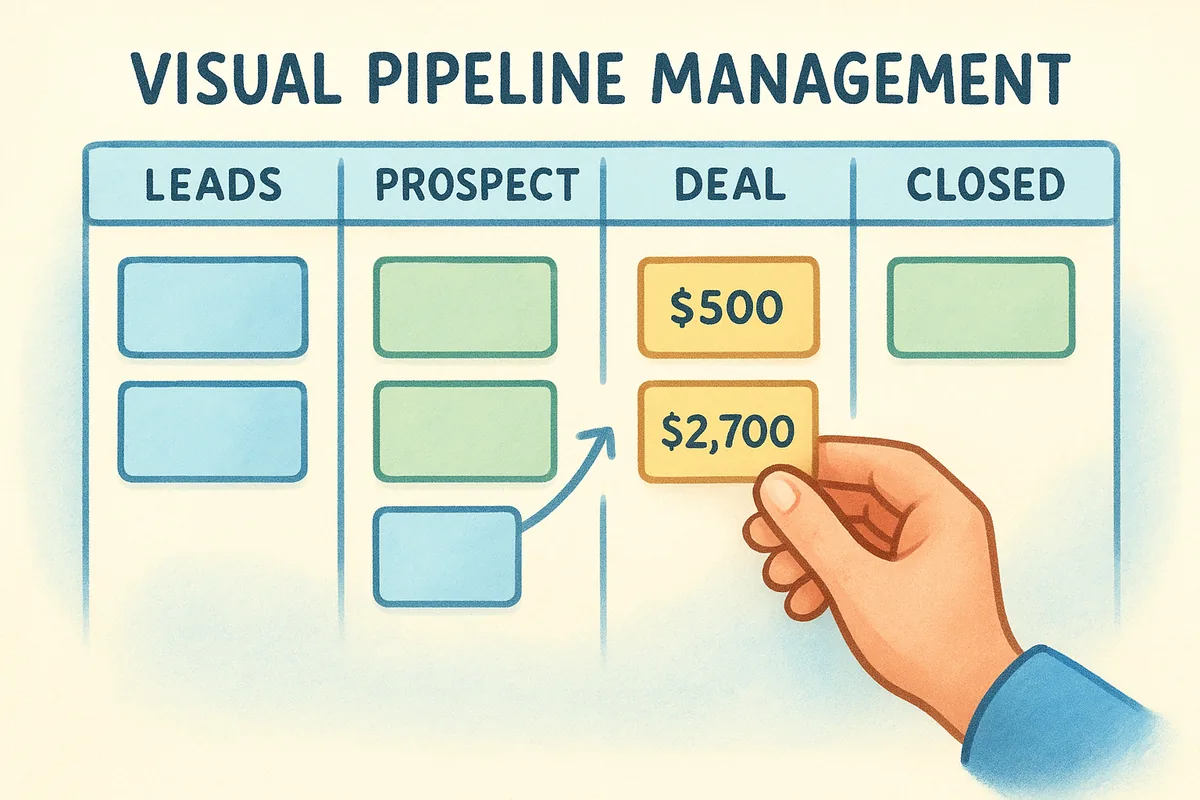
Before anything else, check whether the tool gives you a drag-and-drop pipeline view you can understand in under a minute. You should be able to see deal value, stage, and owner without opening a single record. Tools that bury this behind custom report builders or dashboard configuration wizards defeat the purpose of "simple." Look for color-coded stages, at-a-glance deal counts per column, and the ability to reorder stages without submitting a support ticket.
Fast setup and low learning curve
Setup time tells you a lot about how a tool was designed. If it takes a consultant or a multi-week onboarding call to get your pipeline running, the software was built for enterprise procurement teams, not for reps who need to start logging deals today. The best tools in this category get you from signup to a working pipeline in under 15 minutes, often under 5. Import your contacts, name your stages, and start dragging deals. That's the whole process.
Transparent, predictable pricing
Simplicity also applies to the pricing page, not just the interface. Tiered pricing models that lock automation, email sync, or reporting behind a "Professional" or "Enterprise" plan create hidden complexity you don't discover until you've already onboarded your team. A genuinely simple tool tells you upfront what you get for what you pay, with no surprise add-ons three months in.
Native email and calendar integration
Your reps live in Gmail or Outlook, not in a separate CRM tab. Two-way email sync, meeting scheduling, and activity logging need to happen automatically in the background. If your team has to manually copy-paste email threads into deal notes, the tool isn't simple, it's extra work disguised as software.
Automation without a technical degree
Finally, look for no-code workflow automation that a sales manager can build without pulling in IT. Simple tools let you set up follow-up reminders, stage-change notifications, and lead assignment rules through a visual builder, not a scripting console. Here's a quick checklist to run through when evaluating any tool on this list:
- •Can you build a working pipeline in under 15 minutes?
- •Is the Kanban board the default view, not buried in settings?
- •Does pricing include email sync and automation, or are those add-ons?
- •Can a non-technical manager build an automation rule alone?
- •Does the mobile app mirror the desktop pipeline view?
Keep this checklist in mind as you read through the next nine tools, because it's the same standard we used to rank them.
Frequently Asked Questions
What is the best sales pipeline management software for small businesses in 2026?
Pipedrive and Freshsales are the best options for small businesses, offering intuitive interfaces and affordable pricing starting at $14-$19 per user monthly. Pipedrive excels at visual pipeline management with its drag-and-drop kanban board, while Freshsales provides excellent email integration and automation features. Both outperform Salesforce and HubSpot for small teams due to their simpler feature sets and lower implementation costs.
How much does HubSpot CRM cost compared to Salesforce and Zoho in 2026?
HubSpot CRM offers a free tier plus paid plans starting at $50/month, while Salesforce begins at $165/month and Zoho CRM starts at just $18/month per user. For budget-conscious teams, Zoho and Pipedrive ($14/month) provide the best value, though HubSpot's free option is ideal for testing before committing. Salesforce's premium pricing reflects its enterprise-grade capabilities, making it better suited for larger organizations.
Which sales pipeline software has the best mobile app for field sales teams?
Salesforce and HubSpot offer the most robust mobile applications with real-time pipeline visibility and offline functionality for field teams. Pipedrive's mobile app is also highly rated for its intuitive design and quick deal updates on-the-go. Freshsales and Zoho CRM provide solid mobile experiences, though Vedain focuses primarily on web-based access and may require more mobile optimization for heavy field users.
What sales pipeline software integrates best with email and calendar tools?
HubSpot and Freshsales offer the tightest integrations with Gmail, Outlook, and calendar applications, automatically logging emails and scheduling activities. Pipedrive provides strong email sync capabilities through native integrations, while Salesforce requires additional setup but offers enterprise-level synchronization. Zoho CRM integrates seamlessly within the Zoho ecosystem and also supports Gmail and Outlook, making it versatile for most email workflows.
Which CRM software provides the best sales forecasting and analytics features?
Salesforce leads in advanced forecasting with AI-powered predictive analytics and customizable forecast categories for enterprise teams. HubSpot's Revenue Intelligence uses AI to identify at-risk deals and forecast accuracy, while Pipedrive offers visual pipeline analytics that are easy to understand for smaller teams. Zoho CRM and Freshsales provide solid forecasting dashboards, though Vedain's analytics capabilities are more limited compared to market leaders.
Can I migrate my existing sales pipeline data to a new CRM software in 2026?
Yes, most major CRM platforms including HubSpot, Salesforce, Zoho, Pipedrive, and Freshsales offer data migration tools and support for importing existing pipeline data. HubSpot and Pipedrive provide user-friendly import wizards that handle CSV files and common data formats with minimal manual work. For complex migrations from legacy systems, Salesforce and Zoho offer professional migration services, though Vedain may require more technical support for data transfers.