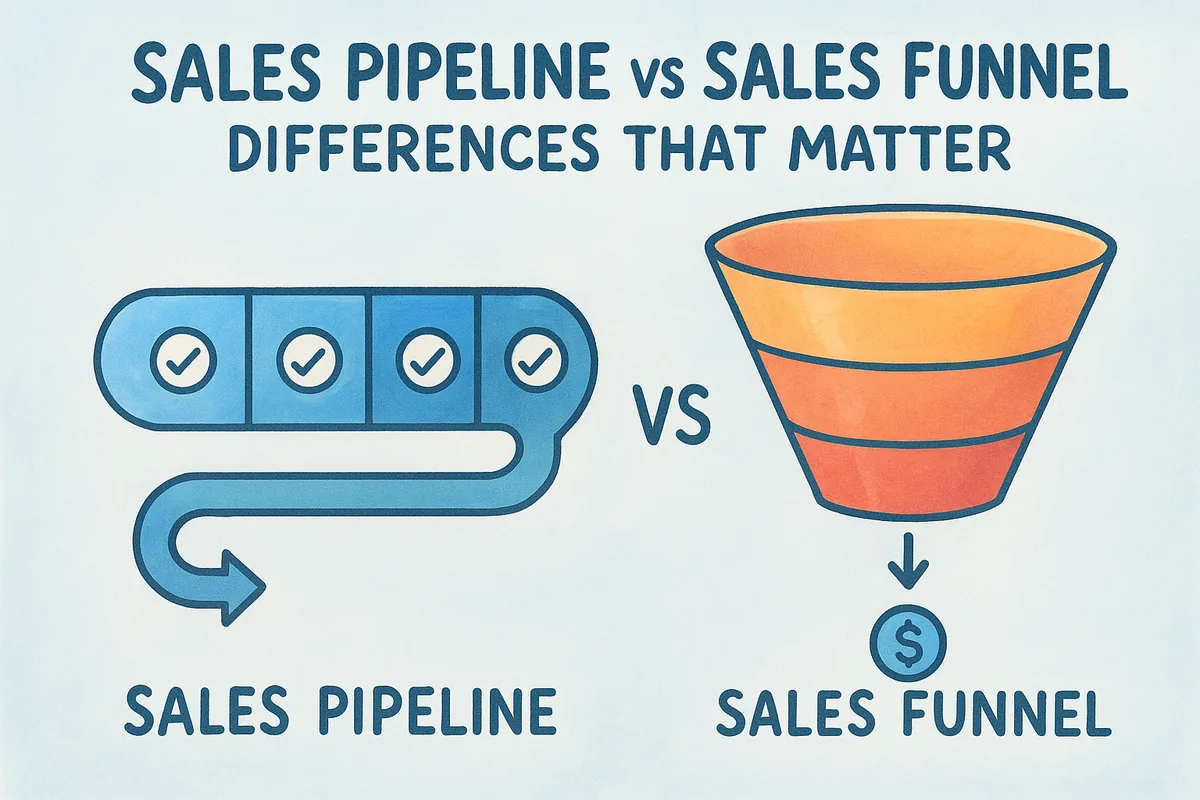
A sales pipeline maps the steps your reps take to move a deal from first contact to closed-won. A sales funnel tracks how prospects narrow down at each stage of their buying journey. Both models matter, but they measure different things and require different actions. Understanding where each one applies gives you sharper forecasting, better coaching conversations, and a clearer picture of what's actually happening in your sales process.
This article breaks down the real differences between pipelines and funnels, how they're structured, what they measure, and when to use which. We'll also cover how the two work together in practice. At Vedain CRM, we built our deal pipeline and reporting tools specifically to give sales teams visibility into both sides of the equation, so you can track rep activity and buyer progression without juggling multiple platforms. Let's get into it.
Why the difference matters in real sales teams
When a sales team treats pipeline and funnel as interchangeable, the result isn't just a terminology problem. It's a diagnosis problem. You end up looking at the wrong data to solve the wrong issue. A rep who's losing deals in the proposal stage needs different coaching than one whose pipeline is stuffed with prospects who were never serious buyers. Without separating the two models, you can't tell which problem you're actually facing, so you keep applying the wrong fix.
When your team conflates the two concepts
Many sales teams fall into this trap without realizing it. They track deal stages in their CRM as if those stages represent buyer psychology, or they describe funnel conversion rates when they actually mean rep activity at each pipeline stage. Both misreads lead to bad decisions. If you pull a "funnel report" but you're really looking at CRM stage progression, you're measuring what your reps did, not what buyers experienced. Those are two very different signals, and the difference matters more than most teams acknowledge.
This confusion also creates problems when you bring new reps onto the team. If your onboarding blurs the two concepts, new hires won't understand why deals stall or where to focus their energy. They'll push deals forward through pipeline stages without checking whether the buyer's mindset is actually moving in the same direction. That disconnect slows deal velocity and makes quota targets harder to hit consistently over time.
Separating pipeline from funnel gives you two lenses instead of one, and that means more precise action at every stage of the sales process.
How confusion affects forecasting and coaching
Forecasting accuracy depends on your ability to read the right signals from the right model. Pipeline data tells you where deals currently sit and what actions your reps need to take next. Funnel data tells you how many of your leads are actually progressing toward a decision and where they're dropping off. When you pull forecast numbers without distinguishing between the two, you end up with inflated projections built on pipeline volume rather than real buyer intent, which means your numbers look strong until they suddenly don't.
Coaching conversations suffer from the same confusion. If a manager looks at a rep's pipeline and sees 20 open deals, that looks healthy on the surface. But if the funnel view shows that 70% of those prospects never engaged after the first touchpoint, the actual situation is far weaker than the pipeline number suggests. You need both models working in your sales system to coach effectively, catch problems early, and set realistic targets that your team can actually hit.
Why both models need to coexist
In the sales pipeline vs sales funnel discussion, the real issue isn't which model is more important. Each one answers a fundamentally different question. Your pipeline answers: where are your deals right now, and what does your rep need to do next? Your funnel answers: how well are you converting interest into revenue across the full buyer journey? Running your sales operation without both is like navigating with half a map. You can move forward, but you'll miss turns and waste time backtracking when results don't match expectations.
The teams that get the most out of their sales data are the ones who treat pipeline health and funnel performance as separate reporting categories with separate actions tied to each. That structural clarity is what lets you scale a sales process without guessing.
What a sales pipeline is and how it works
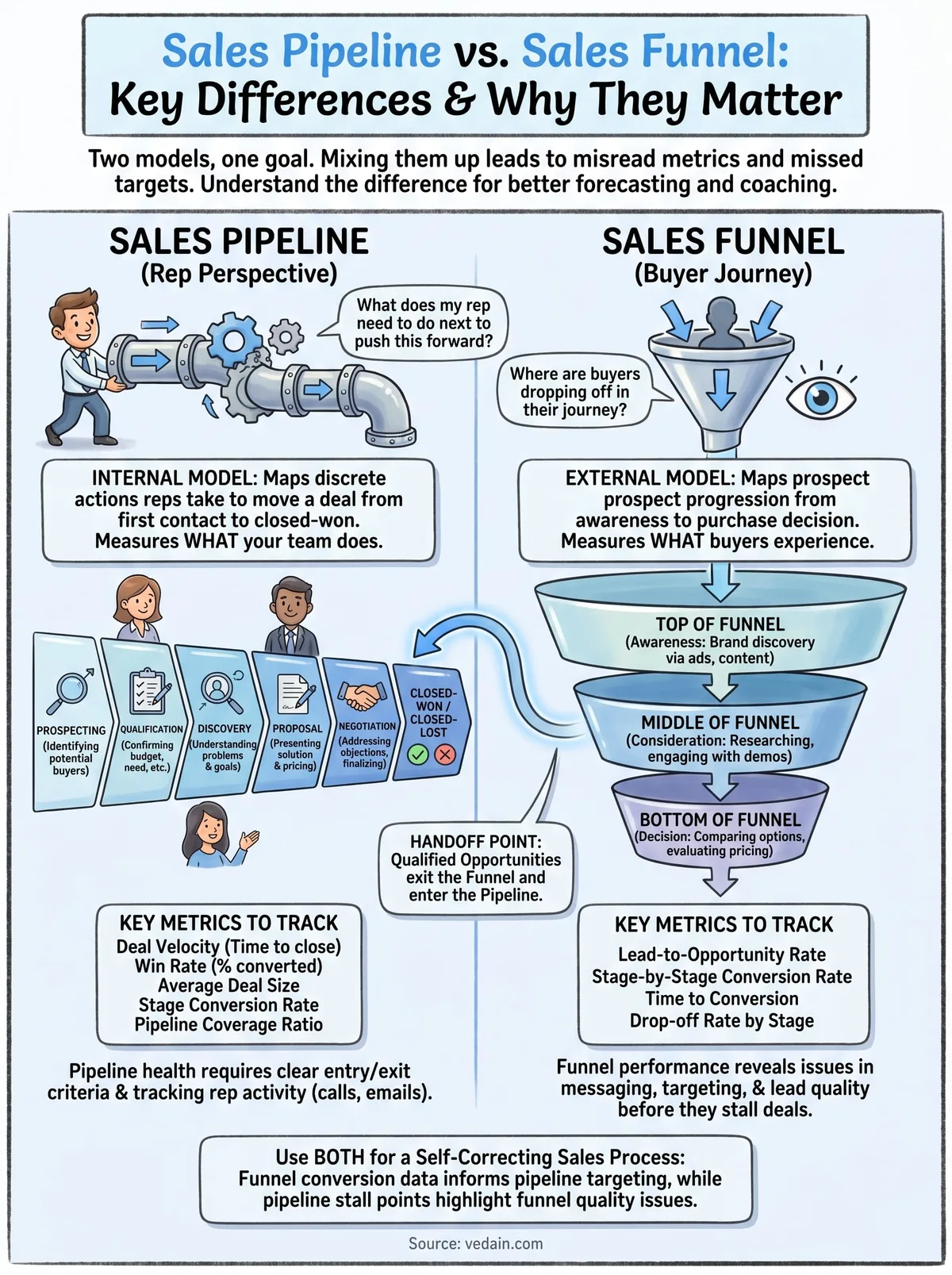
A sales pipeline is a rep-facing model that maps every discrete action your team takes to move a deal from first contact to closed. Think of it as a series of defined stages, each representing a specific milestone in your sales process. When you look at your pipeline, you're answering one question: where does each deal stand right now, and what does your rep need to do next to push it forward?
The stages that define a pipeline
Most sales pipelines follow a predictable structure, though the exact stages vary by business model and deal complexity. A typical pipeline moves through prospecting, qualification, discovery, proposal, negotiation, and close. Each stage has entry and exit criteria that your reps must meet before a deal advances. That discipline is what makes a pipeline useful as a management tool, because without defined criteria, stages become meaningless labels rather than meaningful signals about deal progress.
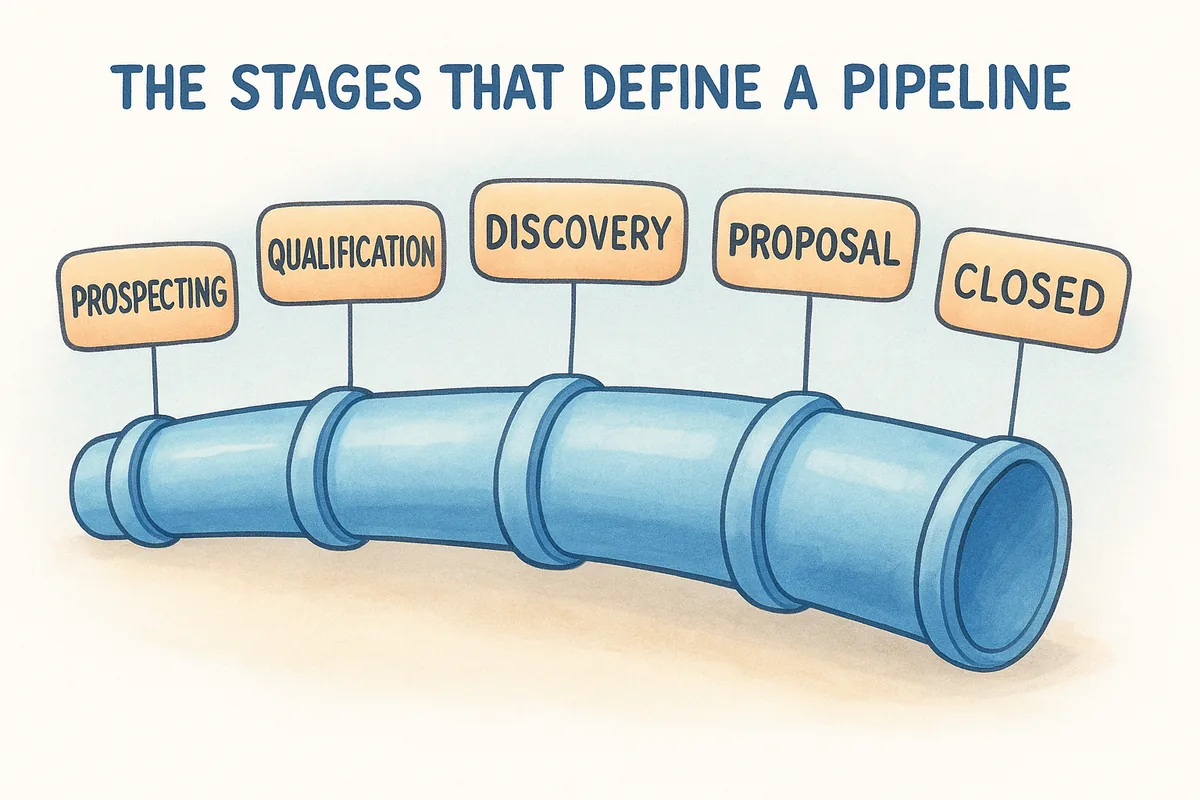
Here's what a standard pipeline structure looks like in practice:
- •Prospecting: Identifying and reaching out to potential buyers
- •Qualification: Confirming the lead has budget, authority, need, and timeline
- •Discovery: Understanding the buyer's specific problem and goals
- •Proposal: Presenting your solution and pricing
- •Negotiation: Addressing objections and finalizing terms
- •Closed-Won / Closed-Lost: Recording the final outcome
How pipeline data drives rep behavior
Your pipeline is only as useful as the activity data attached to it. When your CRM tracks stage progression alongside rep-level actions like calls made, emails sent, and meetings booked, you get a clear picture of which reps are doing the right work and which deals are sitting idle without a clear next step. That visibility separates a managed pipeline from a simple list of open opportunities.
A pipeline without activity data is just a wishlist. What you track inside each stage determines whether your pipeline reflects reality or optimism.
In the sales pipeline vs sales funnel conversation, the pipeline sits firmly on the internal side. It measures what your team controls: actions, timing, and stage movement. That internal focus makes it the right tool for forecasting, rep coaching, and catching stalled deals before the quarter is already gone.
What a sales funnel is and how it works
A sales funnel is a buyer-facing model that maps how your prospects move from first awareness of your product all the way to a purchasing decision. Unlike the pipeline, the funnel isn't about what your reps are doing. It's about what your buyers are experiencing, thinking, and deciding at each stage of their journey. The funnel gets narrower as it moves down because not every prospect who enters at the top will reach a buying decision at the bottom.
The stages of a buyer-focused funnel
The funnel is typically divided into three broad layers: top of funnel (TOFU), middle of funnel (MOFU), and bottom of funnel (BOFU). Each layer reflects a different level of buyer intent and awareness. At the top, prospects are becoming aware of your product. In the middle, they're evaluating whether it fits their problem. At the bottom, they're comparing options and deciding whether to buy.
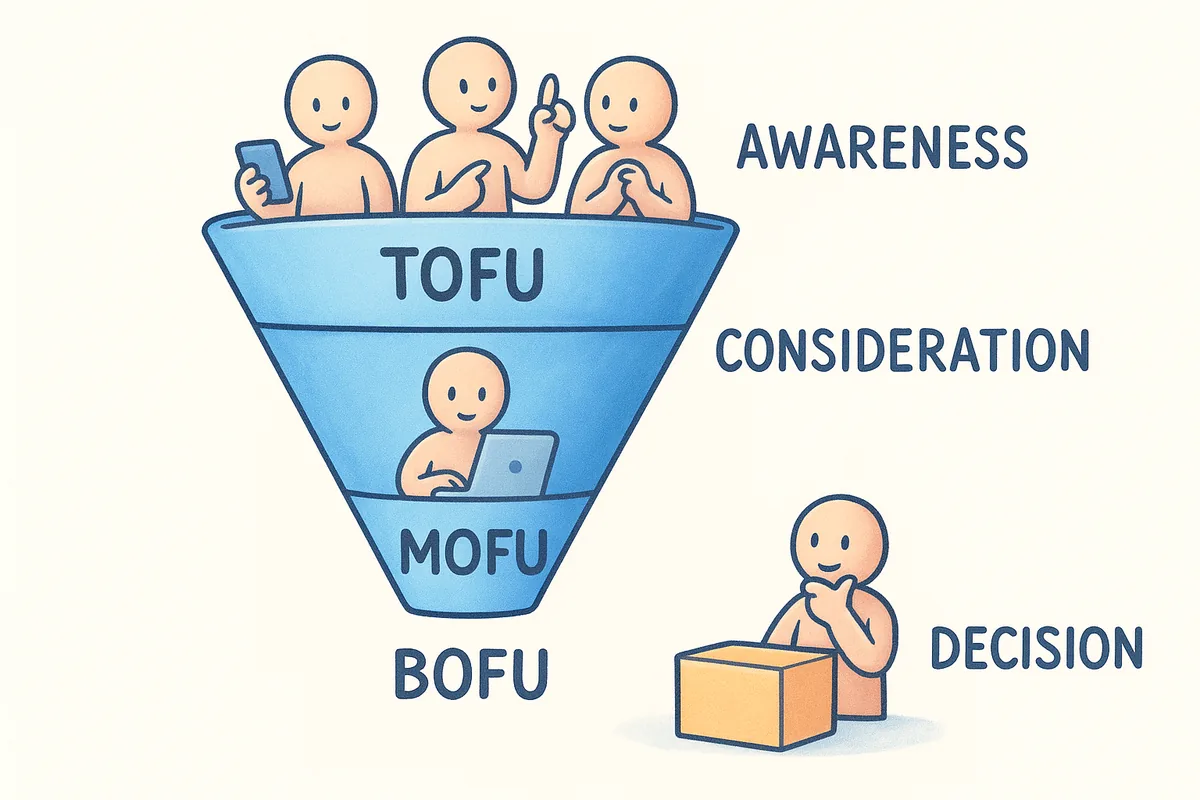
Here's how the funnel layers break down in practice:
- •Top of funnel: Awareness - prospects discover your brand through ads, content, or referrals
- •Middle of funnel: Consideration - prospects research your product and engage with demos or trials
- •Bottom of funnel: Decision - prospects are evaluating pricing, comparing alternatives, and moving toward a purchase
Your funnel shows you where buyers are dropping off, which is the data you need to improve messaging, not rep activity.
How funnel data reveals buyer behavior
Funnel metrics tell you how well your marketing and sales process converts interest into revenue at each stage. When you see a large drop-off between awareness and consideration, that signals a messaging or targeting problem, not a rep performance issue. That distinction is exactly why the sales pipeline vs sales funnel comparison matters. You need to read each model on its own terms before you can act on what it's telling you.
Tracking funnel conversion rates consistently surfaces patterns that pipeline data alone would never show. A funnel that widens at the bottom suggests your nurturing process is working. A funnel that collapses after the first touch means you're attracting the wrong audience or failing to communicate value fast enough to hold attention.
Sales pipeline vs sales funnel: the key differences
Now that you understand each model on its own terms, the contrast becomes clear. The sales pipeline vs sales funnel distinction comes down to one core difference: perspective. Your pipeline is internal, built around what your sales reps do. Your funnel is external, built around what your buyers experience. Everything else flows from that separation.
Perspective, ownership, and direction
Your pipeline is owned by your sales team. Every stage represents a rep action or milestone that your team controls, from qualifying a lead to sending a proposal. Your funnel, on the other hand, reflects your buyer's decision-making process. Your marketing and sales teams both influence it, but the buyer drives the direction. This difference in ownership is why pipeline problems get solved through rep coaching, while funnel problems get solved through messaging, targeting, or offer adjustments.
The direction each model moves also differs. A pipeline tracks forward movement through defined stages, where a rep actively pushes deals from left to right. A funnel tracks downward progression through layers of buyer intent, where prospects self-select based on how well your product fits their needs. Conflating the two means applying rep-focused fixes to buyer-psychology problems, which wastes time and produces no results.
Confusing pipeline action with funnel conversion is one of the fastest ways to misdiagnose why deals are stalling.
Structure, measurement, and what each tracks
Understanding these structural differences helps you apply each model correctly rather than pulling the wrong data when something breaks in your sales process. Here is a direct comparison across the dimensions that matter most:
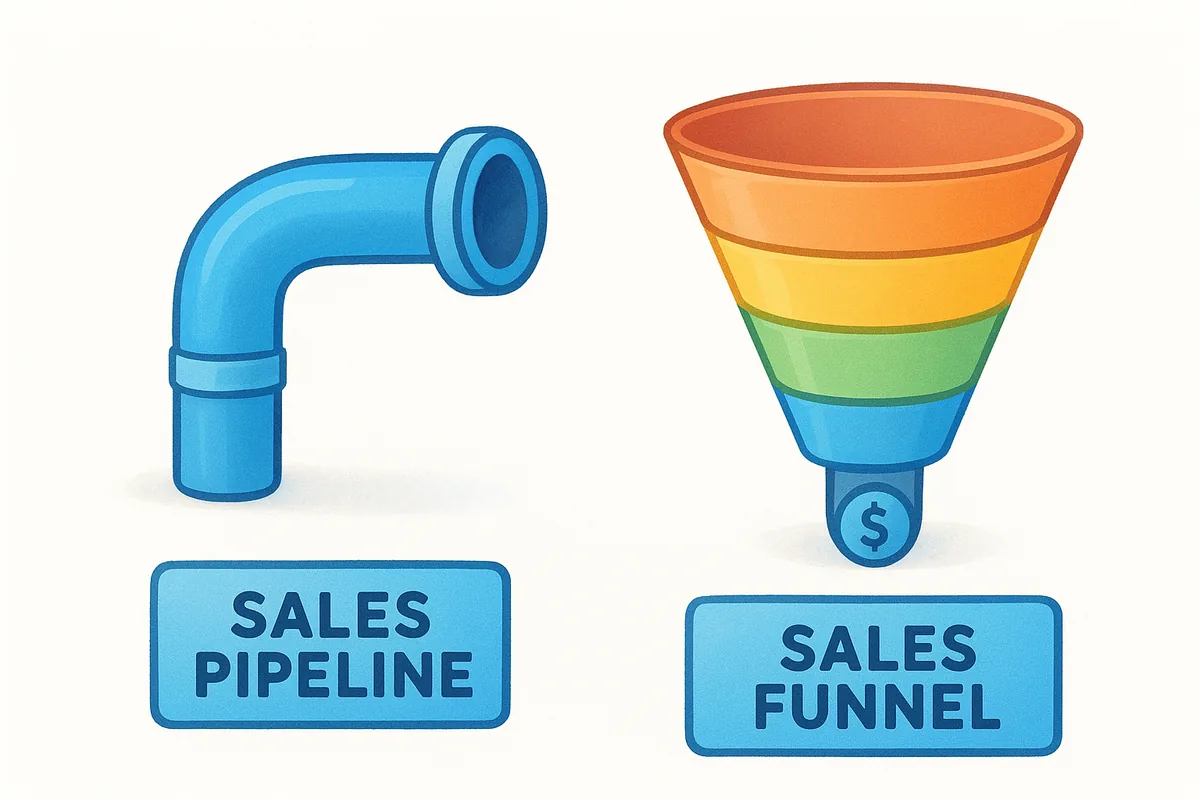
Your pipeline gives you deal-level visibility so you can forecast and coach individual reps. Your funnel gives you population-level visibility so you can identify where your process loses buyers before they ever reach a meaningful conversation. Running your sales system without separating these two models means reading mixed signals, which makes it harder to take the right action at the right time.
Metrics to track in pipelines and funnels
Tracking the right numbers in each model is where the sales pipeline vs sales funnel distinction becomes most practical. You don't need the same metrics for both, and pulling pipeline numbers to answer funnel questions produces data that looks useful but points you in the wrong direction. Each model has its own set of metrics tied directly to what it measures, and mixing them up is one of the most common reasons sales teams misread their own performance data and apply fixes that don't match the actual problem.
Pipeline metrics that reveal rep performance
Your pipeline metrics center on deal-level activity and stage progression. These numbers tell you how effectively your reps are managing individual opportunities and whether your team's overall deal flow is healthy enough to hit quota. Without these metrics tracked consistently in your CRM, you're making forecast decisions based on gut feel rather than real stage-by-stage deal data.
Key pipeline metrics to track:
- •Deal velocity: How many days a deal takes to move from first contact to close
- •Win rate: The percentage of qualified opportunities your reps convert to closed-won
- •Average deal size: The typical revenue value of a closed deal
- •Stage conversion rate: How often deals advance from one pipeline stage to the next
- •Pipeline coverage ratio: Total open deal value compared to your quota target
A pipeline with high volume but low stage-to-stage conversion usually means reps are letting unqualified deals sit open instead of disqualifying them early.
Funnel metrics that reveal buyer behavior
Funnel metrics operate at the population level. Rather than tracking individual deals, you're measuring how large groups of prospects move through each layer of the buyer journey. These numbers surface problems in your messaging, targeting, and lead quality before those problems show up as lost deals inside your pipeline.
Core funnel metrics to monitor:
- •Lead-to-opportunity rate: How many raw leads become qualified pipeline opportunities
- •Stage-by-stage conversion rate: The percentage of prospects who advance through each funnel layer
- •Time to conversion: How long buyers spend in each funnel stage before moving forward
- •Drop-off rate by stage: Where prospects exit the funnel without advancing
Funnel data won't identify which rep needs coaching. What it will tell you is whether your inbound traffic matches your ideal customer profile and whether your nurturing sequences are strong enough to carry buyers from initial interest into a real sales conversation with your team.
How to use a pipeline and funnel together
Running a pipeline and funnel separately is the right starting point, but the real value comes when you connect them into a single operating system. Your funnel feeds your pipeline. The leads that make it through your funnel's awareness and consideration stages are the ones who become the qualified opportunities sitting in your pipeline. When you treat these two models as linked rather than independent, your sales process becomes self-correcting because weak funnel performance shows up before your pipeline stalls, and stalled pipeline stages tell you exactly where funnel quality broke down.
Map your funnel exit points to pipeline entry criteria
The cleanest way to connect the two models is to define a clear handoff point where a prospect exits your funnel and enters your pipeline as a qualified deal. Most teams skip this step, which means unqualified leads pile up inside pipeline stages and inflate your open deal count without contributing to real revenue. Set specific criteria that a prospect must meet before your team moves them into the pipeline, such as confirmed budget, a specific timeline, and demonstrated interest in your product. Everything before that threshold lives in the funnel, not the pipeline.
Here is a practical way to map the handoff across both models:
Use funnel conversion data to adjust pipeline targeting
Once you have a clean handoff defined, funnel conversion data becomes one of your most useful pipeline planning tools. If your funnel shows a 5% lead-to-opportunity conversion rate, you can work backwards to calculate how many raw leads your team needs to generate to hit your pipeline coverage ratio. That math lets you set realistic activity targets tied to actual data rather than optimistic assumptions about how many leads will convert.
In the sales pipeline vs sales funnel system, funnel conversion rates are the upstream variable that determines whether your pipeline ever has enough quality volume to hit quota.
Tracking both models inside your CRM keeps this connection visible so your team can act on real numbers instead of discovering the gap at the end of the quarter.
Common mistakes and how to fix them
Even sales teams with a solid understanding of the sales pipeline vs sales funnel distinction still make predictable errors when they put both models into practice. These mistakes usually don't show up immediately, but they compound over time until your forecast accuracy drops and deal velocity slows without a clear explanation. Recognizing these patterns early gives you the chance to fix them before they cost you a quarter.
Treating every lead as a pipeline opportunity
One of the most damaging habits a sales team can develop is moving every inbound lead directly into the pipeline without applying qualification criteria first. When unqualified contacts land in your pipeline, they inflate your open deal count, skew your stage conversion rates, and make your coverage ratio look stronger than it actually is. Your reps end up spending time on leads that were never going to buy, while high-intent prospects don't get the attention they need.
The fix is straightforward: define a minimum qualification threshold before any contact becomes a pipeline deal. Confirmed budget, clear need, and a specific timeline should all be required. Contacts that don't meet those criteria stay in your funnel, where nurturing sequences can build interest before they're ready for a real sales conversation.
Letting unqualified leads sit in your pipeline doesn't just hurt your metrics, it burns your team's time on deals that were never real.
Ignoring funnel drop-off data
Many sales teams track their pipeline closely but never look at where prospects are exiting the funnel before they even reach a qualified opportunity. If you only monitor pipeline stages, you're reacting to problems that the funnel data could have predicted weeks earlier. A spike in early-stage drop-offs usually signals a targeting or messaging problem, not a rep performance issue, and you'll apply the wrong fix if you're only reading pipeline signals.
Pull funnel conversion reports on a consistent schedule, at least monthly. Look specifically at the stages where your largest drop-offs occur and ask whether the issue is lead quality, content relevance, or follow-up timing. Matching your fix to the actual data is what separates teams that improve systematically from teams that keep repeating the same errors.
Leaving stale deals open in the pipeline
Stale deals distort every pipeline metric your team depends on. Win rates drop, deal velocity numbers inflate, and forecast accuracy suffers when deals that have no real chance of closing stay open simply because no one disqualified them. Most reps leave dead deals open because closing them feels like admitting failure, but an honest pipeline is always more useful than an optimistic one.
Set a clear staleness threshold, typically 30 or 45 days without meaningful buyer activity, and build a review process that requires reps to either advance a deal or close it out within that window. Clean pipeline data gives you reliable forecasts and better coaching conversations.
Next steps to clean up your sales system
The sales pipeline vs sales funnel distinction gives you a cleaner way to diagnose problems, coach reps, and forecast revenue with more confidence. Your next move is to audit what you're currently tracking. Check whether your pipeline stages have clear qualification criteria and whether you're pulling funnel conversion data on a regular schedule. If you're not doing both, you're making decisions with incomplete information.
From there, define a hard handoff point between your funnel and pipeline so unqualified leads stop inflating your deal count. Build a staleness rule so your reps close out dead deals instead of carrying them indefinitely. These two changes alone will sharpen your metrics faster than any new tool or process overhaul.
If you want a CRM that tracks both pipeline health and funnel performance in one place, try Vedain CRM free and see how your sales data looks when it's actually organized.
Frequently Asked Questions
What is the main difference between a sales pipeline and a sales funnel?
A sales pipeline is a visual representation of all deals in progress across different stages, while a sales funnel tracks the percentage of prospects who move through each stage, showing how many drop off. The pipeline focuses on individual deal progression and revenue forecasting, whereas the funnel emphasizes conversion rates and customer loss. Tools like HubSpot and Salesforce both support pipeline views, but Pipedrive specifically emphasizes pipeline management as its core strength, while Freshsales combines both perspectives in its interface.
Should I use a sales pipeline or funnel for forecasting revenue?
You should primarily use a sales pipeline for revenue forecasting because it tracks the actual value and stage of each deal in progress. A sales funnel is better for analyzing drop-off rates and conversion efficiency rather than predicting revenue. Most enterprise CRMs like Salesforce ($165/month+) and HubSpot ($50/month+) provide pipeline-based forecasting tools that calculate expected revenue by multiplying deal probability by deal value at each stage.
Can a CRM track both sales pipelines and sales funnels at the same time?
Yes, most modern CRMs including HubSpot, Salesforce, Zoho ($15/month+), and Pipedrive ($15/month+) can display both pipeline and funnel analytics simultaneously. Pipedrive is particularly strong for pipeline visualization, while HubSpot excels at funnel analysis through its reports dashboard. Vedain and Freshsales also support dual reporting, allowing you to view deal progression in pipeline format while simultaneously analyzing conversion rates in funnel format.
How do sales funnels help identify bottlenecks in my sales process?
Sales funnels reveal bottlenecks by showing which stages have the lowest conversion rates and where prospects are dropping off most frequently. By comparing the percentage of prospects moving from one stage to the next, you can pinpoint exactly where your sales process breaks down. CRMs like Salesforce and Zoho provide detailed funnel reports ($165+ and $15+ per user monthly) that highlight these conversion gaps, while Freshsales offers visual funnel analytics to spot performance issues quickly.
Is a sales pipeline better than a funnel for individual sales rep accountability?
A sales pipeline is better for individual sales rep accountability because it tracks specific deals assigned to each rep and measures their progress toward quotas. Funnels show aggregate team-level conversion rates but don't isolate individual performance. Pipedrive ($15/month) is specifically designed for rep-level pipeline accountability with clear deal ownership, while HubSpot ($50/month) and Salesforce provide both rep scorecards and individual pipeline visibility for performance management.
What metrics should I track in a sales pipeline versus a sales funnel?
In a sales pipeline, track metrics like deal value, deal probability, sales cycle length, and deals closed per stage; in a sales funnel, focus on conversion rates, drop-off percentages, and average time spent in each stage. Pipeline metrics help forecast revenue and predict individual deal outcomes, while funnel metrics identify process inefficiencies. Tools like HubSpot ($50/month+) and Freshsales both provide customizable dashboards for tracking both metric types, though Pipedrive specializes in pipeline-specific KPIs.