Most agencies get stuck because "CRM" and "agency management system" are sold as if they were the same product. They are not. Buying the wrong one means paying for policy-servicing features you never open, or discovering in month two that your leads still live in spreadsheets.
We build Vedain, a sales CRM for teams in India and the UAE, so it appears first. We say plainly where it fits an agency and where it does not. Every pick gets the same three checks: what it does, where it falls short, and who it suits at what price. After the six picks, you get a CRM vs agency management system breakdown and a buying checklist that covers free options.
1. Vedain CRM
Vedain is a general sales CRM that works as insurance agent CRM software once you shape the pipeline to your sales cycle. It covers the front half of agency work: capturing leads, following up and chasing renewals.
What it does for an insurance agency
Leads arrive from website forms, Facebook and Instagram Lead Ads, IndiaMART, Justdial, Google Sheets or CSV imports. A visual pipeline with custom stages lets you build your own flow, for example quote sent, application, issued, renewal due.
Communication sits in the same record. You get two-way Gmail and Microsoft 365 sync, WhatsApp Business messaging for India and the UAE (billed separately, see pricing below), calling campaigns, and multi-step email sequences with open and click tracking. No-code workflows and AI lead scoring cut the manual follow-up. The feature hub lists the rest.
Vedain works best as the sales layer of an agency: it moves the lead to an issued policy and brings the client back at renewal.
Where it falls short
Vedain is not an agency management system. It does not replace a policy-administration system, and it has no commission calculation and no e-signature. Policy numbers and carrier data are not built in, so keep them in your policy system.
The interface is English only, and the app is a mobile-responsive web app, not native iOS or Android. If your producers live in an Android app all day, test the mobile web experience first.
Who it suits and pricing
Vedain suits small and mid-sized agencies in India and the UAE that sell over WhatsApp and buy leads from portals or ads. Setup takes under five minutes.
There is one plan: $10 per user per month (₹500 or AED 25) with every feature included. Annual billing gets two months free, and the 14-day trial needs no credit card. There is no free plan. WhatsApp messaging is a usage-based extra on top of the seat price: a ₹1,500 one-time registration, a ₹1,000 monthly platform fee covering 1 admin and 5 users (₹250 per extra user), plus Meta's per-message rates (₹0.98 marketing, ₹0.14 utility or authentication, service replies free).
2. AgencyBloc
AgencyBloc is the specialist on this list. It combines an agency management system with a CRM for health, life, senior-market and group benefits agencies, with commissions processing (Commissions+) and quoting and enrollment (Quote+) in the same platform.
What it does for an insurance agency
It keeps clients, policies and producer activity in one place, so account records connect to the money side of the business. Commissions processing is the headline feature. Spreadsheets break there first as an agency grows.
Quoting tools and sales tracking sit on the same records. Producers and service staff see one version of each client instead of reconciling a CRM against a policy system.
Where it falls short
It is built for health, life, senior and benefits business. A property and casualty agency, or a team selling a mix of products, should check carefully that its workflows match.
A platform that covers this much also takes longer to set up and learn than a sales CRM. Ask about onboarding time, and ask how it handles the channels your clients use, such as WhatsApp or text.
Choose AgencyBloc when commissions and policy records are your biggest headache, not lead follow-up.
Who it suits and pricing
It suits health and life agencies that want one system for sales and operations. AgencyBloc publishes no prices: it is quote only, with Commissions+ packages based on transaction volume and Quote+ packages based on groups quoted. Request a quote and ask what the base price includes versus add-ons.
3. Zoho CRM
Zoho CRM is a flexible general CRM that many insurance teams adapt, mainly because it gives you a lot of configuration for a modest price.
What it does for an insurance agency
It gives agents a 360-degree view of each client across email, phone, chat and social channels. Customizable workflows and an AI assistant, Zia, help with lead and deal prediction. Integrations cover hundreds of other apps.
Agents can track deals from first contact to close and automate lead scoring. Mobile access is strong, which matters for producers who are out visiting clients.
Where it falls short
Zoho offers limited out-of-the-box insurance functionality. Claims, policy administration and compliance workflows usually need heavy customization or third-party add-ons.
Someone has to build and maintain those customizations. If nobody on your team enjoys configuring software, the flexibility turns into a project.
Zoho CRM is a good insurance agent CRM only if someone on your team will configure it.
Who it suits and pricing
It suits budget-conscious agencies with a person who can set it up and stay on top of it. Zoho has a free edition for up to 3 users, and its paid editions start with Standard at $14 per user per month billed annually ($20 monthly), rising to Professional ($23), Enterprise ($40) and Ultimate ($52) on annual billing. Check its pricing page before you buy, since prices change.
4. HubSpot CRM
HubSpot is the best-known free route into CRM. It positions its free CRM for insurance agencies that want to manage client relationships and track a book of business.
What it does for an insurance agency
The free CRM handles contacts, deals and email logging. Paid tiers add deal scoring and workflow automation, with marketing and service tools in separate products on the same contact records.
For agencies that generate leads through content, web forms and email nurture, HubSpot connects marketing activity to the sales pipeline better than most competitors.
Where it falls short
HubSpot has limited insurance-specific features. Policy fields and renewal tracking need custom configuration or integrations.
The free tier is a genuine starting point, but deeper automation, reporting and marketing tools require paid plans. Costs can climb quickly as you add seats and products.
HubSpot's free CRM is a real starting point, but the useful automation sits behind paid tiers.
Who it suits and pricing
It suits agencies that win clients through inbound marketing and want a free tier to start. The free tools cover up to 2 users. Sales Hub Starter starts at $7 per seat per month billed annually ($20 monthly), and Professional is $90 per seat per month billed annually plus a required $1,500 one-time onboarding fee. Confirm current prices on HubSpot's pricing page, since the Starter price is marked "starts at".
5. Less Annoying CRM
Less Annoying CRM (LACRM) targets small businesses, and insurance agents are among the teams it markets to. The pitch is simplicity: track client details, log policy notes and keep a client relationship pipeline.
What it does for an insurance agency
It centralizes contacts, notes, follow-up tasks and calendar items. Agents can log policy details against a client record and use a simple pipeline to track prospects through the sales process.
The scope stays deliberately small. Setup is quick, and there is little to learn, which suits an agent who wants a working system this week.
Where it falls short
It is not an agency management system. Expect no carrier connections and no commission handling. Automation and reporting are also lighter than on larger platforms.
If you plan to grow to a dozen producers, check whether the reporting and permission controls will keep up before you move all your data in.
Less Annoying CRM works because it does less, and that is the point and the limit.
Who it suits and pricing
It suits solo agents and teams of two to five who want a tidy client database with follow-ups. LACRM has one plan at $15 per user per month, with a 30-day free trial and no credit card. There is no free plan.
6. Salesforce
Salesforce is the enterprise option. Its Financial Services Cloud adds insurance capabilities, and Salesforce describes its insurance CRM as covering carriers, agencies and brokers, including policy lifecycle tracking.
What it does for an insurance agency
It handles the full lifecycle from lead to policy servicing and retention, with deep automation, segmentation, analytics and integrations. It can model complex households, multiple product lines and several offices.
If you already have developers or a Salesforce admin, it can be shaped into almost any agency workflow. Nothing else on this list scales further.
Where it falls short
The learning curve is steep, and licensing is expensive. Insurance-specific capabilities and AI features often come as add-ons, which raises the cost of ownership further.
Most agencies also need ongoing IT help to tailor and maintain it. For a team of five, that overhead usually outweighs the benefit.
Salesforce is worth its cost only when your agency has the complexity and the admin to use it.
Who it suits and pricing
It suits larger agencies and brokers with multiple product lines and technical staff. Sales Cloud starts at $25 per user per month (Starter Suite) with a 30-day free trial, but Financial Services Cloud and its insurance products are priced separately. Request a quote and compare the total cost across three years.
CRM vs agency management system: which one you need
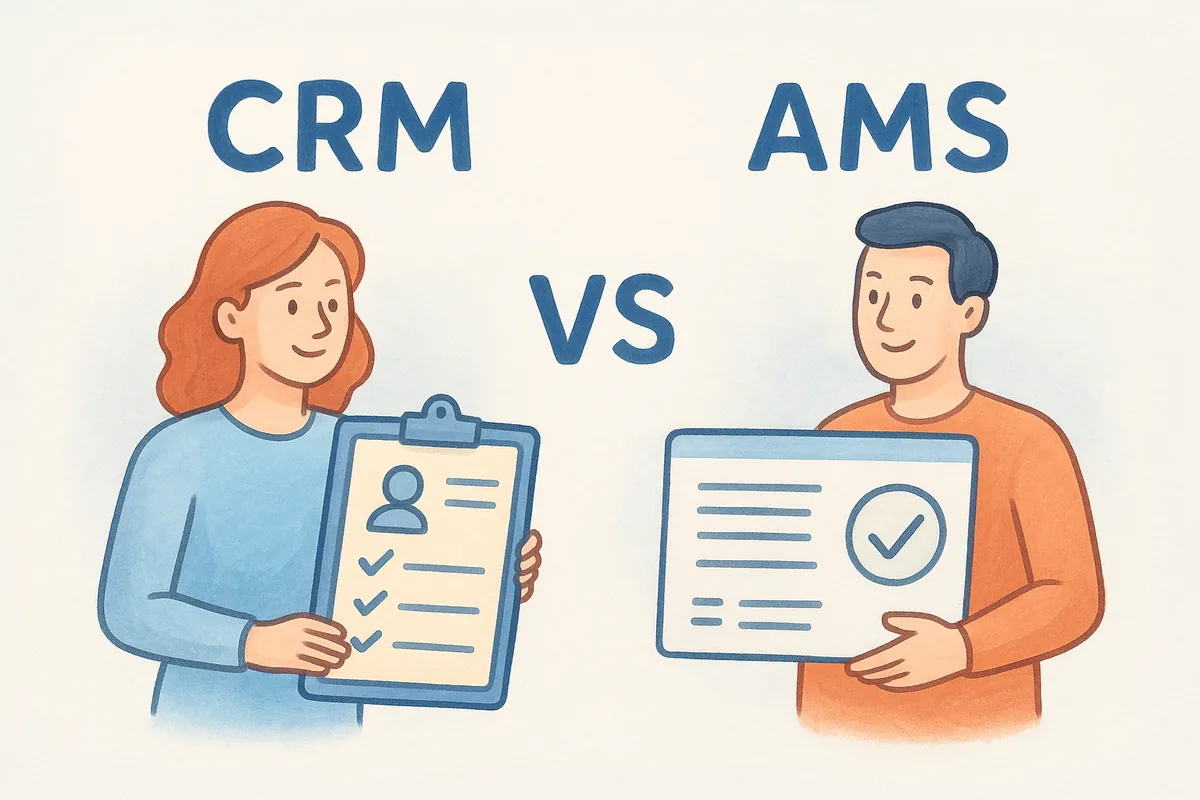
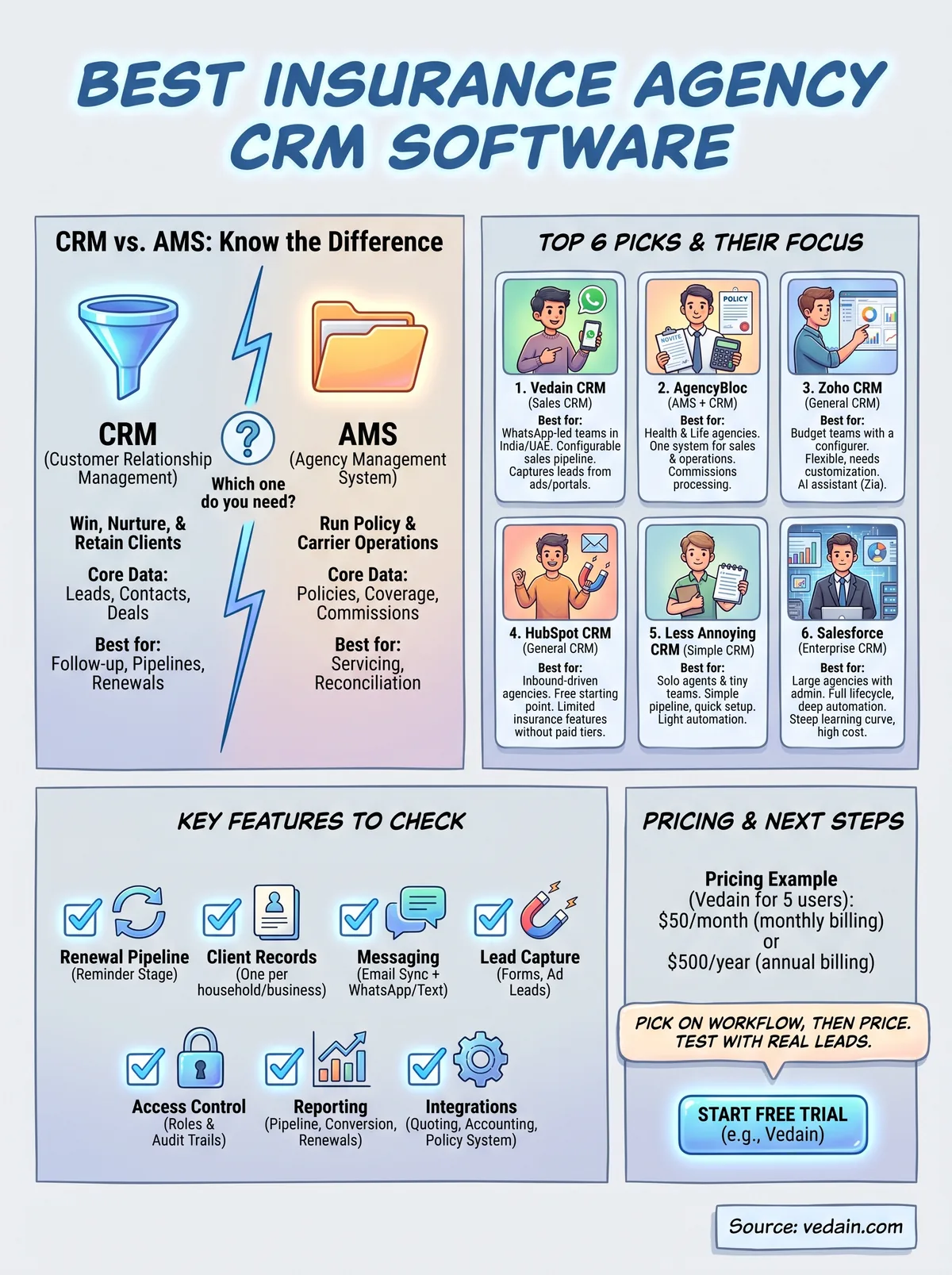
A CRM manages your relationships and sales pipeline. An agency management system (AMS) manages the operational record: policies, carriers, servicing and commissions. Many small agencies start with a CRM and add an AMS once policy servicing grows.
How a CRM and an AMS differ
Where the six picks sit
Some tools cover both jobs, some only one. Use this table to see which side each pick leans toward and what it costs to start. Agencies that need both often run an AMS as the system of record and a CRM on top for lead handling and campaigns.
| Tool | CRM or AMS | Starting price (billing basis) | Free plan or trial | Best for |
|---|---|---|---|---|
| Vedain | Sales CRM | $10/user/month (₹500 or AED 25); ~$8.33 billed annually. WhatsApp messaging billed separately | 14-day trial, no card; no free plan | Small and mid-sized agencies in India and the UAE selling over WhatsApp |
| AgencyBloc | AMS + CRM | Quote only | No free plan published | Health, life, senior and benefits agencies |
| Zoho CRM | Sales CRM | $14/user/month billed annually ($20 monthly), Standard | Free for up to 3 users | Budget agencies with someone to configure it |
| HubSpot CRM | Sales and marketing CRM | $7/seat/month billed annually ($20 monthly), Sales Hub Starter | Free tools for up to 2 users | Agencies that win clients through inbound marketing |
| Less Annoying CRM | Simple CRM | $15/user/month, single plan | 30-day trial, no card; no free plan | Solo agents and teams of two to five |
| Salesforce | CRM (insurance via Financial Services Cloud) | $25/user/month, Sales Cloud Starter Suite; Financial Services Cloud quote only | 30-day Sales Cloud trial | Larger agencies and brokers with an admin |
If policy servicing and commissions drive your day, buy an AMS first. If lead conversion and renewals drive it, buy a CRM.
What to check before you buy, including free options
Pick on workflow fit first, then price. A cheap tool that misses one daily task costs more than a pricier tool that fits.
Features that matter most
Test these against your own week, not a vendor demo:
- •Renewal pipeline: a stage or reminder that brings a client back before the policy expires.
- •Client records: one record per household or business, with every call, email and message attached.
- •Messaging: email sync, plus WhatsApp or text if your clients use them.
- •Lead capture: forms, ad leads and portal leads arriving without copy and paste.
- •Access control: roles and audit trails for sensitive client data.
- •Reporting: pipeline value, conversion by source and renewal rate.
- •Integrations: quoting tools, accounting and your policy system.
Free insurance CRM options
Free CRM plans exist, but they are limited. HubSpot's free CRM is the most complete free starting point, and Zoho has offered a free edition for very small teams. Expect caps on users, automation and reporting, and check each vendor's pricing page for the current limits.
Vedain has no free plan. It offers a 14-day trial with no credit card, and if you do not subscribe your account is paused, not deleted. The one permanent free piece is the live chat widget, which answers website visitors with an AI assistant for up to 100 conversations a month and saves every chat as a lead.
What a five-person agency pays
Multiply seats by the per-user price, then add onboarding fees and add-ons. For Vedain, five users cost:
- •$50 per month on monthly billing (₹2,500 or AED 125).
- •$600 per year on monthly billing.
- •$500 per year on annual billing, with two months free.
These figures cover the CRM seats only. WhatsApp messaging, if you use it, adds its own registration, platform and per-message fees. Ask every other vendor for the same three numbers.
Picking the right tool for your agency
Start by deciding whether you need an agency management system, a CRM or both. Specialists like AgencyBloc fit agencies whose pain is policies and commissions. Flexible CRMs like Zoho, HubSpot and Less Annoying CRM fit agencies whose pain is follow-up, and Salesforce fits large teams with an admin.
Whichever you pick, test it with real leads and a real renewal list during the trial. If your team sells over WhatsApp and captures leads from ads and portals in India or the UAE, you can start a 14-day free trial of Vedain and have a working pipeline in under five minutes.
Frequently Asked Questions
What is the best CRM for an insurance agency?
It depends on what the system must own. If you need policies, commissions and quoting in one place, an insurance specialist such as AgencyBloc fits. If your main job is capturing leads, following up and winning renewals, a sales CRM like Vedain, Zoho CRM or HubSpot does it for far less.
What is the difference between an insurance CRM and an agency management system?
A CRM manages relationships and the sales pipeline: leads, follow-ups, quotes and renewals. An agency management system holds the operational record, such as policies, carriers, servicing and commissions. Many small agencies start with a CRM and add an AMS as policy servicing grows.
Is there a free CRM for insurance agents?
Yes, with limits. HubSpot's free tools cover up to 2 users and Zoho CRM is free for up to 3 users, but automation and reporting are capped. Vedain has no free plan; it offers a 14-day trial with no credit card.
How much does insurance agency CRM software cost?
General sales CRMs start at about $7 to $25 per user per month: Vedain is $10, Zoho CRM Standard $14 billed annually, Less Annoying CRM $15 and Salesforce Sales Cloud Starter $25. Insurance specialists such as AgencyBloc are quote only, so add onboarding fees and add-ons when you compare.
Can a general CRM track policy renewals?
Yes. Add a renewal stage or a renewal-date field and set a workflow to remind the agent, or open a follow-up task, before the policy expires. What a general CRM will not do is administer the policy or calculate commissions, so keep those in your policy system.
Does Vedain include WhatsApp for insurance agents?
Vedain supports WhatsApp Business messaging for India and the UAE inside the CRM record. Messaging is billed separately from the $10 seat price: a ₹1,500 one-time registration, a ₹1,000 monthly platform fee for 1 admin and 5 users, plus Meta's per-message rates.