
The good news? There are clear, repeatable strategies that actually work, and most of them don't require a massive budget or a six-month rollout. From smarter automation to better pipeline visibility, small operational changes can drive measurable gains in quota attainment and deal velocity.
We built Vedain CRM around this exact problem: giving sales teams a complete, affordable toolkit, pipelines, automation, email sequences, AI agents, so reps can focus on revenue instead of busywork. Below, you'll find 8 proven tactics to boost your team's output, along with practical ways to put each one into action starting this week.
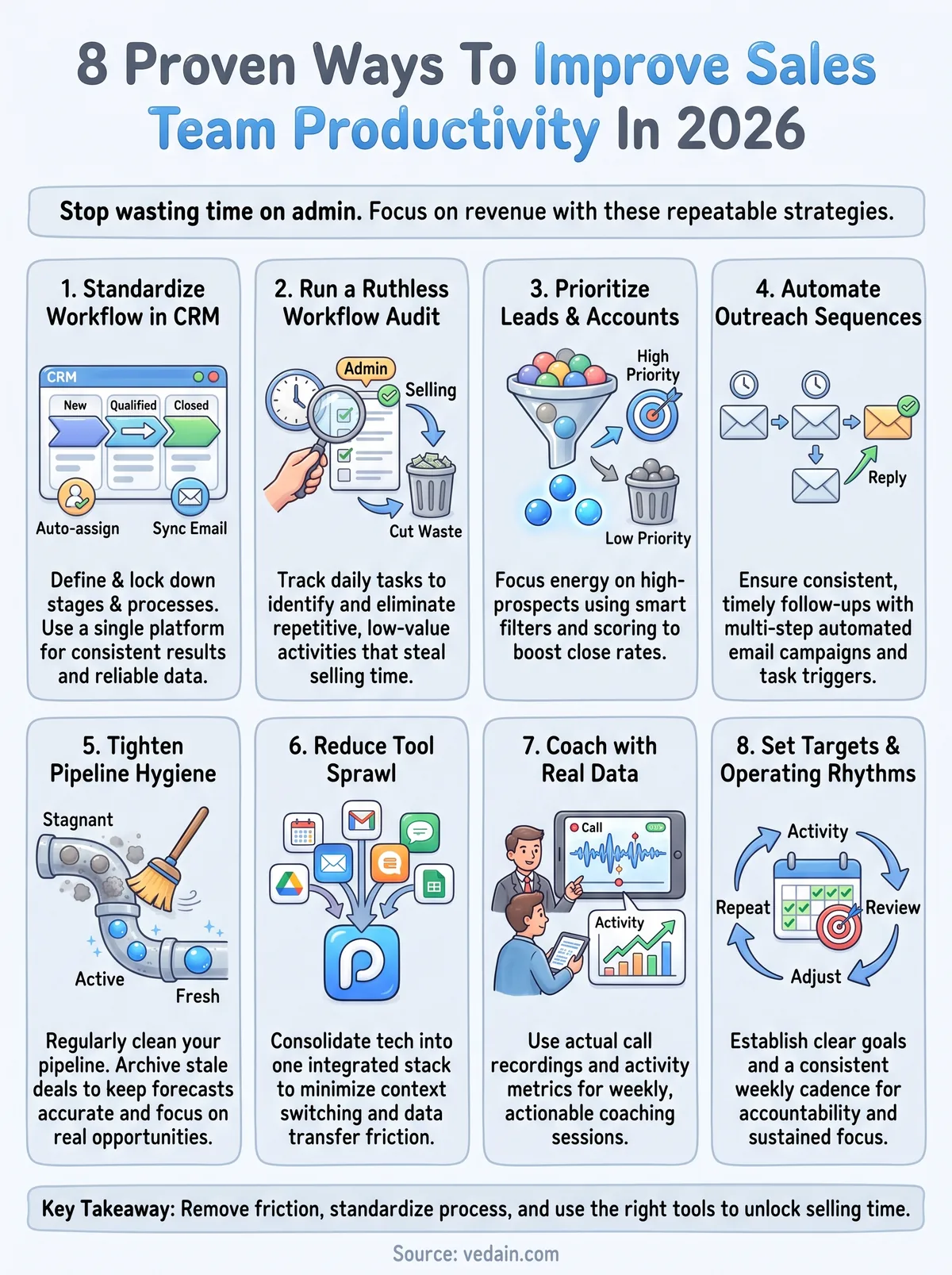
1. Standardize your workflow in Vedain CRM
When every rep runs their own version of the sales process, you get inconsistent results and no clear picture of what's actually working. Standardizing your workflow inside a single platform gives your team a shared operating system, so managers can spot bottlenecks fast and reps always know what to do next, without having to think about it.

What it solves
Without a consistent process, time gets wasted on decisions that should already be made: which stage does this deal belong in, what's the next action, who owns this lead? Standardizing inside Vedain CRM eliminates that friction. Every rep follows the same pipeline stages, uses the same custom fields, and logs activity the same way, which means your reporting data becomes reliable enough to act on.
Inconsistent process is the single biggest reason sales data becomes useless for forecasting and coaching.
Steps to implement
Start by mapping your existing sales process from first contact to closed deal. Then build that process inside Vedain: set up your deal pipeline stages to match real buying milestones, create custom fields to capture the information that matters, and use the no-code workflow builder to trigger automatic tasks when deals move between stages. Enable email sync with Gmail or Outlook so all communication logs automatically without reps having to enter it manually.
- •Define 5-7 pipeline stages that reflect actual buyer decisions, not internal status labels
- •Add required custom fields to every lead and deal record
- •Build one workflow that auto-assigns a follow-up task whenever a deal changes stage
- •Set up a lead form to route inbound leads directly into the CRM
Metrics to watch
Once your workflow is standardized, track stage-to-stage conversion rates to see exactly where deals stall. Also monitor average time in each stage to identify steps where deals sit too long. Both metrics tell you whether your process is working or just documented on paper.
Mistakes to avoid
The most common mistake is building too many pipeline stages upfront. More stages create more confusion for reps and dirtier data for managers. Start simple, then add complexity only when your numbers show you need it. Also avoid letting individual reps create their own custom fields outside the agreed structure; that breaks reporting across the whole team fast.
2. Run a ruthless workflow audit
Before you can fix how your team works, you need an honest look at what they actually do all day. A workflow audit forces that conversation. It surfaces repetitive tasks, unnecessary handoffs, and duplicate tools that quietly steal selling time from your reps every week. If you're serious about how to improve sales team productivity, this is the first place to look.
What it solves
Most reps lose 60 to 70 minutes daily to low-value activity they didn't even realize was optional. A workflow audit helps you identify exactly where that time goes, so you can cut, automate, or reassign those tasks before they compound into lost quota.
Time you reclaim from admin is time your reps can reinvest directly into pipeline activity.
Steps to implement
Ask each rep to track every task they complete over a two-week period, including time spent. Then sort those tasks into three buckets: revenue-generating, support-related, and unnecessary. Anything in the third bucket gets cut immediately. Anything in the second bucket becomes a candidate for automation using Vedain's no-code workflow builder or AI agents.
- •Log all recurring tasks for 10 business days
- •Categorize each task by revenue impact
- •Automate or eliminate tasks with no direct impact on deals
Metrics to watch
Track selling time as a percentage of total work hours before and after the audit. You want to see that number climb. Also watch activity volume per rep to confirm gains are going toward calls and emails, not just reduced admin.
Mistakes to avoid
Run the audit once and revisit it every quarter. Workflows drift, and new tools introduce new inefficiencies. A one-time audit solves today's problems but won't catch tomorrow's bloat.
3. Prioritize the right leads and accounts
Not every lead deserves equal attention, but most sales teams treat them as if they do. When reps chase low-quality leads with the same energy they give to high-fit prospects, your best opportunities get buried and close rates suffer. Knowing how to improve sales team productivity often starts with teaching your team to say no faster to the wrong leads so they can go deeper on the right ones.
What it solves
Chasing unqualified leads is one of the most expensive time drains in sales. When reps work every lead in the same order they came in, they waste hours on prospects that will never buy while high-intent accounts go cold. Lead prioritization fixes that by directing energy where it converts.
The rep who works fewer, better-fit leads consistently outperforms the one chasing volume.
Steps to implement
Use Vedain's smart filters and custom fields to tag leads by fit score, deal size, or buying intent. Then build a saved filter view that surfaces your highest-priority accounts first so reps open their CRM and know exactly where to start. You can also use Vedain's AI agents to enrich lead records automatically, pulling in data that helps your team score and sort faster.
- •Define your ideal customer profile with 3 to 5 qualification criteria
- •Create a lead scoring system using custom fields in Vedain
- •Build filtered views that sort leads by priority score
Metrics to watch
Track your lead-to-opportunity conversion rate by lead source and segment. If certain sources consistently produce low conversion, cut them or de-prioritize them in your rep's daily queue.
Mistakes to avoid
Avoid building a scoring system so complex that reps ignore it. Start with two or three criteria, get buy-in from the team, and refine the model after you have enough data to see what actually predicts a closed deal.
4. Automate follow-ups and outreach sequences
Follow-up timing is one of the biggest drivers of deal conversion, yet most reps still handle it manually. That means deals slip through the cracks simply because a rep got busy, forgot, or moved on too fast. Automating your outreach sequences removes that human variable, so every lead gets consistent, timely contact without your team having to think about it.

What it solves
Manual follow-ups create uneven outreach across your team. One rep sends three touches; another sends seven. Understanding how to improve sales team productivity often comes down to closing that gap with automation that runs the same proven sequence for every lead, every time.
Consistent follow-up sequences can increase reply rates significantly compared to ad-hoc, one-off outreach.
Steps to implement
Use Vedain's email campaigns to build multi-step outreach sequences that trigger automatically based on lead activity or deal stage. Set delays between messages, personalize with merge fields, and pair sequences with workflow automations that assign follow-up tasks when a prospect replies.
- •Build a 4 to 6 step email sequence for cold outreach
- •Set automatic task reminders if a prospect opens but doesn't reply
- •Use Vedain's email warmup feature before launching high-volume sequences
Metrics to watch
Track open rates, reply rates, and sequence completion rates across every campaign. Low completion rates usually mean your sequence is too long or the messaging quality drops by step three.
Mistakes to avoid
Avoid blasting the same generic sequence to every segment. Personalization at the sequence level, not just the name field, is what separates replies from ignored emails.
5. Tighten pipeline hygiene and deal stages
A dirty pipeline is worse than no pipeline at all. When deals sit in the wrong stage, stale opportunities inflate your forecast, and managers end up making decisions based on data that doesn't reflect reality. Knowing how to improve sales team productivity includes knowing how to keep your pipeline honest so your team focuses on deals that can actually close.
What it solves
Bloated, inaccurate pipelines give sales teams false confidence. Reps chase deals that have gone cold months ago, and managers can't forecast accurately because no one has cleaned out the noise. Regular pipeline hygiene forces your team to confront reality on a schedule, not just when a missed quarter forces the conversation.
A clean pipeline with 20 real opportunities always beats a cluttered one with 80 stale deals.
Steps to implement
Set a weekly pipeline review cadence and use Vedain's pipeline reports to filter deals by last activity date. Any deal with no activity in the past 14 days needs an immediate action or a stage change. Build a workflow that auto-flags stagnant deals so nothing slips into a forecast unnoticed.
- •Archive or disqualify any deal with no activity in 30+ days
- •Limit each pipeline stage to deals with a defined next action logged
Metrics to watch
Track average deal age by stage and your overall pipeline coverage ratio. Both numbers tell you whether your team is working live opportunities or just maintaining the appearance of a full pipeline.
Mistakes to avoid
Avoid treating pipeline reviews as purely administrative meetings. Use the data to coach on specific deals, not just to update numbers for reporting purposes.
6. Reduce tool sprawl and context switching
The average sales rep switches between 8 to 10 different tools throughout their day. Every switch burns time, breaks concentration, and adds friction that compounds across your entire team. If you're serious about how to improve sales team productivity, consolidating your tech stack into fewer, better-connected tools is one of the fastest ways to get selling time back.
What it solves
Constant context switching forces reps to rebuild focus every time they jump between platforms, which research shows can take over 20 minutes per interruption. That's not a small cost when it happens a dozen times a day. A consolidated stack means fewer logins, less manual data transfer, and a single source of truth your whole team actually uses.
Every tool you eliminate is one less place a deal can fall through the cracks.
Steps to implement
Audit your current tools against what Vedain already covers natively: pipeline management, email sync, sequences, lead forms, automation, and AI enrichment all live in one place. Then cut any tool that duplicates existing functionality.
- •List every tool your team uses weekly
- •Map each tool's function to a native Vedain feature
- •Remove redundant subscriptions within 30 days
Metrics to watch
Track time spent in non-CRM tools before and after consolidation. Also watch data accuracy scores in your CRM; fewer tools usually means fewer gaps in your contact and deal records.
Mistakes to avoid
Avoid consolidating too fast without training your team on the replacement features first. A forced migration without proper onboarding creates resistance that undoes any efficiency gains you expected.
7. Coach weekly using real calls and activity data
Generic feedback does not move numbers. When managers coach from gut feeling instead of actual call recordings and activity data, reps get vague advice that doesn't connect to their real performance gaps. If you're serious about how to improve sales team productivity, weekly data-driven coaching sessions are one of the most direct investments you can make in your team's output.
What it solves
Most reps receive feedback that is either too infrequent or too abstract to act on. Coaching sessions tied to real activity data close that gap by giving reps something concrete to work with. When they see exactly where their conversion dropped or which outreach step triggered the most replies, the feedback becomes immediately actionable rather than something they nod at and forget.
Coaching tied to specific data points produces behavior change far faster than generalized performance reviews.
Steps to implement
Pull Vedain's pipeline reports, conversion funnels, and team leaderboards before each weekly session. Focus each meeting on one to three specific behaviors, not overall performance numbers. Use activity data alongside deal records to connect what reps did to what outcomes followed.
- •Review stage-to-stage conversion rates by rep each week
- •Target one skill area per session, not five
- •Compare top performers' activity patterns against the rest of the team
Metrics to watch
Track rep-level close rates and weekly activity volume over rolling four-week periods. Consistent improvement in close rate after targeted coaching confirms your feedback is translating into better selling behavior and not just noted and ignored.
Mistakes to avoid
Avoid turning coaching sessions into performance reviews. The goal is to develop specific skills, not evaluate overall job performance. Reps disengage quickly when weekly coaching starts to feel like a formal assessment rather than a genuine development conversation.
8. Set targets and operating rhythms that stick
Strategy without structure falls apart fast. When your team lacks clear targets and a predictable operating cadence, even strong performers drift. Knowing how to improve sales team productivity long-term means building a rhythm your team can repeat week after week without needing you to reset it manually every time.
What it solves
Most sales teams set annual quotas and then check in only when numbers look off. That gap between goal-setting and accountability is where consistency breaks down. A reliable operating rhythm closes that gap by creating regular, structured touchpoints that keep reps focused and managers ahead of problems before they compound.
Targets without rhythm are just wishful thinking dressed up as a plan.
Steps to implement
Use Vedain's sales targets feature to set monthly and quarterly goals at the individual and team level. Then build a simple weekly cadence that every rep follows without variation.
- •Set weekly activity minimums per rep: calls, emails, demos
- •Run a 15-minute Monday pipeline standup to confirm weekly priorities
- •Close each week with a Friday wrap-up reviewing what moved and what stalled
- •Review quarterly targets in Vedain's dashboards during monthly one-on-ones
Metrics to watch
Track target attainment rate by rep each month and compare it against weekly activity volume. Reps who hit their activity numbers but miss quota usually have a skill gap; reps who miss both have a motivation or clarity problem.
Mistakes to avoid
Avoid setting targets so aggressive that your team stops believing they're achievable. Unrealistic goals produce the opposite of accountability; reps disengage and stop tracking their own progress entirely.
Quick wrap-up
If you've been searching for how to improve sales team productivity, the answer is already in this list. None of these tactics require a massive budget or months of planning. They require consistent execution across your pipeline, your outreach, your coaching, and your team's daily rhythm. Fix the workflow first, then layer in automation, prioritization, and accountability. Each change compounds on the one before it.
The teams that make real gains in 2026 won't do it by hiring more reps or working longer hours. They'll do it by removing friction, standardizing process, and using the right tools to give their reps back the selling time that admin has been quietly stealing. That's exactly what Vedain is built to do. If you want a platform that handles pipeline, automation, email sequences, and AI enrichment without charging you separately for each one, try Vedain CRM free today and see how fast your team can move when the system works with them.
Frequently Asked Questions
What is the best CRM software for improving sales team productivity?
The best CRM for sales productivity depends on your team's needs, but HubSpot, Salesforce, and Pipedrive are top choices in 2026. HubSpot offers an intuitive interface starting at $50/month with strong automation features, while Salesforce ($165/month) provides enterprise-level customization, and Pipedrive ($14/month) excels at pipeline management. For budget-conscious teams, Zoho CRM ($18/month) and Freshsales ($15/month) deliver solid productivity tools without premium pricing.
How much time can sales automation save your team daily?
Sales automation can save teams 2-3 hours per sales rep daily by eliminating manual data entry and follow-up tasks. Modern CRMs like HubSpot, Salesforce, and Pipedrive include workflow automation that reduces administrative work by 40-50%, allowing reps to focus on selling. Organizations implementing comprehensive automation across lead scoring, email sequences, and task management typically see productivity gains within the first 30 days.
What features should a CRM have to boost sales productivity?
A productivity-focused CRM should include lead scoring, sales pipeline automation, mobile access, real-time reporting, and AI-powered insights. Top performers like HubSpot and Salesforce offer predictive analytics and intelligent workflow automation, while Pipedrive specializes in visual pipeline management that keeps deals organized. Freshsales and Zoho CRM provide similar core features at lower price points, making them ideal for small to mid-sized teams.
How do sales teams measure productivity improvements after implementing a CRM?
Sales teams measure CRM productivity gains through key metrics like sales cycle length, deal close rates, average deal size, and rep activity levels. Most modern CRMs like HubSpot, Salesforce, and Pipedrive include built-in dashboards and reporting that track these metrics in real-time, allowing managers to identify bottlenecks quickly. Average improvements typically show a 25-35% reduction in sales cycle time and 15-20% improvement in win rates within 90 days of proper implementation.
Can AI features in CRMs really increase sales productivity?
Yes, AI features in modern CRMs significantly boost productivity by automating lead prioritization, predicting deal outcomes, and recommending next-best actions. Salesforce Einstein, HubSpot's AI Assistant, and Pipedrive's MARA (Machine Learning Activity Recommendations) help reps focus on high-value prospects and opportunities. Studies show teams using AI-powered CRMs like these see 20-30% productivity increases, though success depends on data quality and proper training.
Is Salesforce or HubSpot better for sales team productivity in 2026?
HubSpot excels for mid-market and SMB teams seeking ease of use and faster implementation ($50-120/month), while Salesforce dominates enterprise environments with advanced customization ($165+/month). HubSpot's all-in-one platform reduces tool switching and has a faster learning curve, whereas Salesforce's deeper capabilities suit complex sales operations. For teams wanting simplicity, Pipedrive ($14-49/month) and Freshsales ($15-79/month) offer excellent productivity features at lower costs than both market leaders.