
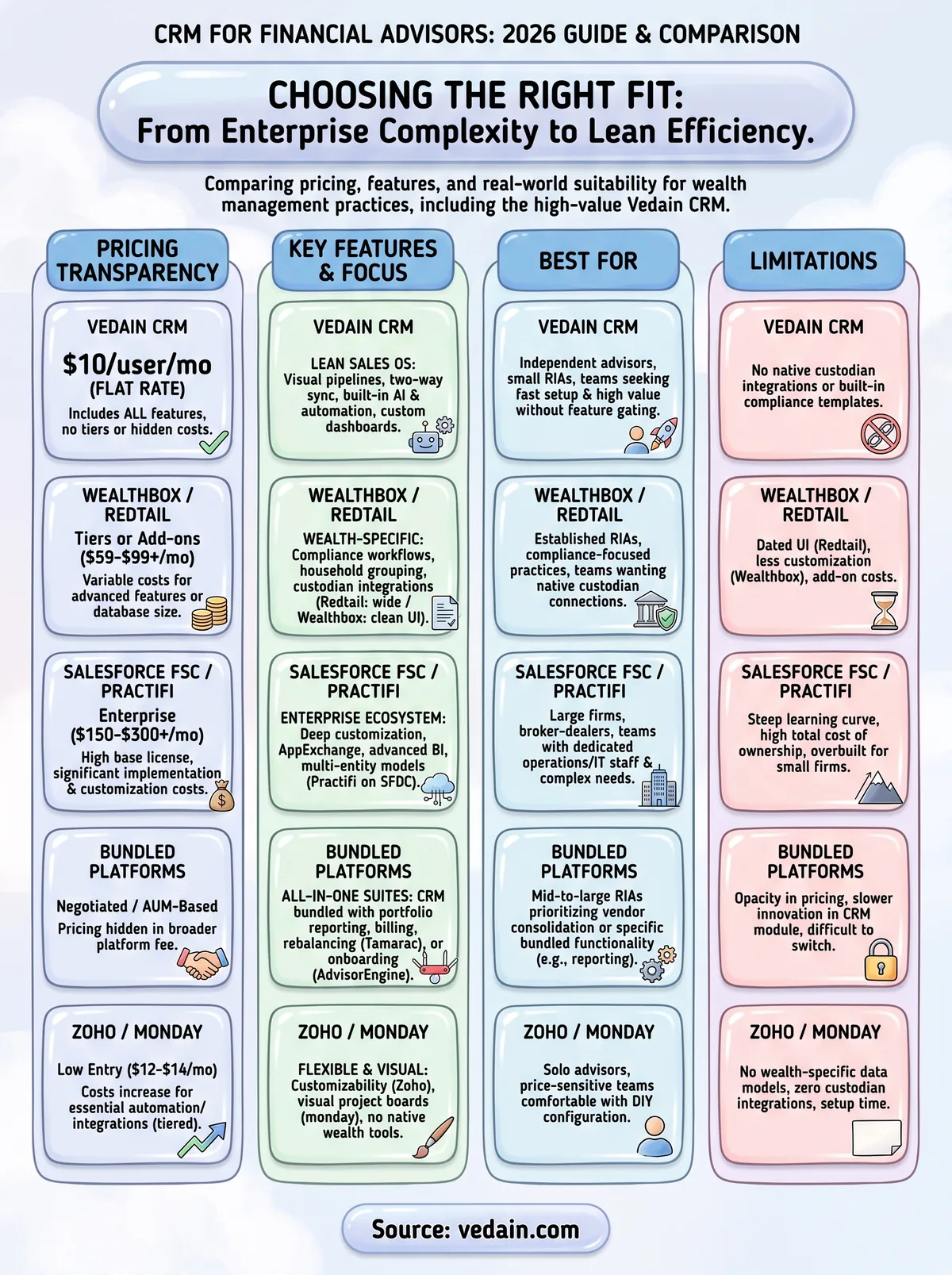
This list answers the real question advisors ask: which platform actually fits a wealth management practice in 2026, and which one is just a rebranded sales CRM with a finance logo slapped on it. We compare the usual names, Wealthbox, Redtail, Salesforce Financial Services Cloud, alongside newer, leaner options, looking at pricing transparency, compliance features, and how fast your team can actually get running.
We've included Vedain in this roundup too, since its flat $10 per user pricing and built-in automation make it worth a look for advisors tired of feature-gated tiers. Below, you'll find eleven CRMs broken down by cost, features, and the type of practice each one suits best, so you can stop comparing spreadsheets and start comparing actual fit for your firm.
1. Vedain CRM
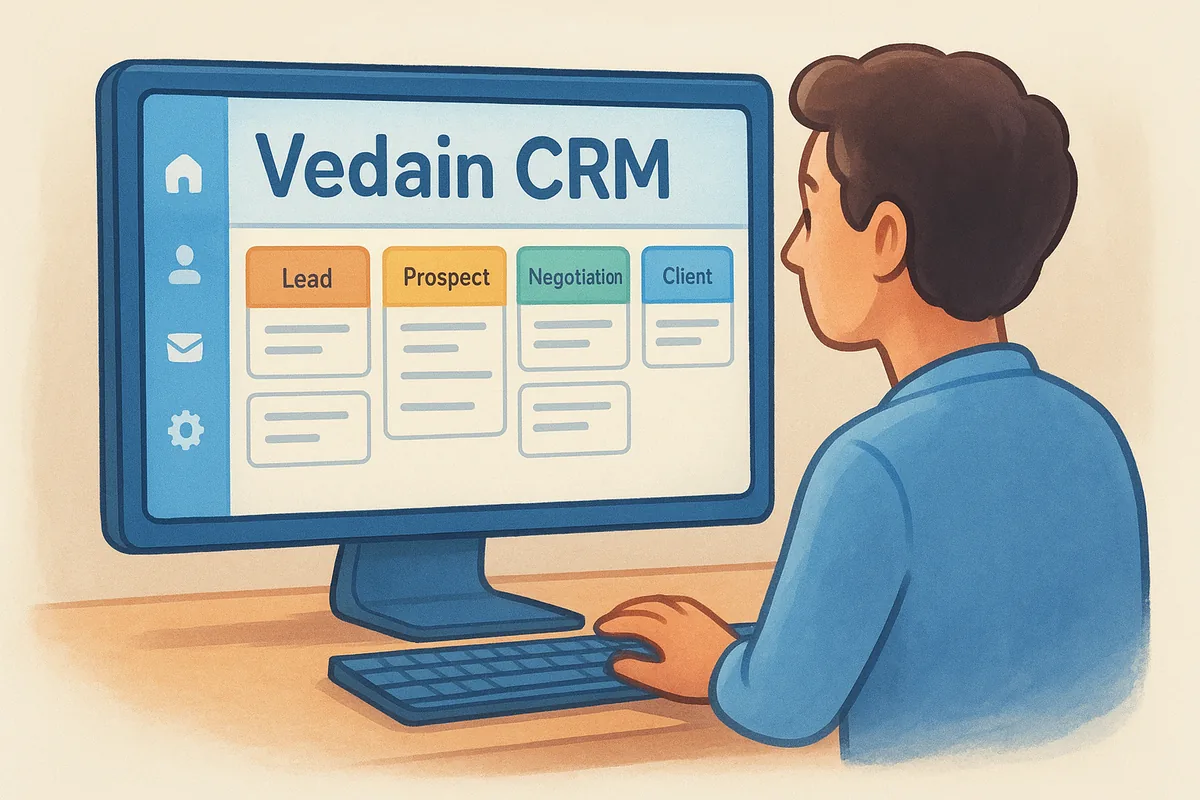
Vedain isn't built specifically for financial advisors, and we won't pretend otherwise. What it offers instead is a complete sales operating system at a price that makes the specialized wealth management tools look overpriced for what they deliver. If your practice runs lean, manages its own compliance workflow outside the CRM, and just needs a fast, flexible system to track leads, clients, and referrals, Vedain deserves a serious look before you sign a multi-year contract with a legacy player.
A CRM that hides half its features behind a paywall isn't saving you money, it's just deferring the bill.
Key features
Vedain packs the essentials a growing advisory practice actually uses day to day, without splitting them across pricing tiers. The deal pipeline uses a visual Kanban board so you can track prospects moving from initial consultation to signed client, and the two-way email sync with Gmail and Outlook means every client conversation stays logged automatically, no manual forwarding required.
- •Leads and contacts with custom fields for household details, account types, or referral source
- •No-code workflow automation for follow-up sequences and task assignments
- •Email warmup tool to protect deliverability for prospect outreach email tools
- •Custom dashboards with drag-and-drop widgets for pipeline and revenue tracking
- •AI agents for data enrichment, so you spend less time updating records manually
- •Granular team permissions, useful if you have junior advisors who shouldn't see every client file
Pricing
Vedain charges a flat $10 per user per month, and that price includes every feature listed above. There's no "professional" or "enterprise" tier hiding automation or reporting behind a higher bill, and no credit card is required to start a trial. Compare that to the per-seat costs of Salesforce Financial Services Cloud or Practifi, where the base license is often just the entry point before you add modules, and the value gap becomes obvious fast.
Best for
Vedain suits independent advisors and small RIAs who want a CRM that does more than track contacts, without paying enterprise prices for it. It's also a strong fit for teams migrating off HubSpot or Pipedrive who got tired of feature-gating, and for practices that want automation and AI tools included rather than sold as add-ons. If your compliance needs are handled by a separate archiving or recordkeeping system, Vedain's flexibility becomes an advantage rather than a gap. You can see the full breakdown of what's included on the Vedain CRM plan details page.
Limitations
Vedain doesn't offer native custodian integrations with Schwab, Fidelity, or Pershing, which matters if your workflow depends on pulling account data directly into client records, though there are tailored setups like the CRM for insurance brokers and agents. It also lacks the purpose-built compliance documentation templates that Redtail or Wealthbox include out of the box. Larger RIAs with strict audit requirements may still need a specialized tool alongside it.
2. Wealthbox
Wealthbox built its reputation as the CRM advisors actually enjoy using, a rare compliment in this category. It leans on a clean, social-feed style interface that feels more like a modern app than the clunky database tools most wirehouses force on their teams. Advisors switching from spreadsheets or generic CRMs often cite Wealthbox's design and usability as the deciding factor over feature checklists alone.
Key features
Usability aside, Wealthbox covers the fundamentals financial advisors need without overcomplicating the interface.
- •Household and relationship mapping to track family accounts together
- •Task and workflow templates built specifically for onboarding and reviews
- •Integrations with custodians including Schwab, Fidelity, and Albridge
- •Two-way email and calendar sync with Gmail and Outlook
- •Opportunity and pipeline tracking with customizable stages
- •A mobile app that mirrors the desktop experience closely
Pricing
Plans start around $59 per user per month billed annually for the Starter tier, with Pro and Premier tiers climbing toward $79 and $99 respectively as you add advanced reporting and integrations. Compared to Vedain's flat $10 rate, Wealthbox's pricing reflects its specialization, but you're paying a real premium for that finance-specific polish.
Wealthbox wins on interface, not on price, and advisors should budget accordingly.
Best for
Teams that prioritize daily usability over deep customization tend to stick with Wealthbox longest. It suits solo advisors and small RIAs who want custodian integrations without a steep learning curve, and firms that value a CRM their advisors won't resist adopting.
Limitations
Customization options lag behind heavier platforms like Salesforce Financial Services Cloud or Practifi, so firms with complex multi-entity structures may outgrow it. Reporting depth also falls short for larger RIAs needing granular compliance audits, and the per-tier pricing means advanced features cost extra as your team scales.
3. Redtail CRM
Redtail has been the workhorse behind independent RIAs for over a decade, and its longevity shows in how deeply it's wired into the wealth management ecosystem. Advisors who've used it for years describe it less as software and more as infrastructure, the system every other tool in their stack is built to talk to. It's not flashy, but it's the closest thing to a default choice for a financial advisor CRM software search among established RIAs.
Key features
Redtail's strength comes from breadth of integration rather than interface polish.
- •Deep integrations with over 100 third-party tools, including custodians, financial planning software, and portfolio management systems
- •Workflow templates built around compliance-heavy processes like onboarding and annual reviews
- •Shared calendaring and activity logging across the whole team
- •Document imaging and storage tied directly to client records
- •Robust reporting built for RIA compliance audits
Pricing
Redtail charges $99 per month for the database, which covers up to three users, then adds roughly $32 per month for each additional user. That structure makes it cheaper than Wealthbox for small teams but less predictable as headcount grows, since you're managing a database fee plus a per-seat add-on rather than one flat number.
Redtail rewards firms that already run their whole tech stack around it, and punishes those that don't.
Best for
Established RIAs with an existing integration ecosystem get the most value here. It suits compliance-focused practices that need documented workflows and audit trails, and teams that have already standardized on the custodians and planning tools Redtail connects to.
Limitations
Interface design feels dated next to Wealthbox or Vedain, and new hires often need real training time before they're productive. The database pricing model also gets confusing once you factor in add-ons like imaging, and switching away from Redtail later means untangling years of integrated workflows.
4. Salesforce Financial Services Cloud
Salesforce Financial Services Cloud takes the world's most widely used CRM platform and layers on wealth management specific objects like households, financial goals, and life events. Firms already running Salesforce for other departments often adopt FSC because it slots into an existing enterprise stack, not because it's the leanest option for a solo advisor. This is the platform enterprise RIAs and broker-dealers reach for when they need a system that can scale to thousands of users and integrate with nearly anything.
Key features
FSC's depth comes from Salesforce's broader ecosystem and the AppExchange marketplace.
- •Household and relationship modeling with financial goal tracking
- •Einstein AI for next-best-action recommendations and lead scoring
- •Extensive AppExchange integrations for custodians, planning tools, and portfolio systems
- •Advanced automation through Flow Builder for compliance workflows
- •Role-based permissions built for multi-office, multi-entity firms
- •Robust reporting and dashboards with drill-down capability
Pricing
Pricing starts around $150 per user per month for the base FSC license, with enterprise and unlimited tiers pushing past $300 once you add advanced automation or AI features. Implementation and customization costs on top of that license fee frequently run into the tens of thousands, since most firms hire a Salesforce consultant to configure it properly.
Salesforce Financial Services Cloud delivers enterprise power, but you pay enterprise implementation costs to unlock it.
Best for
Large RIAs, broker-dealers, and firms already invested in Salesforce elsewhere get the clearest return here. It suits organizations with dedicated IT or operations staff who can manage ongoing configuration, and practices that need deep customization more than fast setup.
Limitations
Small practices routinely find FSC overbuilt and overpriced for their needs, and the learning curve is steep without dedicated admin support, which is why many advisors weigh a flat-rate CRM against Salesforce instead. Total cost of ownership, including consultants and add-on licenses, puts it out of reach for most independent advisors.
5. Advyzon
Advyzon markets itself as an all-in-one platform rather than a standalone CRM, bundling portfolio management, reporting, and client portal tools alongside its relationship management module. Advisors who want to consolidate vendors instead of juggling separate logins for CRM, billing, and performance reporting often land here first. It's a genuine contender for firms researching crm for financial advisors who also want to shed a portfolio accounting subscription in the same move.
Key features
Because Advyzon builds its CRM inside a broader wealth management suite, the feature set leans toward integration rather than standalone depth.
- •Combined CRM, portfolio reporting, and billing in one login
- •Client portal with document sharing and performance dashboards
- •Task automation tied to portfolio events like rebalancing or fee billing
- •Custodial data feeds from Schwab, Fidelity, and TD Ameritrade
- •Mobile app for advisors and clients alike
Pricing
Advyzon doesn't publish flat CRM-only pricing since it bundles the module into its broader platform fee, which typically runs based on assets under management or a per-account structure negotiated directly with their sales team. Firms report all-in costs landing somewhere between Wealthbox and Salesforce FSC once portfolio reporting and billing are included, though you'll need a quote to know your exact number.
Bundling CRM with portfolio reporting saves a vendor relationship, but it also means you can't shop the CRM piece separately if it underperforms.
Best for
Established RIAs already using or considering Advyzon for portfolio reporting get the most value, since the CRM comes essentially free as part of that decision. It suits firms that want fewer vendors to manage rather than the single best tool in each category.
Limitations
Standalone CRM depth lags behind Wealthbox or Redtail, since Advyzon didn't build the module as its primary product. Firms happy with their existing portfolio reporting tool gain little by switching just for the CRM, and pricing opacity makes upfront comparison harder than competitors with published rate cards.
6. AdvisorEngine CRM
AdvisorEngine started as a digital onboarding and account-opening tool before expanding into a full CRM, and that history still shapes the product today. Rather than treating the CRM as a bolt-on, AdvisorEngine built it around the client lifecycle, from prospecting through onboarding to ongoing servicing, which appeals to firms that want one system managing the whole relationship rather than stitching together separate tools for signup and follow-up. It's a common shortlist name for RIAs vetting a crm for financial advisors that also handles digital paperwork.
Key features
AdvisorEngine leans hardest on the onboarding and workflow side of the advisor relationship, an area covered by most tools for onboarding new clients.
- •Digital account opening integrated directly with CRM records
- •Household relationship mapping with linked account views
- •Workflow automation for onboarding, reviews, and servicing requests
- •Integrations with major custodians and portfolio management platforms
- •Configurable dashboards for pipeline and book-of-business tracking
- •Open API access for firms building custom integrations
Pricing
AdvisorEngine doesn't publish a public rate card, and pricing gets negotiated based on firm size and modules selected, similar to Advyzon's approach. Advisors report quotes generally landing in the same range as Wealthbox's higher tiers or above, though the exact figure depends heavily on whether you add the digital onboarding suite or just the core CRM.
A CRM built around onboarding pays off most for firms that onboard often, not for those managing a stable, low-turnover book.
Best for
Growing RIAs that bring on new clients regularly benefit most from AdvisorEngine's onboarding focus. It suits firms that want digital account opening tied directly to their CRM data, and practices willing to work through a sales conversation rather than a self-serve signup to get pricing.
Limitations
The lack of published pricing slows down comparison shopping, and smaller solo practices may find the onboarding-heavy feature set overbuilt for a book with few new accounts each year. Implementation also tends to take longer than lighter platforms like Wealthbox or Vedain.
7. Practifi
Practifi built its platform on top of Salesforce, giving it enterprise-grade architecture without forcing firms through the full Financial Services Cloud implementation. Larger advisory practices and hybrid RIAs pick Practifi when they need business intelligence tools built specifically for wealth management, not just a relabeled sales CRM. It sits in an odd middle spot: more configurable than Wealthbox, but less overwhelming to set up than raw Salesforce FSC.
Key features
Practifi's design centers on giving operations teams visibility across the whole book of business, not just individual advisor pipelines.
- •Household and entity relationship mapping built for multi-generational wealth
- •Business intelligence dashboards tracking revenue, AUM, and referral sources
- •Workflow automation for onboarding, reviews, and compliance tasks
- •Salesforce-native architecture, so AppExchange integrations work out of the box
- •Configurable permission structures for multi-office firms
- •Built-in reporting for practice management and succession planning
Pricing
Practifi doesn't list public pricing, and quotes get built around firm size and Salesforce licensing needs, since the platform runs as a managed package on top of Salesforce infrastructure. Advisors researching it report all-in costs landing closer to Salesforce FSC than to Wealthbox, once you factor in the underlying Salesforce license plus Practifi's own subscription fee.
Practifi gives you Salesforce's power with less setup pain, but you still pay Salesforce-adjacent prices to get there.
Best for
Mid-size to large RIAs with dedicated operations staff get the most out of Practifi, especially firms tracking practice-level metrics like referral conversion or revenue per household. It also suits firms already committed to Salesforce's ecosystem but unwilling to build FSC from scratch.
Limitations
Solo advisors and small teams will find Practifi's business intelligence focus wasted on a book too small to need it. The Salesforce dependency also means you inherit Salesforce's learning curve, and switching platforms later means migrating off Salesforce entirely, not just swapping a CRM login.
8. Tamarac CRM
Tamarac, now part of Envestnet, built its name on portfolio rebalancing and performance reporting before folding CRM into the same suite. Firms already running Tamarac for trading and rebalancing often adopt the CRM module simply to keep client data in one ecosystem rather than syncing two separate systems. It's less a standalone CRM pick and more a natural extension for shops already inside the Envestnet universe.
Key features
Tamarac's CRM leans on the same data backbone as its portfolio tools, which shapes what it does well.
- •Client relationship data synced directly with portfolio and performance reporting
- •Household grouping tied to account-level rebalancing activity
- •Workflow automation for reviews, rebalances, and billing events
- •Custom reporting that blends CRM notes with performance data
- •Integrations across the broader Envestnet ecosystem, including financial planning tools
Pricing
Tamarac doesn't publish standalone CRM pricing, since it's sold as part of the larger Envestnet | Tamarac platform, typically priced on assets under management or a negotiated enterprise contract. Firms report all-in costs running comparable to or above Salesforce FSC once trading, rebalancing, and reporting modules get bundled in, so budget for a sales conversation rather than a self-serve checkout, and know what a CRM really costs once add-ons land.
Tamarac's CRM only makes sense as part of a bigger platform decision, not as a line item on its own.
Best for
Mid-size to large RIAs already using or evaluating Tamarac for rebalancing and trading get the clearest value, since the CRM comes bundled into that broader decision. It suits operations-heavy firms that want portfolio data and client notes living in the same system.
Limitations
Standalone CRM depth trails purpose-built tools like Wealthbox or Redtail, and firms uninterested in Tamarac's trading platform gain little by adopting just the CRM piece. Pricing opacity and enterprise sales cycles also make it a poor fit for solo advisors or small teams wanting a quick decision.
9. Zoho CRM
Zoho CRM isn't built for wealth management specifically, but its sheer configurability has made it a popular budget pick for advisors who don't need custodian integrations baked in. Firms that already run other Zoho products, like Zoho Books or Zoho Campaigns, often add the CRM simply to keep everything under one vendor umbrella. It's a reasonable answer to crm for financial advisors searches from advisors who want customization without paying enterprise prices, provided they're comfortable configuring it themselves.

Key features
Zoho's strength lies in its breadth of modules and its willingness to let you build around them.
- •Custom modules and fields for household data, account types, or referral tracking
- •Zia AI assistant for lead scoring and basic forecasting
- •Workflow automation (Blueprint) for onboarding and review sequences
- •Multichannel communication tracking across email, phone, and social
- •Integration marketplace covering hundreds of third-party apps
Pricing
Plans range from $14 per user per month on the Standard tier up to $52 on the Ultimate tier, billed annually. Unlike Vedain's flat rate, Zoho gates automation depth, AI features, and advanced analytics behind higher tiers, so the sticker price on the entry plan doesn't reflect what a fully functional setup actually costs, as this Zoho tier-by-tier breakdown shows.
Zoho's low entry price hides the real cost, which shows up once you need the features on the higher tiers.
Best for
Price-sensitive advisors comfortable with DIY configuration get the most value from Zoho, especially those already using other Zoho apps. It suits small practices willing to trade custodian-native integrations for flexibility and a lower starting bill.
Limitations
Zoho lacks native custodian connections, wealth-specific templates, and compliance documentation that Redtail or Wealthbox include by default. Configuration takes real time investment, and firms without an admin willing to learn the platform often end up using a fraction of what they're paying for.
10. Black Diamond CRM
Black Diamond, part of SS&C Advent, built its name on performance reporting and portfolio analytics before adding CRM functionality to the same platform. Firms already running Black Diamond Wealth Platform for reporting often turn on the CRM module simply to avoid managing client data in a separate system. It's a natural extension pick rather than a standalone CRM you'd shop for on its own merits.
Key features
Black Diamond's CRM tools lean on the reporting engine underneath them, which shapes what the module actually does well.
- •Client relationship data linked directly to performance and billing reports
- •Household grouping tied to account-level reporting structures
- •Workflow automation for reviews, onboarding, and billing events
- •Custom dashboards blending CRM activity with portfolio performance
- •Integrations across custodians already feeding the reporting platform
Pricing
Black Diamond doesn't publish standalone CRM pricing since it ships as part of the broader Black Diamond Wealth Platform, typically priced on assets under management or a negotiated enterprise contract. Firms report all-in costs landing in a similar range to Tamarac once reporting, billing, and CRM modules get bundled together, so expect a sales call rather than a self-serve signup.
Black Diamond's CRM earns its keep only when the reporting platform underneath it already justifies the bill.
Best for
Mid-size to large RIAs already using or evaluating Black Diamond for performance reporting get the clearest value here, since the CRM comes as part of that broader platform decision. It suits operations teams that want client notes and reporting data living in one place rather than synced across systems.
Limitations
Standalone CRM depth trails purpose-built platforms like Wealthbox or Redtail, and firms uninterested in Black Diamond's reporting suite gain little by adopting just the CRM piece. Enterprise sales cycles and bundled pricing also make it a slow, opaque choice for solo advisors or small teams wanting a fast decision.
11. monday CRM
monday CRM started life as a visual project management tool before its parent company built a dedicated sales module on top of the same board-based interface. Advisors who like color-coded status columns and drag-and-drop simplicity tend to gravitate here, especially small teams that want something more flexible than a spreadsheet but aren't ready to pay for wealth-specific software. It's a reasonable entry point for a crm for financial advisors search from a solo practice still figuring out what it actually needs.
Key features
monday CRM's appeal comes from its visual flexibility rather than any finance-specific tooling.
- •Customizable boards for pipeline, client onboarding, or referral tracking
- •Automation recipes for task assignment and follow-up reminders
- •Integrations with Gmail, Outlook, and hundreds of apps through its marketplace
- •Dashboards combining multiple boards into one view
- •Mobile app with real-time sync across devices
- •Forms for capturing lead or client information
Pricing
Plans start around $12 per user per month on the Basic tier, climbing to $24 on Standard and higher still on Pro, billed annually with a three-seat minimum. Automation and integration limits scale with each tier, so a growing practice often finds itself upgrading sooner than expected just to keep workflows running.
A flexible board isn't the same thing as a finance-ready CRM, no matter how good it looks on day one.
Best for
Solo advisors and very small teams testing whether they need a dedicated CRM at all get reasonable value here. It suits practices comfortable building their own structure from scratch rather than adopting pre-built wealth management workflows.
Limitations
monday CRM has zero custodian integrations, no compliance templates, and no household-specific data modeling, so you're building everything from generic building blocks. Firms that outgrow the basics usually migrate to a purpose-built option like Wealthbox, Redtail, or a board tool versus a dedicated sales CRM within a year or two.
Finding the right fit for your practice
Most of the platforms on this list charge a premium for the word "wealth management" in their marketing copy, whether or not the features underneath justify it, much like other CRM setups tuned to a specific vertical. If your firm leans on deep custodian data feeds and compliance-specific templates, Redtail or Wealthbox still make sense despite the cost. But if your practice handles compliance separately and just needs a fast, flexible crm for financial advisors that won't nickel-and-dime you as you grow, the calculation changes.
Vedain earns its spot on this list because it refuses to gate automation, reporting, or AI tools behind a higher tier. You get the full platform at $10 per user, no negotiation, no sales call required. Before you sign another annual contract with a legacy player, spend five minutes comparing what you'd actually get. Try Vedain free for 14 days and see whether a leaner CRM handles your practice better than the specialized ones ever did.
Frequently Asked Questions
What is the best CRM for financial advisors with client relationship management?
The best CRM for financial advisors depends on your specific needs, but Vedain, HubSpot, and Salesforce are top contenders. Vedain specializes in wealth management with integrated financial planning tools starting at $99/month, while HubSpot offers broader CRM functionality at $50-3,200/month and Salesforce provides enterprise solutions at $165-330/month. For advisors prioritizing personalized client interactions and financial data integration, Vedain typically edges out competitors due to its industry-specific features.
How much does financial advisor CRM software typically cost?
Financial advisor CRM costs vary widely based on features and scale, ranging from $50-$500+ per month. Pipedrive offers affordable options starting around $14-99/month, Zoho CRM starts at $18-45/month, HubSpot Professional begins at $50/month, while Salesforce and enterprise solutions like Vedain can exceed $200/month. Most providers offer tiered pricing, allowing you to scale costs as your advisory practice grows.
Which CRM integrates best with financial planning software?
Vedain and Salesforce offer the strongest integrations with financial planning and portfolio management tools commonly used by advisors. HubSpot and Zoho also provide solid integration capabilities through third-party apps and APIs, though they require more manual setup. Pipedrive offers integration options but may require custom development for advanced financial software connections, making Vedain and Salesforce better choices for seamless financial ecosystem integration.
Can you use HubSpot CRM for financial advisory businesses?
Yes, HubSpot CRM can be used for financial advisory businesses, though it's not purpose-built for the industry. HubSpot's flexible structure allows advisors to track client interactions, manage pipelines, and automate marketing at $50-3,200/month depending on features needed. However, industry-specific solutions like Vedain offer better compliance tracking and financial data management, while Salesforce provides more customization than HubSpot for complex advisory workflows.
What CRM features do financial advisors need most?
Financial advisors prioritize client relationship management, compliance documentation, appointment scheduling, and portfolio tracking in their CRM choice. Vedain excels with built-in financial planning and regulatory compliance features, while HubSpot and Salesforce offer strong automation and customization for these workflows. Zoho and Pipedrive provide cost-effective alternatives but may require additional tools for compliance-heavy requirements specific to financial advisory firms.
Is Zoho CRM good for wealth management and financial advisory?
Zoho CRM is a good budget-friendly option for financial advisors at $18-45/month, offering solid contact management and pipeline tracking capabilities. However, Zoho lacks the specialized financial planning integrations and compliance features that Vedain or Salesforce provide out-of-the-box. For wealth management practices with complex client portfolios, Vedain or Salesforce are stronger choices, though Zoho works well for independent advisors managing smaller client bases with minimal regulatory complexity.