This article answers the question directly: which CRMs handle distributor workflows well, and which ones just add complexity without solving your real problems. We looked at pipeline visibility, automation depth, and email deliverability since cold outreach and reorder reminders are constant in this industry.
Below you'll find 8 platforms worth considering in 2026, including where each one excels and where it falls short. We'll also cover pricing transparency, since distributors often run lean teams and can't afford hidden fees or feature gates that force costly upgrades as you scale from 5 users to 50.
1. Vedain CRM
Vedain CRM built its reputation on transparent, all-inclusive pricing, which matters a lot to distributors who run lean sales teams and hate surprise upgrade fees. You get a visual deal pipeline, two-way email sync, and no-code automation in one flat plan, so a five-person team and a fifty-person team pay the same rate per seat. That structure alone solves a common headache for wholesale distribution CRM shoppers who get quoted one price in a demo and a much higher one once they need automation or unlimited contacts.
Key features
Distributors deal with repeat buyers, seasonal reorders, and long quote-to-close cycles, and Vedain's toolset was built for exactly that kind of recurring sales motion.
- •Deal Pipeline with a Kanban deal board to track quotes, purchase orders, and reorders through every stage
- •Workflows, a no-code automation builder for reorder reminders, follow-up sequences, and internal task assignments
- •Email Integration with email sync across Gmail and Outlook, so quote threads stay attached to the account
- •Email Warmup that improves domain deliverability over 21 days, useful for teams doing high-volume cold outreach to new territories
- •Lead Forms to capture inbound requests from a distributor's website or trade show landing pages
- •Reports & Analytics covering pipeline health, conversion funnels, and rep leaderboards
- •AI Agent Marketplace with 30+ prebuilt AI agents for data enrichment, useful when cleaning up messy account lists inherited from spreadsheets
The single biggest advantage of Vedain for distributors is that automation and email sync are included at every seat, not locked behind a pricier tier.
Pricing
Vedain charges $10 per user per month across the board, with every feature included, no tiers, and no credit card required to start a trial. That's a meaningful difference from competitors that charge extra for automation, email sync, or higher contact limits once you outgrow their entry plan. You can check current details on the Vedain CRM pricing page.
Best for
Vedain fits distributors best when the sales team is growing fast and needs predictable software costs. Owners who've been burned by a competitor's "starter" plan that quietly excludes automation will appreciate that Vedain includes it from day one. Reps who split their day between quoting, following up, and updating account notes benefit from the under-5-minute setup and the fact that nothing here requires an IT ticket to configure.
2. Proton.ai
Proton.ai built its platform specifically for B2B distributors, which shows in how it handles product recommendations and account-level buying patterns. Instead of a generic contact database, you get a sales intelligence layer that surfaces which accounts are due for a reorder and which products they're likely to buy next based on historical purchase data. Sales teams juggling thousands of SKUs across dozens of accounts often need exactly this kind of guidance, since manual account review doesn't scale once your catalog grows past a few hundred items.
Key features
Distributors choose Proton.ai mainly for its predictive analytics engine, which flags churn risk and upsell opportunities before a rep would notice them manually.
- •AI-driven product recommendations based on historical order data
- •Account health scoring to flag at-risk or declining accounts
- •Integration with ERP systems common in distribution, like NetSuite and SAP
- •Rep-facing dashboards showing next-best-action for each account
Proton.ai earns its keep by predicting reorders before your reps think to ask.
Pricing
Proton.ai doesn't publish pricing on its site, which means every quote comes through a sales call and typically scales with account volume and ERP integration complexity. Expect enterprise-level costs here, since the platform positions itself for mid-market and larger distributors rather than small teams testing the waters. That opacity can be a dealbreaker if you're comparing costs against a flat-rate crm for wholesale distributors like Vedain, where the price is public and predictable from day one.
Best for
Proton.ai suits distributors with an existing ERP investment and a large enough catalog that manual account review has become impractical. It's less useful for smaller teams without dedicated data or IT resources to manage the integration, since getting real value out of it requires clean, connected order history.
3. WizCommerce
WizCommerce positions itself as an order management and CRM hybrid built for wholesalers, distributors, and manufacturers who take orders across trade shows, sales reps, and B2B ecommerce portals. Instead of treating quoting and CRM as separate tools, it combines catalog management with deal tracking, so reps can pull up live inventory and pricing while they're still on a call with a buyer. That combination appeals to teams tired of switching between an ERP screen and a CRM tab just to confirm what's actually in stock.
Key features
Buyers researching a wholesale CRM software option often land on WizCommerce because of its AI-assisted ordering tools and its focus on speeding up the quote-to-order cycle.
- •AI-powered product recommendations during order entry
- •Digital catalog with real-time inventory sync
- •B2B ecommerce storefront built into the platform
- •Mobile app for reps taking orders at trade shows or in-person visits
WizCommerce works best when your reps need to quote and order in the same breath, not in two separate systems.
Pricing
Details aren't published openly on the WizCommerce site, and most sources point to custom quotes based on team size and catalog complexity. That's typical for distribution-focused software, but it makes upfront budgeting harder than with a flat-rate platform like Vedain, where a five-person team knows the exact monthly cost before signing up.
Best for
Manufacturers and distributors running a hybrid sales model, part field reps, part B2B ecommerce, get the most value here, though a CRM for manufacturing and industrial sales may fit the quoting side better. Teams that need heavy catalog and inventory visibility baked into their CRM will find WizCommerce more purpose-built than a generic sales tool.
4. White Cup
White Cup CRM grew out of the distribution industry itself, built specifically to plug into ERP systems like Epicor Prophet 21, Infor, and SAP that many wholesalers already run. Rather than replacing your ERP, it layers a sales and business intelligence tool on top, pulling order history, margins, and inventory data straight into the CRM view. Distributors who've tried generic CRMs and found the reporting shallow tend to gravitate here because White Cup treats analytics as a core feature, not an add-on.
Key features
Quoting speed and margin visibility drive most of White Cup's feature set, since distributors live and die by thin margins on high volume.
- •Deep ERP integration with Prophet 21, Infor, and other distribution-focused systems
- •Business intelligence dashboards showing margin trends by rep, product line, and account
- •Guided selling tools that surface cross-sell and upsell opportunities during quoting
- •Territory and account management built around distributor sales structures
White Cup's real strength is turning your existing ERP data into sales insight instead of asking reps to re-enter it somewhere else.
Pricing
White Cup doesn't list pricing publicly, and quotes typically depend on your ERP integration, user count, and which BI modules you need. Expect a sales conversation and an implementation timeline longer than a flat-rate platform, since ERP integration work adds setup complexity that a simple Gmail-synced CRM doesn't require.
Best for
Established distributors already running Prophet 21, Infor, or SAP get the most value here, since the whole platform assumes that ERP relationship exists. Sales leaders who need margin and territory reporting baked into daily CRM use, rather than built later in a separate BI tool, will find White Cup solves a real gap that generic CRMs leave open.
5. WebPresented
WebPresented targets a narrower slice of the distribution world: companies that need a B2B ecommerce and CRM combo without the enterprise price tag of the bigger ERP-linked platforms. It leans heavily on giving distributors a branded ordering portal for their buyers while keeping a lightweight CRM layer underneath to track accounts, quotes, and rep activity. Teams that sell mostly through repeat online ordering rather than heavy field sales tend to find this combination more practical than a pure CRM that ignores the ecommerce side entirely.
Key features
Most of what WebPresented offers centers on getting buyers self-service access to catalogs and reorders, with the CRM tracking what happens around those orders.
- •Branded B2B ordering portal for wholesale buyers
- •Account and contact tracking tied to order history
- •Quote generation directly from catalog data
- •Basic reporting on order volume and account activity
WebPresented suits distributors whose growth depends more on buyers reordering online than on reps chasing new leads.
Pricing
WebPresented doesn't publish a public pricing page, so you'll need to request a quote, and costs typically scale with catalog size and the number of buyer accounts on the portal. That's a common pattern among distribution CRM software vendors built around ecommerce portals, but it makes it hard to compare costs against a flat, published rate like Vedain's $10 per user without first booking a call.
Best for
Distributors whose sales model already leans on a self-service buyer portal, rather than a team of outbound reps, get the most out of WebPresented. It's a weaker fit for companies whose growth depends on cold outreach, automated follow-up sequences, or deep pipeline visualization, since the CRM piece here plays a supporting role to the ecommerce side rather than driving the whole sales process.
6. Salesforce
Salesforce is the default answer whenever someone asks about enterprise CRM software, and plenty of large distributors run their sales org on it. Configured well, it handles complex approval chains, multi-entity accounts, and custom objects for tracking things like territory assignments or contract terms. Getting there usually means hiring a consultant or an in-house admin, since the platform's flexibility comes with a setup curve that most lean distribution teams don't have time for.
Key features
Distributors that adopt Salesforce usually do so for its depth, not its simplicity.
- •Highly customizable objects and fields for complex distributor account structures
- •AppExchange marketplace with thousands of third-party integrations, including ERP connectors
- •Advanced forecasting and territory management tools
- •Einstein AI features for lead scoring and predictive analytics
Salesforce can do almost anything a distributor needs, but almost none of it works out of the box.
Pricing
Salesforce sells in tiers, and the features a distribution team actually needs, like automation and advanced reporting, usually sit in the pricier plans.
Costs climb fast once you add implementation and third-party apps, the opposite of the flat-rate model a Salesforce alternative like Vedain offers at $10 per seat.
Best for
Larger distributors with dedicated CRM administrators and budget for ongoing customization get the most out of Salesforce. Smaller wholesale teams without IT support, or those wanting predictable monthly costs, will likely find the setup burden and tiered pricing work against them rather than for them.
7. HubSpot
HubSpot is the CRM most sales reps have used somewhere in their career, and its free entry tier makes it an easy first stop for distributors testing whether a CRM is worth the switch at all. The catch shows up fast: the free and Starter plans strip out the automation and reporting depth that a distribution sales cycle actually needs, pushing you toward Professional or Enterprise tiers to get real workflow automation. That upgrade path is exactly what makes flat-rate CRM software for wholesale distributors appealing by comparison, and it's worth seeing HubSpot's tier jumps next to one flat rate before you commit.
Key features
HubSpot's strength lies in its marketing and sales alignment, which matters if your distribution business also runs email campaigns or a content-driven website.
- •Marketing Hub integration for email campaigns and landing pages
- •Deal pipeline with customizable stages and forecasting
- •Workflow automation, gated behind Professional tier and above
- •Extensive app marketplace, including ERP and ecommerce connectors
HubSpot rewards marketing-heavy distributors more than it rewards pure sales operations.
Pricing
HubSpot's Sales Hub starts free with limited features, moves to roughly $20 per user monthly for Starter, and jumps sharply at Professional, often landing near $100 per user once you add the automation and reporting a distributor needs daily. Contract minimums and required onboarding fees at higher tiers add further cost that a $10 flat-rate plan avoids entirely.
Best for
Distributors already running HubSpot's marketing tools, or teams that generate significant inbound leads through content, get the most value from staying inside its ecosystem. Lean sales-only teams without a marketing function will likely pay for features they never touch.
8. Zoho CRM
Zoho CRM appeals to distributors already running other Zoho apps, like Zoho Inventory or Zoho Books, since the whole suite shares data and login credentials. Its modular pricing structure lets you start cheap and add modules as needed, which sounds appealing until you realize the automation and analytics distributors actually want live in the pricier tiers. Buyers comparing wholesale distribution CRM options often shortlist Zoho for its low entry price, then discover the real cost once they add the modules a distribution sales cycle requires.
Key features
Zoho's breadth is its main selling point, spanning far beyond a simple contact database.
- •Blueprint tool for building custom sales process stages
- •Zoho Inventory and Books integration for order and stock visibility
- •Workflow automation, limited on lower tiers
- •Zia AI assistant for lead scoring and basic forecasting
Zoho gives you a lot of modules to buy, but distributors often end up needing more of them than the base price suggests.
Pricing
Zoho CRM starts around $14 per user monthly on its Standard plan, climbing to roughly $52 per user for Ultimate, where deeper automation and analytics actually unlock. Add-on modules like Inventory or advanced Zia features carry separate costs, so a distributor's real monthly bill often lands well above the advertised entry price. That stacking of add-ons is the same complaint many teams have about tiered CRMs generally, and seeing Zoho's modules next to one flat rate shows why a $10 per user price reads simpler on paper.
Best for
Small distributors already invested in the Zoho ecosystem, particularly Zoho Inventory or Books, get the most value from staying inside one vendor's suite. Teams wanting predictable pricing without tracking which module unlocks which feature will likely find the add-on structure more confusing than helpful.
Finding the right CRM fit for your distribution team
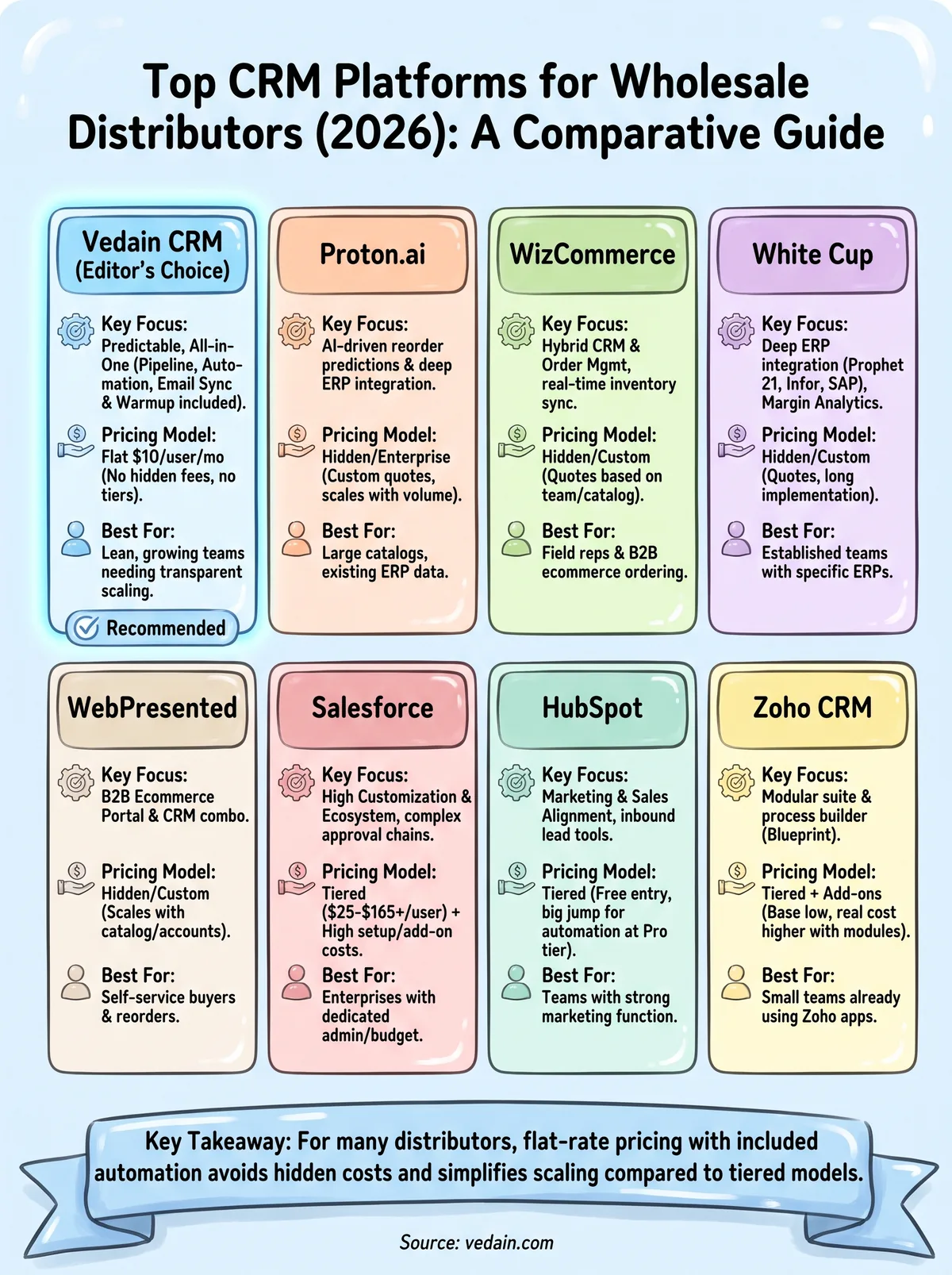
Every platform on this list solves a different piece of the distributor puzzle. Proton.ai and White Cup lean on ERP-deep intelligence for teams with complex catalogs, WizCommerce and WebPresented bet on ecommerce ordering, and Salesforce, HubSpot, and Zoho offer breadth at the cost of tiered pricing that grows unpredictable as you scale. If your team needs a wholesale distribution CRM that handles pipeline, email, and automation without a sales call to find out what it costs, that's the gap Vedain fills.
Given all this, the smartest move for a lean distribution team is picking a system priced flat, so a five-person team and a fifty-person team pay the same rate with the same features. Compare the numbers yourself and see what a flat $10 per seat includes for a distribution team.
Frequently Asked Questions
What is the best CRM for wholesale distributors with inventory management?</answer>
Vedain is specifically designed for wholesale distributors and includes built-in inventory management features starting at $99/month, making it ideal for tracking stock levels across multiple locations. While Salesforce and HubSpot offer CRM capabilities, they require additional integrations for comprehensive inventory control, whereas Vedain combines both functionalities in a single platform optimized for the distribution industry.
How much does Pipedrive cost compared to other CRMs for wholesalers?
Pipedrive's entry-level plan starts at $14/user/month, making it one of the most affordable options for wholesale distributors who prioritize sales pipeline management. HubSpot's free tier is available but lacks advanced features, while Salesforce's pricing starts at $165/month and Zoho CRM begins at $18/user/month, positioning Pipedrive as a budget-friendly middle ground for small to mid-sized distributors.
Which CRM integrates best with wholesale distribution accounting software?
Zoho CRM excels at integration with accounting systems like QuickBooks and Zoho Books, making it particularly effective for wholesale distributors who need seamless financial data synchronization. HubSpot and Salesforce also offer integrations but typically require more customization work, while Vedain has native connections to distribution-specific accounting platforms that automatically sync orders and inventory data.
Can I use HubSpot for B2B wholesale distribution sales?
Yes, HubSpot can be used for wholesale distribution with its CRM starting at $50/month, offering strong contact management and deal tracking features suitable for B2B sales. However, dedicated solutions like Vedain may provide better functionality for managing complex wholesale relationships, bulk orders, and distributor-specific workflows, while HubSpot works well for companies seeking an all-in-one marketing and sales platform.
What CRM features do wholesale distributors need that most platforms lack?
Wholesale distributors typically need multi-location inventory tracking, tiered pricing management, and bulk order handling—features that Vedain includes natively but that require significant customization in general CRMs like Salesforce and HubSpot. Additionally, distributor-specific reporting on margin analysis and territory management are built into Vedain starting at $99/month, whereas Pipedrive and Zoho CRM require third-party apps or custom development for these capabilities.
Is Salesforce worth the cost for small wholesale distribution businesses?
Salesforce's starting price of $165/month may be excessive for small wholesale distributors who don't need enterprise-level features and customization capabilities. Smaller distributors typically benefit more from Zoho CRM ($18/user/month), Pipedrive ($14/user/month), or Vedain ($99/month), which offer distribution-focused functionality at lower price points while still providing essential CRM, sales tracking, and reporting tools needed for growth.