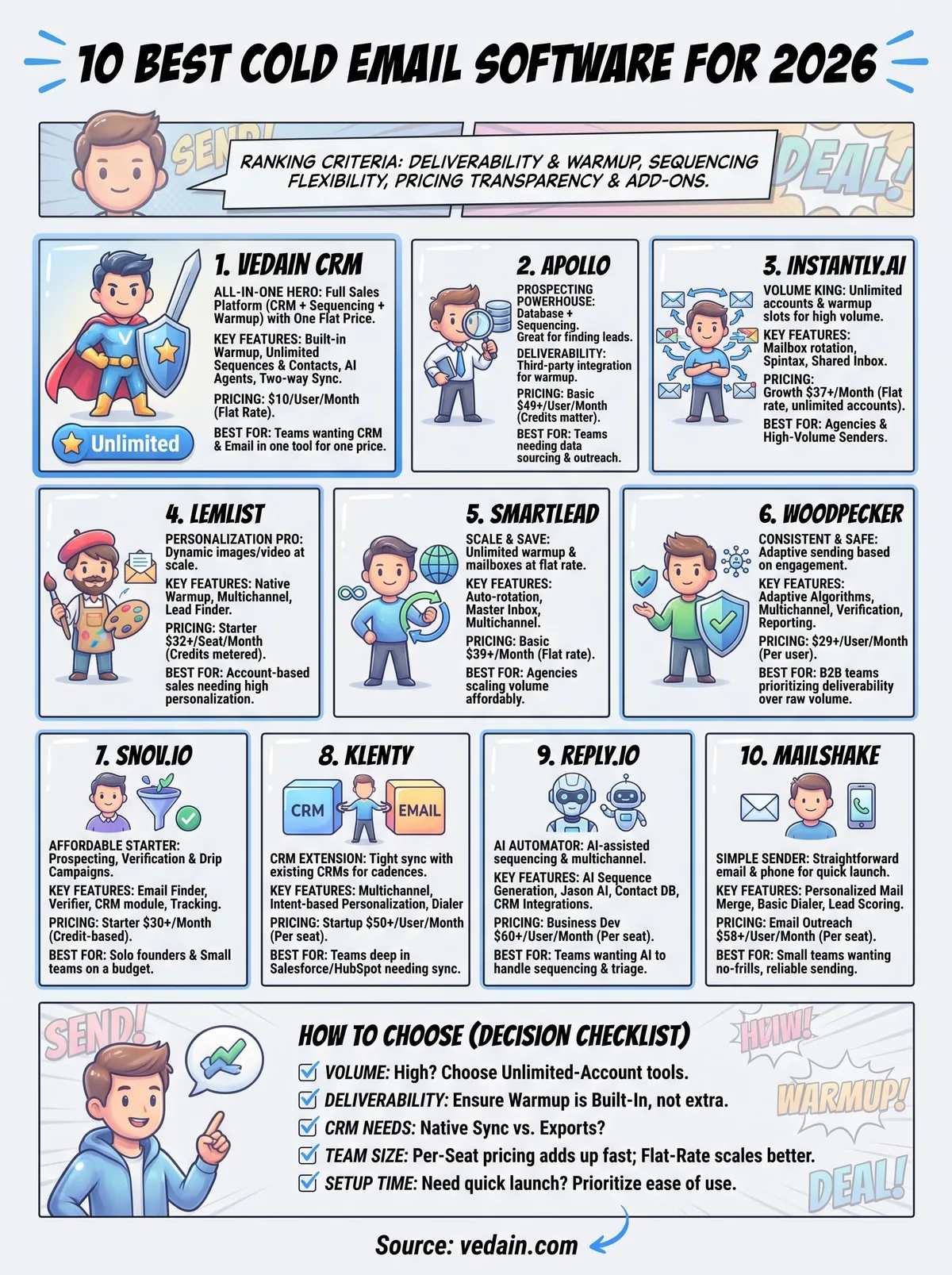
This guide ranks the ten tools worth your time in 2026, based on deliverability performance, sequencing flexibility, and how much you pay once you factor in add-ons most vendors don't advertise upfront. You will see where each platform shines, where it falls short, and which one fits your team size and budget.
We built this list from real usage, not vendor pitch decks, comparing pricing transparency against actual feature depth like warmup, multi-step sequences, and reply detection. Whether you are running solo outreach or scaling a full sales team's pipeline, you will find a tool below that matches how you actually sell, without paying for features you'll never touch.
1. Vedain CRM
Vedain CRM built its cold email tools inside a full sales platform, not as a bolted-on add-on. That matters if you're tired of juggling a separate outreach tool, a separate CRM, and a spreadsheet to tie the two together. Vedain CRM combines lead management, deal pipelines, and cold email sequencing under one flat price, which is rare among the tools on this list. You send your campaigns, track replies, and move contacts into your pipeline without exporting a single CSV.
Key features
The platform's email tooling sits on top of its core CRM, so every cold email you send is already tied to a contact record, a deal stage, and a note history. Here's what you get in the base plan:
- •Two-way email sync with Gmail and Outlook, so replies land in your inbox and your CRM at the same time
- •Multi-step automated sequences with conditional branching based on opens, clicks, and replies
- •A no-code workflow builder for triggering follow-ups or CRM updates from email activity
- •Lead forms that feed new contacts straight into your sequences
- •An AI Agent Marketplace with over 30 pre-built agents for writing subject lines, personalizing openers, and enriching lead data before you send
Because the sequencing lives inside the CRM, you can filter by deal stage, deal value, or custom field and launch a cold email sequence to that exact segment in a couple of clicks.
Deliverability
Most cold email tools treat deliverability as an afterthought or a paid upgrade. Vedain includes a 21-day email warmup process built into every account, gradually ramping up your sending volume and engagement signals so new domains and mailboxes build sender reputation before you launch real campaigns. This is the single feature that separates tools that get you into the inbox from tools that get you flagged as spam.
Warmup isn't optional if you want your cold emails read, and Vedain includes it for every user instead of charging extra for it.
The two-way sync also means bounce and reply data feed back into your sending logic automatically, so you're not manually pruning bad addresses out of a list a week too late.
Pricing
Vedain charges a single flat rate of $10 per user per month, and that price includes the email warmup, sequencing, workflows, AI agents, and unlimited contact records. There's no tiered pricing, no "warmup add-on," and no cap on how many active sequences you can run. You can compare that against the per-tier pricing tables further down this list, most of which strip warmup or advanced sequencing out of their entry plan.
You can start a trial without entering a credit card, and setup takes under five minutes according to the platform's own onboarding flow at vedain.com.
Best for
Vedain fits sales teams who want cold email and CRM in the same tool instead of stitching two subscriptions together. It's a strong match for startups and small to mid-sized teams that are price-sensitive but don't want to sacrifice deliverability infrastructure to save money. If you're currently paying for a standalone sender plus a separate pipeline tool, switching to Vedain likely cuts your stack down to one bill and one login.
2. Apollo
Apollo built its name as a sales intelligence database first, then layered cold email sequencing on top. That combination is the appeal: you get a searchable pool of over 275 million contacts alongside the sending tools, so prospecting and outreach happen in the same tab. Apollo works well if your bottleneck is finding leads, not just emailing the ones you already have.
Key features
The database is the headline feature, but the sequencing engine has grown up around it. You get:
- •A contact and company database with filters for job title, industry, and technology stack
- •Multi-step sequences with email, call, and LinkedIn touchpoints mixed together
- •A Chrome extension for pulling verified emails off LinkedIn profiles
- •Basic A/B testing on subject lines and email copy
- •Native dialer and call recording for teams that mix email with phone outreach
That mix of prospecting and outreach in one place saves you from paying for a separate data provider on top of your sender.
Deliverability
Apollo's deliverability tools live behind its higher tiers, and even then, warmup is handled through a third-party integration rather than a built-in feature. You'll need to connect an external warmup service or manage mailbox rotation yourself if you're sending real volume. Apollo does offer basic spam testing and sending limits to protect your domain, but it's noticeably thinner than tools built around deliverability from day one.
If deliverability infrastructure is your top priority, Apollo's data isn't enough to make up for the missing native warmup.
High-volume senders often pair Apollo's database with a dedicated warmup tool, which adds a second subscription most buyers don't budget for upfront.
Pricing
Apollo's plans start free for very limited use, then move to a Basic tier around $49 per user per month, with Professional and higher tiers climbing past $79 as you add more credits and automation. Email credits, not just seats, factor into cost here, so heavy prospecting teams can blow past the included allowance fast and trigger overage charges.
Best for
Apollo suits sales teams whose biggest challenge is finding accurate contact data, not just sending emails to a list they already have. It's a solid pick if you're building outbound lists from scratch and want prospecting and sequencing under one roof, even if that means bolting on a separate warmup tool later.
3. Instantly.ai
Instantly.ai built its reputation on one thing: sending high volumes of cold email without getting your domains blacklisted. The platform lets you connect dozens of mailboxes and rotate sends across them automatically, which is why agencies running outreach for multiple clients gravitate toward it. Instantly.ai treats mailbox infrastructure as the core product, with sequencing and lead management built around that foundation rather than the other way around.
Key features
Unlimited email accounts and warmup slots sit at the center of the platform, and everything else supports high-volume sending:
- •Unlimited sending accounts on every paid plan, so you scale mailboxes without paying per inbox
- •A built-in lead finder with a database for sourcing new prospects
- •Multi-step campaign sequences with spintax for message variation
- •A shared team inbox for managing replies across multiple senders
- •Deliverability analytics showing spam placement rates by mailbox
That mailbox-first design makes Instantly a natural fit if your outreach depends on spreading volume across many domains at once.
Deliverability
Instantly's warmup network is one of the most established in the space, running automated engagement across a pool of real inboxes to build sender reputation before you launch campaigns. The platform also includes a deliverability score and inbox placement tests so you can catch problems before a full send.
High-volume senders choose Instantly specifically because it was built to manage dozens of mailboxes without tanking any single domain's reputation.
Where it falls short is CRM depth. Once a reply comes in, you're often exporting data elsewhere to manage the actual deal.
Pricing
Plans start around $37 per month for the Growth tier, scaling to $97 and higher for unlimited warmup and advanced sending features. Unlimited email accounts come standard even on lower tiers, which sets Instantly apart from tools that charge per mailbox connected.
Best for
Instantly suits agencies and teams running high-volume campaigns across many mailboxes and domains at once. If your outreach strategy depends on spreading sends thin to protect deliverability, this is one of the strongest options among any best cold email software list, though you'll likely need a separate CRM to manage what happens after the reply.
4. Lemlist
Lemlist built its name on personalization at scale, letting you drop custom images, videos, and dynamic text into cold emails instead of sending the same static template to everyone. Lemlist appeals to teams who believe generic outreach is dead and want proof their emails were written for a specific prospect, not copied from a template library. The platform pairs that personalization engine with sequencing and a smaller built-in lead database, so you can prospect and send without leaving the tool.
Key features
Personalization tokens go far beyond first name and company here, and the feature set reflects that focus:
- •Dynamic image and video personalization inserted directly into email bodies
- •Multi-channel sequences mixing email, LinkedIn touches, and calls
- •A lead finder with filters for job title, industry, and company size
- •A/B testing across subject lines, send times, and full email variants
- •Native integrations with popular CRMs for syncing reply and deal data
Teams running account-based outreach lean on Lemlist specifically for the visual personalization, since a screenshot with the prospect's name on it gets noticed faster than plain text.
Deliverability
Lemlist includes a native warmup tool called lemwarm, bundled into paid plans rather than sold as a separate add-on. It rotates engagement across your connected mailboxes and monitors your sender score, flagging drops before they tank a live campaign.
Personalization gets your email opened, but Lemlist still needs its warmup feature running constantly to keep that email out of spam in the first place.
Deliverability here holds up well for mid-volume senders, though agencies managing dozens of client domains often find the mailbox limits per plan restrictive.
Pricing
Plans start around $32 per seat per month for the Email Starter tier, with multi-channel and warmup features unlocking on the Standard tier near $50. Lead database credits are metered separately, so prospecting-heavy teams should budget for overage before they hit send.
Best for
Lemlist fits teams selling to a smaller, higher-value list where personalization actually moves reply rates, like agencies pitching creative work or B2B sales targeting named accounts. If your outreach relies on volume over customization, the per-seat cost adds up faster than the reply rate improvement justifies.
5. Smartlead
Smartlead built its platform around unlimited warmup and mailbox rotation at a price point that undercuts most of the tools above it. The pitch is simple: connect as many sending accounts as you want, spread your volume across them, and pay one flat rate regardless of how many mailboxes you're running. Smartlead attracts agencies and lead gen shops that need to scale outreach across dozens of client domains without a per-mailbox fee eating the margin.
Key features
The platform leans into automation and scale rather than personalization depth or a built-in contact database. You get:
- •Unlimited warmup and unlimited mailbox connections on every paid plan
- •A unified inbox called Master Inbox for managing replies across all connected accounts
- •Multi-channel sequences that combine email with LinkedIn and SMS steps
- •Auto-rotation of sending accounts to spread volume and protect any single domain
- •An API and native integrations for pushing reply data into external CRMs
That mailbox rotation logic runs quietly in the background, so you don't have to manually track which inbox has sent how many emails that day.
Deliverability
Smartlead's warmup pool works across a shared network of real inboxes, and the platform reports spam placement rates per mailbox so you can spot a domain going bad before it drags down a whole campaign. Auto-rotation also caps daily sends per mailbox automatically, which protects new domains from the kind of aggressive sending that gets flagged in week one.
Unlimited warmup at a flat rate is the single reason agencies switch to Smartlead over pricier per-mailbox competitors.
Where the platform is thinner is on lead sourcing. You'll need an outside data provider, since Smartlead assumes you already have a list to load in.
Pricing
Plans start around $39 per month for the Basic tier, with the Pro tier near $79 unlocking higher sending limits and multi-channel outreach. Unlimited email accounts come standard even at the entry tier, which is the platform's biggest cost advantage over Instantly and Apollo.
Best for
Smartlead suits agencies and high-volume outbound teams managing many client domains who need warmup and mailbox rotation without a per-seat or per-mailbox surcharge. If you already have a lead list and just need infrastructure to send it safely, this is one of the more affordable options on this list.
6. Woodpecker
Woodpecker built its reputation among agencies that need to prove outreach results to clients, with reporting and deliverability checks baked into the core workflow rather than tacked on as an afterthought. The platform targets B2B teams running cold email alongside cold calling, treating the two channels as parts of one sequence instead of separate tools. Woodpecker leans conservative on sending volume by design, capping daily limits to protect domain reputation instead of chasing the unlimited-mailbox pitch you see elsewhere on this list.
Key features
The platform's standout feature is its adaptive sending algorithm, which adjusts daily volume per mailbox based on real engagement instead of a flat cap you set once and forget. Core features include:
- •Adaptive sending that throttles volume automatically based on bounce and reply rates
- •Multi-channel sequences combining email, cold calling tasks, and LinkedIn steps
- •A built-in email verification step before each send to strip out invalid addresses
- •Detailed campaign reports broken down by mailbox, useful for agencies reporting to clients
- •Integrations with popular CRMs for pushing reply and deal data downstream
Agencies running outreach for multiple clients often pick Woodpecker specifically for the reporting layer, since client-facing dashboards are easier to build here than in tools designed for solo senders.
Deliverability
Woodpecker's approach to deliverability centers on restraint rather than raw mailbox volume. The adaptive sending algorithm watches your bounce rate and spam complaints in near real time, automatically slowing down a mailbox that shows warning signs before it gets flagged. Warmup is included on paid plans, though it's less aggressive than the always-on pools you'll find at Instantly or Smartlead.
Woodpecker protects deliverability by sending less when signals turn bad, not by spreading volume across more inboxes.
That conservative posture suits teams sending moderate volume who care more about consistency than raw throughput.
Pricing
Plans start around $29 per user per month for the Cold Email tier, with the Cold Email + Calling tier pushing closer to $49 as you add phone outreach. Pricing scales per user rather than per mailbox, which keeps costs predictable if your team is small but each rep manages several inboxes.
Best for
Woodpecker fits agencies and B2B teams that mix cold email with calling and want detailed, client-ready reporting without managing dozens of mailboxes. If your priority is steady, protected sending over maximum volume, this is a safer pick than the mailbox-heavy platforms above it.
7. Snov.io
Snov.io started as an email finder browser extension before growing into a full outreach platform, and that history still shows in how the product is structured. Snov.io bundles a prospecting database, email verification, and drip campaigns into one subscription, which appeals to teams who want lead sourcing and sending without paying two separate vendors. The platform sits at a lower price point than most tools on this list, making it a common pick for solo founders and small teams testing cold email for the first time.
Key features
The toolset spans the full outreach workflow, from finding an email address to tracking whether a prospect opened your third follow-up. Core pieces include:
- •An email finder and verifier that checks deliverability before you add a contact to a campaign
- •Drip campaigns with automated follow-ups based on opens, clicks, and replies
- •A built-in CRM module for tracking deal stages tied to email activity
- •Email tracking that shows opens and link clicks per recipient
- •API access for teams who want to pull Snov.io data into other tools
Bundling verification directly into the sending flow cuts down on the bounce rate spikes that happen when you import a stale list from elsewhere.
Deliverability
Snov.io includes a warmup feature on its paid plans, rotating engagement across connected mailboxes to build sender reputation before a real campaign launches. It's a newer addition to the platform compared to tools like Instantly or Lemlist, so the warmup pool is smaller and the reporting around spam placement is less granular.
Snov.io covers the deliverability basics, but if you're sending serious volume, expect to lean on manual list hygiene more than the warmup tool alone.
Email verification before send does most of the heavy lifting here, catching bad addresses that would otherwise hurt your sender score over time.
Pricing
Plans start around $30 per month for the Starter tier, based on the number of prospects and email credits rather than seats, with higher tiers unlocking more credits and unlimited campaigns. That credit-based model means light senders pay less than platforms charging a flat per-seat rate, but heavy prospecting can push you into a higher tier fast.
Best for
Snov.io fits solo founders and small teams who want prospecting, verification, and sending in one affordable tool without committing to a per-seat CRM. If your outreach volume is modest and your budget is the main constraint, it's one of the cheaper complete packages on this list.
8. Klenty
Klenty built its platform around sales engagement for teams that already have a CRM and just need a sequencing layer that plugs into it cleanly. The company positions itself less as a standalone cold email tool and more as an extension of your existing sales stack, with tight two-way sync to Salesforce, HubSpot, and Pipedrive. Klenty appeals to revenue teams running structured outbound motions where reps need cadences tied directly to CRM records, not a separate list they manage on the side.
Key features
The platform's strength is cadence management across multiple channels, built for reps who juggle email, calls, and LinkedIn touches in one sequence. You get:
- •Multi-channel cadences combining email, phone, LinkedIn, and WhatsApp steps
- •Native two-way sync with major CRMs so sequence activity updates deal records automatically
- •Intent-based personalization that swaps email content based on prospect behavior
- •A dialer with call scripts and voicemail drop for reps mixing email and phone outreach
- •Team-level reporting on cadence performance and rep activity
That CRM-first sync is the reason sales ops teams often shortlist Klenty over lighter sequencing tools.
Deliverability
Klenty includes a warmup feature on its higher-tier plans, though it launched later than the warmup pools at Instantly or Smartlead and covers a smaller pool of rotating inboxes. The platform also runs spam testing before campaign launch and flags mailboxes showing bounce spikes, but you won't find the granular per-mailbox deliverability dashboards that dedicated sending tools offer.
Klenty treats deliverability as a supporting feature behind CRM sync, not the core product, so budget for a separate warmup tool if you're sending high volume.
Teams running moderate outbound volume through a handful of mailboxes generally find the built-in warmup adequate, but agencies managing many client domains often add a dedicated warmup service on top.
Pricing
Plans start around $50 per user per month for the Startup tier, with Growth and Enterprise tiers climbing past $70 as you add multi-channel cadences and advanced reporting. Pricing runs per seat rather than per mailbox, which gets expensive fast for small teams managing multiple inboxes each.
Best for
Klenty fits sales teams already committed to Salesforce, HubSpot, or Pipedrive who want cadence automation layered on top rather than a full replacement. If your reps live in the CRM already and just need sequencing to sync natively, Klenty closes that gap better than standalone senders on this list.
9. Reply.io
Reply.io positions itself as a full sales engagement platform rather than a simple sender, mixing AI-assisted sequence writing with multichannel outreach across email, LinkedIn, and calls. Reply.io built its reputation on AI SDR agents that can run entire outbound sequences with minimal manual input, which appeals to teams trying to scale outreach without adding headcount. The platform also ships a Chrome extension for pulling contact data straight from LinkedIn, so prospecting and sequencing happen without switching tabs.

Key features
Reply.io leans heavily on automation layered over a fairly deep sequencing engine. Core pieces include:
- •AI-powered sequence generation that drafts multi-step email copy from a short campaign brief
- •Multichannel touchpoints spanning email, LinkedIn, SMS, and calls in one cadence
- •A built-in contact database with filters for company size, industry, and job title
- •Jason AI, a chat-based assistant for handling routine reply triage and scheduling
- •Native CRM integrations for pushing reply data into Salesforce, HubSpot, and Pipedrive
That AI-first framing sets Reply.io apart from tools like Klenty or Woodpecker, which treat automation as a supporting feature rather than the headline.
Deliverability
Reply.io includes warmup and deliverability tools on its paid plans, covering spam testing, sender score monitoring, and a warmup pool for rotating engagement across connected mailboxes. Coverage is solid for mid-volume senders, though it doesn't match the raw scale of Instantly's or Smartlead's dedicated warmup networks built specifically for high-volume agency use.
Reply.io's AI sequencing draws the most attention, but its deliverability tooling is only mid-pack compared to platforms built around warmup first.
Spam testing runs before each campaign launch, catching obvious red flags in subject lines and body copy that tend to trigger filters.
Pricing
Plans start around $60 per user per month for the Business Development tier, with AI SDR features and higher sending volume pushing costs past $90 on upper tiers. Pricing runs per seat, and the AI features that make Reply.io distinct are gated behind the pricier plans rather than included at the entry level.
Best for
Reply.io fits sales teams that want AI handling a chunk of the sequencing and reply triage work, not just a plain sender with templates. If you're comfortable paying a premium for automation depth and already have a CRM to receive the data, Reply.io earns its spot on this list.
10. Mailshake
Mailshake built its reputation as a straightforward sender for sales teams who don't want a database, an AI assistant, or a multichannel dialer bolted onto their outreach tool. The platform focuses on cold email and basic phone tasks, keeping the interface simple enough that a rep can launch a campaign in an afternoon without a training call. Mailshake appeals to teams who tried a heavier platform, got lost in setup, and just want a tool that sends personalized sequences and reports on what happened.
Key features
Simplicity is the selling point here, and the feature set stays narrow on purpose. You get:
- •Personalized mail merge sequences with mail-merge fields pulled from a CSV or connected CRM
- •Basic phone dialer tasks that slot into the same sequence as email steps
- •A/B testing on subject lines and email body copy
- •Lead scoring called Mailshake AI Sales Engagement Score, ranking replies by likely intent
- •Native integrations with Salesforce, HubSpot, and Pipedrive for pushing activity data
Most teams get a campaign live within a day, since there's no lead database or AI builder to configure before you start sending.
Deliverability
Mailshake includes basic sending limits and email verification to catch bad addresses before launch, but native warmup arrived later than at Instantly, Smartlead, or Lemlist, and the pool of rotating inboxes is smaller. The platform recommends connecting a limited number of mailboxes per account, which keeps volume manageable but caps how far you can scale sends without adding seats.
Mailshake keeps deliverability simple rather than sophisticated, which works fine at moderate volume but shows its limits once you're running dozens of mailboxes.
Heavy senders often pair Mailshake with a separate warmup service, similar to the workaround Apollo users need.
Pricing
Plans start around $58 per user per month for the Email Outreach tier, with the Sales Engagement tier near $83 adding phone dialing and lead scoring. Pricing runs per seat with no credit-based metering, so cost stays predictable as long as your team size doesn't grow faster than your budget.
Best for
Mailshake fits small sales teams that want a no-frills sender without a database, AI layer, or multichannel dialer to configure. If your outreach is simple, your list is already built, and you just need reliable sequencing and reporting, Mailshake gets you there without the setup overhead of the bigger platforms above it.
11. How to choose the right cold email software
Picking between ten tools comes down to matching the platform to how you actually sell, not which one has the longest feature list. Sending volume is the first question to answer honestly. If you're running dozens of mailboxes across client accounts, an unlimited-mailbox tool like Instantly or Smartlead beats a per-seat platform every time. If you're a small team sending from two or three inboxes, that unlimited pitch is wasted money.
Deliverability infrastructure should be your second filter, and it's the one buyers skip most often. Ask whether warmup comes built in or whether you'll need a separate subscription to protect your domain. That single gap explains most of the price difference between tools on this list.
The tool with the most features loses to the tool that keeps your emails out of spam, every single time.
Budget honestly for the full stack, not just the sticker price. A cheap sender that needs a bolted-on warmup service and a separate CRM often costs more monthly than one flat-rate platform that includes all three.
Quick decision checklist
- •Volume: Sending from 10+ mailboxes? Prioritize unlimited-account platforms over per-mailbox pricing.
- •Deliverability: Confirm warmup is included, not an add-on, before you compare monthly price tags.
- •CRM needs: If replies need to become deals, check whether the tool syncs natively or requires exports.
- •Team size: Per-seat pricing punishes larger teams fast; flat-rate models scale more predictably.
- •Setup time: If you don't have a dedicated ops person, favor tools with under 30-minute onboarding.
Teams already juggling a separate CRM subscription should weigh whether consolidating into one platform saves money once you add up sender fees, warmup add-ons, and CRM seats separately. That's usually where an all-inclusive platform like Vedain CRM pulls ahead on total cost, even against tools with a lower advertised starting price. Run the math on your actual stack, not the homepage pricing page, before you commit to a year-long contract.
Finding your best fit for 2026
Every tool on this list can send a cold email. The difference shows up three weeks later, when your domain either lands in the inbox or sits quarantined in spam because nobody set up warmup. That's the real cost most buyers miss until it's too late. Deliverability infrastructure decides whether your outreach works at all, and total stack cost decides whether it's worth the trouble once you add up separate senders, warmup add-ons, and CRM seats.
Going by pure sending volume, Instantly or Smartlead win. Going by AI-assisted sequencing, Reply.io takes it. But if you want warmup, sequencing, and a real CRM under one flat price with no add-ons creeping onto your invoice, Vedain CRM is the practical pick for 2026.
Start a free trial at Vedain CRM and launch your first warmed-up sequence in under five minutes, no credit card required.
Related reading
Frequently Asked Questions
What is the best cold email software for small businesses in 2026?
Pipedrive and Freshsales are the best cold email solutions for small businesses, offering affordable pricing starting at $14-$15/month with built-in email sequences and automation. Both platforms provide better value than HubSpot's entry plan ($45/month) while delivering comparable cold outreach features. Vedain is also a strong alternative specifically designed for cold email campaigns with competitive pricing and high deliverability rates.
Which cold email tools integrate with CRM systems like Salesforce and HubSpot?
Most modern cold email software integrates seamlessly with major CRMs, including Salesforce, HubSpot, Zoho, and Pipedrive. Tools like Freshsales and Pipedrive offer native integrations that sync contacts and track email performance directly in your CRM dashboard. Vedain also provides robust API connections to popular CRM platforms, making it easy to centralize your outreach efforts without switching between applications.
How much does cold email software typically cost in 2026?
Cold email software typically ranges from $14-$99 per month depending on features and volume. Pipedrive and Freshsales start at $14-$15/month for basic cold email features, while HubSpot's sales hub begins at $45/month with more advanced functionality. Enterprise solutions like Salesforce and Zoho require custom pricing, but Vedain offers mid-market plans starting around $29/month with excellent deliverability features.
What features should I look for in a cold email tool for B2B outreach?
Essential cold email features include email sequence automation, list segmentation, deliverability tracking, and A/B testing capabilities. Advanced tools like HubSpot and Salesforce offer AI-powered personalization and detailed analytics, while Pipedrive and Freshsales provide affordable alternatives with solid automation. Vedain specializes specifically in cold outreach with features like warmup sequencing and detailed bounce/reply tracking that other general CRMs may lack.
Is HubSpot or Pipedrive better for cold email campaigns?
Pipedrive is better for cold email campaigns if budget is a priority, starting at just $14/month with dedicated cold outreach features and cleaner automation workflows. HubSpot offers more comprehensive analytics and AI personalization at $45/month but can feel over-engineered for simple cold email needs. Salesforce and Zoho provide enterprise-level capabilities but require higher investment, while Freshsales and Vedain offer middle-ground solutions with strong cold email specialization.
Can I use cold email software for follow-up sequences and lead nurturing?
Yes, all major cold email platforms support automated follow-up sequences and lead nurturing workflows. HubSpot, Salesforce, Zoho, and Pipedrive offer sophisticated multi-touch email sequences that adapt based on recipient behavior and engagement. Freshsales and Vedain are particularly strong for follow-up automation with template libraries and timing optimization features specifically designed to re-engage prospects without appearing spammy.
Related: Email & Deliverability