This list answers that search directly: ten platforms that actually handle dual-pipeline workflows for candidates and clients, not just repurposed sales software. Some are built specifically for staffing firms, others are general-purpose CRMs agencies adapt like Vedain, which recruiters reshape using custom pipelines and automation to fit sourcing and placement cycles at a fraction of the cost.
We compared each option on pricing transparency, automation depth, and how well it scales from a two-person recruiting shop to a firm placing hundreds of candidates a month. You'll get a clear picture of setup speed, hidden fees to watch for, and which tools give you the reporting you need to prove ROI to clients.
1. Vedain CRM
Vedain isn't built specifically for staffing firms, but that's exactly why so many recruiting teams end up here after outgrowing a spreadsheet or getting burned by hidden fees elsewhere. Vedain CRM ships as a flexible sales operating system, and recruiters repurpose its pipeline builder to run two tracks at once: one for candidates moving through screening and interviews, and one for client accounts and open requisitions. Because every module ships unlocked at the same price, an agency can build a genuine crm for recruitment agencies setup without paying extra for automation, email sync, or reporting later.
Key features
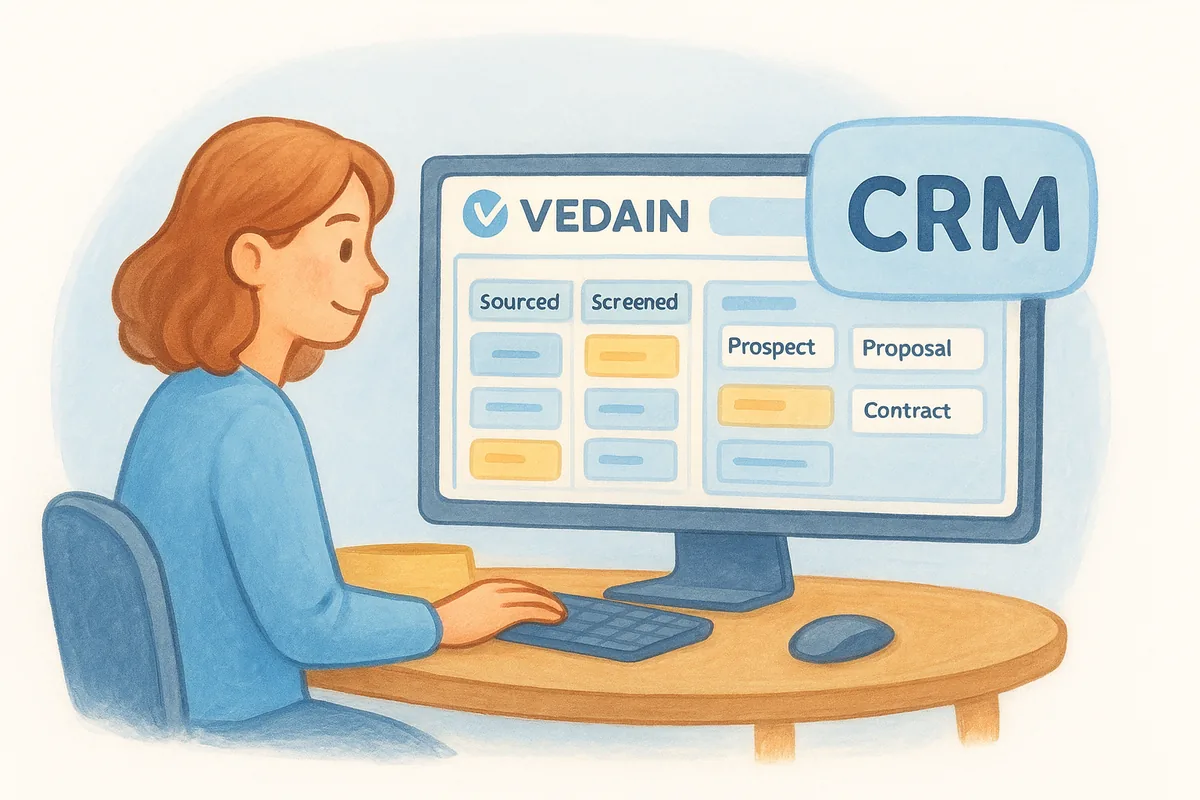
Setting up a dual pipeline in Vedain takes less than an hour once you know what to configure. Agencies typically build it like this:
- •Custom pipelines: one Kanban board for candidate stages (sourced, screened, submitted, interviewing, placed), a separate board for client deals (prospect, proposal, contract, active)
- •Custom fields: track candidate specifics like desired salary, notice period, or certifications directly on the contact record
- •Workflows: no-code automation that moves a candidate to "submitted" and fires an email the moment a hiring manager responds
- •Email Warmup: keeps high-volume outbound recruiting email out of spam during sourcing campaigns
- •AI Agent Marketplace: over 30 pre-built AI agents that enrich candidate profiles and draft outreach copy without manual research
That combination gives smaller agencies most of what dedicated staffing software offers, minus the enterprise price tag.
A recruitment CRM only earns its keep if it tracks candidates and clients in one place without charging you twice for the privilege.
Best for
Solo recruiters and small-to-mid agencies get the most value here, especially teams already managing five to fifty reqs at a time who don't want to pay per feature. Founders who've used HubSpot or Pipedrive and hit a wall with pricing tiers tend to switch here first, because Vedain's flat rate covers automation and email sync that HubSpot's higher plans gate behind an upgrade. Agencies that need visual pipeline tracking and lightweight reporting, rather than deep ATS features like resume parsing or job board syndication, fit best.
Pricing
Vedain charges $10 per user per month, flat, with every feature included from day one.
There's no separate tier for automation, email warmup, or the AI agent marketplace. That transparency matters for agency owners who've been surprised by add-on costs on other platforms. You can see the full breakdown of every included module on the Vedain pricing page.
Integrations
Outlook and Gmail both sync two-way natively, which covers most recruiter inboxes without needing a middleware tool. Beyond email, the platform connects to lead forms for capturing candidate applications straight off your careers page, and its AI Studio lets you describe a feature in plain English to build custom fields or automations without a developer. Currently, it doesn't offer native job board posting or resume parsing integrations that dedicated ATS platforms include, so agencies running heavy sourcing volume may still want a parsing tool feeding candidates into Vedain's pipeline.
2. Recruit CRM
Recruit CRM is built from the ground up as staffing agency software, not a repurposed sales tool, and that shows the moment you log in. Resume parsing, candidate sourcing, and client management sit in the same interface, with a Chrome extension that pulls candidate data straight from LinkedIn profiles into your database. Agencies that need a purpose-built crm for recruitment agencies without any DIY pipeline configuration tend to land here first.
Key features
The platform leans hard into automation built specifically for staffing workflows:
- •Resume parsing: pulls structured data from uploaded resumes into candidate records automatically
- •Kanban pipelines: separate boards for candidates and job orders, similar to Vedain's dual-track setup but with staffing-specific stages baked in
- •Chrome extension: sources candidates from LinkedIn and job boards without manual data entry
- •Client and candidate portals: lets hiring managers review submissions and candidates track their own application status
A staffing CRM built with recruiting stages baked in saves you the setup work a generic sales tool demands.
Best for
Mid-sized staffing agencies running high candidate volume get the most out of Recruit CRM, particularly firms doing contingency or contract placements where speed of sourcing matters more than deal customization. Agencies that want an out-of-the-box ATS-CRM hybrid, rather than one they configure themselves, will find the learning curve shorter here than with flexible sales platforms.
Pricing
Recruit CRM prices per user, per month, across three tiers, and costs climb quickly once you add seats.
Compared to a flat $10/user rate, and looking at how CRM costs compare per seat across vendors, agencies paying for Business or Enterprise tiers are covering features that platforms like Vedain include by default.
Integrations
Gmail and Outlook both sync natively, and Recruit CRM connects to major job boards including Indeed and ZipRecruiter for posting reqs directly from the platform. Zapier support extends that further for agencies running custom stacks, though it adds another tool and another monthly cost to manage rather than a native connection.
3. Recruiterflow
Recruiterflow markets itself as an ATS and CRM for recruiting and staffing agencies, and it leans heavily into marketing automation for business development alongside candidate tracking. Unlike Recruit CRM's sourcing-first approach, Recruiterflow puts more weight on the client acquisition side, with email sequences designed to help agencies win new job orders while still tracking candidates through a standard staffing pipeline. Agencies searching for a recruitment agency CRM that doubles as a business development engine tend to shortlist this one.
Key features
Recruiterflow bundles sourcing, outreach, and pipeline tracking into a single workspace built for staffing teams:
- •Email sequences: automated multi-step outreach for both candidate sourcing and client business development
- •Chrome sourcing extension: pulls profiles from LinkedIn and other sites into candidate records
- •Custom pipeline stages: separate boards for candidates and job orders with staffing-specific defaults
- •Analytics dashboards: track recruiter activity, time-to-fill, and pipeline conversion by client
An agency's growth depends as much on winning new clients as filling open roles, so a CRM that automates both sides earns its subscription faster.
Best for
Growth-focused agencies that treat business development as seriously as candidate sourcing fit Recruiterflow best. Teams running outbound campaigns to land new client accounts, not just filling reqs that already exist, get more value from the built-in sequencing than agencies that only need a tracking system. Firms with dedicated business development recruiters, rather than solo generalists, tend to justify the cost.
Pricing
Recruiterflow prices by tier, and the entry point sits well above flat-rate alternatives.
Most agencies land on Growth or Scale, which puts annual costs for a five-person team well into five figures before add-ons.
Integrations
Gmail and Outlook sync natively, and Recruiterflow connects to job boards including Indeed and LinkedIn Recruiter for cross-posting reqs. Zapier fills gaps for agencies needing custom connections to accounting or payroll software, though that's another subscription layered on top rather than something included in the base price.
4. Bullhorn
Bullhorn is the name most staffing veterans recognize first, and it holds a huge share of the enterprise staffing market for a reason: it was purpose-built for high-volume agencies before most competitors on this list existed. Bullhorn runs as a full ATS and CRM combo, with a data model designed around job orders, submissions, and placements rather than generic deals. Agencies searching for an established crm for recruitment agencies with decades of staffing-specific development behind it tend to land here, especially larger firms that need enterprise-grade infrastructure.

Key features
Bullhorn's feature set reflects its enterprise roots, with depth that smaller platforms don't attempt to match:
- •Automation engine: triggers actions across candidate and client records based on status changes, submissions, or placement milestones
- •Reporting suite: customizable dashboards built for staffing metrics like time-to-fill, submission ratios, and revenue per recruiter
- •Marketplace: hundreds of third-party add-ons for background checks, texting, and onboarding
- •Mobile app: full pipeline access for recruiters working from job sites or client meetings
Enterprise staffing software delivers depth, but that depth usually comes bundled with a price and setup timeline smaller agencies can't justify.
Best for
Larger staffing firms and enterprise recruiting teams get the most from Bullhorn, particularly agencies placing hundreds of candidates monthly across multiple offices or business lines. Firms with dedicated IT staff or a Bullhorn-certified implementation partner handle the setup complexity better than lean teams trying to configure everything solo.
Pricing
Bullhorn doesn't publish flat rates. Pricing runs through custom quotes based on user count, modules, and contract length, and agencies typically report costs starting well above $100 per user per month once implementation is factored in.
That's a steep jump from flat-rate platforms, and it's worth weighing against how much of Bullhorn's enterprise depth your agency will actually use.
Integrations
Bullhorn connects to an enormous marketplace of staffing-specific tools, including job boards, background check providers, and payroll systems like Microsoft 365 for email sync. Its Automation and Analytics products add further connectivity, though many of the deeper integrations require additional licensing beyond the base subscription.
5. Loxo
Loxo bills itself as a Talent Intelligence Platform, and that framing matters because it goes further than a standard recruitment CRM by folding in AI sourcing tools that search millions of profiles for you. Where Bullhorn leans on decades of staffing infrastructure, Loxo leans on machine learning to shortcut the sourcing grind, matching candidates to open reqs before a recruiter even opens a search bar. Agencies that want AI doing the heavy lifting on candidate discovery, not just pipeline tracking, tend to shortlist this one.
Key features
Loxo's standout piece is its AI sourcing engine, but the platform backs it up with a full CRM and ATS layer underneath:
- •AI-powered sourcing: searches a database of hundreds of millions of profiles and ranks matches against your open job requirements
- •Unified CRM and ATS: candidate and client records live in the same system, with pipelines built around staffing stages
- •Automated outreach: email and SMS sequences that trigger based on candidate status changes
- •Talent CRM database: builds a searchable internal pool from every candidate your agency has ever touched, not just current applicants
AI sourcing shortens the time between opening a req and having a shortlist worth calling, which is the real bottleneck for most agencies.
Best for
Agencies doing high-volume contingency search, where speed to shortlist decides who wins the placement, get the most value from Loxo. Firms that struggle with sourcing bandwidth more than pipeline organization will find the AI matching solves a real pain point instead of just adding another dashboard to check. Solo recruiters can use it too, though the pricing starts to feel steep without a team splitting the cost.
Pricing
Loxo prices per user with tiers that scale based on sourcing volume and AI features unlocked.
Agencies running lean often find themselves upgrading past Starter once AI sourcing credits run out mid-month.
Integrations
Gmail and Outlook both sync for two-way email tracking, and Loxo connects to major job boards for posting reqs without leaving the platform. It also integrates with background check and onboarding vendors through its partner network, though agencies report that some of the deeper AI sourcing features work best when Loxo is the primary system of record rather than layered alongside an existing CRM.
6. Manatal
Manatal positions itself as an AI-powered recruitment CRM built for agencies that want automation without the enterprise price tag of Bullhorn or Loxo. The platform runs candidate sourcing, client management, and placement tracking in one workspace, and its AI recommendation engine scores candidates against job requirements automatically. Agencies searching for a recruitment CRM software option that's lighter than Bullhorn but still purpose-built for staffing, rather than adapted from a generic sales tool, tend to land here.
Key features
Manatal packs AI scoring and sourcing tools into a straightforward interface that doesn't require heavy onboarding:
- •AI candidate scoring: ranks applicants against job requirements automatically, cutting manual resume review
- •Candidate sourcing: pulls profiles from over 2,500 channels including LinkedIn and job boards
- •Client and job order management: tracks requisitions alongside candidate pipelines in one view
- •Career page builder: lets agencies publish branded job listings without a separate website tool
AI scoring only earns its place in a recruiter's workflow if it actually cuts the time spent skimming resumes that were never a fit.
Best for
Small to mid-sized agencies that want AI-assisted sourcing without paying Loxo's enterprise rates fit Manatal well, though it's worth weighing against AI CRM options priced for small teams. Teams that value a candidate tracking system with built-in scoring, rather than one they'd need to configure themselves, will find the setup faster than Recruiterflow or Bullhorn. Firms running lean recruiting teams across multiple regions also lean on Manatal because its interface supports several languages and currencies out of the box.
Pricing
Manatal prices per user, per month, across three tiers, with AI features gated behind the higher plans.
Compared to a flat, all-inclusive $10 rate, Manatal costs more even at its entry tier, though it bundles staffing-specific sourcing that a generic sales CRM doesn't offer natively.
Integrations
Gmail and Outlook sync for email tracking, and Manatal connects to major job boards for cross-posting reqs without leaving the dashboard. Zapier extends connectivity to accounting and payroll tools, and the platform also offers an open API for agencies wanting custom builds, though that typically requires developer time most small agencies don't have on staff.
7. Gem
Gem built its reputation inside tech company talent acquisition teams before recruiting agencies picked it up, and that engineering-recruiting background still shows in how the platform prioritizes outbound sourcing over transactional pipeline tracking. Gem CRM treats every candidate touch, from a cold LinkedIn message to a rejection six months later, as data that feeds future outreach, which makes it a strong fit for agencies running high-volume passive candidate campaigns rather than reactive job-order fulfillment. Agencies weighing a recruitment CRM built around sourcing analytics, not just deal stages, tend to add Gem to their shortlist.
Key features
Gem's toolset leans hard into sourcing intelligence and outreach measurement:
- •Sourcing analytics: tracks response rates, time-to-response, and pipeline conversion by recruiter and campaign
- •Chrome extension: sources candidates from LinkedIn, GitHub, and other profiles directly into Gem's database
- •Automated email sequences: multi-step outreach with A/B testing built in for subject lines and messaging
- •Diversity sourcing insights: flags representation gaps in a pipeline before submissions go out
Sourcing data only matters if it changes what a recruiter does next, and Gem's analytics are built to push that decision, not just report on it.
Best for
Agencies running outbound-heavy searches for hard-to-fill technical or executive roles get the most from Gem, particularly teams that already treat sourcing as a measurable, repeatable process rather than ad hoc outreach. Firms placing high volumes of transactional, inbound-driven roles will find less value here than agencies competing for passive candidates who need convincing over several touches.
Pricing
Gem doesn't publish flat pricing. Costs run through custom quotes based on seat count and sourcing volume, and agencies typically report annual contracts rather than month-to-month billing.
That structure suits agencies with budget for enterprise sourcing tools more than lean teams wanting to test before committing.
Integrations
Gmail and Outlook both sync natively for tracking outreach, and Gem connects to major ATS platforms including Greenhouse and Lever for agencies running a separate applicant tracking system alongside it. It also integrates with LinkedIn Recruiter, though agencies without an existing ATS may find Gem works best layered on top of another system rather than as a standalone replacement.
8. Crelate
Crelate built its platform for staffing and executive search firms that want ATS depth without locking themselves into rigid, one-size-fits-all pipelines. The system separates candidate and client data cleanly, but lets agencies customize field names, stages, and workflows to match how they actually place people rather than how a vendor assumes they should. Firms comparing a flexible crm for recruitment agencies against Bullhorn's more rigid enterprise structure often shortlist Crelate specifically because of that configurability.

Key features
Crelate's strength sits in how much of the platform an agency can reshape without developer help:
- •Visual pipeline builder: drag-and-drop candidate and job order stages that match your agency's exact placement process
- •Talent CRM: builds a searchable database from every candidate touchpoint, useful for repeat placements in niche verticals
- •Sourcing tools: a browser extension pulls candidate data from LinkedIn and other sites into records automatically
- •Client portal: hiring managers review and comment on submissions without needing a Crelate login
A recruiting pipeline only works long term if your agency can reshape it as your placement process changes, not the other way around.
Best for
Executive search and boutique staffing firms with a distinct, non-standard placement process fit Crelate well, especially agencies frustrated by out-of-the-box tools that force a generic staffing workflow onto specialized searches. Teams that value configuring their own stages over adopting a vendor's default setup will find more room to work here than with Recruit CRM or Recruiterflow.
Pricing
Crelate prices per user across a few published tiers, landing well above flat-rate platforms but below Bullhorn's enterprise quotes.
Agencies with fewer than five seats sometimes find the entry tier disproportionately expensive compared to their actual usage.
Integrations
Two-way inbox sync covers Gmail and Outlook for email tracking, and Crelate connects to major job boards for cross-posting requisitions directly from open reqs. Zapier extends the platform to accounting and background check tools, and Crelate also publishes an open API for agencies wanting custom builds, though that route typically requires developer resources most boutique firms handle through a paid implementation partner instead.
9. Zoho Recruit
Zoho Recruit rides on the back of the broader Zoho ecosystem, which makes it an easy sell for agencies already running Zoho Books, Zoho Campaigns, or Zoho CRM's sales features for other parts of the business. Zoho Recruit splits cleanly into modules for staffing agencies and internal HR teams, so agencies get a dedicated candidate and client pipeline rather than a generic sales tool retrofitted for recruiting. Firms comparing a recruiting CRM software option against pricier staffing-specific platforms often shortlist Zoho Recruit because the entry tier undercuts most of the competitors on this list.
Key features
Zoho Recruit bundles sourcing, parsing, and pipeline tracking into a suite that scales with add-ons from the wider Zoho product line:
- •Resume parsing: extracts candidate data automatically from uploaded resumes across multiple formats
- •Candidate and client portals: hiring managers review submissions and candidates track application status without a login to the main system
- •Zia AI assistant: suggests matching candidates for open reqs and flags duplicate records
- •Multi-channel sourcing: posts job listings across job boards and social channels from a single dashboard
A CRM that plugs into tools you already run saves more setup time than one with a longer feature list you'll never touch.
Best for
Agencies already invested in the Zoho ecosystem, or ones running lean on budget while still wanting AI-assisted sourcing, get the most value here. Small firms testing whether a dedicated recruiting CRM is worth the switch from spreadsheets find Zoho Recruit's low entry price makes that trial low-risk. Larger agencies needing deep staffing-specific reporting typically outgrow the platform faster than they would Recruit CRM or Bullhorn.
Pricing
Zoho Recruit prices per user, per month, with a free tier for very small teams and paid plans scaling from there.
Compared to a flat $10/user rate, Zoho Recruit's paid tiers still land higher once an agency needs the automation locked behind Enterprise.
Integrations
Gmail and Outlook both sync for email tracking, and the platform connects natively to other Zoho products like Zoho Sign and Zoho Analytics for agencies already in that ecosystem. Zapier extends connectivity further for accounting and payroll tools outside the Zoho suite, though agencies without existing Zoho subscriptions may find fewer native advantages than the pricing suggests.
10. JobAdder
JobAdder rounds out this list as a recruitment platform built for agencies that want a clean, no-frills interface without sacrificing the client and candidate split that dedicated staffing tools offer. Popular across Australia, the UK, and increasingly the US, JobAdder keeps its feature set tighter than Bullhorn or Loxo, focusing on job order management, candidate tracking, and job board distribution rather than AI sourcing or deep analytics. Agencies that found platforms like Crelate or Recruiterflow too configuration-heavy often land here looking for something simpler to run day to day.
Key features
JobAdder keeps its core workflow tight, favoring speed over breadth:
- •Job ad distribution: posts open reqs to dozens of job boards from a single dashboard, including free and paid listings
- •Candidate pipeline: drag-and-drop stages for sourcing, screening, and placement, separate from client job order tracking
- •Mobile app: full candidate and client access for recruiters working from client sites or interviews
- •Placement tracking: handles fee and commission tracking automatically once a candidate is marked placed
A simpler recruiting CRM wins when your team spends more time filling reqs than configuring the software that's supposed to help.
Best for
Small to mid-sized agencies that want a straightforward applicant tracking system paired with client management, without the sourcing AI or heavy automation of Loxo or Gem, fit JobAdder well. Firms in Australia and the UK especially benefit from local job board integrations built into the platform from the start. Agencies that need deep customization or executive search workflows will likely outgrow it faster than Crelate.
Pricing
JobAdder doesn't publish flat public rates, quoting instead based on user count and job board add-ons.
Agencies budgeting for JobAdder should factor in job board posting credits as a separate line item, since these often aren't bundled into the base subscription.
Integrations
Gmail and Outlook sync for email tracking, and JobAdder connects to a wide range of job boards across multiple countries, which is part of its appeal for agencies posting internationally. It also integrates with background check providers and onboarding tools through its marketplace, though agencies report that some regional job board connections work better than others depending on where the firm operates.
Picking the right CRM for your agency
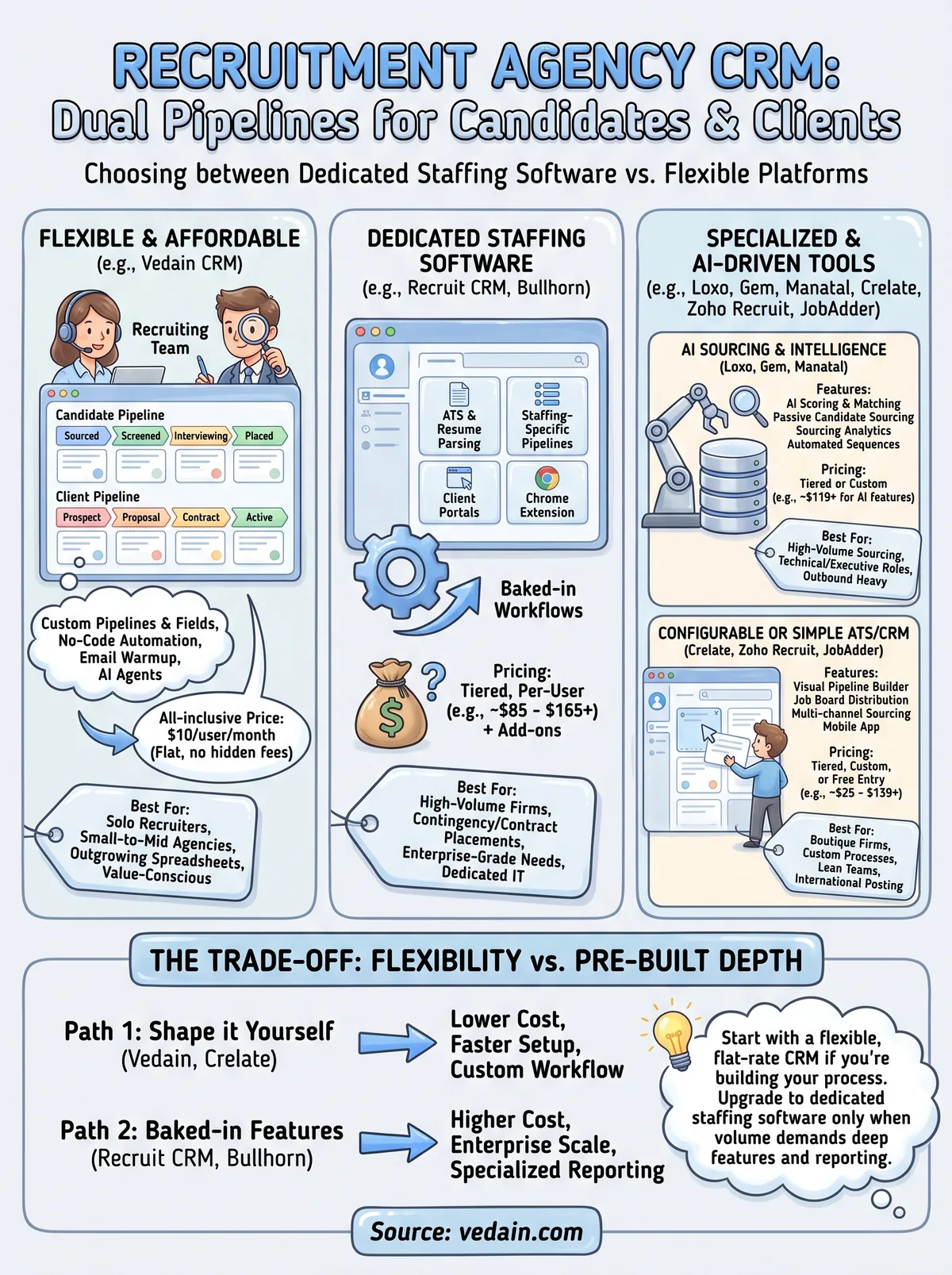
Most agencies on this list charge $75 to $180 per user monthly once you factor in the tiers that unlock automation and reporting. That math changes fast once you add a few recruiters, and it's worth asking whether your team actually needs job board syndication and resume parsing baked in, or whether a flexible crm for recruitment agencies setup covers the same ground for less. Dedicated staffing platforms like Recruit CRM or Bullhorn earn their price when your volume justifies the depth. Smaller shops still building their placement process often get further with a system they can shape themselves.
Vedain fits that second group: dual pipelines for candidates and clients, automation, and email sync at $10 per user, with nothing gated behind a higher tier. If that matches how your agency actually works, start a free trial and build your candidate pipeline in the next five minutes.
Related reading
Frequently Asked Questions
What is the best CRM for recruitment agencies?
The best CRM for recruitment agencies depends on your specific needs, but top options include Vedain, HubSpot, and Pipedrive. Vedain is specifically designed for recruitment with built-in applicant tracking, starting at $99/month, while HubSpot offers a free tier with robust contact management, and Pipedrive excels at pipeline visualization for sales-driven recruiting teams. Consider your agency size, budget, and whether you need specialized recruitment features versus general CRM functionality.
How much does a CRM for recruitment cost?
Recruitment CRM pricing varies widely based on features and users. Entry-level options like Pipedrive start around $11-$59/month per user, HubSpot offers a free plan with paid tiers at $50-$1,200/month, while Salesforce and Zoho CRM range from $25-$300+/month per user depending on the plan. Specialized recruitment platforms like Vedain typically cost $99-$299/month, making them more affordable than enterprise solutions for smaller agencies.
Is Salesforce good for recruitment agencies?
Salesforce can work for recruitment agencies, but it's often considered overkill for smaller to mid-sized firms due to its complexity and higher cost ($165-$330+/month per user). While Salesforce offers powerful customization and scalability for large enterprise recruiting teams, alternatives like Vedain, HubSpot, or Zoho CRM provide recruitment-specific features at a lower price point and with easier implementation. Salesforce is best suited for agencies with dedicated IT support and substantial recruiting volume.
What features should a recruitment CRM have?
A recruitment CRM should include candidate database management, pipeline tracking, applicant status updates, email automation, interview scheduling, and integration with job boards. Advanced features like resume parsing, collaborative notes for hiring teams, and reporting analytics are also valuable for most agencies. Platforms like Vedain and Pipedrive offer these core features, while HubSpot and Zoho provide additional marketing automation capabilities to nurture passive candidates.
Can you use HubSpot for recruitment?
Yes, you can use HubSpot for recruitment by leveraging its contact management, email sequences, and pipeline features to track candidates. However, HubSpot lacks built-in applicant tracking system (ATS) functionality compared to specialized platforms like Vedain, so you may need additional tools to manage resumes and applications. Many agencies use HubSpot alongside ATS software or choose dedicated recruitment CRMs like Pipedrive or Zoho CRM for a more integrated solution.
What is the difference between a CRM and ATS for recruitment?
A CRM focuses on managing client relationships and business pipeline, while an ATS (Applicant Tracking System) specializes in candidate sourcing, application management, and hiring workflows. Many recruitment agencies use both tools together—CRMs like HubSpot or Pipedrive handle client relationships, while platforms like Vedain combine CRM and ATS functionality in one system. Salesforce and Zoho offer CRM platforms that can be enhanced with ATS capabilities, though dedicated recruitment solutions typically provide superior applicant management features.