The right CRM for a dealership tracks every lead from first contact to signed deal, automates the follow-ups salespeople forget to send, and gives managers a clear view of pipeline health without forcing them into a 40-click report, which is a short list of the features that actually matter in a CRM. It should also sync with the email you already use and not punish you with add-on fees for basic automation.
This list breaks down eight CRMs worth considering in 2026, comparing pricing structures and core features side by side so you can see what fits a dealership's actual workflow. We built Vedain with flat, all-inclusive pricing and no feature gates in mind, so you'll see how it stacks up against bigger names like HubSpot and Pipedrive in our top CRM software picks compared, along with platforms built specifically for auto sales teams.
1. Vedain CRM
How it works
Vedain sets up in under five minutes, which matters when you've got a lot manager who wants a live view of the pipeline today, not after a two-week onboarding call. You build custom fields for the exact data a dealership tracks, VIN numbers, trade-in value, financing status, lead source, and drop them into a visual Kanban pipeline that shows every deal from first contact to signed paperwork. Salespeople see their leads in one screen instead of digging through a separate desking tool or a shared spreadsheet, and managers reassign leads with a drag instead of a phone call.
Key features
Luckily, the feature list doesn't stop at pipeline tracking. Vedain bundles the tools most dealership CRMs charge extra for into the same flat plan:
- •Two-way email sync with Gmail and Outlook, so every reply lands in the contact record automatically, the same Gmail and Outlook sync you'd look for in any CRM
- •No-code workflow automation for follow-up sequences after test drives or missed calls, built with triggers and actions you set up without writing code
- •Email warmup that protects domain deliverability over 21 days, useful for high-volume outreach
- •Lead capture forms for your website and landing pages
- •Reports on conversion funnels, pipeline health, and rep-by-rep leaderboards
- •An AI agent marketplace with over 30 pre-built AI agents for data enrichment and content drafting
A dealership CRM should never make you pay extra for the follow-up automation your sales team actually needs.
Best for
Anyone running a small to mid-sized dealership, or a group managing a handful of rooftops, gets the most out of Vedain. It suits teams that outgrew a spreadsheet but don't want the multi-year contracts and hidden module fees common in automotive CRM software built decades ago. If your team already lives in Gmail or Outlook and wants automation without hiring an admin to manage it, this fits.
Pricing
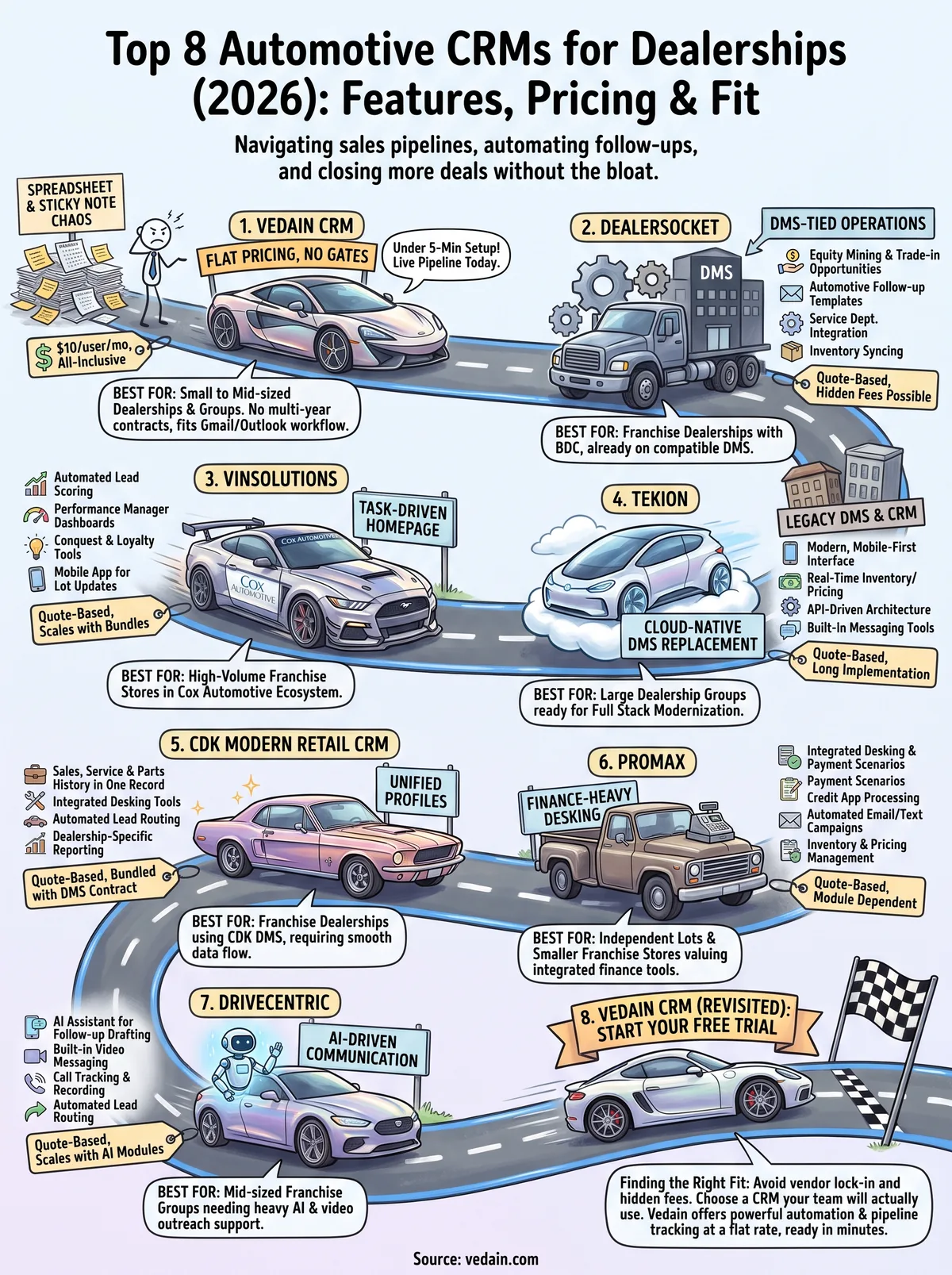
Pricing stays flat at $10 per user per month, with every feature included from day one. There's no separate tier for automation, no upcharge for email sync, and no credit card required to start a trial. For a dealership comparing this against the five-figure annual contracts common with legacy platforms, that flat rate is often the deciding factor. You can see what's included at $10 per user on the Vedain pricing page.
2. DealerSocket
How it works
DealerSocket built its reputation as one of the original automotive-specific CRM platforms, tying lead management directly into dealership operations like service scheduling and inventory. Salespeople work leads through a pipeline view, but much of DealerSocket's value comes from its integrations with DMS providers and its equity mining tools that flag customers ready for a trade-in based on loan payoff and vehicle value. Setup typically involves a dedicated onboarding team, since the platform connects to your existing dealer management system rather than running as a standalone tool.
Key features
Beyond lead tracking, DealerSocket layers in several dealership-specific tools:
- •Equity mining to surface trade-in opportunities from your existing customer base
- •Text and email templates built for automotive follow-up cadences
- •Service department integration for cross-department lead sharing
- •Inventory syncing with third-party listing sites
A CRM tied tightly to your DMS can save time, but it also ties your pricing and flexibility to that same vendor relationship.
Best for
Franchise dealerships already running a compatible DMS get the most value here, especially larger groups with dedicated BDC (business development center) staff who need equity mining and cross-department handoffs built into daily workflow.
Pricing
DealerSocket doesn't publish pricing publicly. Quotes come through a sales call and vary by dealership size, module selection, and DMS integration needs, which makes budget comparisons harder than with flat-rate platforms, so it helps to know the hidden fees buried in CRM quotes before you sit through the call.
3. VinSolutions
How it works
VinSolutions runs as Cox Automotive's flagship CRM for franchise dealerships, built around a "Connect CRM" dashboard that pulls in data from vAuto, Autotrader listings, and your DMS if it's a Cox partner product. Salespeople get a task-driven homepage that tells them who to call next based on lead score and days since last contact, rather than a plain pipeline view. Setup usually runs through a Cox Automotive rep, and the platform leans heavily on its own ecosystem, so the more Cox products you already run, the smoother the connections work.
Key features
VinSolutions packs in tools aimed at high-volume franchise stores:
- •Automated lead scoring that ranks prospects by likelihood to buy
- •Performance Manager dashboards for tracking rep activity against store goals
- •Conquest and loyalty campaign tools tied into Cox Automotive data
- •Mobile app for updating deal status from the lot
A CRM built around one vendor's ecosystem pays off only if you're already committed to that same vendor everywhere else.
Best for
Franchise dealerships already running other Cox Automotive products, like vAuto for inventory or Autotrader for listings, get the most value from VinSolutions. It suits stores with a dedicated BDC team that can lean on the lead-scoring and task-based workflow daily, rather than smaller independent lots managing leads with a leaner staff.
Pricing
VinSolutions doesn't list pricing publicly. Quotes come through a Cox Automotive sales rep and typically scale with dealership size, add-on modules, and how many other Cox products you're bundling in.
4. Tekion
How it works
Tekion built its platform from scratch as a cloud-native alternative to the legacy systems most dealerships grew up on, positioning its Automotive Retail Cloud as a full replacement for a DMS and CRM stack rather than a bolt-on tool. Deals move through a unified workspace where sales, finance, and service data live in the same record, so a rep can see a customer's service history while working a trade-in lead. Onboarding tends to run longer than most CRMs on this list, since Tekion often replaces your DMS entirely rather than syncing alongside it.
Key features
Beyond the DMS replacement angle, Tekion brings a few things dealerships notice right away:
- •A modern, mobile-first interface built for tablets on the sales floor
- •Real-time inventory and pricing data pulled straight into the deal desk
- •API-driven architecture that plays well with third-party apps
- •Built-in messaging tools for texting customers from inside the deal record
Replacing your DMS and CRM at once can modernize your stack fast, but it also raises the stakes on a smooth rollout.
Best for
Groups ready to rip out an aging DMS alongside their CRM get the most from Tekion. It fits larger dealership groups with IT staff who can manage a bigger transition, rather than a single-store operation wanting a quick CRM swap without touching the rest of the tech stack.
Pricing
Tekion doesn't publish pricing publicly, and quotes depend heavily on whether you're adopting the full DMS-plus-CRM bundle or just the CRM layer. Expect a sales consultation and a longer implementation timeline factored into the quote.
5. CDK Modern Retail CRM
How it works
CDK built its Modern Retail CRM as part of a broader push to replace the legacy CDK Elead system, aiming for a cleaner interface that still ties into the same dealer management backbone thousands of stores already run. Leads flow into a workspace that connects directly to inventory, service records, and financing data, so a rep working a trade-in doesn't have to jump between systems to check a customer's service visits. Rolling this out usually means working with a CDK implementation team, especially if your store is migrating off the older Elead platform rather than starting fresh.
Key features
CDK leans on its dealership roots to bundle in tools built specifically for auto retail:
- •Unified customer profiles pulling sales, service, and parts history into one record
- •Desking tools connected to real-time inventory and pricing
- •Automated lead routing based on source and rep availability
- •Reporting dashboards built around dealership-specific KPIs like closing ratio and gross per unit
A CRM tied to your DMS provider can simplify data flow, but switching costs later get a lot harder.
Best for
Franchise dealerships already running CDK as their DMS get the smoothest experience here, since the CRM layer plugs directly into data they're already generating. It suits larger stores with dedicated IT support for the migration, rather than independent lots wanting a lighter, standalone tool they can set up without vendor coordination.
Pricing
CDK doesn't publish pricing publicly. Quotes come through a sales consultation and typically bundle CRM costs with existing DMS contracts, so the real price depends heavily on what else you're already running with CDK.
6. ProMax
How it works
ProMax has been around the dealership world longer than most CRMs on this list, and it shows in how the platform handles desking and lead management side by side. Reps work leads through a pipeline view while pulling deal structures, payment scenarios, and credit applications from the same screen, so a salesperson doesn't have to bounce between a separate desking tool and the CRM to close a deal. Setup usually runs through a ProMax rep, and dealerships already comfortable with older-style software tend to adjust faster than teams used to a cleaner, modern interface.
Key features
ProMax bundles desking and CRM functions in ways that appeal to finance-heavy sales floors:
- •Integrated desking tool for building payment scenarios inside the same lead record
- •Credit application processing tied directly to the deal
- •Automated follow-up campaigns by email and text
- •Inventory management with pricing tools for used and new stock
Bundling desking and CRM into one tool cuts screen-switching, but only if your team is comfortable with an interface that hasn't changed much in years.
Best for
Independent used car lots and smaller franchise stores that want desking and CRM in one place, without paying for two separate subscriptions, get the most value from ProMax. It suits dealerships less concerned with a modern interface and more focused on functional finance tools baked into daily lead work.
Pricing
ProMax doesn't publish pricing publicly. Quotes come through a sales call and typically depend on dealership size and which desking or inventory modules you add on top of the core CRM.
7. DriveCentric
How it works
DriveCentric built its platform around AI-assisted lead scoring, aiming to tell reps not just who to call but what to say when they do. Leads land in a pipeline view alongside a conversational AI assistant that drafts texts and emails based on where a customer sits in the buying process. Salespeople work from a single deal record that pulls in communication history, so a rep picking up a lead from a coworker can see every text and call logged before dialing. Setup runs through a DriveCentric onboarding team, and the platform leans on video and messaging tools more than most CRMs built for dealerships.
Key features
DriveCentric's feature set centers on communication and AI-driven follow-up:
- •AI assistant that drafts follow-up texts and emails based on lead behavior
- •Built-in video messaging for personalized customer outreach
- •Call tracking and recording tied directly to the deal record
- •Automated lead routing based on rep availability and lead source
An AI assistant that drafts your follow-ups only helps if your team actually reads what it sends before hitting send.
Best for
Dealerships wanting heavier AI involvement in day-to-day follow-up, particularly stores with reps who struggle to keep up with texting and video outreach on their own, get the most from DriveCentric, though it's worth weighing against other CRMs that automate sales follow-up with AI. It suits mid-sized franchise groups more than single-location lots watching every line item on a software bill.
Pricing
DriveCentric doesn't publish pricing publicly. Quotes come through a sales consultation and typically scale with dealership size, number of users, and which AI and video modules you add to the base CRM.
Finding the right fit for your dealership
Most of the platforms on this list lock you into a DMS ecosystem, a vendor sales call, or a pricing quote that only shows up after a demo. That works fine if you're a large franchise group with IT staff to manage the migration, but it's overkill for a lot of dealerships just trying to stop losing leads in a shared inbox. The real question isn't which CRM has the longest feature list, it's which one your sales team will actually use every day without fighting the interface or waiting on a vendor to unlock a module you already need.
If you want pipeline tracking, email sync, and automation without a five-figure contract or a hidden fee showing up in month three, that's exactly what we built Vedain to handle. Start your free trial of Vedain and see your first pipeline running in five minutes.
Frequently Asked Questions
What is the best CRM for car dealerships?
The best CRM for car dealerships depends on your specific needs, but top options include Vedain, HubSpot, and Salesforce. Vedain is purpose-built for automotive dealerships starting at $99/month, while HubSpot offers a free tier with robust features and Salesforce provides enterprise-level solutions starting around $165/month. Most dealerships find success with Vedain due to its specialized inventory management and lead tracking features designed specifically for the automotive industry.
How much does a car dealership CRM cost?
Car dealership CRM pricing varies widely depending on features and scale. Vedain starts at $99/month, HubSpot's CRM begins free with premium plans at $50/month, Zoho CRM offers plans from $14-65/month, and Pipedrive ranges from $11-99/month depending on users and features. Enterprise solutions like Salesforce can cost significantly more, starting at $165/month and scaling based on customization and user count.
Does HubSpot work well for car dealerships?
HubSpot can work for car dealerships, but it's a general-purpose CRM rather than automotive-specific. While HubSpot excels at lead management and automation starting at $50/month, dealerships often need specialized features like inventory integration and trade-in valuation that Vedain or Salesforce automotive solutions provide out-of-the-box. Many dealerships use HubSpot as part of their stack but supplement it with automotive-specific tools for optimal performance.
What features should a car dealership CRM have?
A quality dealership CRM should include lead management, inventory tracking, customer communication tools, appointment scheduling, and sales pipeline visualization. Specialized options like Vedain also offer vehicle matching, trade-in appraisals, and dealership-specific workflows, while general platforms like HubSpot, Salesforce, and Pipedrive require more customization. Look for integrations with your DMS (Dealer Management System) and reporting dashboards that track sales metrics and customer lifetime value.
Is Salesforce or Pipedrive better for car dealerships?
Salesforce is better for large dealership groups needing enterprise-level customization, starting at $165/month, while Pipedrive ($11-99/month) suits smaller dealerships wanting simplicity and affordability. However, Vedain specifically outperforms both for automotive use cases because it includes dealership-native features without heavy customization. Salesforce requires significant implementation time and expertise, whereas Pipedrive and Vedain can be deployed faster for immediate dealership operations.
Should I use Zoho CRM or Vedain for my car dealership?
Zoho CRM ($14-65/month) is a cost-effective general CRM option, while Vedain ($99/month) is purpose-built specifically for automotive dealerships. Vedain offers pre-configured workflows, inventory management, and automotive compliance features out-of-the-box, whereas Zoho requires customization to match dealership processes. If budget is your primary concern, Zoho is viable, but Vedain typically delivers faster ROI and reduced implementation time for car dealerships.