This article compares eight CRM platforms built to handle the way manufacturers actually sell, from quote-to-order pipelines to email automation for staying in touch with distributors and buyers between orders. We looked at pricing transparency, setup time, and whether automation and reporting come standard or get locked behind expensive tiers.
You'll find a breakdown of each platform's strengths, pricing structure, and best-fit team size, including where Vedain fits with its flat $10 per user rate that includes email sync, workflow automation, and unlimited records with no hidden add-ons. By the end, you'll know exactly which CRM matches your manufacturing workflow and budget.
1. Vedain CRM
Vedain built its pricing model around the exact pain point manufacturing sales teams run into with other platforms: paying more as you add automation, reporting, or extra contacts. Small manufacturers often run lean sales teams tracking quotes, distributor accounts, and repeat buyers across long cycles, and Vedain's flat-rate structure means you never hit a wall where a feature you need suddenly costs extra. Setup takes under five minutes, which matters when your team doesn't have a dedicated IT person to manage a rollout.
Key features for manufacturers
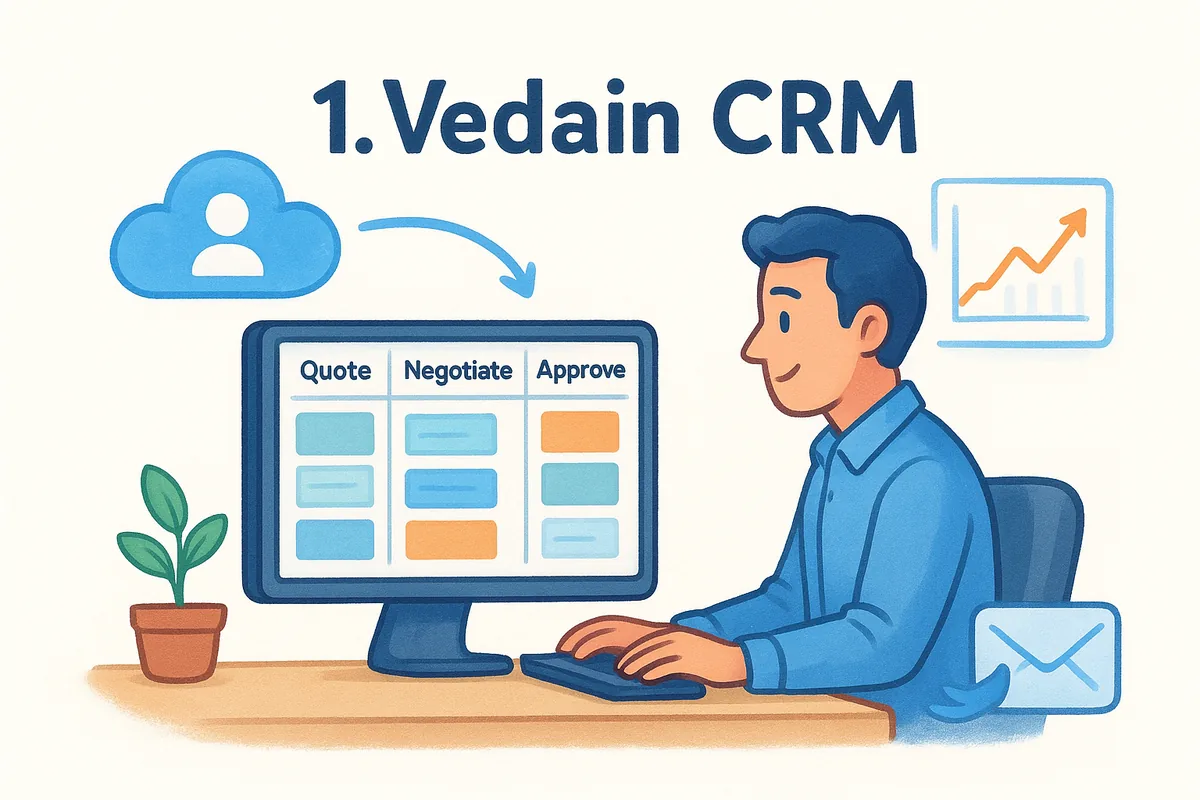
Manufacturing sales cycles rarely close in a single call, so Vedain's visual deal pipeline lets you track quotes through negotiation, approval, and reorder stages on a Kanban board. Two-way email sync with Gmail and Outlook keeps every quote request and follow-up logged against the right account automatically, without manual data entry. The no-code workflow automation builder handles repetitive tasks like reminding a rep to follow up on a stale quote or triggering a check-in email after a shipment date passes. For manufacturers running distributor outreach, the built-in email warmup feature protects domain deliverability over a 21-day period, which matters since cold outreach to new B2B buyers can tank sender reputation fast if you skip that step.
A CRM that includes automation and email sync at every tier means your sales process doesn't get more expensive as your team grows.
Pricing
Vedain charges a single flat rate of $10 per user per month, with every feature, including workflows, email campaigns, custom dashboards, and the AI agent marketplace, included from day one. There's no tiered structure and no credit card required to start a trial, so you can test it against real quotes before committing budget.
Best for
Small manufacturing teams of 2 to 50 reps who need quote tracking, distributor follow-up automation, and clean reporting without paying for enterprise modules they'll never touch. It also suits teams currently priced out of HubSpot or Zoho's higher tiers but still want comparable automation depth.
Limitations
Vedain doesn't offer the deep manufacturing-specific modules you'd find in ERP-adjacent platforms like NetSuite, such as inventory-linked quoting or production scheduling integrations. If your sales process depends heavily on syncing with a manufacturing ERP system, you'll want to confirm integration support before switching.
2. Zoho CRM
Zoho CRM has been a staple for small and mid-sized businesses for over a decade, and manufacturers often land here because of its deep ecosystem of add-on apps for inventory, invoicing, and project tracking. If you're already using Zoho Inventory or Zoho Books, the CRM ties into that stack without much extra setup, which appeals to manufacturers who want one vendor handling multiple back-office functions.
Key features for manufacturers
Zoho's Blueprint feature lets you map out multi-stage approval processes, useful for quote approvals that need sign-off from production or finance before a deal moves forward. Its multichannel communication hub tracks email, calls, and social messages in one timeline, and the built-in inventory management module (on higher tiers) connects deal stages to stock levels, a genuine advantage for manufacturers quoting against limited raw material.
Manufacturers already inside the Zoho ecosystem gain the most from this CRM; everyone else pays for integrations they may never use.
Pricing
Inventory and advanced automation features sit behind the Professional and Enterprise tiers.
Best for
Small manufacturers already running other Zoho products who want tight cross-app integration without adopting a separate CRM vendor.
Limitations
Pricing climbs fast once you need automation or inventory syncing, and the interface can feel cluttered compared to purpose-built sales tools, requiring more onboarding time for reps unfamiliar with the platform.
3. HubSpot CRM
HubSpot built its reputation on marketing software, and its CRM still carries that DNA, which makes it a popular pick for manufacturers who want lead capture and email marketing tightly bundled with pipeline tracking. Small manufacturing teams with an inbound content strategy, think downloadable spec sheets or trade show follow-ups, tend to get the most value here because HubSpot's forms and landing pages feed directly into deal records.
Key features for manufacturers
HubSpot's deal pipeline view supports custom properties, so you can track quote numbers, order quantities, or lead times alongside standard fields. The marketing hub integration lets you nurture distributor leads with drip sequences, and its reporting dashboards break down deal velocity by rep or product line. A free tier exists, but manufacturers quickly outgrow it once they need automation or custom reporting.
HubSpot rewards teams with a marketing motion already in place; without one, you're paying for tools you won't touch.
Pricing
HubSpot's Sales Hub starts free for basic contact and deal tracking, with Starter at $20 per user per month, Professional jumping to roughly $100 per user per month, and Enterprise reaching $150 per user per month. Automation, custom reporting, and forecasting sit behind the Professional tier.
Best for
Manufacturers running active inbound marketing alongside sales, especially those already publishing content or running trade show lead capture campaigns.
Limitations
Costs scale steeply once you need automation or advanced reporting, and the platform's marketing-first design means manufacturing-specific workflows, like quote approvals or reorder tracking, require workarounds rather than native tools.
4. Pipedrive
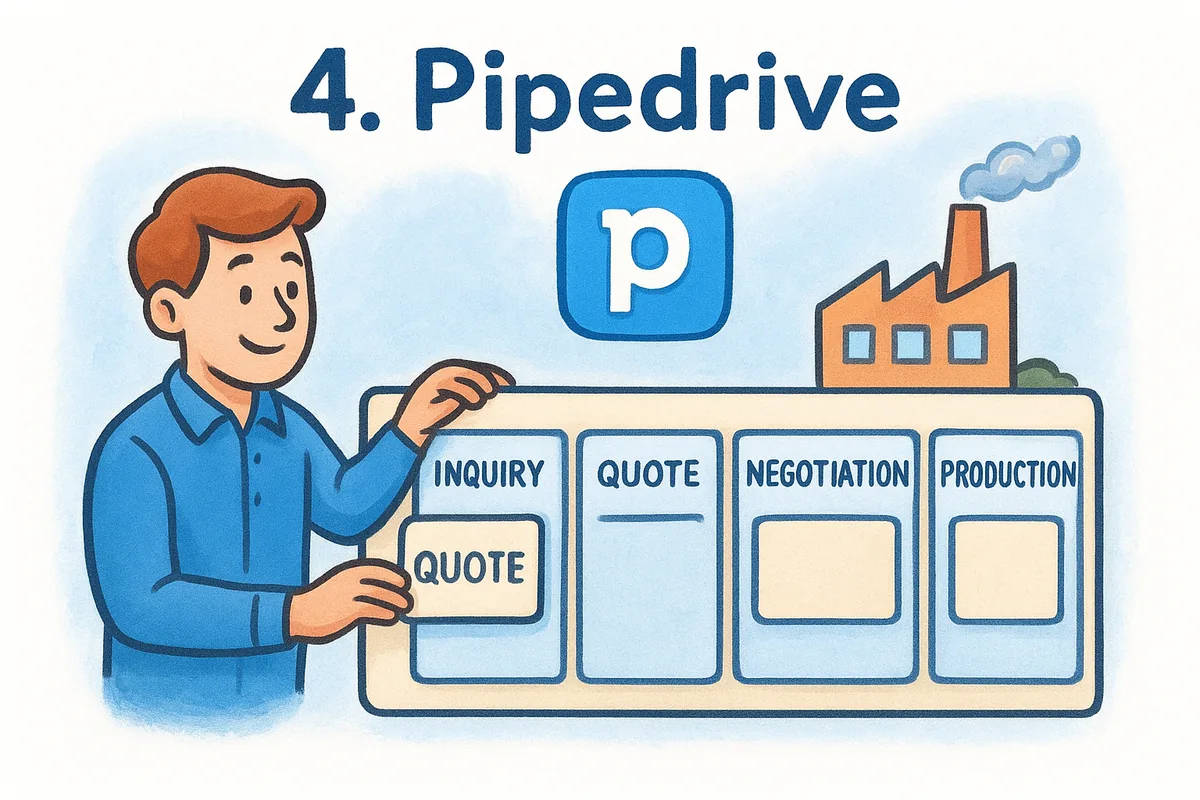
Pipedrive earned its reputation as a visual, sales-first CRM, and manufacturing teams often pick it because the pipeline interface is dead simple to configure around a quote-to-order process. Reps who resist typing notes into a CRM tend to actually use Pipedrive, since the drag-and-drop board mirrors how deals move through a factory floor's sales cycle: inquiry, quote, negotiation, production, delivery.
Key features for manufacturers
Pipedrive's customizable pipeline stages let you rename and reorder columns to match your exact quote-to-cash workflow, and its activity reminders nudge reps to follow up before a lead goes cold. The email sync feature logs correspondence against deals automatically, and higher tiers add revenue forecasting that helps predict cash flow from long manufacturing sales cycles.
Pipedrive's simplicity is its selling point, but that same simplicity means manufacturers need third-party apps to fill gaps in reporting and automation.
Pricing
Workflow automation and advanced reporting require the Advanced tier or higher, and many manufacturing-specific integrations run through Pipedrive's app marketplace at extra cost.
Best for
Small manufacturing sales teams that want a visual, easy-to-adopt pipeline without a steep learning curve for reps who've never used a CRM before.
Limitations
Native reporting stays basic until you climb into higher-priced tiers, and Pipedrive lacks built-in inventory or production-adjacent features, so manufacturers relying on ERP data inside their CRM will need paid integrations to bridge that gap.
5. Creatio
Creatio takes a different approach than most CRMs on this list by combining sales tools with a full no-code process automation platform, which appeals to manufacturers whose sales cycles involve custom approval chains that don't fit a standard pipeline template. Manufacturers with an ops-minded person willing to build out workflows tend to get the most value here, since Creatio rewards configuration time with genuinely flexible automation.
Key features for manufacturers
Building on that flexibility, Creatio's case management tools let you route quote approvals through production, finance, or compliance checkpoints before a deal advances, something generic pipeline tools handle poorly. Its industry-specific templates include manufacturing workflows out of the box, covering distributor onboarding and repeat order tracking, and the platform's marketing automation runs multi-channel campaigns to keep buyers engaged between orders.
Creatio gives manufacturers real customization power, but that power comes with a setup curve most small sales teams don't have time for.
Pricing
Creatio's Growth plan starts around $25 per user per month, with Enterprise tiers climbing past $55 per user per month depending on modules and contract length, and pricing often requires a sales call rather than a published rate. That lack of upfront transparency makes budgeting harder for small teams comparing options quickly.
Best for
Small manufacturers with complex, multi-step approval processes and at least one team member comfortable configuring no-code workflows without outside developer help.
Limitations
Learning the platform takes considerably longer than the simpler CRMs on this list, and the lack of transparent, published pricing makes it harder to compare against flat-rate alternatives before committing to a demo or contract negotiation.
6. NetSuite CRM
NetSuite comes from Oracle's ERP world, and manufacturers who already run their operations, inventory, or accounting on NetSuite often add its CRM module to keep everything under one roof. Small manufacturing businesses without an existing NetSuite footprint rarely start here, since the platform is built for companies that need order management, production tracking, and sales data unified in a single system rather than a standalone sales tool.
Key features for manufacturers
NetSuite's native ERP integration means quotes convert to sales orders without leaving the platform, pulling real inventory and production capacity data directly into the deal record. Its forecasting engine accounts for long manufacturing sales cycles and multi-location inventory, and role-based dashboards give production and finance teams visibility into the same pipeline sales reps work from.
NetSuite makes sense once your CRM needs to talk to your ERP; otherwise, you're paying for infrastructure your sales team will never use.
Pricing
NetSuite doesn't publish flat pricing. Base licensing typically starts around $999 per month plus per-user fees, and CRM functionality often gets bundled into a broader ERP implementation that requires a sales consultation and custom quote.
Best for
Small manufacturers already running or planning to adopt NetSuite ERP, where unifying sales, inventory, and production data justifies the implementation cost and timeline.
Limitations
Implementation takes weeks or months, not minutes, and the cost structure puts NetSuite out of reach for lean sales teams that just need pipeline tracking and email automation without a full ERP overhaul.
7. Insightly
Insightly positions itself as a CRM built for businesses that need project management baked into the sales process, which fits manufacturers who treat order fulfillment as its own workflow after the deal closes. Small teams juggling custom orders, where a signed quote kicks off a production timeline that needs tracking just as closely as the sale itself, tend to find Insightly's dual focus useful instead of bolting on a separate project tool.
Key features for manufacturers
Insightly's project management module converts won deals into trackable projects with milestones and tasks, so a rep can hand off a closed order to production without losing visibility into delivery dates. Its custom object feature lets you model manufacturing-specific data, like batch numbers or material specs, directly into records, and built-in workflow automation handles routine follow-ups on quotes sitting untouched for too long.
Insightly earns its keep for manufacturers who need order fulfillment tracked alongside the sale, not just the deal itself.
Pricing
Insightly's plans start at $29 per user per month for the Plus tier, climbing to $49 for Professional and $99 for Enterprise, all billed annually. Automation and custom objects require the Professional tier or higher, pushing real functionality out of reach at the entry price point.
Best for
Manufacturers who need project tracking tied directly to closed deals, particularly custom or made-to-order businesses managing production timelines after the sale.
Limitations
Entry-level pricing looks competitive until you need automation, which sits behind a $49 tier, and the interface feels dated compared to newer sales-first CRMs on this list.
8. Zendesk Sell
Zendesk Sell grew out of Zendesk's customer service roots, and that heritage shows in how it handles the handoff between sales and support, a genuine strength for manufacturers who need warranty claims or reorder requests routed back to the same account history a rep already sees. Teams already running Zendesk for customer support tend to adopt Sell first, since the shared data layer means a support ticket about a defective batch surfaces right next to the original deal record.
Key features for manufacturers
Zendesk Sell's built-in call tracking and email sequencing keep distributor outreach logged without manual entry, and its visual pipeline supports custom stages for quote, production, and delivery tracking. The platform's mobile app stands out for field reps visiting plant floors or distributor warehouses, letting them update deal stages and log notes without a laptop. Integration with Zendesk's support suite means a manufacturer running both platforms gets a single view of the customer across sales and post-sale service.
Zendesk Sell earns its value from the sales-to-support handoff, not from manufacturing-specific pipeline features.
Pricing
Advanced reporting, forecasting, and workflow automation require the Growth tier or higher, billed annually.
Best for
Small manufacturers already using Zendesk for customer support who want warranty and service history connected directly to sales records without a separate integration.
Limitations
Zendesk Sell lacks the manufacturing-specific templates found in Creatio or the inventory ties in Zoho, and pricing climbs quickly once you need automation, making it a harder sell for teams without an existing Zendesk support subscription to justify the cost.
9. How to choose the right CRM for your manufacturing business
Most small manufacturing teams overthink this decision by comparing feature lists instead of matching a platform to how their sales cycle actually runs. Start with your quote-to-order timeline: if deals close in weeks with multiple approval steps, you need a pipeline that supports custom stages and reminders, not just a simple contact list. Think about your team's technical comfort next, since a no-code automation builder only helps if someone on your team will actually build the workflows.
Budget matters just as much as features, but the real question is whether the price you see today stays the price you pay in a year. Many crm for manufacturing companies searches end with teams signing up for an entry tier, then getting hit with upgrade prompts the moment they need automation or reporting.
The CRM that fits your manufacturing business is the one whose price stays flat as your feature needs grow, not the one with the lowest sticker price today.
Run through this checklist before you commit:
- •Does the pricing include automation, email sync, and reporting, or do those sit behind a paywall?
- •Can you customize pipeline stages to match your quote-to-order process without a developer?
- •Does it integrate with the email provider your team already uses daily?
- •Will it still make sense at double your current headcount?
- •Can you trial it with real quotes before paying anything?
Once you've answered those honestly, the shortlist gets short fast.
Finding the right fit for your team
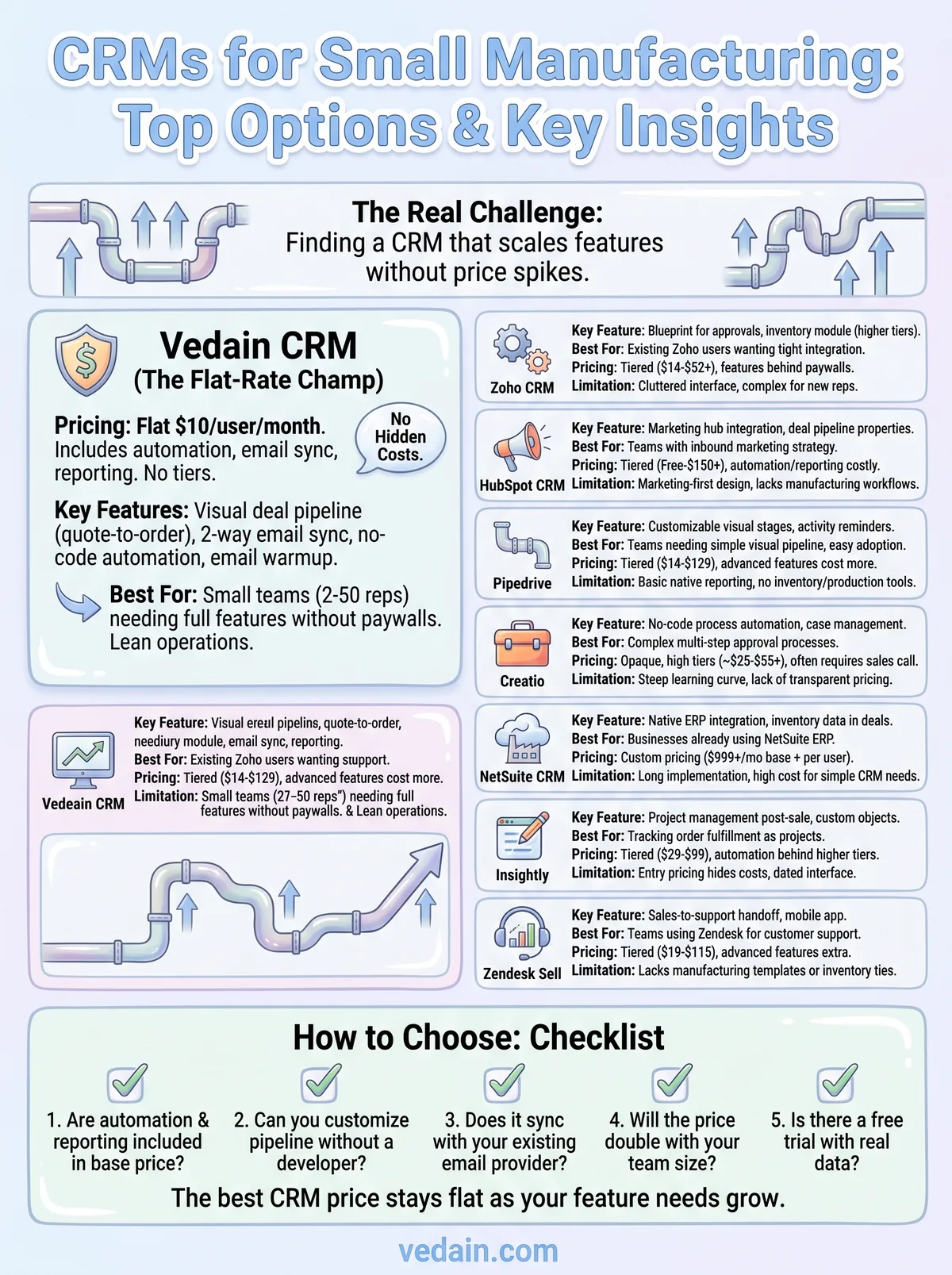
Every CRM on this list solves a real problem, but most of them solve it by charging you more once your manufacturing sales process gets serious about automation, reporting, or email sync. Zoho and NetSuite make sense if you're already tied into their ecosystems. Creatio and Insightly fit teams with complex approval chains or production handoffs worth the setup time. HubSpot and Zendesk Sell reward teams with an existing marketing or support motion. Pipedrive keeps things simple but hands you a bigger bill the moment you need more than a basic pipeline.
Given all that, the best CRM for small manufacturing business teams comes down to one question: does the price you pay today stay the price you pay as you grow? Vedain answers that with a flat $10 per user rate that never gates automation or reporting behind a higher tier. Start a free trial and test it against your real quotes before you decide.
Related reading
Frequently Asked Questions
What is the best CRM for small manufacturing businesses with limited budgets?
Zoho CRM is the best budget-friendly option for small manufacturers, starting at just $14 per user per month. It offers robust features like inventory management, order tracking, and sales automation comparable to HubSpot's $45/month starter plan, but at a fraction of the cost. Pipedrive and Freshsales are also affordable alternatives, making them ideal for manufacturers watching their bottom line.
Which CRM has the best inventory and supply chain integration for manufacturers?
Vedain CRM is specifically designed for manufacturing and includes native inventory management and supply chain visibility features that general CRMs like Salesforce and HubSpot require custom integration to achieve. Zoho CRM also excels in this area with integrated inventory tracking and manufacturing-specific workflows. These platforms outperform generic options like Pipedrive when it comes to managing manufacturing-specific processes.
Can small manufacturers use Salesforce, or is it too expensive?
Salesforce's Essentials plan starts at $165 per month, making it expensive for most small manufacturers compared to alternatives. Zoho CRM, Pipedrive, and Freshsales offer similar functionality at significantly lower price points ($14-29 per user monthly). Most small manufacturing businesses find better value in mid-market solutions that balance affordability with manufacturing-specific features.
What CRM features do manufacturing sales teams need most?
Manufacturing sales teams need quote management, project tracking, multi-stage deal pipelines, and customer account hierarchies to manage complex B2B relationships. HubSpot, Salesforce, and Zoho CRM all offer these features, but Vedain and specialized manufacturing CRMs include additional tools like bill of materials tracking and production scheduling. Pipedrive and Freshsales provide solid pipeline management but lack native manufacturing-specific capabilities.
Is HubSpot CRM better than Zoho for manufacturing businesses?
HubSpot CRM's free tier is excellent for very small teams, but Zoho CRM offers better value for manufacturers due to lower paid tier costs ($14-35/month) and native manufacturing integrations. HubSpot's pricing jumps significantly ($45+ monthly for paid features), and it lacks built-in inventory management that manufacturers need. For manufacturing-specific requirements, Zoho, Vedain, or industry-specific solutions typically outperform HubSpot.
Which CRM integrates best with manufacturing accounting software?
Zoho CRM integrates seamlessly with Zoho Books and other accounting platforms, making it ideal for manufacturers who want unified financial and sales data. Salesforce offers extensive integrations through AppExchange, but requires more technical setup and investment. Vedain, Pipedrive, and Freshsales all support common manufacturing accounting systems, though Zoho's native integration with its own ecosystem provides the smoothest experience for small manufacturers.