This guide cuts through that noise. We tested and compared 11 platforms based on lead capture quality, pricing transparency, ease of setup, and how well each tool plays with the rest of your sales stack, especially your CRM. Whether you need website forms, cold outreach automation, or AI-powered enrichment, you'll find a clear pick here instead of a vague ranking.
Below, you'll see honest breakdowns of what each tool does well, where it falls short, and who it actually fits. We built Vedain CRM because too many teams pay extra for basic features like email sync or automation, so you'll notice we're upfront about pricing traps elsewhere on this list too. By the end, you'll know exactly which lead generation software matches your budget and your team's size in 2026.
1. Vedain CRM for all-in-one lead management and automation
Vedain CRM built its reputation by refusing to gate basic features behind expensive tiers, which matters most when you're evaluating lead generation software for a growing sales team. It combines lead capture, pipeline tracking, and outreach automation into one flat-rate platform instead of forcing you to stitch together three or four separate tools. Setup takes under five minutes, and you don't need a credit card to start the trial, so you can test real lead flows before committing a budget line.
Key features
The full Vedain CRM feature set covers the entire lead lifecycle, from the first form fill to the closed deal, without upsells hiding behind a paywall.
- •Lead Forms for capturing website visitors directly into your pipeline
- •AI Agent Marketplace with 30+ AI agents for sales teams handling data enrichment and content generation
- •Email Warmup that improves domain deliverability over 21 days
- •Workflows, a no-code automation builder for nurturing leads automatically
- •Two-way Email Integration with Gmail and Outlook
- •LinkedIn Automation for scheduling AI-generated posts that attract inbound leads
- •Visual Kanban pipeline for tracking deals from lead to close
A CRM that captures leads but can't nurture or enrich them just shifts your busywork somewhere else.
Best for
Small to mid-sized sales teams and startups get the most out of Vedain, especially ones tired of paying extra for automation or email sync that competitors treat as premium add-ons. Founders running lean operations appreciate that lead capture, enrichment, and outreach live in the same system, so nothing falls through the cracks between tools. Teams already using Gmail or Outlook will notice the two-way sync works out of the box, no middleware required.
Pricing
Pricing stays simple: $10 per user per month, flat, with every feature included. There's no tiered plan that locks Workflows, Email Warmup, or the AI Agent Marketplace behind a higher price point, which is rare in this category. Compare that to competitors charging $50 to $150 per user once you add marketing automation or enrichment add-ons, and the math favors Vedain quickly for teams over five seats. You can check current details and start a trial on the affordable CRM pricing page.
2. HubSpot for inbound marketing and CRM
HubSpot built the modern playbook for inbound marketing software, pairing blogs, landing pages, and forms with a CRM that tracks every touchpoint a lead makes before they ever talk to sales. It's the tool most marketing teams already know, which makes it an easy default pick even when the pricing gets complicated fast. If your lead generation strategy leans heavily on content and SEO rather than outbound outreach, HubSpot's ecosystem fits naturally.
Key features
HubSpot packages marketing, sales, and service tools into one suite, though many of the best pieces sit behind paid hubs.
- •Landing page and form builder with A/B testing
- •Marketing automation workflows for nurturing leads
- •Built-in CRM with contact timelines and deal tracking
- •Ads management syncing directly with lead data
- •Reporting dashboards across marketing and sales funnels
Inbound tools only pay off when the CRM behind them doesn't punish you for growing your list.
Best for
Marketing-led teams with dedicated content or demand generation staff get the most value here, especially companies already producing blog content and needing a lead generation platform to capture and score that traffic. Larger teams with budget to spend on multiple hubs will find HubSpot scales, but smaller teams often outgrow the free tier faster than expected and start comparing HubSpot alternatives for small business.
Pricing
Starter plans begin around $20 per month, but real functionality like automation and multiple contact properties pushes you into Professional tiers costing $800 or more per month for the Marketing Hub alone, as the full pricing breakdown shows. Add Sales Hub and Service Hub, and costs climb quickly for teams that need more than basic contact management. Compare that structure against flat-rate alternatives before committing, since feature gating here is common and expensive.
3. Salesforce Sales Cloud for enterprise sales pipelines
Salesforce built its name on customization, and Sales Cloud remains the benchmark for large organizations that need a lead generation platform flexible enough to model complex, multi-region sales processes. If your team has a dedicated admin or Salesforce partner on staff, you can build almost anything on top of it, from custom lead scoring rules to territory management across dozens of business units. That flexibility comes at a cost in both dollars and setup time, so it rarely suits teams looking for a quick start.
Key features
Sales Cloud's strength lies in depth rather than simplicity, which shows in how many modules it packs into its ecosystem.
- •Einstein AI for lead scoring and predictive forecasting
- •Customizable pipeline stages and approval workflows
- •AppExchange marketplace with thousands of third-party integrations
- •Advanced reporting with cross-object dashboards
- •Role-based permission hierarchies for large sales orgs
Enterprise flexibility only helps if your team has the time and budget to configure it properly.
Best for
Larger sales organizations with dedicated Salesforce admins or consultants get the most value, particularly companies running complex approval chains or multiple business units that need strict data segmentation. Smaller teams without technical resources often find the setup overwhelming compared to simpler lead management software options built for speed, which is why many end up reviewing leaner Salesforce alternatives.
Pricing
Plans start around $25 per user per month for the Starter Suite, but most growing teams need Professional or Enterprise tiers, which run $80 to $165 per user monthly before add-ons like Einstein AI or CPQ. Implementation and admin costs often exceed the license fee itself, according to Salesforce's own pricing page, so budget accordingly before you commit.
4. Apollo.io for B2B sales prospecting and data enrichment
Apollo.io built its name on a massive contact database, giving outbound sales teams a lead generation platform that finds verified emails and phone numbers before a rep ever picks up the phone. Reps searching for B2B lead generation software often land here first because Apollo combines prospecting, enrichment, and outreach sequencing in one workspace, which cuts down on the tab-switching that slows down cold outreach. If your growth strategy depends on outbound volume rather than inbound content, Apollo fills a gap most CRMs leave open.
Key features
Apollo's core strength is its database, but the platform wraps useful automation around that data.
- •Contact database with over 275 million verified profiles
- •Chrome extension for pulling contact data from LinkedIn
- •Multi-step email sequences with automated follow-ups
- •Intent data signals showing which accounts are actively researching
- •Built-in dialer for click-to-call outreach
A prospecting tool only earns its price tag if the contact data behind it stays accurate.
Best for
Outbound-focused sales teams get the most value from Apollo, especially SDR teams running high-volume cold email or call campaigns that need fresh, verified contact data every week, though it's worth weighing against other B2B sales prospecting tools first. Startups without a dedicated data enrichment budget also lean on Apollo instead of paying separately for tools like ZoomInfo.
Pricing
Apollo offers a free plan with limited credits, while paid plans range from roughly $49 to $99 per user per month depending on how many email credits and enrichment records you need. Costs climb fast once you add advanced intent data or larger export limits, so calculate your monthly credit usage before committing to a tier.
5. Zapier for automating your lead generation stack
Zapier isn't a lead generation platform itself, it's the glue that connects your lead forms, ad platforms, and CRM so leads move automatically instead of sitting in a spreadsheet someone forgets to check. Teams running lead generation automation across multiple tools use Zapier to trigger workflows the moment a new lead fills out a form on Facebook, submits a Typeform, or replies to a cold email. If your stack already includes five or six specialized tools, Zapier is often the cheapest way to make them talk to each other, though you can also send website leads straight into your CRM without a developer.
Key features
Zapier's value comes from breadth, connecting thousands of apps without writing a line of code.
- •Over 6,000 app integrations, including most CRMs and ad platforms
- •Multi-step Zaps that chain actions across tools
- •Filters and conditional logic for routing leads by source or score
- •Built-in formatter for cleaning data between apps
- •Webhooks for connecting custom or less common tools
Automation only saves time when it removes manual steps, not when it just adds another dashboard to check.
Best for
Teams juggling multiple point solutions get the most from Zapier, especially marketers who capture leads through several forms or ad platforms and need them synced into one CRM without manual exports. It also suits technical teams who want custom logic between tools that native integrations don't support.
Pricing
Zapier's free plan covers basic single-step Zaps, but most lead workflows need the Starter plan at around $20 per month, with Professional and Team tiers running $50 to $100 or more depending on task volume, according to Zapier's pricing page. Costs scale with usage, so high-volume lead flows can get expensive fast.
6. Hunter for cold email outreach
Hunter built a focused reputation around one job: finding and verifying professional email addresses so your outreach lands in real inboxes instead of bouncing. Sales teams searching for cold email software often start here because Hunter's domain search shows every publicly associated email tied to a company, paired with a confidence score for deliverability. It's a lighter tool than a full prospecting suite like Apollo or the heavier cold email outreach platforms, which makes it a good fit when you already know who you want to reach and just need verified contact details fast.
Key features
Hunter keeps its feature set narrow but reliable, which suits teams who don't want a bloated platform for a simple job.
- •Domain Search for finding email patterns tied to any company
- •Email Verifier that checks deliverability before you send
- •Chrome extension for pulling emails while browsing LinkedIn or company sites
- •Campaigns feature for sending simple follow-up sequences
- •API access for connecting email finding to other tools in your stack
Cold outreach only works when the address you're emailing actually exists.
Best for
Solo founders and small sales teams get the most value from Hunter, especially those running lean lead generation for small business outreach without a dedicated SDR team. It also suits marketers building targeted outreach lists who need quick verification before a campaign, rather than an always-on prospecting database.
Pricing
Hunter offers a free plan with 25 monthly searches, while paid plans start around $34 per month for 500 searches and scale up to $149 or more for higher volume teams. Compare that against Apollo's bundled prospecting and sequencing if you need more than email finding, since Hunter charges purely for search and verification volume rather than full outreach automation.
7. OptinMonster for converting website visitors into leads
OptinMonster tackles a different problem than the prospecting tools above: turning the traffic you already have into captured leads before visitors bounce. It's built around exit-intent popups, floating bars, and gamified spin-to-win wheels that trigger based on scroll depth, time on page, or cursor movement toward the close button. Marketers searching for website lead generation tools often land here because OptinMonster works on top of any site, whether that's WordPress, Shopify, or a custom-built page, without requiring a developer to install it.
Key features
OptinMonster's strength is its targeting logic, letting you show the right offer to the right visitor instead of blasting one popup to everyone.
- •Exit-intent detection that triggers offers right before a visitor leaves
- •Drag-and-drop campaign builder with dozens of templates
- •Behavior-based targeting by referral source, device, or page visited
- •A/B testing built into every campaign for optimizing conversion rate
- •Native integrations with major email platforms and CRMs
A popup only converts if it shows up at the exact moment a visitor is about to leave, not five seconds after they land.
Best for
Content sites and ecommerce stores get the most value here, especially teams running blogs or product pages with steady traffic but low email signup rates. Marketers who already invest in SEO or paid traffic use OptinMonster to squeeze more leads out of visits they're already paying for, usually alongside forms designed to convert visitors into qualified leads, rather than spending more on acquisition.
Pricing
Plans start around $9 per month billed annually for the Basic tier, but exit-intent technology and A/B testing require the Plus or Pro tiers, which run $19 to $49 per month. Higher tiers unlock more campaign types and remove branding, so budget for Pro if conversion testing matters to your team.
8. Intercom for live chat and conversational lead capture
Intercom turns your website into a live conversation instead of a static page, using chat widgets that qualify visitors while they're still browsing instead of waiting for them to fill out a form. Teams searching for conversational lead generation tools pick Intercom because it blends live chat, chatbots, and product tours into one system that routes qualified conversations straight to a rep. If your visitors have questions before they buy, a website chat widget as a lead channel often captures leads that a static contact form would lose.
Key features
Intercom's strength is combining automation with human handoff, so bots handle the repetitive questions and reps jump in when it matters, the same pattern behind AI live chat with human handoff in Vedain.
- •Custom chatbots that qualify leads with branching questions
- •Live chat inbox shared across sales and support teams
- •Product tours for onboarding leads before a sales call
- •Lead routing rules based on company size, source, or intent
- •Integrations with major CRMs for syncing captured conversations
A chat widget only generates leads if it asks the right questions before a human ever joins.
Best for
SaaS companies and product-led businesses get the most value from Intercom, especially teams where support and sales share the same website traffic and need one inbox instead of two disconnected tools. Companies with steady site traffic but low form completion rates often see chat convert visitors that would otherwise leave without any contact info.
Pricing
Intercom's pricing starts around $29 per seat monthly for its entry-level plan, but chatbot automation and lead routing typically require higher tiers that can run $85 to $132 per seat once you add resolutions and advanced workflows, according to Intercom's pricing page. Budget carefully, since usage-based fees for bot resolutions can push costs well past the sticker price for high-traffic sites.
9. Calendly for scheduling meetings with prospects
Calendly solves the back-and-forth email problem that kills momentum right when a lead is ready to talk. Instead of trading five messages to find a time that works, you send one link and let the prospect book directly into your calendar. Teams searching for meeting scheduling software pick Calendly because it removes friction at the exact moment a lead shows buying intent, which matters more than any fancy popup or ad campaign.

Key features
Calendly keeps its core simple but layers in enough logic to handle real sales workflows, and CRMs increasingly ship booking pages that let prospects pick a slot natively.
- •Booking links that sync with Google, Outlook, and Office 365 calendars
- •Routing forms that send prospects to the right rep based on their answers
- •Automated reminders and confirmations that cut no-show rates
- •Round-robin scheduling for distributing leads evenly across a team
- •Embeddable booking widgets for landing pages and emails
A qualified lead who can't book a meeting in ten seconds often just doesn't come back.
Best for
Sales teams handling inbound demo requests get the most out of Calendly, especially when reps split territory or product lines and need routing logic baked into the booking flow. It also suits solo consultants and account executives who want one link to share instead of managing calendar invites manually all day.
Pricing
Calendly offers a free plan for single event types, while the Standard tier runs around $12 per seat monthly and adds routing forms plus reminders. Teams and Enterprise plans climb to $20 and up per seat, unlocking round-robin distribution and admin controls, according to Calendly's pricing page. Budget for Standard at minimum if your lead generation software stack depends on fast meeting handoffs.
10. Mailchimp for email marketing and drip campaigns
Mailchimp started as a simple newsletter tool and grew into a full email marketing platform built for nurturing leads long after they hit your list. Teams searching for lead nurturing software often already know the name, since Mailchimp's drag-and-drop editor and audience segmentation make it easy to turn a cold signup into a warm lead without writing code. Unlike prospecting tools higher on this list, Mailchimp assumes you already have the contact, its job is turning that contact into a conversation.
Key features
Mailchimp's strength sits in campaign design and automation, not in finding new contacts.
- •Drip campaigns triggered by signup, purchase, or inactivity, built from ready-made drip campaign templates
- •Audience segmentation by tags, behavior, or purchase history
- •Landing page and signup form builder for capturing new leads
- •A/B testing for subject lines and send times
- •Basic CRM features including contact scoring and activity timelines
Email nurturing only works when the sequence matches where the lead actually is, not where you wish they were.
Best for
Ecommerce brands and content businesses get the most value here, especially teams that already collect emails through checkout or content downloads and need automated follow-up without hiring a marketing ops person. Smaller teams appreciate that Mailchimp bundles basic CRM functions, though it won't replace a dedicated pipeline tool once deal volume grows and you need nurture sequences that run on autopilot.
Pricing
Mailchimp offers a free plan for up to 500 contacts, while the Essentials tier starts around $13 per month and scales with list size. Standard and Premium tiers run $20 to $350 or more monthly depending on contacts and automation depth, according to Mailchimp's pricing page. Budget for Standard if drip campaigns and behavioral targeting matter to your lead flow.
11. LinkedIn, Facebook, and Google ads for paid lead generation
Paid ads solve a different problem than every tool above: instead of waiting for organic traffic or cold outreach to work, you buy your way in front of the exact audience you want today. LinkedIn Lead Gen Forms, Facebook Lead Ads, and Google's Local Services and Search campaigns all let visitors submit contact details without leaving the platform, which removes the landing page friction that kills conversion rates. Teams researching paid lead generation usually run all three at once, since each platform reaches a different buying stage and audience type.
Key features
Each platform brings its own targeting strengths, but together they cover cold, warm, and bottom-funnel intent.
- •Native lead forms on LinkedIn and Facebook that pre-fill contact info from the user's profile, ready for automatic lead capture and routing into your CRM
- •Google Search campaigns targeting high-intent keywords tied to buying decisions
- •Detailed audience targeting by job title, company size, or interest
- •Conversion tracking pixels for measuring cost per qualified lead
- •Retargeting pools built from website visitors or CRM lists
Paid ads only pay off when your CRM captures every lead the moment it arrives, before the cost per click adds up.
Best for
B2B teams selling to specific job titles get strong results from LinkedIn, while Facebook suits consumer offers and local businesses needing volume. Google Ads works best for teams targeting buyers already searching for a solution, since intent runs highest there.
Pricing
Costs vary widely by industry, but expect $5 to $15 per click on Google for competitive B2B keywords, and LinkedIn's cost-per-lead often runs $50 to $150 depending on targeting. Facebook stays cheaper per click but needs more volume to hit the same lead quality, so budget for testing before scaling spend.
12. How to choose the right lead generation software
Picking the right tool starts with an honest look at where your leads actually come from today. If most of your pipeline comes from outbound cold email, a prospecting database like Apollo or Hunter matters more than a popup builder. If your traffic already converts poorly on a content-heavy site, OptinMonster or Intercom fixes a real leak before you spend more on ads. Match the tool to the bottleneck, not the trend, and be clear on the difference between lead generation and lead nurturing before you buy.
Budget deserves the same scrutiny. Many platforms advertise a low entry price, then gate automation, sync, or reporting behind a Professional or Enterprise tier once you actually need them. Feature gating turns a $20 plan into an $80 plan fast, so read the pricing page for what's excluded, not just what's included.
Team size and technical resources narrow the field further, which is where a checklist for choosing a CRM helps. A five-person startup rarely needs Salesforce's configuration depth, and a 200-person sales org will outgrow a single-purpose tool like Calendly within a year. Consider these questions before you commit:
- •Does the tool sync natively with the CRM your reps already use daily?
- •Will pricing stay predictable as your team or contact list grows?
- •Does it solve your actual lead bottleneck, capture, outreach, or nurture?
- •Can your team set it up without hiring a consultant or developer?
The best lead generation software isn't the one with the most features, it's the one that fits the gap in your current pipeline.
Most teams end up running two or three tools from this list together: one for capture, one for outreach, and a CRM like Vedain tying the data together so nothing gets lost between them.
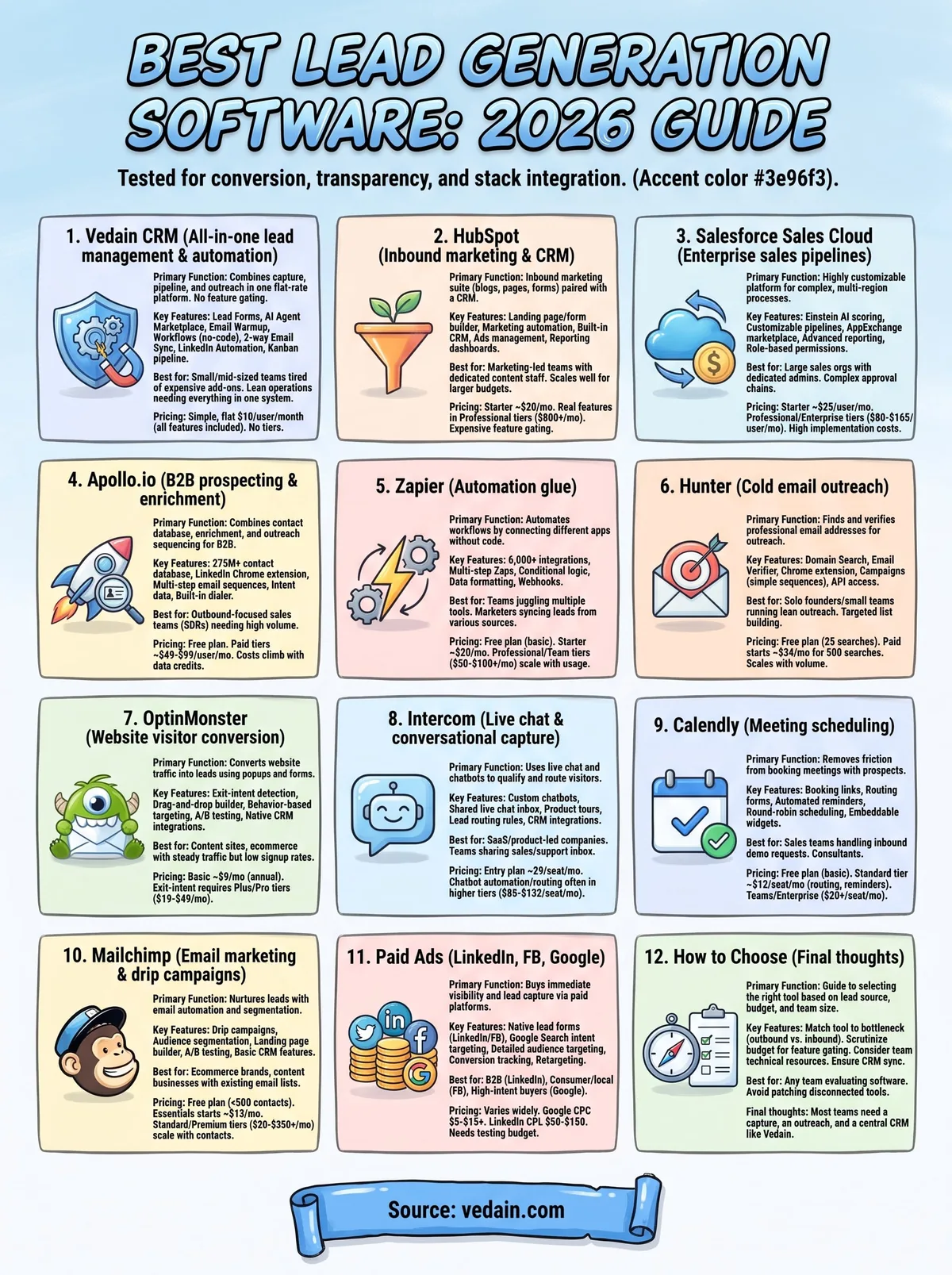
Final thoughts on choosing your tools
None of these 11 tools work in isolation, and the best lead generation software for your team depends entirely on where leads actually stall today. Outbound teams need Apollo or Hunter. Content-heavy sites need OptinMonster or Intercom. Every team needs somewhere to send captured leads that doesn't punish growth with hidden fees or locked features.
That's the gap Vedain fills. Rather than paying separately for pipeline tracking, email sync, automation, and enrichment, you get all of it at one flat rate, so the tools above plug into a CRM that actually keeps up instead of forcing you to upgrade every time you add a feature you need.
Stop patching together disconnected tools and start with a system built to hold your entire pipeline. Start your 14-day free trial of Vedain CRM and see how fast a properly connected sales stack moves leads to closed deals.
Frequently Asked Questions
What is the best lead generation software for small businesses in 2026?
HubSpot and Pipedrive are the best lead generation tools for small businesses, offering affordable pricing starting at $45-50/month with robust lead capture and nurturing features. HubSpot provides free CRM functionality alongside its paid tools, while Pipedrive excels at pipeline management. Freshsales and Zoho CRM are also budget-friendly alternatives with strong lead tracking capabilities at lower price points.
How much does enterprise lead generation software cost compared to SMB solutions?
Enterprise lead generation software from Salesforce typically costs $150-$500+ per user monthly, significantly higher than SMB tools like Pipedrive ($45-$99/month) or HubSpot ($50-$120/month). Zoho and Freshsales offer mid-market solutions at $30-$60/month, making them cost-effective bridges between budget and enterprise options. The price difference reflects advanced AI, custom integrations, and dedicated support in enterprise platforms.
Which lead generation tool integrates best with existing CRM systems?
HubSpot and Salesforce offer the most extensive integrations with over 1,000+ third-party applications, including email, marketing automation, and analytics platforms. Pipedrive and Zoho CRM provide strong integration capabilities within their ecosystems, while Freshsales excels at connecting with customer support and helpdesk tools. Most modern lead generation platforms use APIs and Zapier compatibility to bridge gaps with legacy systems.
What are the key differences between HubSpot and Salesforce for lead generation?
HubSpot emphasizes ease-of-use with all-in-one marketing, sales, and service tools at lower price points ($50-$3,200/month), while Salesforce focuses on enterprise customization and scalability at higher costs ($165-$500+/month). HubSpot is better for inbound lead generation through content and automation, whereas Salesforce excels at managing complex B2B sales processes with advanced forecasting. For small to mid-market companies, HubSpot typically offers better value; enterprises benefit more from Salesforce's customization.
Can lead generation software automatically qualify leads based on criteria?
Yes, modern lead generation tools like HubSpot, Salesforce, and Pipedrive use AI-powered lead scoring to automatically qualify prospects based on engagement, demographics, and behavior. Zoho CRM and Freshsales offer customizable scoring rules that assign points based on website visits, email opens, and form submissions. This automation saves sales teams time by prioritizing high-quality leads and reducing manual qualification work.
Which lead generation software has the best mobile app for sales teams?
Pipedrive and Salesforce offer the most comprehensive mobile apps, allowing sales reps to capture, qualify, and nurture leads directly from their phones. HubSpot's mobile app provides solid functionality for managing pipelines and viewing lead information on-the-go. Freshsales and Zoho CRM also deliver strong mobile experiences with offline capabilities, making them ideal for field sales teams who need real-time lead access.