Most buyers hit the same wall. Every vendor says it is built for growth, prices hide behind tiers and add-ons, and "CRM for SaaS companies" can mean either a cloud CRM or a CRM tuned to subscription revenue. You end up with a dozen tabs open and no shortlist.
This article fixes that. It explains what a SaaS CRM is and what changes when your company sells software. Then it reviews eight platforms with the same three checks: what each offers, who it suits and what it costs. Vedain is our own product, so it comes first, and we judge it by the same criteria as the rest.
What a SaaS CRM is and how CRM for SaaS differs
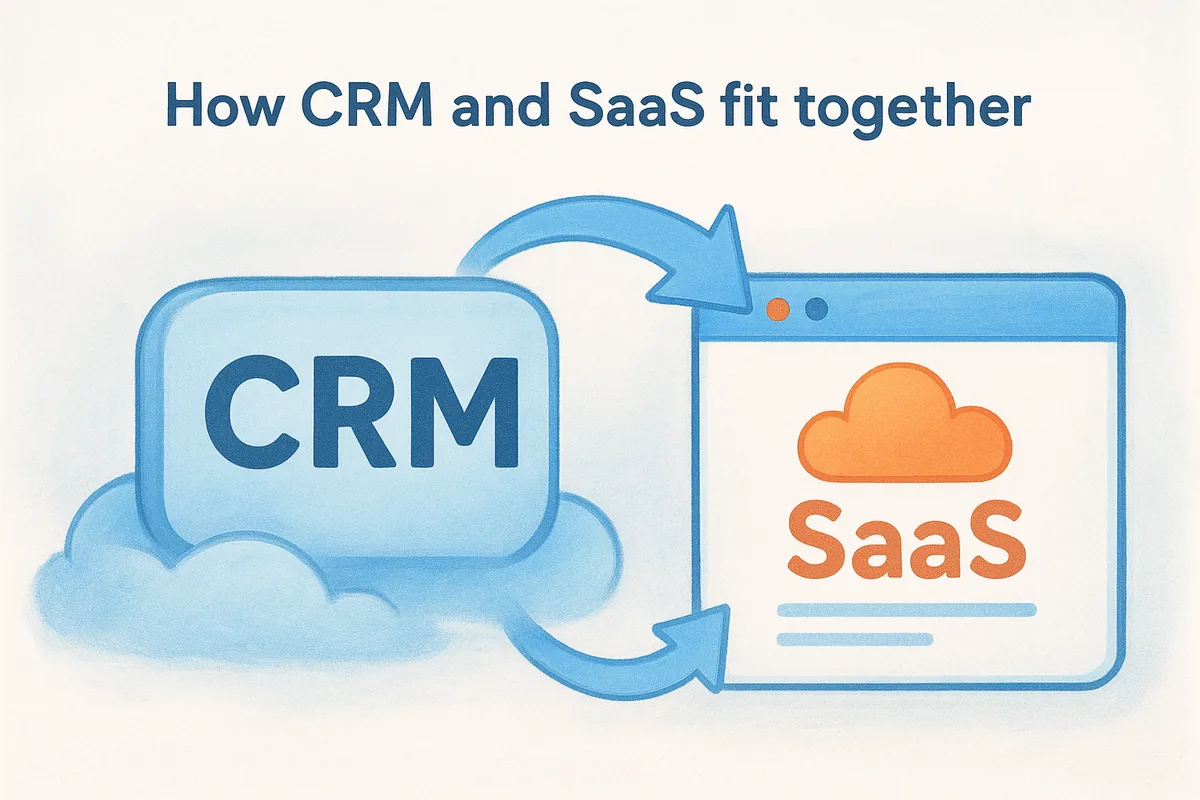
How CRM and SaaS fit together
A CRM is the software category, and SaaS is the way it is delivered. A SaaS CRM (also called a cloud CRM, or CRM as SaaS) is hosted, updated and secured by the vendor, and you pay a monthly or annual subscription per user. Nearly every modern CRM works this way, so "CRM and SaaS" is really a choice against the older on-premise model.
| SaaS CRM | On-premise CRM | |
|---|---|---|
| Hosting | Vendor's cloud | Your own servers |
| Upfront cost | Low, subscription-based | Licenses, hardware, IT staff |
| Setup | Days, sometimes minutes | Often months |
| Updates and security | Handled by the vendor | Handled by your IT team |
| Access | Any device with internet | Depends on your network setup |
Almost every CRM you can buy today is SaaS, so the real decision is which one, not whether.
What CRM for SaaS companies adds
"CRM for SaaS" has a second meaning: a CRM tuned to subscription selling rather than one-off deals. The pipeline looks different. You track trial sign-ups, trial-to-paid conversion, renewals and expansion revenue, not only closed-won deals. Reports should show MRR, churn and customer lifetime value.
Before you shortlist, check how each tool receives product and billing data. Some handle it with custom objects and a Stripe integration, while others need a connector. A general cloud CRM works well for a sales-led SaaS company. A trial-heavy product needs sign-up data in the same record as the deal.
The four types of CRM
Analysts group CRM tools into four types. Operational CRM runs daily sales, marketing and service processes. Analytical CRM turns customer data into reports. Collaborative CRM shares customer information across teams. Strategic CRM serves long-term, customer-centric goals. Most platforms below blend the first three, so use the labels to define what you need, not as a product category.
1. Vedain CRM
What it offers
Vedain is a flat-price sales CRM with every feature on one plan. Its SaaS CRM setup gives software sales teams full funnel visibility, from first sign-up to expansion ARR. The rest of the product covers how small teams actually sell, and the full feature list shows the detail.
- •Lead and contact management, a visual deal pipeline, reports and custom dashboards.
- •Two-way Gmail and Outlook sync, multi-step email campaigns with a drag-and-drop designer and 130+ templates, plus safe domain warmup and email verification.
- •WhatsApp messaging (a usage-based extra), website Live Chat with an AI assistant, Facebook and Instagram posting with Lead Ads capture, LinkedIn post automation and no-code workflows.
Who it suits
Founders, sales managers and small and mid-sized sales teams in India and the UAE get the most from Vedain. It fits teams that sell over WhatsApp, capture leads from IndiaMART, Justdial and Meta ads, and handle GST invoicing. It also suits teams that care about email deliverability, because warmup and verification sit inside the CRM. UAE startups from pre-seed to Series A can use the Startup CRM setup to replace a WhatsApp-and-spreadsheet sales process.
One price, every feature, and the channels your buyers actually answer on.
The trade-off is scope. If you need a marketplace of thousands of third-party apps or heavily customized enterprise processes, a larger platform such as Salesforce fits better. Setup is quick, so you can test the fit during the free trial before you commit.
Pricing
Vedain costs $10 per user per month, or about $8.33 per user per month on annual billing (two months free), with no feature tiers or upsells. Every CRM feature is included; usage-based extras such as WhatsApp messaging are billed separately. The 14-day free trial needs no credit card. You can cancel at any time and add or remove seats from the Billing page.
Take a 10-person team. That is $100 a month, or $1,000 a year on annual billing. Payments run in USD and AED through Stripe and in INR through Razorpay, including UPI and net banking.
2. HubSpot CRM
What it offers
HubSpot CRM runs marketing, sales and service on one platform and starts with free tools for up to 2 users. That is why it is often the first CRM a SaaS team tries.
- •Drag-and-drop pipelines you can customize per sales motion, such as new business versus renewals.
- •Custom objects and reporting that track MRR, churn and retention.
- •An app marketplace with thousands of integrations, including Stripe, Slack and Zoom.
- •AI agents that help research leads and draft outreach.
Who it suits
Scaling SaaS companies that want marketing and sales to share one set of data get the most from HubSpot. A marketing lead becomes a deal and then a support ticket without stitching tools together. The interface is easy enough that reps adopt it quickly.
HubSpot is the safest default for a SaaS team that wants marketing and sales on one record.
The catch is cost and depth. Advanced customization sits on higher-priced tiers, and the bill grows as you add seats and extra hubs. A team that only needs a pipeline may pay for more than it uses.
Pricing
HubSpot offers free CRM tools for up to 2 users. Sales Hub Starter is listed from $7 per seat per month billed annually, or $20 billed monthly. Professional costs $90 per seat per month billed annually ($100 monthly) plus a required one-time $1,500 onboarding fee, and Enterprise starts at $150 per seat.
For a 10-person team on Starter, expect about $70 a month on annual billing or $200 on monthly billing. The $7 rate is labelled "starts at" and may be promotional, so confirm the current figure on HubSpot's pricing page before you budget.
3. Salesforce Sales Cloud
What it offers
Salesforce Sales Cloud is the enterprise standard for deep customization, and the company popularized the SaaS CRM category. It is also a development platform, so people count it as both SaaS and PaaS.
- •Flow Builder for complex automation logic.
- •Einstein, the AI layer for insights and generative drafting.
- •AppExchange, a large marketplace of third-party apps.
Who it suits
Large sales organizations with complex, custom workflows are the natural fit. That includes SaaS companies with several products, territories or approval chains, where a CRM has to model unusual processes.
Salesforce can model almost anything, but you pay for that freedom in time and money.
Implementation is the trade-off. Rollouts can stretch over months, the learning curve is steep, and many companies need a dedicated administrator or consultants. A ten-person team rarely needs that weight.
Pricing
Plans run from $25 per user per month for Starter Suite and $100 for Pro Suite (billed annually). In September 2026 Salesforce replaced its Enterprise, Unlimited and Agentforce 1 editions with Core at $195, Advanced at $395 and Max at $550 per user per month, billed annually. There is also a Free Suite and a 30-day free trial.
Ten users on Starter Suite cost $250 a month. Ten on Core cost $1,950 a month, before any implementation work.
4. Zoho CRM
What it offers
Zoho CRM delivers a lot of function for little money and sits inside a wider suite of business tools that includes mail, documents and finance.
- •Zia, an AI assistant for predictions and sentiment analysis.
- •Canvas, a design studio for reshaping the CRM interface.
- •Omnichannel communication across phone, email and social media.
- •A free plan for up to 3 users.
Who it suits
Budget-conscious SaaS startups that want one suite instead of five tools are Zoho's core audience. Bootstrapped teams get a long feature list at a low price, along with deep customization options.
Zoho gives you the most function per dollar, if you accept some setup work.
Expect some friction. The interface can feel cluttered next to newer tools, support quality is reported as inconsistent, and tailoring the system to your process takes time. Plan a few days of configuration, not a few minutes.
Pricing
Zoho has a free plan for up to 3 users. Paid plans start with Standard at $14 per user per month billed annually, or $20 billed monthly. Professional is $23 annually ($35 monthly) and Enterprise $40 ($50).
Ten users land at roughly $140 a month on the entry paid plan with annual billing, or $200 on monthly billing.
5. Pipedrive
What it offers
Pipedrive is a sales execution tool built around a clean, visual pipeline. It is less a growth platform than a place to move deals from left to right.
- •A Kanban-style visual pipeline.
- •Activity reminders that keep deals from going stale.
- •An AI sales assistant that suggests what to prioritize.
Who it suits
Small sales teams focused on pipeline velocity get the best return. That includes SaaS teams with a structured, activity-based sales process. Setup is quick and reps rarely need training.
Pipedrive is the right pick when selling is the whole job and marketing lives in another tool.
The limits show up outside sales. Marketing and customer service features are thin next to all-in-one platforms. Report customization is limited, and add-on packages can raise the final bill noticeably.
Pricing
Pipedrive starts at about $14 per user per month on the Lite plan, billed annually. It has no free plan but offers a 14-day trial with no card. Prices can vary by region, and add-ons such as LeadBooster are priced separately, so check which your process needs.
A 10-person team pays about $140 a month for the base plan on annual billing, before add-ons.
6. Freshsales
What it offers
Freshsales is part of the Freshworks suite and positions itself as an easy-to-use alternative to Salesforce. It combines sales and marketing data into a single customer view.
- •Freddy AI for deal insights and forecasting.
- •A 360-degree view of every customer.
- •Drag-and-drop visual pipelines.
- •Web forms that capture website leads directly.
Who it suits
Mid-market SaaS teams that want AI features out of the box and a fast setup fit Freshsales well. Freddy AI is a headline feature, but the AI features included vary by tier, so check what your plan covers during the trial.
Freshsales is a low-cost way to get AI-assisted selling without a long implementation.
Reporting is the weak spot. Teams with complex reporting needs can outgrow it, so test your most important dashboards during the trial.
Pricing
Freshsales no longer lists a free plan. The Growth plan starts at $9 per user per month billed annually, Pro is $39 and Enterprise $59, and there is a 21-day free trial.
Ten users on Growth cost about $90 a month on annual billing, which makes it one of the cheapest paid entries in this list.
7. Close
What it offers

Close is built for communication-heavy selling. You call, text and email from inside the app, and every interaction is logged automatically.
- •A power dialer with built-in calling.
- •SMS and email from the same screen.
- •Automated sequences for email and call follow-ups.
- •A unified inbox for all communications.
Who it suits
High-volume outbound teams and SDR groups benefit most. If your SaaS sales motion depends on cold calling and fast follow-up, Close removes clicks from every step.
Close wins when your reps spend their day on the phone, not in dashboards.
It has no free plan, and its team plans cost more per seat than most rivals. It is also a sales communication tool first, so marketing automation and service features are not its strength.
Pricing
Close starts with a single-user Solo plan at $9 per month billed annually, or $19 monthly. Team plans begin with Essentials at $35 per user per month billed annually, or $49 monthly, and there is a 14-day free trial with no card.
A 10-person team on Essentials pays about $350 a month on annual billing, against $100 for ten Vedain seats on monthly billing. The extra spend only pays off if your reps use the dialer daily.
8. monday CRM
What it offers
monday CRM grew out of a project management tool. Its Work OS model manages sales and project delivery in the same place.
- •Sales and project delivery in one view.
- •If-this-then-that automations that are easy to build.
- •Visual dashboards with flexible reporting widgets.
Who it suits
Agencies and SaaS companies where a closed deal becomes a complex onboarding project are the best match. The handoff from sales to delivery happens in one tool, so promises made in the sales cycle carry through to the project plan.
monday CRM suits teams whose real work starts after the deal is signed.
It is not a dedicated CRM. Deep sales features such as power dialers are missing, so outbound-heavy teams will want a sales-first tool.
Pricing
monday CRM starts at about $12 per seat per month billed annually on the Basic plan, with a three-seat minimum. There is no free plan, but there is a 14-day trial.
That makes the floor about $36 a month. A 10-seat team pays roughly $120 a month at the entry rate on annual billing.
How to choose a CRM for your SaaS team
The eight platforms at a glance
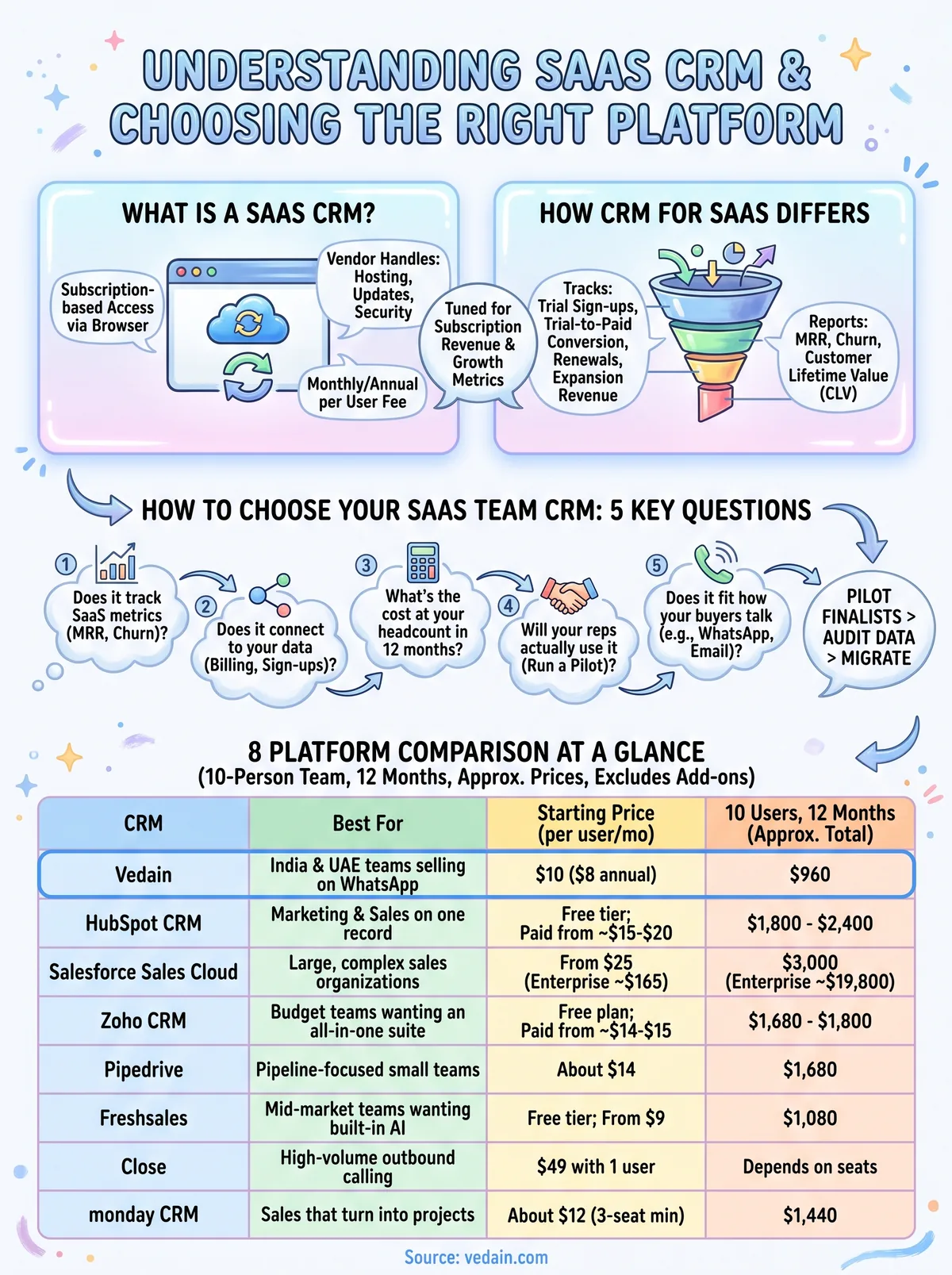
The table compares entry list prices as published on each vendor's pricing page in October 2026. Figures exclude add-ons, taxes and implementation, and some vendors price differently by region.
| Tool | Starting price (billing basis) | Free plan or trial | Best for |
|---|---|---|---|
| Vedain | $10/user/mo monthly; about $8.33 annual | 14-day trial, no card; no free plan | India and UAE teams selling on WhatsApp, one flat price |
| HubSpot | $7/seat/mo annual; $20 monthly (Starter) | Free tools for up to 2 users | Marketing and sales on one record |
| Salesforce | $25/user/mo (Starter Suite) | Free Suite; 30-day trial | Large teams with complex workflows |
| Zoho CRM | $14/user/mo annual; $20 monthly (Standard) | Free for up to 3 users | Budget teams wanting a full suite |
| Pipedrive | $14/user/mo annual (Lite) | 14-day trial, no card; no free plan | Pipeline-focused sales teams |
| Freshsales | $9/user/mo annual (Growth) | 21-day trial; no free plan listed | Low-cost paid entry |
| Close | $9/mo annual (Solo, 1 user); $35/user/mo annual (Essentials) | 14-day trial, no card; no free plan | High-volume calling and outbound |
| monday CRM | $12/seat/mo annual (Basic, 3-seat minimum) | 14-day trial; no free plan | Sales-to-delivery handoff |
The gap widens fast at the top end. Ten Salesforce Core seats cost $23,400 a year on annual billing, against $1,080 for ten Freshsales Growth seats.
Five questions that narrow the list
Work through these in order. Most teams are down to two finalists by question three.
- Does it track SaaS metrics? Look for trial conversion, MRR, churn and expansion, either built in or through custom objects.
- Does it connect to your data? Check billing (such as Stripe), email and your product's sign-up events.
- What will it cost at your headcount in 12 months? Use the table above, then add implementation help and add-ons.
- Will your reps use it? Run a two-week pilot with your most skeptical reps, because adoption decides whether the data is any good.
- Does it fit how your buyers talk? For teams in India and the UAE, that means WhatsApp, IndiaMART and Justdial lead capture, GST invoicing and INR or AED pricing.
If you are asking which CRM is best for a SaaS company, no single tool wins. HubSpot suits teams that want everything unified, Pipedrive and Close suit pure sales motions, and Vedain suits small teams that want every feature at one price. When you migrate, audit your current data, remove duplicates, map fields to the new system, run a small test import, and only then move everything.
Picking your SaaS CRM
A CRM SaaS tool is simply a CRM you rent and open in a browser, and nearly every option today works that way. What separates the eight above is price, depth and fit. Salesforce offers the most customization and costs the most to run. HubSpot offers a gentle free start, and Freshsales offers one of the cheapest paid entries. Pipedrive, Close and monday CRM each serve one sales style well.
If you sell in India or the UAE, want every feature at one price and live on WhatsApp, Gmail and Meta ads, Vedain is built for that workflow. You can judge the fit yourself in a few minutes, so start your 14-day free trial, with no credit card required.
Frequently Asked Questions
What is a CRM SaaS?
A CRM SaaS is customer relationship management software delivered as a subscription service over the internet. The vendor hosts, updates and secures it, and you pay per user per month or year. Nearly every modern CRM, including HubSpot, Salesforce, Zoho and Vedain, works this way.
Is Salesforce a SaaS or a CRM?
It is both. Salesforce Sales Cloud is a CRM delivered as SaaS, and the wider Salesforce platform also works as a PaaS for building custom apps. Paid plans start at $25 per user per month for Starter Suite.
What is the difference between a SaaS CRM and an on-premise CRM?
A SaaS CRM runs on the vendor's servers and you open it in a browser, with updates and security handled for you. An on-premise CRM is installed on your own servers, so your team handles maintenance, upgrades and backups. SaaS usually means lower upfront cost and faster setup.
Which CRM is best for a SaaS company?
No single tool wins. HubSpot suits teams that want marketing and sales on one record, Salesforce suits complex enterprise processes, and Pipedrive or Close suit pure sales motions. Small teams in India and the UAE that sell over WhatsApp can get every CRM feature at one price with Vedain.
Is there a free SaaS CRM?
Yes. HubSpot offers free tools for up to 2 users, Zoho CRM is free for up to 3 users, and Salesforce lists a Free Suite. Pipedrive, Freshsales, Close, monday CRM and Vedain have no free plan but offer free trials of 14 to 21 days.
How much does a SaaS CRM cost per user?
Entry plans in this list run from about $7 to $25 per user per month, depending on the billing period. Enterprise editions cost far more, with Salesforce Core at $195 per user per month billed annually. Vedain costs $10 per user per month, or about $8.33 on annual billing.