This list covers the platforms actually built for how solar teams sell: fast lead response, territory tracking, proposal and financing integrations, and pipeline stages that match a real install timeline instead of a generic sales funnel. We tested pricing, automation depth, and ease of setup so you're not stuck paying for features you'll never touch.
Below you'll find eight CRMs worth your time in 2026, from solar-specific platforms to flexible general CRMs like Vedain that let you build a custom solar pipeline without the enterprise price tag. Each entry breaks down pricing, standout features, and who the tool fits best, so you can shortlist fast and get back to closing deals.
1. Vedain CRM
Vedain isn't built exclusively for solar, but that's exactly why it works so well for solar teams. Instead of forcing you into rigid "install" or "repair" stages that don't match how you actually sell, you get a customizable deal pipeline you can rename and reorder to fit your process: lead, site survey, proposal, financing approval, permit, install, PTO. Solar shops that outgrow spreadsheets but don't want to pay Salesforce-level fees for a fraction of the features tend to land here first, especially teams already frustrated by HubSpot's tiered pricing.
Key features
Vedain packs the tools a solar sales floor actually uses into one flat plan:
- •Visual Kanban pipeline you can rename to match your install timeline
- •Lead capture forms to pull leads straight off your website into the pipeline
- •No-code workflow automation to auto-assign leads and trigger follow-up reminders when a homeowner goes quiet
- •Two-way Gmail and Outlook sync so reps never leave their inbox to log an email
- •Custom dashboards and team leaderboards to track who's closing and who's stalling
- •AI Agent Marketplace for data enrichment and drafting proposal follow-ups
A CRM that bends to your install timeline beats one that forces your timeline to bend to it.
Best for
Smaller and mid-sized solar installers, EPCs, and door-to-door sales orgs get the most out of Vedain, particularly teams of 5 to 50 reps who need pipeline visibility without a six-week implementation. It also suits companies migrating off Pipedrive or Zoho because they hit a feature wall and got quoted more for the next tier up. If your team already lives in Gmail or Outlook and just needs a real pipeline behind it, this is a strong starting point.
Pricing
Vedain charges a single flat rate of $10 per user per month, and that price includes everything: automation, email sync, unlimited records, reporting, and email warmup. There's no credit card required to start a trial, and setup typically takes under five minutes. You can see the full breakdown of what each CRM costs per seat before you commit.
2. Scoop Solar
Scoop Solar builds its entire product around one job: running a solar sales floor from door knock to install. It's a purpose-built solar CRM layered on top of Salesforce, so you get solar-specific pipeline stages out of the box instead of relearning a generic sales tool and bending it to fit panels and permits.
Key features
Scoop Solar leans hard into the operational side of solar sales, not just lead tracking:
- •Territory and canvassing management for door-to-door teams tracking knock counts and appointment rates
- •Built-in proposal and financing tool integrations so reps quote without leaving the pipeline
- •Permit and install tracking stages that mirror a real project timeline
- •Commission tracking for reps and setters on split deals
- •Salesforce-native reporting for teams that already run other Salesforce products
A CRM built on solar-specific stages saves you the setup work of forcing a generic pipeline to fit permits and PTO.
Best for
Door-to-door solar sales organizations with dedicated canvassing teams get the most value here, especially outfits already running other tools on the Salesforce platform. Companies with in-house appointment setters and separate closers, who need clean handoffs and commission visibility, tend to fit this mold well.
Pricing
Scoop Solar doesn't publish flat rate pricing publicly. You'll need to book a demo and get a custom quote, and because it runs on Salesforce infrastructure, expect setup and per-user costs to land noticeably higher than flat-rate alternatives like Vedain.
3. Sunbase
Sunbase markets itself as an all-in-one solar operating system, covering everything from the first door knock to the final utility interconnection. Unlike Scoop Solar's Salesforce add-on model, Sunbase runs as its own standalone platform, so you're not paying a Salesforce license fee on top of the CRM cost. That makes it a common pick for solar companies that want solar-specific workflows without inheriting the complexity of a larger CRM ecosystem underneath.
Key features
Sunbase bundles field operations and sales tracking into a single app most reps run from their phone:
- •Door-to-door canvassing maps with real-time knock tracking for setters
- •In-house financing and proposal tools built directly into the deal flow
- •Installation and project management modules to track crews after the sale closes
- •Automated texting and calling dialer for faster lead follow-up
- •Customer portal so homeowners can track their own install progress
Combining sales and install tracking in one app cuts the handoff gaps that usually stall a solar project.
Best for
Vertically integrated solar companies that handle sales, financing, and installation in-house get the most out of Sunbase. Growing regional installers who want field reps and office staff working off the same real-time data, without stitching together three separate tools, also fit well here.
Pricing
Sunbase doesn't list public per-user pricing on its site. You'll need to request a quote, and costs typically scale with the number of modules you activate, including CRM, financing, and install management, so total cost can climb fast for smaller teams.
4. Insightly
Insightly started as a general-purpose CRM and project management tool, and that history shows in how it's built. It's not solar-specific, but its strength in linking a closed deal to a project management workflow makes it a decent fit for smaller solar installers who want sales and post-sale project tracking in one place instead of exporting deals into a separate tool once the contract is signed.
Key features
Insightly's core strength is bridging the gap between the sale and the job that follows:
- •Pipeline management with customizable stages for solar-style sales cycles
- •Project management module that converts a closed deal into a trackable job with tasks and milestones
- •Custom objects and relationship linking to connect homeowners, properties, and referral sources
- •Workflow automation for routing leads and triggering task assignments
- •Reporting dashboards with customizable business intelligence views
Linking the deal to the project it becomes saves you from re-entering the same job in two different systems.
Best for
Small solar installers who need light project management tacked onto their CRM, without paying for a dedicated CRM for construction companies or field service tool, fit Insightly well. Teams that value flexibility over solar-specific automation, and don't mind building their own pipeline stages from scratch, also do fine here.
Pricing
Plans start around $29 per user per month on the Plus tier, climbing to $49 and $99 for Professional and Enterprise tiers as you unlock more automation and reporting depth, a noticeable jump from flat-rate options like Vedain.
5. HubSpot
HubSpot is the CRM most solar teams already know from other industries, and that familiarity is part of its appeal. It's not built for solar specifically, but its marketing and sales tools are deep enough that some installers use it to run lead gen campaigns alongside their pipeline, rather than bolting on a separate marketing platform.
Key features
HubSpot's strength is the breadth of its ecosystem, even if solar-specific stages aren't included out of the box, and it's worth weighing where HubSpot helps and where it hurts first:
- •Marketing Hub integration for running ad campaigns and landing pages that feed straight into the CRM
- •Custom deal pipelines you can adapt for site survey, proposal, and install stages
- •Email sequences and automation for nurturing homeowners who aren't ready to sign
- •Reporting dashboards with customizable attribution and funnel views
- •Marketplace of integrations for financing tools, e-signature apps, and proposal software
A CRM built for every industry means you'll spend more time configuring it to look like a solar tool.
Best for
Solar companies running heavy digital marketing campaigns alongside door-to-door sales get the most value from HubSpot, especially teams that want marketing and sales data in one system. It also suits larger installers with a dedicated ops person who can manage the tiered pricing structure and build out solar-specific automation from scratch.
Pricing
HubSpot's free tier covers basic contact management, but real sales functionality starts on the Starter plan at roughly $20 per user per month, jumping sharply to $100+ per user on Professional once you need automation and custom reporting, a steep climb compared to flat-rate CRMs like Vedain, as this 2026 guide to HubSpot's per-seat cost lays out.
6. Salesforce
Salesforce is the platform other CRMs get compared to, and plenty of solar companies land here simply because a private equity backer or a bigger competitor already runs on it. It's not a solar CRM software out of the box. Everything from lead stages to financing integrations gets built through custom development or a paid app from the AppExchange, which is why so many solar-specific tools like Scoop Solar exist as layers on top of it rather than competing with it directly.
Key features
Salesforce's real strength is depth, assuming you have the budget and staff to configure it:
- •Fully customizable objects and pipelines for any solar sales structure you can imagine
- •AppExchange marketplace with solar-specific add-ons for financing, permitting, and design
- •Advanced reporting and forecasting across territories and rep performance
- •Enterprise-grade permissions for large, multi-region sales teams
- •API access for connecting proprietary in-house tools
A platform this configurable only pays off once you've hired someone whose whole job is configuring it.
Best for
Large, multi-region solar companies with an in-house admin or a Salesforce consultant on retainer get the most from this platform. It rarely makes sense for a team under 20 reps still figuring out its sales process, which is why many of them look for a CRM with Salesforce's power minus the overhead.
Pricing
Salesforce Sales Cloud starts around $25 per user per month on the entry tier, but solar-ready functionality usually requires Enterprise or Unlimited plans running $165 to $330 per user monthly, before implementation and add-on costs, which is why smaller installers often shortlist cheaper Salesforce alternatives for small business.
7. OpenSolar CRM
OpenSolar started as a free proposal and design tool for solar installers, and the CRM layer got bolted on as the platform grew. It's still best known for its solar design software, letting reps sketch a system on a satellite image and generate a proposal on the spot, with the CRM tracking everything that happens before and after that moment.
Key features
OpenSolar folds sales tracking around its design and proposal engine rather than the other way around:
- •Free solar design tool with satellite imagery and shading analysis built into every proposal
- •Lead pipeline tracking tied directly to proposal status
- •Financing partner integrations for quick loan and lease approvals
- •Automated proposal generation reps can send from the field
- •Marketplace of hardware suppliers connected to the design tool
A CRM built around the proposal, instead of the other way around, only works if your sales process actually revolves around design.
Best for
Smaller residential installers who lean heavily on fast, in-home design and proposals fit OpenSolar well, especially solo reps or two-person crews who need a CRM for solar companies without a big software budget. Teams that already use OpenSolar's free design tool and want light pipeline tracking layered on top get the most value without switching platforms.
Pricing
OpenSolar's design and proposal tools are free to use, and the CRM features come bundled at no extra charge for basic use, much like other free CRM software built around a single core tool. Paid tiers unlock deeper automation and priority support, with pricing available on request rather than published upfront.
8. Shape Solar
Shape Solar built its reputation on speed, both in setup and in how fast leads move through the pipeline. It's marketed directly at solar and home services companies that want a CRM with built-in dialing and texting, so reps spend less time switching apps between a call, a text follow-up, and a pipeline update. Shape leans on automation to keep leads warm during the gap between a door knock and a signed contract, which is often where solar deals quietly die.
Key features
Shape packs communication tools directly into the pipeline instead of treating them as an add-on:
- •Built-in power dialer and SMS so reps call and text without leaving the CRM
- •Automated drip campaigns for leads who need multiple touches before booking a site visit
- •Custom pipeline stages for solar-specific steps like site survey and permit approval
- •Commission tracking for reps and setters splitting a deal
- •Reporting dashboards covering call volume, response time, and rep activity
The faster a lead gets a call back, the more likely it becomes a signed contract, and Shape builds its whole pipeline around that math.
Best for
Door-to-door and phone-heavy solar sales teams get the most out of Shape, especially outfits where speed to first contact decides who closes the deal, though it's worth comparing against other CRMs ranked on pipeline visibility and price. Companies running high lead volume through call centers or setters also fit this mold well.
Pricing
Shape Solar doesn't publish flat per-user pricing publicly. Expect a custom quote based on team size and which communication tools you activate, with costs typically landing above flat-rate CRMs like Vedain once texting and dialing add-ons get included.
Picking the right CRM for your solar team
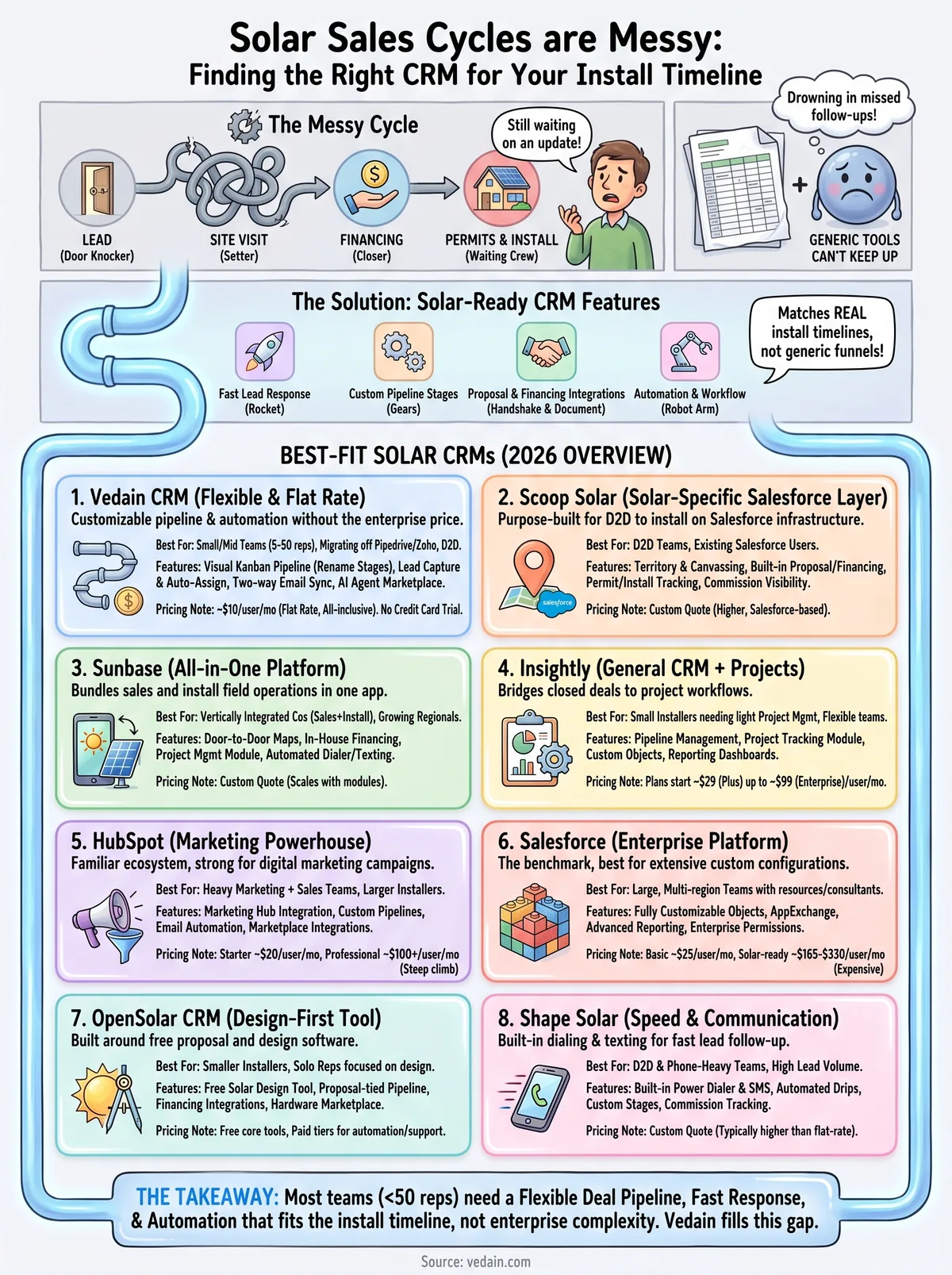
Solar-specific tools like Scoop Solar and Sunbase make sense once you've got dedicated canvassing crews and in-house install teams to manage, the same way CRM setups built for each vertical fit other trades. But most solar companies, especially those under 50 reps, don't need that complexity or the price tag that comes with it. What you actually need is a flexible deal pipeline, fast lead response, and automation that keeps homeowners from going quiet between the site survey and the signed contract.
That's the gap Vedain fills. You get a pipeline you can shape around your own install timeline, email sync that keeps reps in their inbox, and workflow automation that catches leads before they stall, all for one flat rate with nothing gated behind a pricier tier. No solar company should pay Salesforce prices to track a permit status.
If you're ready to see it running against your own pipeline, book a walkthrough of Vedain CRM and bring your toughest deal stage with you.
Frequently Asked Questions
What is the best CRM for solar companies in 2026?
The best CRM for solar companies depends on your specific needs, but top options include Vedain (purpose-built for solar with $99-299/month pricing), HubSpot ($45-3,200/month), and Salesforce ($165-330+/month). Vedain stands out for solar-specific features like lead scoring for solar prospects and installation tracking, while HubSpot offers excellent general CRM capabilities with strong integration options. Consider your team size and budget—smaller solar companies often prefer Vedain or Pipedrive ($59-499/month), while enterprises gravitate toward Salesforce.
How much does a CRM cost for solar installation businesses?
CRM costs for solar businesses range from $59-$3,200+ monthly depending on the platform. Vedain is specifically priced for solar companies at $99-299/month, Pipedrive starts at $59/month for basic features, HubSpot begins at $45/month, and Salesforce starts at $165/month for its standard edition. Most solar companies find that mid-tier plans ($100-300/month) offer the best value, providing sales automation, lead management, and customer tracking without enterprise-level costs.
Is Salesforce or HubSpot better for solar companies?
Salesforce and HubSpot serve different solar company sizes: HubSpot ($45-3,200/month) is ideal for small-to-mid-sized solar installers needing user-friendly sales and marketing automation, while Salesforce ($165-330+/month) suits larger enterprises with complex sales processes and customization needs. However, solar-specific solutions like Vedain often outperform both for solar workflows, offering built-in features for site assessments and installation scheduling. If you're choosing between the two, HubSpot typically has a faster implementation time, while Salesforce provides greater long-term scalability.
Do I need a solar-specific CRM or can I use general CRM software?
You can use general CRMs like HubSpot, Pipedrive, or Zoho, but solar-specific CRMs like Vedain are purpose-built for your industry's unique workflow. Solar-specific CRMs include features like roof measurement tools, solar panel configuration calculators, installation scheduling, and solar-qualified lead scoring that general platforms lack. While HubSpot and Salesforce offer customization to add these features, starting with Vedain or another solar-focused solution can save setup time and provide immediate industry relevance at competitive pricing ($99-299/month).
What CRM features do solar companies need most?
Solar companies prioritize lead management, pipeline tracking, customer communication history, and installation scheduling in their CRM selection. Key features include solar quote generation, site assessment tools, appointment scheduling, integration with solar design software, and mobile access for field teams. Vedain and HubSpot excel at these requirements, while Salesforce and Pipedrive require more customization to achieve solar-specific workflows. Zoho CRM also offers affordable customization options ($20-55/month base) for solar installers needing specialized functionality.
Can I integrate a solar CRM with my existing business tools?
Yes, most modern CRMs including HubSpot, Salesforce, Pipedrive, and Vedain offer extensive integrations with accounting software, email platforms, and solar-specific tools. Vedain specializes in solar software integrations, while HubSpot integrates with 1,500+ applications and Salesforce supports AppExchange with thousands of add-ons. Before selecting a CRM, verify it integrates with your current accounting software, proposal tools, and scheduling platforms—this integration capability often determines ROI more than the CRM's base price.