This guide skips the marketing fluff and gets straight to what matters: which tools actually help you find verified contacts, automate outreach, and keep your pipeline moving without draining your budget. We compare pricing structures, feature depth, and real use cases so you can match a tool to your team's size and workflow instead of guessing.
You'll find data enrichment platforms, email finders, and full CRM-based prospecting suites in this list, including where Vedain fits for teams that want lead capture, automated sequences, and AI-driven enrichment bundled into one flat-rate plan. Read through the comparisons below, then jump to the tool that solves your specific bottleneck, whether that's lead volume, outreach automation, or data accuracy.
1. Vedain CRM
Vedain CRM sits at the top of this list because it treats prospecting as part of the sales cycle, not a separate tool you bolt on afterward. Most sales prospecting tools hand you a list of contacts and leave you to figure out the rest. Vedain instead combines lead capture, enrichment, and outreach automation inside one platform, so your reps move from finding a contact to closing a deal without switching tabs. That matters if you're a small or mid-sized team without a dedicated ops person to stitch five tools together.
Key features
Vedain's prospecting toolkit is built around its AI Agent Marketplace and native CRM functions, which means enrichment and outreach share the same data instead of living in separate systems.
- •Lead forms for capturing website visitors directly into your pipeline with custom fields
- •AI Agent Marketplace with 30+ pre-built agents for data enrichment, lead scoring, and content generation
- •Email campaigns with multi-step automated sequences for cold outreach
- •Two-way email sync with Gmail and Outlook, so replies land straight in the CRM
- •Email warmup that protects domain deliverability over a 21-day ramp-up period
- •Visual Kanban pipeline to track prospects from first touch to signed deal
- •LinkedIn automation for scheduling AI-generated posts that support outbound efforts
A prospecting tool only earns its place in your stack if it also helps you close what it finds, and that's exactly where Vedain separates itself from pure data providers.
Best for
Sales teams that want prospecting, enrichment, and pipeline management under one login will get the most value here. Founders and small business owners who can't justify paying for a data tool, a sequencing tool, and a CRM separately tend to switch to Vedain first, since the flat pricing covers all three functions. Growing teams already using Gmail or Outlook also fit well, because the two-way sync removes the manual copy-paste step that slows down most reps during a busy prospecting week.
Pricing
Vedain charges a single flat rate with no feature gates and no add-on fees for enrichment agents, automation, or email sync.
Compare that to enrichment platforms that charge separately for credits, seats, and integrations, and the math favors Vedain quickly once you factor in a full sales team. You can test the platform directly at vedain.com without entering payment details, which makes it low-risk if you're currently comparing tools before renewal season.
2. ZoomInfo
ZoomInfo built its name on one thing: contact data depth. If your reps spend hours guessing which email format a company uses or chasing outdated phone numbers, ZoomInfo solves that by maintaining one of the largest B2B contact databases on the market. It's less a workflow tool and more a research engine that feeds your existing CRM and outreach stack with verified details.
Key features
Beyond raw contact records, ZoomInfo's intent data flags companies actively researching solutions like yours before they ever fill out a form.
- •Company and contact database with direct dials, verified emails, and org charts
- •Intent signals that surface accounts showing buying behavior
- •ZoomInfo Chrome extension for pulling contact data while browsing LinkedIn or a company site
- •Technographic filters to target accounts by the software stack they already run
- •Workflow automation to trigger alerts when a target account changes jobs or funding status
A database is only as valuable as how fresh it stays, and ZoomInfo's ongoing verification is what keeps reps from wasting calls on dead numbers.
Best for
Mid-market and enterprise teams with dedicated SDR functions get the most out of ZoomInfo, since the platform rewards volume prospecting across large territories. Companies running account-based marketing programs also lean on it heavily, because the intent and technographic data help prioritize which accounts to chase first instead of working leads in random order.
Pricing
ZoomInfo doesn't publish flat pricing, and quotes typically start in the thousands of dollars annually depending on seat count and data modules. Plans usually require a sales call and annual commitment rather than a self-serve signup, and add-on modules for intent data or conversation intelligence cost extra. That structure suits larger budgets more than a five-person startup team watching every line item.
3. Apollo.io
Apollo.io built its reputation as a combined database and outreach engine, which makes it one of the more popular sales prospecting tools for teams that want data and sequencing without paying for two separate platforms. Reps get a searchable contact database plus the ability to launch email and call sequences from the same screen, which cuts down on the tool-switching that slows down a typical prospecting day.
Key features
Apollo's biggest draw is how it bundles contact search with outreach execution instead of forcing you to export lists into a third-party sequencer.
- •Database of 275+ million contacts with verified emails and direct dials
- •Multi-channel sequences combining email, calls, and LinkedIn tasks
- •Chrome extension for pulling contact data from LinkedIn profiles
- •Conversation intelligence that records and scores sales calls
- •Built-in dialer for click-to-call prospecting without a separate phone tool
Combining data and outreach in one login saves reps the daily grind of exporting lists between disconnected tools.
Best for
Outbound-heavy SDR teams that live in email and call sequences fit Apollo well, especially teams that don't already have a CRM they're attached to. Startups building their first outbound motion also gravitate toward it, since the combined pricing beats paying separately for a data provider and a sequencing tool.
Pricing
Apollo offers a free plan with limited credits, then paid tiers starting around $49 per user per month, scaling up to $99 or more for advanced data and call features. Credits for exporting or revealing contacts run out fast on lower tiers, so heavy prospecting teams often end up on a higher plan than they initially budgeted for.
4. LinkedIn Sales Navigator
LinkedIn Sales Navigator lives inside the network your prospects already use every day, which makes it different from every other tool on this list. Instead of scraping or buying data from a third party, you get direct access to LinkedIn's own profile and activity data, so the information about job changes, posts, and company moves stays current in a way exported spreadsheets never do. For reps who already spend part of their day on LinkedIn, this tool turns browsing into structured prospecting research.

Key features
Sales Navigator's strength is its filtering depth, since you can narrow a search by seniority, function, company headcount, or recent job change in ways a generic search never allows.
- •Advanced lead and account search with 40+ filters including job change alerts
- •InMail messaging to reach prospects outside your existing network
- •Saved lists with automatic alerts when a saved lead posts or changes roles
- •TeamLink to surface warm introduction paths through colleagues' connections
- •CRM integrations with platforms like Salesforce and HubSpot for syncing saved leads
Prospecting data goes stale fast, and Sales Navigator's edge is pulling straight from the source instead of a database that needs constant re-verification.
Best for
Reps who already run a relationship-driven sales motion get the most value here, particularly in industries like recruiting, financial services, and enterprise software where warm introductions close deals faster than cold email. Teams selling to buyers active on LinkedIn also benefit, since job-change alerts flag re-engagement moments a database tool would miss entirely.
Pricing
LinkedIn Sales Navigator starts at $99.99 per user per month for the Core plan, billed monthly, with an Advanced plan running higher for teams needing CRM sync and TeamLink features. LinkedIn publishes pricing directly on its Sales Navigator page, and there's no free trial requiring a card upfront on most plans, though promotional trials appear periodically.
5. Cognism
Cognism built its name on compliant, phone-verified data for teams selling across borders, particularly into Europe where GDPR makes sloppy data collection a legal risk, not just a nuisance. If your prospecting list is full of mobile numbers that ring dead the moment you dial, Cognism's whole pitch is fixing that problem with human-verified phone numbers instead of scraped guesses. That focus makes it a favorite among sales prospecting tools for teams running international outbound campaigns.
Key features
Cognism leans hard on data compliance and phone accuracy rather than trying to be an all-in-one outreach suite.
- •Diamond Data verified mobile numbers checked by a human research team, not just algorithms
- •GDPR and CCPA compliant sourcing for teams selling into regulated markets
- •Intent data through a Bombora integration to flag active buyer research
- •Chrome extension for pulling verified contacts while browsing LinkedIn
- •Sales Navigator integration to sync enriched contact data directly into saved lead lists
Phone numbers that actually connect matter more than a giant database nobody can verify, and that's the gap Cognism fills for outbound-heavy teams.
Best for
Teams selling into Europe or running global outbound motions get the clearest benefit, since compliance is baked into how Cognism sources its data rather than added as an afterthought. Sales development teams that still rely on cold calling as a primary channel also do well here, because the verified mobile numbers cut down on the dead-line problem that kills call-heavy prospecting days.
Pricing
Cognism doesn't list public pricing and requires a sales call to get a quote, with costs typically scaling based on seats and the number of countries you need data coverage for. Contracts usually run annually rather than month-to-month, which suits established sales teams more than a founder testing outbound for the first time on a tight budget.
6. Lusha
Lusha built a reputation as the lightweight option for reps who just need accurate contact details fast, without learning a complex platform first. Unlike heavier enrichment suites, Lusha's browser extension is the main entry point for most users, pulling verified emails and phone numbers straight from a LinkedIn profile or company site in a couple of clicks. That simplicity makes it a common pick for sales prospecting tools shortlists among smaller teams that don't want a six-week onboarding process before their first outreach campaign.
Key features
Speed is the whole pitch here, and Lusha keeps its feature set narrow on purpose rather than trying to match bigger platforms feature for feature.
- •Chrome extension for one-click contact reveals on LinkedIn and company pages
- •Verified emails and direct dials sourced from a mix of public and proprietary data
- •Prospecting lists to save and organize enriched contacts before export
- •CRM integrations with Salesforce, HubSpot, and Pipedrive for pushing data directly into existing pipelines
- •API access for teams that want to enrich records in bulk rather than one profile at a time
A tool doesn't need every feature under the sun if it nails the one thing reps do fifty times a day, and for Lusha, that's a fast, accurate contact lookup.
Best for
Small sales teams and individual reps who need quick lookups without a heavy platform get the most out of Lusha. Founders doing their own outbound in the early days of a company also fit well, since the extension requires almost no training and slots into whatever browser workflow they already use.
Pricing
Lusha offers a free plan with a limited number of monthly credits, then paid tiers starting around $36 per user per month when billed annually, scaling higher for teams needing more credits or CRM integrations. Credit limits reset monthly, so high-volume prospecting teams often burn through a lower tier faster than expected and need to upgrade within the first billing cycle.
7. 6sense
6sense takes a different angle than the contact databases on this list. Instead of starting with a list of names, it starts with intent signals across the web to tell you which accounts are already in a buying cycle before they ever raise their hand. That shifts prospecting from "who should I call today" to "who is actually ready to talk right now," which matters if your reps are burning hours on accounts that were never going to convert this quarter.

Key features
Predictive intent modeling is the core of what 6sense does, and it pulls in signals your reps would never see on their own, like anonymous website visits and third-party research activity.
- •Account intent scoring that ranks target accounts by buying stage
- •Anonymous visitor identification to reveal which companies are browsing your site without filling out a form
- •Predictive analytics to forecast which accounts are likely to convert based on historical patterns
- •Orchestration tools to trigger ads, emails, and sales alerts automatically when an account's intent score rises
- •CRM and marketing automation integrations with Salesforce, HubSpot, and Marketo
Chasing every lead equally wastes your best reps' time, and 6sense's real value is telling you which accounts deserve that time first.
Best for
B2B companies running account-based marketing programs get the clearest return here, especially teams with a marketing and sales alignment already in place to act on the signals. Larger sales orgs with dedicated ops teams also fit well, since interpreting and acting on intent data takes more setup than a five-person startup usually has bandwidth for.
Pricing
6sense doesn't publish pricing publicly, and you'll need a sales call to get a quote, with costs scaling based on the number of accounts tracked and which modules you add. Implementation typically takes longer than the self-serve tools on this list, and annual contracts are standard rather than the exception.
8. Seamless.AI
Seamless.AI pitches itself as a real-time search engine for contact data rather than a static database that goes stale between refreshes. Instead of pulling from a fixed list, it crawls the web live when you run a search, which means the emails and phone numbers you find are checked at the moment of search rather than pulled from a record last updated months ago. That real-time approach appeals to reps who've been burned by bounce-heavy lists from older sales prospecting tools.
Key features
Seamless.AI leans on AI-powered search to verify contact details on the fly, which is the main thing that separates it from a traditional enrichment database.
- •Real-time search engine that verifies emails and phone numbers as you search, not from a static cache
- •Chrome extension for pulling verified contacts directly from LinkedIn and company websites
- •Autopilot lists that build prospect lists automatically based on your ideal customer profile
- •Writer tool for generating cold email and LinkedIn message drafts
- •CRM integrations with Salesforce, HubSpot, and Pipedrive for pushing enriched contacts straight into your pipeline
Contact data goes bad fast, and verifying it at the moment of search beats trusting a list that hasn't been touched since last quarter.
Best for
Outbound-heavy SDR teams that need fresh contact data at volume tend to get the most out of Seamless.AI, especially teams frustrated with high bounce rates from older enrichment tools. Sales teams without a dedicated data ops person also do well here, since Autopilot lists remove some of the manual list-building work reps would otherwise do themselves.
Pricing
Seamless.AI offers a limited free plan with a small number of monthly credits, then paid plans that require contacting sales for a quote once you move past the entry tier. Credit-based pricing means heavy prospecting volume can get expensive quickly compared to flat-rate alternatives, so it's worth estimating your monthly search volume before committing to a paid plan.
9. HubSpot Sales Hub
HubSpot Sales Hub is the prospecting layer built into one of the most widely adopted CRM ecosystems on the market. Rather than a standalone data tool, it works as part of a broader HubSpot setup, which means your prospecting activity, deal records, and marketing touches all live in the same system. If your team already runs HubSpot's marketing or service tools, adding Sales Hub keeps everything connected instead of forcing you to reconcile data across platforms.
Key features
HubSpot's strength is how tightly prospecting ties into its broader CRM and marketing tools, which matters if your team already tracks buyer activity through HubSpot's forms and landing pages.
- •Sequences for automated multi-step email outreach with follow-up reminders
- •Prospecting workspace that surfaces recommended leads based on account activity
- •Meeting scheduler embedded directly in outreach emails
- •Call tracking and recording built into the sales workspace
- •Deep integration with HubSpot's marketing hub for shared lead scoring and lifecycle stages
Prospecting works best when it shares data with marketing, and HubSpot's biggest edge is that the two live in the same system from day one.
Best for
Teams already invested in the HubSpot ecosystem get the clearest payoff, since prospecting, marketing automation, and customer service all pull from the same contact record. Mid-sized companies with dedicated RevOps functions also fit well, because HubSpot rewards teams that have the bandwidth to configure lifecycle stages and lead scoring properly rather than using it as a simple contact list.
Pricing
Sales Hub starts with a free tier covering basic CRM and limited sequences, then moves to Starter plans around $20 per seat monthly, with Professional and Enterprise tiers climbing into the hundreds per seat once you add automation and reporting depth. Costs escalate quickly once you factor in marketing hub add-ons, so teams comparing total cost should check HubSpot's own pricing page before assuming the entry price covers what they need.
10. Pipedrive
Pipedrive built its reputation as a visual, pipeline-first CRM, and its prospecting features grew out of that same philosophy: keep the deal stages front and center, then layer in enough lead-finding tools to feed that pipeline without overwhelming the interface. It's less data-heavy than ZoomInfo or Cognism, but for reps who think in terms of stages and deal movement, that simplicity is the appeal rather than a limitation.
Key features
Pipedrive's prospecting add-ons work as extensions of its core pipeline view, so new leads flow directly into the same Kanban board reps already use to track deals.
- •LeadBooster add-on for chatbot, live chat, and web form lead capture
- •Prospector tool for finding verified contact and company data based on your ideal customer profile
- •Visual Kanban pipeline to move new prospects through custom deal stages
- •Email sync and templates for tracking outreach directly inside deal records
- •Automation builder for triggering follow-up tasks when a lead goes cold
A pipeline view only helps if new leads actually land in it automatically, and that's the gap Pipedrive's add-ons are built to close.
Best for
Small to mid-sized sales teams that want a simple, visual pipeline paired with light prospecting tools tend to get the most value from Pipedrive. Reps who find heavier data platforms overwhelming often prefer this setup, since the add-on model lets you buy only the prospecting features you actually use instead of paying for a full suite upfront.
Pricing
Pipedrive's core CRM starts around $14 per user per month on the Essential plan, with Advanced and Professional tiers rising toward $49 or more as you add automation and reporting depth. LeadBooster and Prospector are separate add-ons billed on top of your base plan, so total prospecting costs climb fast once you stack the extras most teams end up needing.
11. Leadfeeder
Leadfeeder (now operating under the Dealfront brand in some markets) takes a completely different entry point into prospecting: instead of finding new contacts, it tells you who's already visiting your website without filling out a form. That flips the usual cold-outreach model, since your reps get to reach out to companies that already showed buying intent by browsing your pricing page or product docs, rather than cold-emailing a name pulled from a database that has no idea who you are.
Key features
Leadfeeder's core job is turning anonymous web traffic into identifiable company records your sales team can act on before a competitor does.
- •Visitor identification that reveals company names behind anonymous website traffic
- •Behavioral tracking showing which pages a visiting company viewed and for how long
- •Lead scoring based on page visits, session length, and firmographic fit
- •Slack and email alerts notifying reps the moment a target account visits
- •CRM integrations with Salesforce, Pipedrive, and HubSpot for pushing identified companies into existing pipelines
Waiting for a form fill wastes the warmest signal you have, and Leadfeeder's whole value is catching that intent before the visitor leaves your site.
Best for
B2B companies with meaningful website traffic but low form-fill rates get the clearest benefit here, since Leadfeeder surfaces buyer interest that would otherwise go untracked. Marketing and sales teams that already run account-based strategies also do well with it, because visitor data feeds directly into account prioritization instead of sitting in a separate analytics dashboard nobody checks daily.
Pricing
Leadfeeder offers a limited free plan showing basic visitor data from the past seven days, with paid plans starting around $99 per month depending on the volume of tracked companies. Pricing scales with website traffic rather than seats, so high-traffic B2B sites should expect costs to rise faster than a typical per-user tool as visitor volume grows month over month.
Finding the right fit for your team
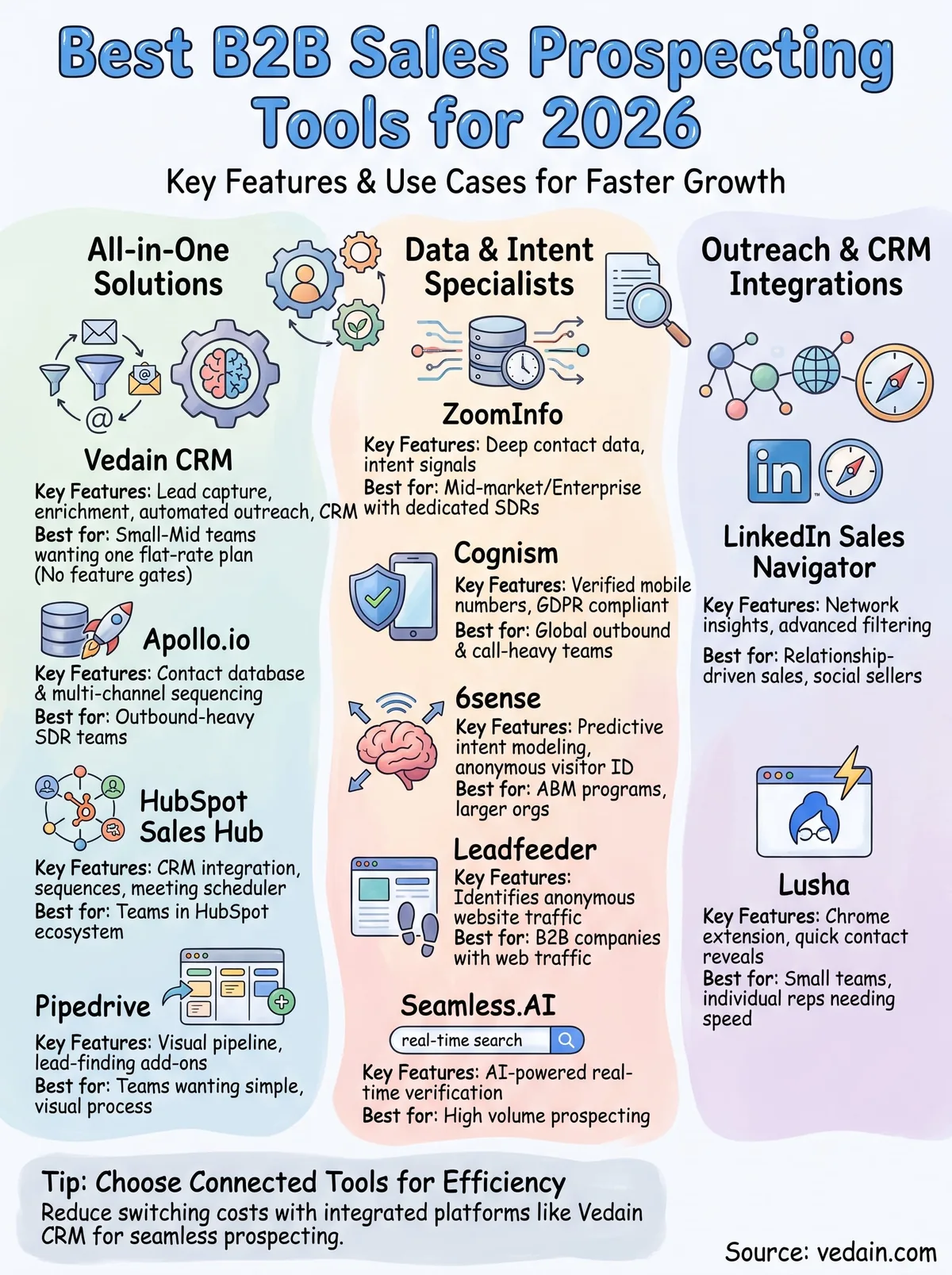
Every tool on this list solves a piece of the prospecting puzzle, but few solve all of it. ZoomInfo, Cognism, and Lusha give you cleaner data. Apollo, Seamless.AI, and Sales Navigator speed up outreach. 6sense and Leadfeeder flag intent you'd otherwise miss. If your team is stitching three or four of these together already, you know how fast the monthly bill and the tab-switching add up.
Going with fewer, better-connected tools usually beats stacking specialists, especially if you're a small or mid-sized team without a RevOps person managing integrations. That's the gap Vedain fills: lead capture, enrichment, sequencing, and pipeline tracking in one flat-rate plan, so your reps spend their day prospecting instead of exporting CSVs between platforms.
If that sounds closer to what your team needs, try Vedain CRM free and see how much simpler your prospecting stack can get.
Frequently Asked Questions
What is the best sales prospecting tool for B2B teams in 2026?
The best sales prospecting tool depends on your team's specific needs, but HubSpot Sales Hub stands out for its comprehensive feature set, offering lead scoring, email tracking, and AI-powered insights starting at $50/month. Competitors like Salesforce Einstein and Pipedrive also excel in prospecting capabilities, with Salesforce providing enterprise-grade AI and Pipedrive offering better affordability for smaller teams at $14/month. Consider Freshsales for mid-market teams seeking a balance between features and cost, or Vedain for advanced automation and personalization features.
How much do B2B sales prospecting tools typically cost in 2026?
B2B prospecting tools range from $14-50+ per user monthly, depending on features and company size. Budget-friendly options like Pipedrive start at $14/month, while HubSpot Sales Hub begins at $50/month with more advanced features. Enterprise solutions like Salesforce require custom pricing, often ranging from $165-300+ per month, while Zoho CRM and Freshsales offer mid-range pricing between $20-100/month for comparable functionality.
Which prospecting tool integrates best with existing CRM systems?
HubSpot and Salesforce offer the most extensive integration ecosystems, supporting 1000+ third-party applications and seamless workflow automation. Pipedrive and Freshsales provide solid integration capabilities with popular tools like Slack, Gmail, and Microsoft Outlook, making them excellent for teams using multiple platforms. Zoho and Vedain also offer strong integrations within their respective ecosystems, though HubSpot's App Marketplace remains the most comprehensive for B2B prospecting workflows.
What AI features should B2B prospecting tools have in 2026?
Modern B2B prospecting tools should include AI-powered lead scoring, predictive analytics, and automated email personalization to qualify prospects efficiently. HubSpot's predictive lead scoring and Salesforce Einstein's forecasting capabilities represent industry standards, while Pipedrive and Freshsales offer AI-driven activity recommendations. Look for tools with conversation intelligence, email optimization, and intent data integration—features that Vedain specializes in for more sophisticated prospecting workflows.
Can sales prospecting tools help with cold email outreach?
Yes, most modern sales prospecting tools include cold email capabilities with built-in templates, tracking, and sequencing features. HubSpot Sales Hub offers email templates and follow-up reminders, while Pipedrive provides email integration and basic automation starting at $14/month. Freshsales and Vedain offer more advanced cold email features including personalization at scale and multi-touch sequences, making them ideal for teams focused on email-based prospecting campaigns.
How do I choose between HubSpot, Salesforce, and Pipedrive for prospecting?
Choose HubSpot for user-friendly, all-in-one prospecting with excellent support and AI features; Salesforce for enterprise-scale operations requiring customization and advanced analytics; and Pipedrive for budget-conscious teams prioritizing sales pipeline management. If you need mid-market solutions, consider Freshsales for better affordability than Salesforce, or Zoho CRM for comprehensive features at lower costs. For specialized prospecting with advanced automation, Vedain offers niche advantages in personalization and intent-based targeting.