The best options combine lead pipeline management with automated follow-up sequences, so a trial sign-up gets a text, an email, and a task for your sales rep without anyone lifting a finger. You also want membership renewal tracking baked in, since retention is where most studios actually make their money, not just first-month sign-ups.
In this list, we break down nine CRMs worth considering in 2026, comparing pricing, automation depth, and how well each handles the lead-to-member journey. We included flat-rate platforms like Vedain alongside fitness-specific tools, so you can see where transparent pricing beats paying extra for basic automation and where a dedicated fitness CRM earns its higher cost.
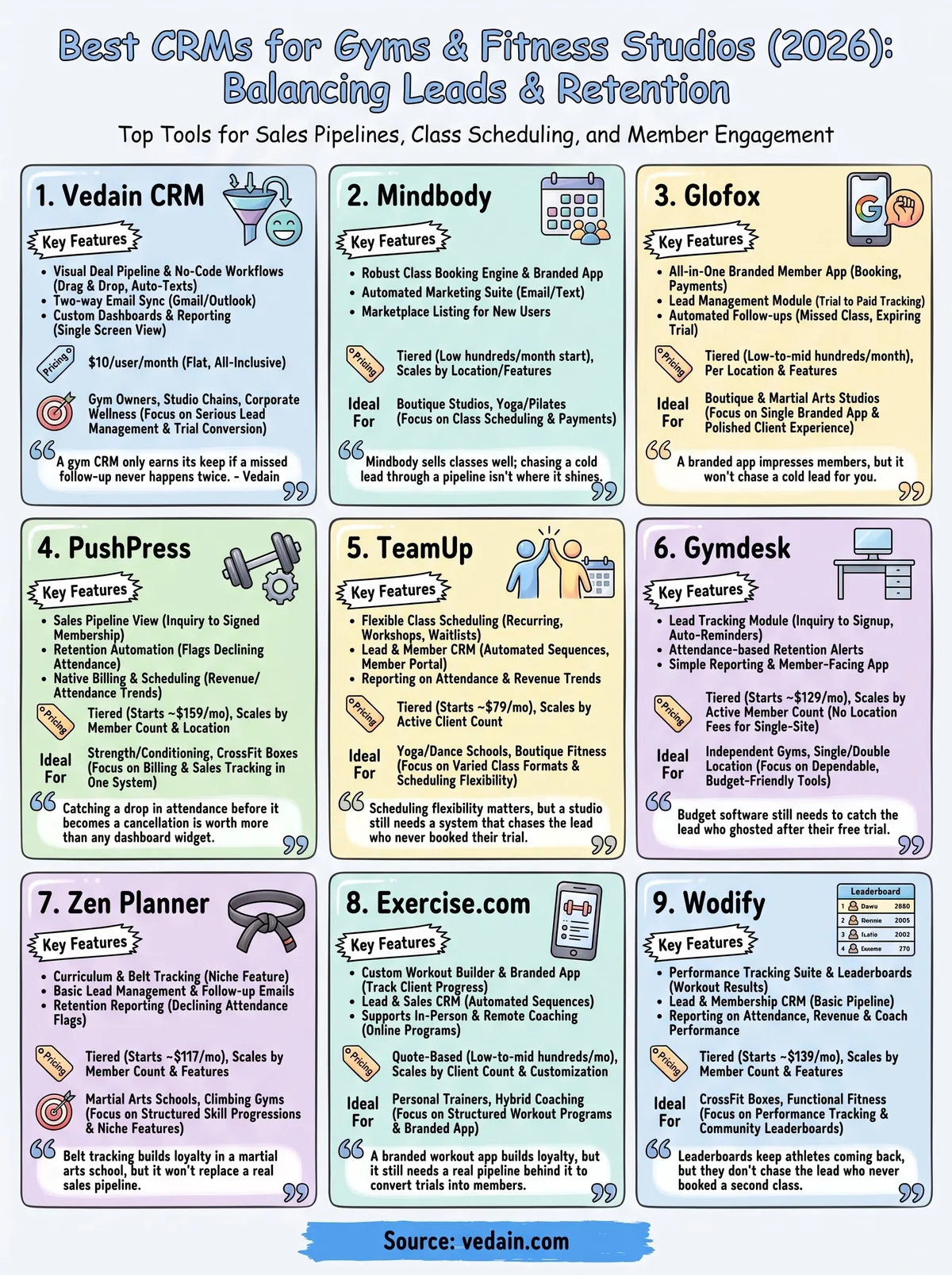
1. Vedain CRM
Vedain built its reputation as a general sales CRM, but gyms and fitness studios use it precisely because it treats a trial membership lead the same way a SaaS company treats a demo request: as a deal that needs a pipeline, a follow-up sequence, and a clear owner. Studios juggling multiple locations or sales reps like that Vedain CRM keeps every prospect visible on one Kanban board instead of scattered across sticky notes and spreadsheets. For an owner comparing tools, that single view of leads-to-members is what separates a real crm for gyms and fitness studios from a scheduling app with a contacts tab bolted on.
Key features
Vedain's visual deal pipeline lets you drag a lead from "trial booked" to "toured facility" to "signed membership" without touching a spreadsheet, and building those stages takes under an hour, with every stage change able to trigger an automated action. The no-code workflow builder handles the busywork gyms actually need: auto-text a lead who missed their intro class, assign a task to a sales rep after 48 hours of silence, or fire off a win-back email sequence to a member who hasn't renewed. Two-way Gmail and Outlook sync means front desk staff see the full email thread with a prospect right inside the CRM record, and lead capture forms plug straight into your website so a class sign-up becomes a tracked deal automatically.
A gym CRM only earns its keep if a missed follow-up never happens twice.
Beyond the core pipeline, Vedain's custom dashboards and reporting tools let a studio owner build a single screen showing new leads this week, renewal risk by location, and sales rep leaderboards side by side. The AI agents built into the CRM add another layer, with pre-built agents that can enrich a lead's contact record or draft follow-up copy, which saves a solo studio owner from writing every renewal reminder by hand.
Pricing
Vedain charges a flat $10 per user per month, and that price includes everything: workflows, email sync, lead forms, dashboards, and reporting. There are no tiers to climb and no add-on fees to unlock automation, which matters for a multi-location studio watching every line item. Here's how that compares to what you'd expect from typical tiered fitness software:
Who it's for
Vedain suits gym owners and studio chains who want serious lead management without paying for a fitness-specific platform that bundles in class scheduling and billing you may not need. It fits especially well if your sales process depends on trial conversions, corporate wellness deals, or multi-location follow-up, where a dedicated sales pipeline beats a basic contacts list. Studios that already run a separate booking system but need something to actually chase down leads and renewals will find Vedain's flat pricing and no-code automation a straightforward upgrade.
2. Mindbody
Mindbody is the name most gym owners already know, since it built its reputation as booking and payment software long before anyone called it a CRM. Studios that run yoga, Pilates, or boutique fitness classes often start here because the class scheduling and payment processing are genuinely strong, and the lead tracking tab feels like a bonus rather than the main event. Owners researching a crm for gyms and fitness studios should know Mindbody works best as gym management software with sales features attached, not the other way around.
Key features
Mindbody's class booking engine remains its core strength, letting members reserve spots, join waitlists, and pay through a branded app. The platform includes basic lead capture and follow-up tools, an automated marketing suite for email and text campaigns, and a marketplace listing that can surface your studio to new users browsing for classes nearby. Reporting covers attendance trends and revenue by class type, though pipeline-style deal tracking is thinner than what a dedicated sales CRM offers.
Mindbody sells classes well; chasing a cold lead through a pipeline isn't where it shines.
Pricing
Pricing scales by location size and feature tier, typically starting in the low hundreds per month and climbing quickly once you add marketing automation or multiple locations. Costs aren't published as a flat rate, so studios often need a sales call to get an actual quote, and add-ons for payment processing or the consumer marketplace listing can push the bill higher than expected.
Who it's for
Boutique studios running heavy class schedules, group fitness formats, or membership models built around drop-in bookings tend to get the most value here. Owners who prioritize class scheduling and payments over deep sales pipeline work will find Mindbody a comfortable fit, especially if member-facing app polish matters more than granular lead automation. Teams that need serious deal tracking alongside scheduling often end up pairing Mindbody with a separate sales-focused tool.
3. Glofox
Glofox positions itself as an all-in-one platform for gyms, martial arts studios, and boutique fitness brands that want booking, billing, and basic sales tracking under one roof. Owners comparing a crm for gyms and fitness studios often shortlist Glofox because it markets directly to fitness businesses rather than general service industries, so the terminology and workflows already match how a studio operates day to day. It leans heavily on member-facing convenience, with a branded app that handles bookings and payments alongside the sales side.
Key features
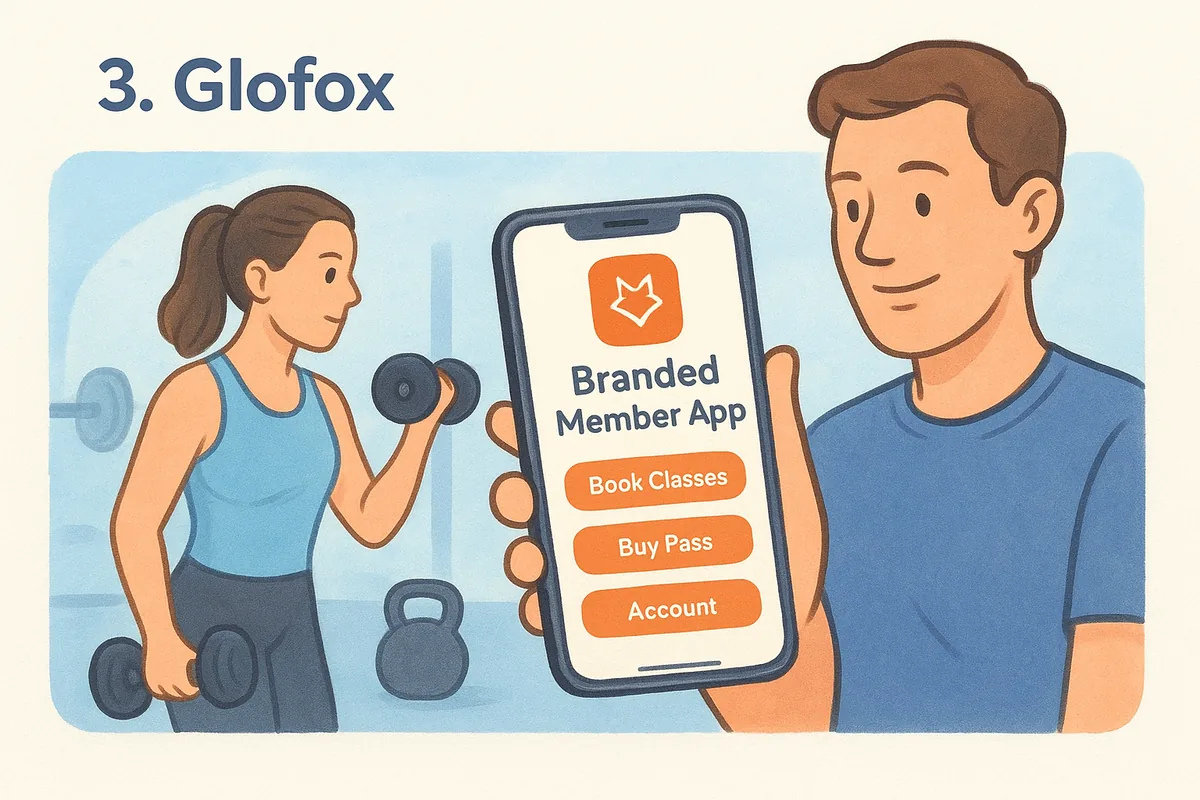
Glofox's branded member app lets clients book classes, buy packages, and manage their own accounts, which cuts down front desk workload considerably. The platform includes a lead management module that tracks prospects from inquiry through trial to paid membership, plus automated email and text follow-ups tied to specific triggers like a missed class or an expiring trial. Reporting covers retention rates, revenue by membership type, and staff performance, and the marketing tools let you run referral campaigns straight from the dashboard.
A branded app impresses members, but it won't chase a cold lead for you.
Pricing
Glofox doesn't publish flat rates, instead pricing by location and feature tier, with quotes typically landing in the low-to-mid hundreds per month once you add marketing automation or multiple sites. Studios report that the entry tier feels light on automation, pushing many toward a higher tier just to get the lead follow-up sequences that competitors bundle in by default. Expect a sales call before you see real numbers, and factor in setup fees some studios mention during onboarding.
Who it's for
Boutique studios and martial arts gyms that want a single branded app for members and staff, without stitching together separate booking and sales tools, tend to get the most out of Glofox. It suits owners who value a polished client-facing experience over deep pipeline customization, and who don't mind a tiered pricing structure in exchange for fitness-specific workflows already built in. Teams that need granular deal-stage automation may still find themselves wanting a dedicated sales CRM alongside it.
4. PushPress
PushPress built its name among strength and conditioning gyms, particularly CrossFit boxes, before expanding into general fitness studios that wanted the same no-nonsense operations software. Owners researching a crm for gyms and fitness studios tend to notice PushPress because it markets itself as software built by gym owners, and the workflows reflect that lived experience rather than a generic service-business template. It handles billing, scheduling, and lead tracking together, aiming to replace three or four separate tools with one dashboard.
Key features
PushPress includes a sales pipeline view that tracks leads from first inquiry through trial and signed membership, with automated email and text sequences triggered by specific actions like a missed check-in or an unbooked intro session. The platform's retention automation flags members whose attendance drops off, prompting staff outreach before a cancellation happens. Billing and scheduling run natively alongside the CRM functions, and reporting covers revenue trends, class attendance, and lead source performance so you can see which marketing channel actually brings in paying members.
Catching a drop in attendance before it becomes a cancellation is worth more than any dashboard widget.
Pricing
PushPress prices by location and member count rather than a flat per-user rate, with plans typically starting around $159 per month for smaller gyms and scaling up as your roster grows. Higher tiers unlock deeper automation and reporting, so a studio wanting the full lead-nurture sequence may need to budget for a mid-tier plan rather than the entry-level option. Setup support is included, but multi-location pricing requires a direct quote.
Who it's for
Strength and conditioning gyms, CrossFit boxes, and functional fitness studios that want billing and sales tracking in one system get the most value from PushPress, especially owners who came up through the CrossFit community and want software that speaks that language. It suits single-location or small multi-location operators more than large chains needing granular permission structures. Studios prioritizing a dedicated sales CRM with deeper pipeline customization may still find PushPress's lead tools a bit lighter than purpose-built sales software.
5. TeamUp
TeamUp built its name among yoga studios, dance schools, and boutique fitness brands that run complex class schedules but don't want the CrossFit-heavy branding of PushPress or the enterprise feel of Mindbody. Owners scanning the market for a crm for gyms and fitness studios often find TeamUp appealing because its pricing structure feels more transparent than most competitors, even though it still splits features across tiers rather than bundling everything at one rate. The platform leans on flexible scheduling first, with sales and retention tools layered on top.

Key features
TeamUp's flexible class scheduling handles recurring classes, workshops, and private sessions with waitlists and automated reminders, which studios running mixed formats appreciate. The lead and member CRM tracks inquiries through trial to paid membership, with automated email sequences for follow-up and rebooking, plus a self-service member portal that cuts down admin work at the front desk. Reporting covers attendance trends, revenue by class type, and instructor performance, giving owners a clearer read on which programs actually drive membership retention.
Scheduling flexibility matters, but a studio still needs a system that chases the lead who never booked their trial.
Pricing
TeamUp prices by active client count rather than a flat per-user rate, starting around $79 per month for smaller studios and rising as your member base grows. Higher tiers add deeper automation, custom branding, and API access, so studios wanting full lead-nurture sequences typically need to budget beyond the entry plan. Unlike Vedain's single flat rate, TeamUp's cost shifts as your roster expands, which multi-location owners should factor into long-term budgeting.
Who it's for
Yoga studios, dance schools, and boutique fitness brands running varied class formats get the most value from TeamUp, especially owners who prioritize scheduling flexibility over deep sales pipeline customization. It suits studios comfortable with a growing bill as membership scales, and less so operators wanting predictable flat pricing from day one.
6. Gymdesk
Gymdesk started as a smaller, budget-conscious alternative to the bigger fitness platforms, and it still markets itself that way, aiming at independent gym owners who feel overcharged by Mindbody or Glofox. Considering a crm for gyms and fitness studios at this price point, owners often land on Gymdesk because it bundles scheduling, billing, and lead tracking without the tiered upsells that pad out competitor invoices. It won't win on polish, but the core sales and retention tools cover what a single-location gym actually needs day to day.
Key features
Gymdesk's lead tracking module logs inquiries from your website form or walk-ins, then moves them through trial and signup stages with automated email and text reminders for unbooked intro sessions. The platform's attendance-based retention alerts flag members whose visits drop off, so staff can reach out before a cancellation request lands. Scheduling, billing, and a member-facing app round out the system, and reporting covers revenue, attendance trends, and lead source performance in a straightforward dashboard rather than a heavily customized one.
Budget software still needs to catch the lead who ghosted after their free trial.
Pricing
Gymdesk prices by active member count, starting around $129 per month for smaller gyms and scaling as your roster grows, with no separate location fees for single-site owners. Automation features that competitors lock behind higher tiers, like text reminders and retention alerts, come included at most plan levels, which is where Gymdesk earns its budget-friendly reputation. Multi-location studios should still request a quote, since per-location costs add up faster than the base price suggests.
Who it's for
Independent gym owners running one or two locations who want dependable lead and retention tools without paying for enterprise features they'll never touch get the most from Gymdesk. It suits operators prioritizing straightforward pricing and simple automation over deep customization or branded app polish. Studios planning rapid multi-location expansion may outgrow its simpler reporting and want a platform built for larger sales teams instead.
7. Zen Planner
Zen Planner has served martial arts schools, CrossFit boxes, and climbing gyms for over a decade, building a reputation as software that understands niche fitness businesses rather than treating every studio like a generic yoga class. Owners hunting for a crm for gyms and fitness studios with martial arts roots often land here because the belt-tracking and curriculum tools don't exist in most competitors. It pairs that specialization with standard billing, scheduling, and lead management, though the sales side feels more like a supporting feature than the main draw.

Key features
Zen Planner's curriculum and belt tracking stands out for martial arts schools, letting instructors log student progress toward the next rank alongside regular attendance. The lead management tools cover the basics: capturing inquiries from a website form, moving them through trial stages, and triggering automated email follow-ups when a prospect goes quiet. Retention reporting flags members with declining attendance, and a member portal handles class bookings and payments without staff intervention.
Belt tracking builds loyalty in a martial arts school, but it won't replace a real sales pipeline.
Pricing
Zen Planner prices by member count and feature tier, with plans typically starting around $117 per month for smaller studios and rising as your roster and automation needs grow. Higher tiers unlock deeper marketing automation and reporting, so studios wanting robust membership retention tracking often need to budget past the entry plan. Multi-location pricing requires a direct quote, and setup fees sometimes apply during onboarding.
Who it's for
Martial arts schools, climbing gyms, and niche fitness studios with structured skill progressions get the most value from Zen Planner, especially owners who want curriculum tracking baked into daily operations. It suits single-location operators more than chains needing granular sales automation across multiple sites. Studios prioritizing deep pipeline customization over niche curriculum features may find the sales tools thinner than a dedicated CRM built for that purpose.
8. Exercise.com
Exercise.com built its platform around workout programming first, then expanded into gym management and sales tools as personal trainers and studio owners asked for more. Owners researching a crm for gyms and fitness studios often discover Exercise.com through its custom-branded app, which lets a gym deliver workout plans, track client progress, and handle bookings under its own logo rather than a generic template. It leans heavily on the training and programming side, with lead tracking and sales automation layered in as the business grew beyond solo trainers.
Key features
Exercise.com's custom workout builder lets trainers assign programs, track sets and reps, and monitor client progress directly through the branded app, which sets it apart from platforms built purely around class scheduling. The lead and sales CRM tracks inquiries from website forms through trial and signed membership, with automated email sequences for follow-up, though the workflow feels built to support programming rather than run a full pipeline on its own. Billing, scheduling, and performance reporting round out the system, and the platform supports both in-person gyms and remote coaching businesses selling programs online.
A branded workout app builds loyalty, but it still needs a real pipeline behind it to convert trials into members.
Pricing
Exercise.com doesn't publish flat rates, instead quoting based on client count, feature tier, and whether you need the fully branded app experience, with costs typically landing in the low-to-mid hundreds per month for small studios. Larger gyms or training businesses wanting the complete branded platform, including custom app store listings, often pay well beyond that starting point. Expect a sales conversation before you see real numbers, since pricing scales with how much customization you want.
Who it's for
Personal training studios, hybrid coaching businesses, and gyms selling structured workout programs alongside memberships get the most value from Exercise.com, especially owners who want their brand front and center in a client-facing app. It suits operators who prioritize programming depth over pipeline automation, and less so studios whose main challenge is chasing cold leads through a sales process.
9. Wodify
Wodify grew up inside the CrossFit community, and it still shows in every corner of the platform, from workout leaderboards to performance benchmarks tracked against a member's own history. Owners scanning the market for a crm for gyms and fitness studios with a functional fitness pedigree usually land here because Wodify treats workout data as seriously as billing data, which most general fitness software never bothers to do. Sales and lead tracking exist, but they sit alongside a much bigger focus on programming and athlete performance.

Key features
Wodify's performance tracking suite logs every workout result, letting members and coaches see progress on lifts and benchmark WODs over months or years, which builds the kind of loyalty that keeps CrossFit athletes renewing. The lead and membership CRM captures inquiries from your website, moves them through trial stages, and sends automated follow-up emails when a prospect stalls, though the pipeline view is simpler than what a dedicated sales CRM offers. Scheduling, billing, and a member app round out the platform, and reporting covers attendance, revenue, and coach performance side by side.
Leaderboards keep athletes coming back, but they don't chase the lead who never booked a second class.
Pricing
Wodify prices by member count and feature tier, typically starting around $139 per month for smaller boxes and climbing as your roster and automation needs grow. Deeper marketing automation and reporting sit behind higher tiers, so a gym wanting full lead nurture sequences should expect to budget past the entry plan. Multi-location pricing requires a direct quote from sales.
Who it's for
CrossFit boxes and functional fitness gyms built around performance tracking and leaderboards get the most from Wodify, especially owners whose members care as much about workout results as class scheduling. Studios needing a genuinely deep sales pipeline for trial conversion may still want a dedicated CRM working alongside it.
10. How to choose the right CRM for your gym
Start by mapping your actual sales process before you compare feature lists. A studio that converts trials through in-person tours needs strong pipeline visibility, while a gym relying on walk-in sign-ups cares more about attendance-based retention alerts. Write down every step from first inquiry to signed membership, then check which platform actually automates each one instead of just tracking it on a list.
Budget shapes this decision more than most owners admit upfront. Tiered platforms like Mindbody, Glofox, and Wodify look affordable at the entry price, then climb fast once you add the automation and reporting your team actually needs, which is exactly how CRM pricing tiers add up in practice. Flat-rate tools avoid that surprise, since a transparent pricing model that doesn't climb as you grow means the invoice you see in month one matches month twelve, no matter how many workflows you build.
The real cost of a gym CRM shows up in month six, not on the pricing page.
Consider whether you need fitness-specific features or general sales power, and how CRM setups differ from one industry to the next. A martial arts school benefits from Zen Planner's belt tracking, and a CrossFit box gets real value from Wodify's leaderboards. But if your bottleneck is chasing cold leads and tracking renewals across multiple locations, a dedicated fitness sales CRM built for pipeline work, like Vedain, often beats a scheduling app with a contacts tab bolted on.
Run through this checklist before you sign a contract, then compare it against the broader nine questions worth asking before buying any CRM:
- •Does it automate follow-up for missed trials and unbooked intro sessions?
- •Can you see lead source performance without exporting a spreadsheet?
- •Are text and email sequences included, or locked behind a higher tier?
- •Does pricing stay flat as your member count grows, or does it climb quietly?
- •Will your front desk staff actually use it, or does it require a training session nobody has time for?
Test two finalists free for 14 days with real leads before committing. Numbers on a sales page rarely match what your team experiences once actual prospects start moving through the pipeline.
Finding the right fit for your gym
Every platform on this list solves a piece of the puzzle, but few solve all of it. Fitness-specific tools like Zen Planner and Wodify win on niche features, curriculum tracking, leaderboards, but their sales pipelines stay thin, and their pricing climbs the moment you need real automation. If your studio's real bottleneck is converting trials and catching renewals before they slip away, that's a sales problem, not a scheduling problem.
General gym management software often bolts a contacts tab onto billing and calls it a CRM. A proper crm for gyms and fitness studios treats every lead like a deal that needs a pipeline, a follow-up sequence, and an owner who's accountable for it. That's the gap Vedain fills, with flat pricing and automation that doesn't disappear behind a paywall once your gym grows.
Ready to see it running against your own lead list? Book a walkthrough with our team and watch how quickly a trial sign-up turns into a tracked, followed-up deal.
Frequently Asked Questions
What is the best CRM for small fitness studios with limited budget?
Pipedrive is the best budget-friendly CRM for small fitness studios, starting at $14/month with essential contact and pipeline management features. While HubSpot offers a free tier, Pipedrive's affordability combined with fitness-specific integrations makes it ideal for studios with 1-5 staff members. Zoho CRM is another cost-effective alternative from $14/user/month (annual), though Pipedrive's intuitive interface requires less training time.
Can you use Salesforce for gym membership management?
Yes, Salesforce can manage gym memberships, but it's overengineered and expensive for most fitness studios, with Starter Suite at $25/user/month and full-featured editions from $100 to $550/user/month. Specialized fitness platforms are better suited for membership billing and class scheduling, while Vedain covers lead pipelines and renewal follow-up without the enterprise complexity. HubSpot offers a more affordable middle-ground from $20/seat/month if you need Salesforce-level customization without the price tag.
Which CRM integrates best with gym management software?
Vedain is a general sales CRM that connects to gym management and billing systems through Zapier, Make, webhooks or its REST API. Pipedrive also offers strong third-party integrations through Zapier with popular gym software like ClassPass and Mindbody. While Zoho and HubSpot support these integrations, they require more manual setup.
What CRM should I use to track personal training client leads?
Pipedrive excels at lead tracking for personal training businesses with visual sales pipelines and automated follow-ups, priced at $14-99/month. HubSpot's free CRM also works well for solo trainers with basic lead capture and email tracking. Vedain covers PT lead pipelines, follow-up sequences and a booking page for consultations at $10/user/month, though it has no workout or progress tracking.
Is HubSpot or Zoho better for fitness studio customer retention?
HubSpot edges out Zoho for retention with superior automation workflows and email marketing tools from $20/seat/month (Starter), making it easier to nurture dormant members. Zoho CRM (from $14/user/month) offers better affordability but requires more manual setup for retention campaigns. For renewal follow-up, Vedain's workflows and email/SMS sequences can automate reminders to lapsing members, though class reminders still come from your booking software.
What CRM has the best mobile app for gym sales consultants?
Pipedrive's mobile app is intuitive and allows gym sales consultants to update deals and log member calls on-site, making it superior to Salesforce's complex mobile interface. HubSpot's mobile CRM is also user-friendly and free-tier compatible, though it lacks fitness-specific features. Vedain has no native app, but its mobile-responsive web app gives consultants real-time access to client history and deal details during gym tours.