This article answers that search directly. We've evaluated platforms based on pipeline flexibility, document handling, email automation, and pricing transparency, because immigration firms can't afford tools that nickel-and-dime you for basic features like email sync or workflow automation.
Below you'll find 8 CRMs worth considering in 2026, including where each one shines and where it falls short. We'll also show you how all-inclusive pricing models, like the flat $10 per user approach we use at Vedain, can save small consulting practices real money while still giving you deal pipelines, automation, and lead capture forms out of the box. By the end, you'll know exactly which CRM fits your caseload and your budget.
1. Vedain CRM for affordable, all-inclusive case management
Vedain built its CRM for consulting practices around the idea that a small firm shouldn't pay extra for the features it actually needs to run a caseload. Its single plan includes deal pipeline tracking, email sync, automation, and lead forms at one flat rate, so an immigration consultant managing 40 active visa cases isn't stuck choosing between a cheap plan that hides workflow automation behind a paywall and an expensive one built for enterprise sales teams. You get a full CRM for immigration consultants without the tiered pricing games that competitors like HubSpot and Salesforce are known for.
Key features for immigration consultants
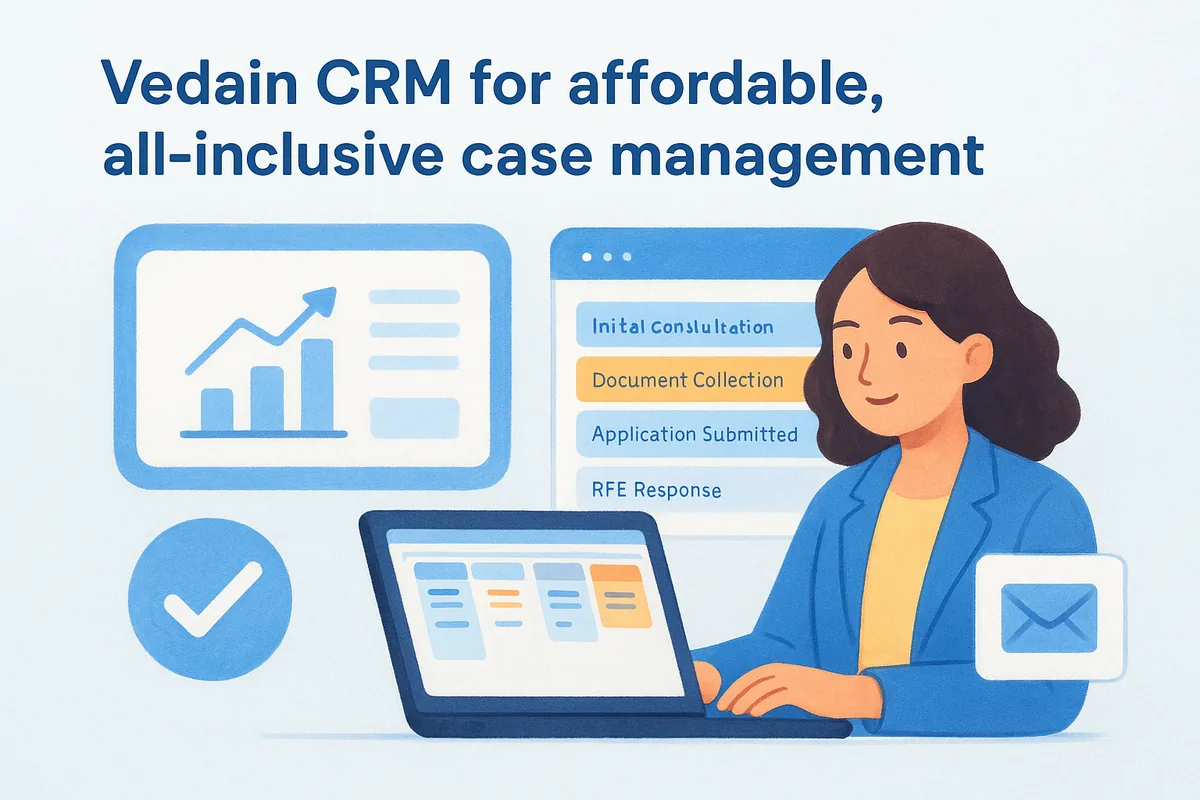
Vedain's Kanban-style deal pipeline lets you build stages that mirror your actual case flow: initial consultation, document collection, application submitted, RFE response, decision pending, approved. Each contact card holds custom fields for visa type, filing deadline, and case notes, so nothing lives in a separate spreadsheet. Two-way email sync with Gmail and Outlook means every client email thread stays attached to the case record automatically. The no-code workflow builder can trigger reminder emails when a document is overdue or move a case to the next stage once a milestone is logged, and lead capture forms on your website feed prospects straight into your pipeline without manual entry.
A CRM only earns its keep when it removes manual tracking work, not adds another spreadsheet to maintain.
Beyond the basics, Vedain's AI agent marketplace offers pre-built agents that can draft follow-up emails or enrich contact records with public data, which saves real time on repetitive client communication. Custom dashboards let you build a view of your pipeline by visa category or consultant workload, and reports show conversion rates from initial inquiry to signed retainer.
Who it's best for
Solo immigration consultants and small to mid-sized firms, roughly 2 to 50 staff, get the most value here. Teams that outgrew a spreadsheet but don't want to pay for a bloated enterprise suite fit the profile well. Practices that already use Gmail or Outlook for client communication will appreciate the native sync, and firms that want automation without hiring a CRM administrator or consultant to configure it will find the setup approachable. Vedain markets a sub-5-minute setup with no credit card required for the trial, which matters when you're testing a tool between client calls.
Pricing
Vedain charges a single flat rate of $10 per user per month, with every feature included regardless of team size. There are no separate tiers for automation, email sync, or reporting, and no per-contact or per-record limits that force an upgrade as your caseload grows.
Where it falls short
Vedain doesn't ship with visa-specific templates or immigration form libraries the way a niche tool like Agentcis does, so you'll need to build your pipeline stages and custom fields yourself. Firms managing dozens of branch offices with complex approval hierarchies may eventually need the deeper role customization that Salesforce offers at a much higher price point.
2. HubSpot for scaling immigration consultancies
HubSpot appeals to immigration firms that expect to grow past a handful of consultants and need a CRM that scales with marketing, sales, and service teams under one roof. It started as a marketing platform, and that heritage shows in how deep the lead nurturing and reporting tools go compared to most CRMs built for smaller teams. If your consultancy runs webinars, gated guides on visa eligibility, or paid ads to attract prospective applicants, HubSpot's marketing hub integrates directly with its CRM data.
Key features for immigration consultants
HubSpot's free CRM tier covers basic contact and deal tracking, which works for a small caseload. Once you need automation, you'll want Marketing Hub or Sales Hub, which add multi-step email sequences, lead scoring based on engagement, and custom report builders. Document tracking exists through file attachments on deal records, and you can build workflows that route a case to a specific consultant once a form is submitted. The platform also connects with hundreds of third-party apps through its marketplace.
The features that make HubSpot powerful for marketing teams are the same ones that make it expensive for a small immigration practice.
Who it's best for
Growing consultancies with a dedicated marketing function, or firms planning to scale past 20 staff with separate sales and case management teams, get the most out of HubSpot. It suits practices that already invest in content marketing and want that data connected to case outcomes.
Pricing
HubSpot's free tier covers basic contact management, and it helps to know what each HubSpot seat really costs before committing. Paid plans start around $20 per user per month for Sales Hub Starter, but the automation and reporting features immigration consultants actually need typically require Professional tiers, which run into the hundreds of dollars monthly per seat once you add Marketing Hub. Check HubSpot's official pricing page for current tiers.
Where it falls short
Costs climb quickly once you need workflow automation, and the interface has a steep learning curve for consultants without a marketing background, which is one of the recurring HubSpot pros and cons buyers weigh. Small practices often pay for features, like advanced marketing analytics, they'll never use.
3. Zoho CRM for budget-conscious mid-size agencies
Zoho CRM sits in a familiar spot for immigration firms that have outgrown a free tool but still watch every dollar of overhead. It's part of the larger Zoho suite, so if you already use Zoho Books for invoicing or Zoho Desk for client support, the CRM slots into that ecosystem without much friction, and it's worth understanding what Zoho CRM actually does before you commit. Consultants who need customization options without HubSpot-level pricing tend to land here.
Key features for immigration consultants
Zoho's Blueprint feature lets you map out a structured case process, like document intake, biometrics, interview scheduling, and decision, with mandatory fields at each stage so a consultant can't skip a step. Zia, Zoho's AI assistant, can score leads and flag deals likely to stall. You get multichannel communication tracking across email, phone, and social, plus a client portal option for document uploads. Custom modules let you build fields specific to visa categories or country of application.
Zoho rewards firms willing to spend time configuring it, but punishes those who expect it to work well out of the box.
Who it's best for
Mid-size agencies with 10 to 100 staff and an in-house admin willing to configure Blueprint workflows and custom modules get the best return here. Firms already inside the Zoho ecosystem, using Zoho Books or Zoho Desk, will find the added CRM integration worthwhile. It also suits practices in cost-sensitive markets like India or Southeast Asia, where Zoho has a strong regional presence.
Pricing
Zoho CRM's paid plans start around $14 per user per month billed annually for the Standard tier, with Professional and Enterprise tiers climbing to roughly $23 and $40 per user monthly for deeper automation and AI features. Check Zoho's official pricing page for current rates, since tiers shift features around fairly often.
Where it falls short
The interface feels dated next to newer CRMs, and the sheer number of settings can overwhelm a small team without dedicated admin time, which pushes many firms toward cheaper Zoho CRM alternatives. Support response times lag for lower-tier plans, which matters when a filing deadline is on the line.
4. Pipedrive for solo consultants and small teams
Pipedrive built its reputation on simple sales pipeline software, and that focus makes it a natural fit for a solo immigration consultant or a two-person practice that just wants to see every case at a glance without wading through marketing tools they'll never touch. The interface stays out of your way, which matters when you're juggling client calls and don't have time to learn a sprawling platform. Consultants coming from a crm for immigration consultants search who just want simple deal tracking, not a full sales operating system, often land here first.
Key features for immigration consultants
Pipedrive's drag-and-drop pipeline lets you customize stages for each visa category, and you can run multiple pipelines side by side if you handle both family-based and employment-based cases. Activity reminders nudge you when a follow-up call or document request is overdue, and email sync with Gmail or Outlook keeps client threads attached to the deal. The automation builder covers basic triggers, like sending a template email when a case moves stages, though it's noticeably lighter than what Zoho or Vedain offer at similar price points, as this side-by-side look at Pipedrive shows.
A clean pipeline view solves the tracking problem, but it doesn't replace document management or deep automation on its own.
Who it's best for
Solo practitioners and teams of two to ten fit Pipedrive best, especially consultants who value a short learning curve over feature depth. It suits anyone switching off spreadsheets for the first time and wanting a visual, low-friction upgrade.
Pricing
Pipedrive's Lite plan starts around $14 per user per month billed annually, with Growth and Premium tiers running about $24–$39 and $49–$59 respectively (annual, varies by region) for added automation and reporting. Document management and advanced workflow features sit behind these higher tiers. See Pipedrive's official pricing page for current details.
Where it falls short
Document storage and case-specific customization feel thin compared to purpose-built immigration tools, and firms with more than a few consultants often outgrow the automation ceiling fast. There's no native immigration case template, so you're building your workflow from scratch.
5. Salesforce for large multi-branch immigration firms
Salesforce sits at the top of the CRM market, and immigration firms with multiple branch offices or hundreds of case files in flight sometimes need that scale of infrastructure. It's the platform enterprise legal and consulting firms already trust, so if your practice merges with another firm or opens offices across states or countries, Salesforce can absorb that complexity without breaking. Few firms actually need this much horsepower, and smaller practices are usually better served by one of the Salesforce alternatives built for small business.

Key features for immigration consultants
Salesforce's Service Cloud and Sales Cloud combination lets large firms track cases across branches while keeping separate permission structures for each office. Custom objects can model visa categories, filing stages, and document checklists in detail, and the AppExchange marketplace has third-party apps built specifically for legal and immigration case management. Reporting goes deep, with dashboards that roll up conversion rates and caseloads across every branch into one executive view.
Salesforce solves complexity for large firms, but it creates complexity for everyone else.
Who it's best for
Large, multi-branch immigration firms with 100 or more staff and a dedicated IT or Salesforce administrator get the most out of this platform. It suits firms already running other Salesforce products, like Service Cloud for client support, and organizations with the budget to hire a consultant for setup and ongoing configuration.
Pricing
Salesforce Starter Suite begins around $25 per user per month, but the customization immigration firms typically need requires Pro Suite or Core tiers, running $100 to $195 per user monthly. Implementation and consultant fees often add thousands more upfront. Check Salesforce's official pricing page for current tiers.
Where it falls short
Setup takes weeks, not minutes, and small to mid-size practices routinely overpay for infrastructure they'll never fully use, which is the case for a lighter alternative to Salesforce. Without a dedicated administrator, the platform's flexibility becomes a liability instead of an asset.
6. Agentcis for ready-made immigration workflows
Agentcis takes a different approach than the general-purpose CRMs on this list: it's built specifically for immigration and education consultants, so the visa categories, document checklists, and case stages come pre-loaded instead of something you configure from scratch. Consultants who don't want to spend their first month mapping pipeline stages often choose this niche immigration CRM over a broader platform.
Key features for immigration consultants
Agentcis ships with pre-built visa workflows for study, work, and family-based applications, along with a document checklist tied to each case type so nothing gets submitted incomplete. A student and applicant portal lets clients upload documents directly, which cuts down on email back-and-forth. The platform also includes commission tracking for consultants who work with education agents or referral partners, plus built-in invoicing for application fees.
A tool built around immigration workflows from day one saves setup time that general CRMs simply can't match.
Who it's best for
Agencies focused heavily on student visa processing or education-linked immigration, especially those working with overseas agents on commission, fit this platform best, though a general CRM for education and training providers can cover the same student inquiry flow. Firms that want case templates ready on day one, rather than building their own pipeline structure, will appreciate the head start.
Pricing
Agentcis doesn't publish flat public pricing the way Vedain or Pipedrive do; instead, quotes typically depend on team size and which modules you need, such as the agent commission tracker or student portal. Expect to contact their sales team for a quote, and budget time for a demo call before you get real numbers.
Where it falls short
The niche focus that makes Agentcis strong for visa-specific workflows also makes it feel rigid if your practice handles broader immigration categories outside its templates. Pricing opacity makes it harder to compare against flat-rate competitors upfront, and the interface feels less polished than mainstream CRMs built with larger design teams.
7. Maple CRM for India and APAC immigration consultancies
Maple CRM comes out of India and has built a strong following among overseas education and immigration consultants across South Asia and the broader APAC region, one of several CRM options built for Indian businesses. It targets the same audience as Agentcis but leans harder into regional payment methods, local language support, and pricing quoted in rupees rather than dollars. Consultants running agencies out of India, Nepal, or the Gulf who need a CRM built with their client base in mind often find Maple feels more native to their day-to-day than a US-built platform.
Key features for immigration consultants
Maple's core strength is its counselor and branch management setup, which tracks which consultant handled which lead across multiple office locations. It includes visa and course-shortlisting tools for education consultants, automated SMS and WhatsApp follow-ups (a channel most Western CRMs treat as an afterthought), and a document checklist tied to destination country requirements. Lead capture forms integrate with common regional job boards and education fairs, and built-in invoicing handles application and service fees in local currency.
A regional CRM earns its keep by matching how your clients actually communicate, not just how your pipeline looks.
Who it's best for
Agencies operating primarily in India, the Middle East, or Southeast Asia, especially those handling student visa and overseas education cases, get the most value from Maple. It suits multi-branch consultancies that need centralized reporting across counselors and offices without paying Salesforce-level prices for that structure.
Pricing
Maple CRM doesn't publish a single global rate; pricing is typically quoted per branch or per user in INR after a sales conversation, and packages vary depending on whether you need the WhatsApp integration or multi-branch reporting add-ons. Budget time for a demo call to get exact numbers for your team size.
Where it falls short
Documentation and support skew toward customers already familiar with the Indian consulting market, which can leave firms outside that region feeling underserved. The interface also feels less refined than mainstream global CRMs, and automation depth trails behind what Vedain or Zoho offer at comparable price points.
8. Monday.com for team-based case collaboration
Monday.com as a sales CRM started as a general work management tool, not a CRM, and that background shows in how well it handles cross-team visibility on a single case. Immigration practices where a case moves through intake, a paralegal, a consultant, and sometimes an outside attorney find that Monday's board-based structure makes it easy to see who owns the next step. Teams searching for a crm for immigration consultants that doubles as project management software, rather than a pure sales pipeline, tend to gravitate here.
Key features for immigration consultants
Boards in Monday.com can represent a caseload, with each row holding a client's visa type, filing deadline, assigned staff member, and document status as color-coded columns. Automations trigger status updates, like notifying a paralegal when a client uploads a missing form, and the CRM template Monday offers adds deal stages and contact tracking on top of the base board structure. Dashboards pull data across multiple boards, so a firm running separate boards for family-based and employment-based cases can still see combined throughput in one view.
A tool built for team collaboration solves handoffs between staff, but it wasn't designed around a sales pipeline first.
Who it's best for
Offices with several staff members touching each case, paralegals, consultants, and reviewers working in sequence, get the most value from Monday.com. It suits teams that already use it for internal project tracking and want to fold client case management into the same workspace.
Pricing
Monday's CRM product starts around $12 per user per month billed annually on the Basic tier, with automation and integration limits expanding at $17 and $28 on the Standard and Pro tiers. Check Monday's official pricing page for current numbers, since seat minimums apply on lower tiers.
Where it falls short
Email sync and deal tracking feel bolted on rather than native, since the platform wasn't built as a CRM first. Automation runs and API calls are capped even on paid tiers, which can bite a busy practice mid-month.
Finding the right fit for your practice
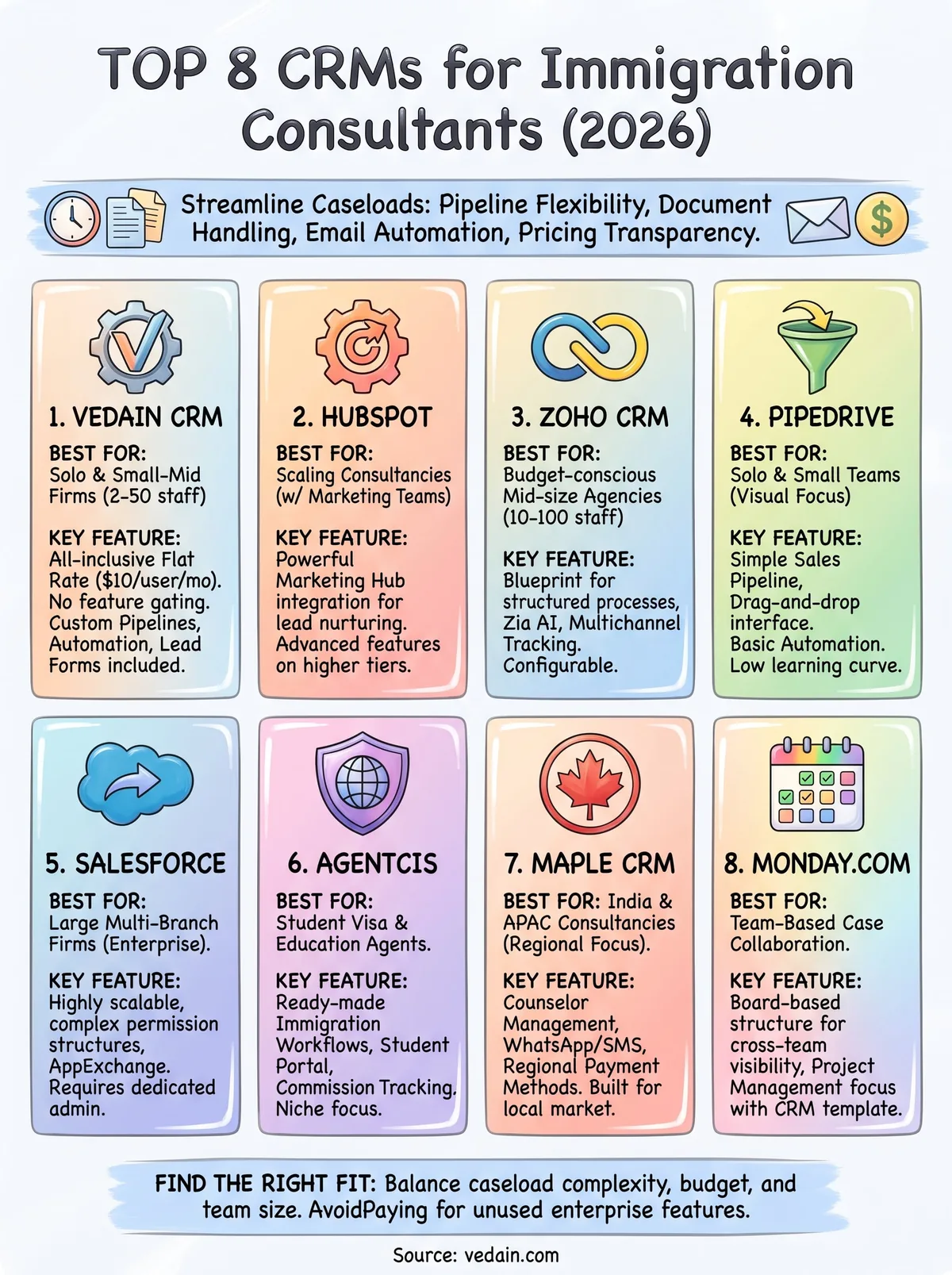
Every CRM on this list solves the same core problem differently: keeping cases, documents, and deadlines from slipping through the cracks. Enterprise tools like Salesforce make sense once you've got branch offices and a dedicated admin, while niche picks like Agentcis or Maple fit consultancies built around one visa category or one region, and general platforms increasingly ship CRM setups by industry. But most solo consultants and small firms don't need that complexity, or the pricing tiers that come with it. They need a pipeline that mirrors their actual caseload, email sync that doesn't require an upgrade, and automation that just works from day one.
That's the gap Vedain was built to close, with every feature included at one flat rate instead of gated behind higher plans. If you're tired of comparing tiers just to find basic automation, see what a full-featured CRM costs at $10 per user with nothing held back.
Frequently Asked Questions
What is the best CRM for immigration consultants with affordable pricing?
Zoho CRM is the best affordable option for immigration consultants, starting at just $14 per user per month, making it significantly cheaper than Salesforce's enterprise pricing. While HubSpot offers a free tier, Zoho provides more customization features specifically for managing client cases and document workflows at a lower cost. Vedain, a general CRM you configure with your own case stages, costs even less at a flat $10/user/month with every feature included.
Can CRM software track visa application deadlines and client documents?
Yes, most modern CRMs including HubSpot, Salesforce, and Zoho CRM can track visa deadlines through custom fields, automated reminders, and document management integrations. Vedain lets you add custom date fields and workflow reminders for each case stage, though it has no visa-specific templates (niche tools like Agentcis do). Pipedrive also offers task automation features that allow you to set deadline alerts for each client's application stage.
Is Salesforce or HubSpot better for immigration consulting firms?
HubSpot is generally better for immigration consulting firms because it's more user-friendly and affordable (Sales Hub from $20/seat/month), whereas Salesforce requires significant customization and its Pro Suite costs $100 per user per month. However, Salesforce offers more scalability for large firms managing thousands of cases simultaneously. For most immigration consultants, HubSpot's superior ease-of-use and client portal features outweigh Salesforce's complexity and cost.
What CRM features do immigration consultants need most?
Immigration consultants need CRMs with document management, deadline tracking, multi-stage pipeline views, and client communication history—features available in HubSpot, Zoho CRM, and Vedain. Pipedrive excels at visual pipeline management for tracking clients through visa application stages, while Salesforce provides advanced reporting for compliance documentation. The ideal CRM should also include email integration and automated reminders for follow-ups with government agencies and clients.
Does Vedain CRM work better than general CRMs for immigration law?
No. Vedain is a general-purpose CRM, not one built specifically for immigration consultants, and it has no pre-configured visa workflows, document checklists or compliance templates. Firms build their own case stages (consultation, document collection, application submitted, decision) and custom fields, at a flat $10/user/month with every feature included. If you want visa workflows out of the box, a niche tool like Agentcis is a better fit; for hybrid practices serving multiple industries, Vedain, HubSpot and Zoho CRM all offer flexible customization.
How much does CRM software cost for immigration consultants per month?
CRM costs vary significantly: Vedain is a flat $10/user/month, Zoho CRM and Pipedrive start at $14/user/month (billed annually), HubSpot Sales Hub runs $20/seat/month for Starter and about $90-100 for Professional, and Salesforce starts at $25/user/month for Starter Suite or $100 for Pro Suite. For a small immigration consulting firm with 5 employees, you'd spend $50/month on Vedain or $70/month on Zoho versus $500/month on Salesforce Pro Suite, making budget-conscious choices critical. Most immigration consultants find Vedain, HubSpot or Zoho offer the best value-to-features ratio for their practice size.