So what is sales prospecting, exactly? It's the deliberate work of identifying potential customers who match your ideal buyer profile, then reaching out through calls, emails, social selling, or referrals to start building a relationship before a formal sales pitch begins. Done right, it's a repeatable system, not a scramble at the end of the quarter.
In this article, you'll get a straight definition, the difference between prospecting and lead generation, and practical techniques your team can run this week. We'll also cover tools and automation shortcuts, including where a CRM like Vedain fits in, so you spend less time on manual list-building and more time talking to people who actually want to buy.
Why sales prospecting matters for your pipeline
Your pipeline is only as healthy as the prospecting that feeds it. Marketing can hand you leads, referrals can trickle in, but neither one shows up on a predictable schedule. Consistent prospecting is the only lever your sales team fully controls, and that alone makes it worth taking seriously instead of treating it as a task you get to "when things slow down."
Prospecting is the only renewable source of pipeline
Every other source of new business fluctuates. Referrals depend on happy customers remembering to mention you. Marketing leads rise and fall with ad spend and seasonality. Inbound signups slow during holidays and speed up around budget season. Sales prospecting doesn't wait on any of that. A rep who commits to 30 minutes of outreach every morning generates new conversations regardless of what marketing is doing that week. That reliability is exactly why sales leaders who track pipeline coverage ratios, the amount of open pipeline compared to the quota still owed, almost always find that teams with a disciplined prospecting habit carry more coverage than teams relying on inbound alone.
A pipeline built only on inbound leads is a pipeline you don't actually control.
What happens when prospecting stops
Stop prospecting for even two or three weeks and the effects don't show up immediately, they show up 60 to 90 days later when your pipeline runs dry and your forecast falls apart. This delay is what makes prospecting so easy to neglect. Reps get busy closing the deals already in motion, prospecting slides to the bottom of the to-do list, and nobody notices the gap until the next quarter starts with an empty top of funnel. Here's what that gap typically looks like when a team goes quiet on outbound activity:
Once you see the pattern, it explains a lot of the "why did this quarter fall apart" postmortems that sales leaders sit through. The damage was done months earlier, quietly, while everyone focused on deals already in progress.
It shortens your sales cycle, not just fills your funnel
Good prospecting doesn't just add volume, it improves the quality of what enters your pipeline. When you research a prospect before reaching out, reference something specific to their business, and time your outreach to a real trigger event like a funding round or a new hire, you start the relationship further along than a cold form-fill ever could. That translates directly into a shorter sales cycle, because you've already done part of the qualifying work before the first call happens. Reps who prospect with intention instead of blasting generic messages consistently report fewer stalled deals in the middle of their pipeline, because the deals they're working came in better qualified from the start.
Prospecting versus lead generation, and why the difference matters
People use these terms interchangeably, but they're not the same job. Lead generation is typically a marketing function: content, ads, webinars, and forms that pull interested people toward you. Prospecting is a sales function: reps actively identifying and reaching out to people who fit their ideal customer profile, whether or not those people have raised their hand yet. A lead generation program might hand you 200 form-fills a month, but if half of them are students downloading a whitepaper for a class project, prospecting is what filters and pursues the ones worth your time. Confusing the two leads teams to under-invest in outbound because they assume marketing will cover the gap, and it rarely does at the volume a growing sales team needs.
The compounding effect on revenue
Consistency compounds. A rep who prospects daily builds a personal pipeline that's always partially full, so a slow month from any single source barely registers. A rep who prospects in bursts, heavy one week and absent the next three, rides a rollercoaster of feast and famine that makes forecasting nearly impossible for their manager. Over a year, the daily prospector books more meetings with less stress, because they're never trying to fill an empty pipeline overnight. That's the real argument for building prospecting into your daily routine rather than treating it as an occasional project: the math rewards consistency far more than it rewards intensity.
How to build a sales prospecting process that works
A process beats a pile of tactics every time. Reps who "just wing it" burn hours deciding who to contact instead of actually contacting anyone. Sales prospecting works best as a defined sequence of steps you repeat, review, and improve, not a grab bag of activities you reach for when the pipeline feels thin.
Start with a clear ideal customer profile
Before you touch a phone or write an email, define who you're actually chasing. An ideal customer profile should include company size, industry, budget signals, and the specific problem your product solves for them. Without this, reps waste time on accounts that were never going to buy, and your conversion numbers suffer for reasons that have nothing to do with skill.
If you can't describe your ideal customer in one sentence, your prospecting list is guessing, not targeting.
Build a repeatable research and outreach sequence
Once you know who you're targeting, standardize how you find and approach them. Here's a sequence that works for most B2B sales teams:
- Source the list. Pull accounts from your CRM, LinkedIn Sales Navigator, or an intent-data tool that matches your ICP.
- Research each prospect. Spend 3-5 minutes checking recent news, job changes, or funding announcements before reaching out.
- Choose the channel. Match the first touch to how the prospect prefers to communicate, email, phone, or LinkedIn.
- Send a personalized first message. Reference something specific, not a generic template with a name swapped in.
- Log the activity immediately. Record the outreach in your CRM so follow-ups don't fall through the cracks.
- Set a follow-up cadence. Plan 5-7 touches over two to three weeks before moving on.
Skipping any of these steps is usually where prospecting programs quietly fall apart. Reps source lists but never research them, or they research thoroughly and forget to log the outreach, which means the next follow-up never happens.
Assign clear ownership and daily time blocks
Processes fail when nobody owns them. Assign specific prospecting hours, ideally the same block every day, so it becomes habit instead of an afterthought squeezed between meetings. Daily consistency matters more than occasional marathon sessions; a rep who prospects for 45 focused minutes every morning will out-produce someone who does three hours once a week, because the daily habit keeps the pipeline fed instead of lurching between empty and overloaded.
Automate the repetitive parts, not the personal ones
This is where a CRM earns its keep. Automating list-building, follow-up reminders, and email sequencing frees reps to spend their energy on the parts that actually require judgment, like customizing a message or reading a prospect's tone on a call. In Vedain CRM, workflows can trigger follow-up tasks automatically after a set number of days with no response, and email campaigns handle multi-step sequences without a rep having to remember which prospect is due for touch four. The rep still writes the personal note; the system just makes sure nothing gets forgotten.
Review and refine the process monthly
No process survives contact with reality unchanged. Review conversion rates by channel and by rep every month, and cut whatever isn't producing meetings. If cold calling delivers a 2% connect rate but a specific LinkedIn approach delivers 8%, that's a signal to shift time, not a reason to keep grinding on the weaker channel out of habit.
Inbound vs outbound prospecting: which fits your team
Most sales teams don't pick one lane and stay there forever. Inbound prospecting works leads who already showed interest, a demo request, a content download, a free trial signup. Outbound prospecting means you initiate contact with someone who hasn't raised their hand yet. Neither approach is inherently better; the right mix depends on your deal size, your sales cycle, and how much marketing traffic you actually generate.

What separates inbound from outbound
Understanding the mechanics matters more than picking a side. Inbound leads arrive with built-in intent, which usually means shorter conversations and higher close rates once you engage them quickly. Outbound leads require you to create the interest yourself, which takes more effort per contact but lets you target exactly who you want instead of waiting for the right person to find you. Here's how the two compare on the factors that actually affect quota attainment:
When inbound wins
Inbound makes sense when your product has a strong content engine or a lot of category search volume already pointing toward it. Companies with a well-optimized website, active SEO content, and paid ads generating steady form-fills can staff a team around responding fast and qualifying well, rather than sourcing cold lists. Speed here is everything: research consistently shows that leads contacted within five minutes convert far better than those contacted an hour later, which is why inbound-heavy teams should obsess over response time before anything else.
When outbound wins
Outbound becomes necessary the moment your growth depends on reaching accounts that will never search for you on their own. Enterprise deals, niche verticals, and long sales cycles usually require someone to proactively identify the right company and the right buyer inside it, because that buyer isn't going to stumble onto your landing page. Startups without much organic traffic yet lean on outbound almost by necessity, since there's no inbound engine to lean on in the first place.
Waiting for inbound to reach your revenue goal is a bet, not a strategy.
Most teams need both, just in different ratios
Realistically, few B2B teams run purely on one channel. A common pattern is letting marketing-generated leads fill part of the pipeline while reps prospect outbound to hit the rest of quota, especially in slower months when inbound volume dips. Deciding the ratio comes down to your numbers: if inbound alone covers 60% of pipeline coverage targets, outbound only needs to close the remaining gap, not replace the whole system. Tracking both sources separately in your CRM, rather than lumping every new deal into one bucket, is what makes that ratio visible instead of guessed at.
Sales prospecting techniques that actually convert
Techniques matter less than most sales blogs make them sound, but the right ones still separate reps who book meetings from reps who send messages into the void. Sales prospecting works when you match the technique to the buyer and the channel, then run it consistently instead of switching approaches every time a message goes unanswered. Below are the techniques that hold up across most B2B teams, along with where each one actually earns its place in your process.
Cold calling still works when you do it right
Cold calling isn't dead, but lazy cold calling is. A rep who dials down a random list with no research gets hung up on; a rep who opens with a specific reference to the prospect's recent hire, product launch, or LinkedIn post gets 30 more seconds to make a case. Cold calling works best as a supplement to email, not a replacement for it, because voicemail-only outreach rarely converts on its own. Keep calls short, lead with a question instead of a pitch, and track connect rates by time of day; most teams find late morning and mid-afternoon outperform the rest of the workday.
Social selling turns cold contacts into warm ones
LinkedIn changes the math on outbound because it lets a prospect see your activity before you ever send a message. Social selling means commenting on a prospect's posts, sharing relevant content, and building light familiarity before the first direct outreach, so your name isn't a complete stranger when it lands in their inbox. This works especially well for founders and sales leaders who are already active on the platform, since a warm connection request converts to a reply far more often than a cold one.
The best cold outreach doesn't feel cold to the person receiving it.
Referral and warm-intro prospecting
Asking existing customers for introductions remains one of the highest-converting techniques available, and most reps still underuse it. A referral ask works best right after a customer hits a win with your product, when goodwill is highest and the ask feels natural instead of transactional. Build this into your process with a simple checklist:
- •Ask for a referral within two weeks of a customer's first measurable win
- •Request a specific introduction, not a general "let me know if you hear of anyone"
- •Offer to draft the intro email yourself to reduce friction for the customer
- •Follow up with the referred contact within 48 hours while the intro is still fresh
Trigger-event prospecting for better timing
Timing beats almost everything else in prospecting. A trigger event, a funding round, a leadership change, a new office opening, tells you a company has budget movement or a fresh problem to solve, which makes your outreach relevant instead of random. Reps who build a habit of checking funding databases or company news before sending outreach consistently see higher reply rates than reps working static, unfiltered lists.
Multi-channel sequencing beats single-channel persistence
No single channel converts a majority of prospects on its own, so the strongest technique is combining several in a planned sequence. A typical sequence might mix two emails, one call, and a LinkedIn touch across ten business days, giving the prospect multiple low-friction ways to respond on their own terms. Multi-channel sequencing also protects against channel fatigue; a prospect who ignores three emails in a row might still answer a phone call, and vice versa.

Prospecting email templates you can customize today
A good template saves you from staring at a blank screen every morning, but a bad one turns your outreach into obvious spam. Prospecting email templates work best as a starting skeleton you personalize with real research, not a script you copy-paste and send unchanged to fifty people. Below are four templates built for the most common prospecting situations, each one short enough to read on a phone and specific enough to earn a reply.
First-touch cold email
Your opening email has one job: earn a response, not close a deal. Keep it under 100 words, reference something specific about the prospect's business, and end with a low-friction question instead of a meeting request.
A subject line that mentions a real detail beats a clever one every time.
Trigger-event follow-up
When you spot a trigger event, a funding round, a new hire, an expansion announcement, lead with it directly instead of burying it in paragraph two. Specificity is what makes this email feel researched instead of mass-sent.
The no-response follow-up
Most replies come after the third or fourth touch, not the first, so don't abandon a prospect after one silent email. Change the angle instead of repeating yourself; a fresh reason to reach out works better than a plain reminder.
Referral request email
This one goes to an existing customer, not a cold prospect, so keep the tone appreciative and make the ask easy to act on. Offering to write the intro yourself removes the biggest reason customers put off referrals.
Using templates like these inside a CRM keeps the personalization from becoming extra work. In Vedain CRM, email campaigns store your base templates while merge fields pull in the specific details automatically, so reps still send a personal-feeling message without retyping the boilerplate every time. That combination, a solid template plus five minutes of real research per prospect, consistently outperforms both fully generic blasts and fully custom emails written from scratch.
Metrics that show whether your prospecting is working
Guessing whether prospecting is working leads to the wrong conversations in every pipeline review. Prospecting metrics fall into two buckets: activity metrics that tell you whether reps are doing enough, and conversion metrics that tell you whether what they're doing actually works. Tracking only one side gives you half the picture, and half a picture is how teams end up rewarding busywork instead of results.
Activity metrics tell you if you're doing enough
Start with the basics: calls made, emails sent, LinkedIn touches, and meetings booked per rep per week. Activity tracking isn't about micromanaging, it's about spotting the rep who's quietly gone quiet before their pipeline dries up 60 days later. A rep averaging 40 calls a week who suddenly drops to 10 is a signal worth a five-minute conversation, not a punishment, because something usually changed, whether that's a personal issue, a broken list, or a shift to a task that felt more urgent.
Conversion metrics tell you if you're doing it well
Once you know reps are active, check whether that activity converts. Conversion rates by channel expose which techniques deserve more time and which ones are eating hours for nothing. Here's how the core conversion metrics typically break down across channels in a healthy B2B prospecting motion:
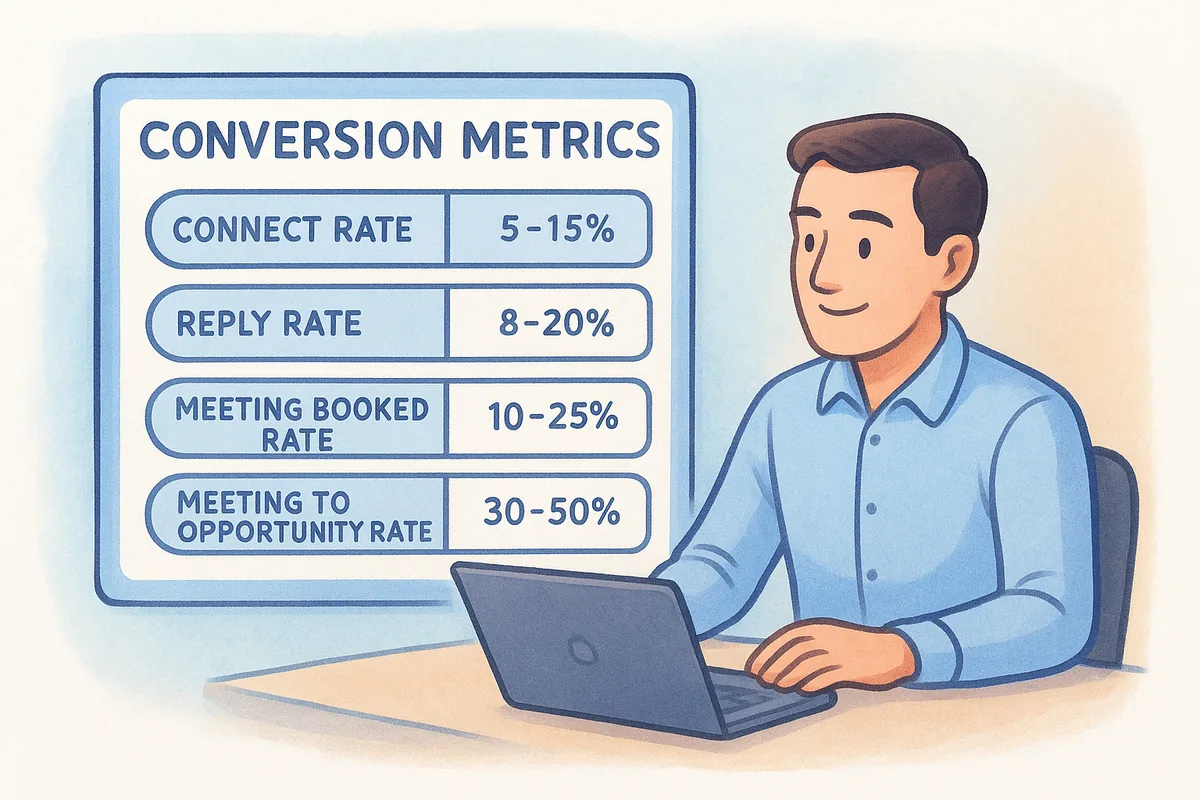
Comparing your own numbers against these ranges tells you fast whether a channel is underperforming because of the message, the list, or the timing, instead of assuming the whole approach is broken.
The metrics that matter most for forecasting
Managers care about one number more than any other: pipeline coverage ratio, the total open pipeline value compared to the quota still owed. A healthy ratio is usually 3x to 4x quota, and prospecting is the primary lever that keeps that ratio where it needs to be quarter after quarter. Watching this number weekly, not just at quarter-end, catches a coverage gap while there's still time to fix it with more outreach instead of a scramble.
A team that only checks pipeline coverage at the end of the quarter is checking it too late to do anything about it.
Track metrics by rep and by channel, not just in aggregate
Aggregate numbers hide the details that actually help you coach. Rep-level tracking, paired with channel-level breakdowns, shows you exactly where to spend coaching time instead of applying blanket advice that only helps some of the team. A CRM that logs activity automatically, the way Vedain's reports and team leaderboards do, removes the manual spreadsheet work and gives managers a live view instead of a stale one pulled together the night before a review. Watching these numbers by rep also surfaces the quiet outperformers, the reps whose numbers are strong enough to turn into a script the rest of the team can borrow, rather than a one-off result nobody bothers to study.
Common prospecting mistakes and how to avoid them
Even a solid process breaks down when a few habits creep in unnoticed. Prospecting mistakes rarely look dramatic in the moment, a skipped research step here, a generic template there, but they compound over weeks into a pipeline that never quite fills up. Spotting these patterns early saves you from the postmortem where nobody can explain why the quarter fell short.
Treating every prospect the same way
Generic outreach is the fastest way to get ignored. Sending the identical message to a startup founder and an enterprise VP ignores that they care about completely different problems, budgets, and timelines. Personalization at scale doesn't mean writing 50 unique emails from scratch, it means segmenting your list by role, industry, or company size first, then customizing one variable per segment rather than treating your whole list as a single audience.
A message that works for everyone usually works for no one.
Giving up after one or two touches
Most reps stop following up right when replies start picking up. Data on outreach sequences consistently shows the third, fourth, and fifth touches produce a meaningful share of total replies, yet plenty of reps quit after touch two out of fear of seeming pushy. Persistence with variety solves this: change the angle, the channel, or the format on each follow-up instead of repeating the same ask, so the prospect sees a reason to respond rather than a reminder to ignore.
Skipping research to hit activity numbers
When managers push pure activity targets, calls made, emails sent, reps start optimizing for volume over quality. Firing off 100 unresearched emails a day feels productive, but it tanks reply rates and trains prospects to delete anything from your domain. Quality over volume wins here: five minutes of research per prospect, checking their role, recent news, or a mutual connection, consistently beats twice the outreach with zero context.
Letting leads go cold from poor follow-up tracking
A prospect who shows interest and then hears nothing for two weeks assumes you moved on. This happens constantly on manual systems, spreadsheets get outdated, sticky notes get lost, and reps rely on memory instead of a system. Logging every touch and setting automatic reminders, the way workflows in a CRM can trigger a task the moment a follow-up is due, closes this gap without requiring a rep to remember a specific date weeks in advance.
Ignoring the data that shows what's actually working
Some reps keep grinding on a channel out of habit long after the numbers say it's underperforming. Without checking conversion rates by channel, a team can spend months on cold calling at a 2% connect rate while a LinkedIn approach sitting at 8% goes underused simply because nobody looked at the comparison. Reviewing metrics monthly, the same discipline covered earlier, is what catches this before it wastes another quarter.
Confusing busy with productive
Filling a calendar with tasks feels like progress, but a rep who spends three hours building a list and thirty minutes actually reaching out has the priorities backward. The fix is simple in theory and hard in practice: block time specifically for outreach, protect it from meetings, and measure output in conversations started, not hours spent preparing to start them.
Making prospecting part of your daily routine
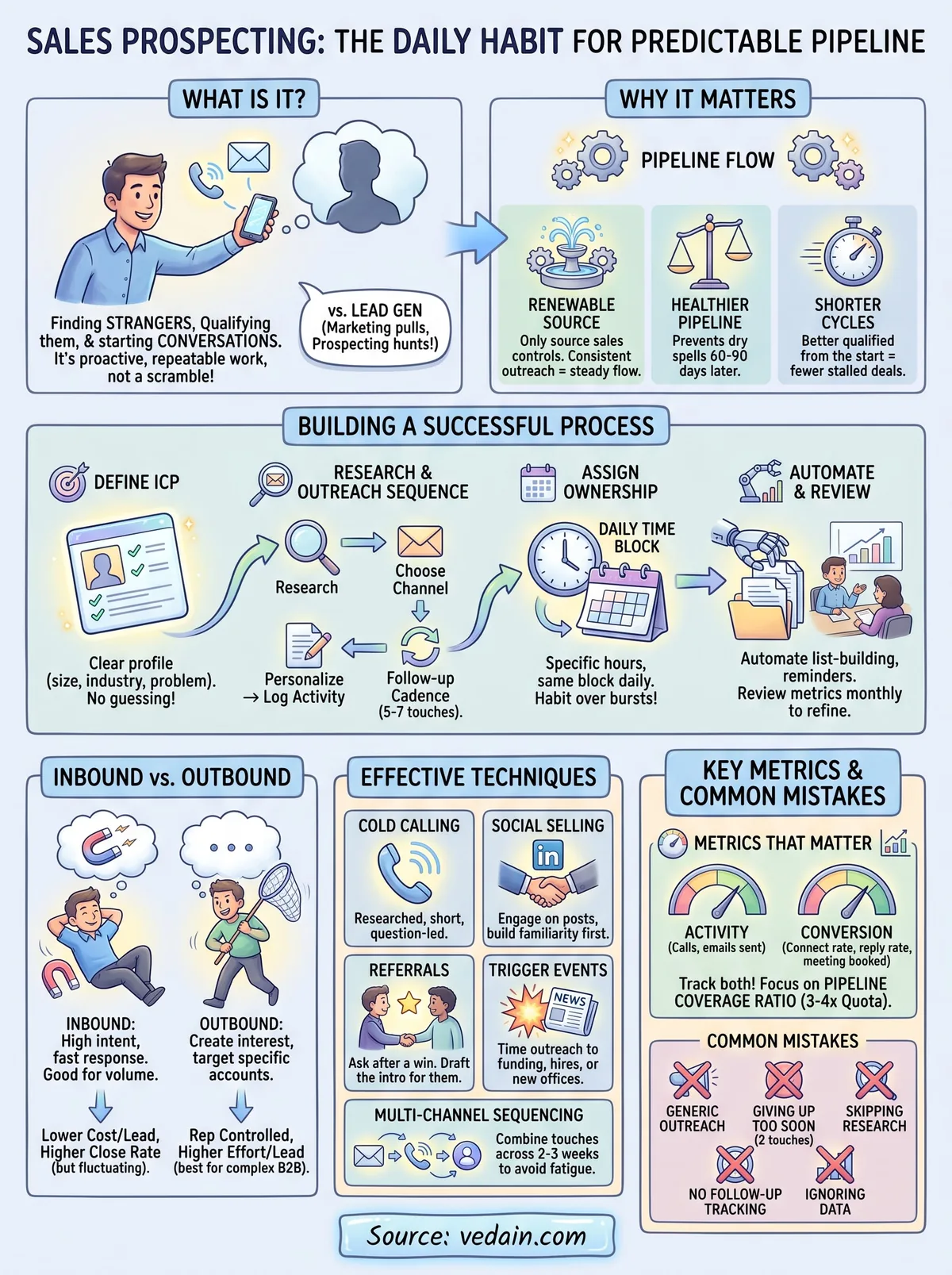
Sales prospecting isn't a project you finish, it's a habit you protect. The teams that win aren't necessarily smarter, they just show up every day with a clear list, a real reason to reach out, and a system that logs what happened so nothing slips through. Sales prospecting rewards consistency far more than intensity, and every technique in this article only works if you actually run it week after week instead of abandoning it when the first few messages go unanswered.
Getting there is easier with the right tools behind you. Tracking outreach in spreadsheets and sticky notes is exactly what causes the mistakes covered above, missed follow-ups, cold leads, no visibility into what's converting. Automated workflows handle the reminders and sequencing so your reps spend their time on conversations, not admin. If you want a CRM built to support that daily habit without the extra cost of feature tiers, try Vedain CRM free and see how much easier consistent prospecting becomes.
Frequently Asked Questions
What is the difference between sales prospecting and lead generation?
Sales prospecting is the process of identifying and contacting potential customers who fit your ideal customer profile, while lead generation is the broader marketing effort to attract interested prospects. Prospecting is more targeted and personal, often involving direct outreach via email or phone calls tracked in CRM platforms like HubSpot (Sales Hub from $20/seat/month) or Salesforce (from $25/user/month). While lead generation fills your pipeline, prospecting converts those leads into qualified opportunities for your sales team.
What are the best sales prospecting strategies for B2B companies?
The most effective B2B prospecting strategies include account-based marketing, cold email outreach, LinkedIn networking, and referral programs combined with intent data. Tools like Pipedrive ($14-79/user/month) and Zoho CRM ($14-52/user/month), billed annually, help track these activities across channels. Many B2B teams also use a combination of inbound content marketing with outbound direct outreach to increase conversion rates.
How do I find qualified sales prospects without buying expensive lists?
You can find qualified prospects by leveraging LinkedIn Sales Navigator, industry-specific directories, competitor customer research, and your existing customer base for referrals. Free resources like Google Maps, industry association websites, and social media also provide prospect information without upfront list costs. CRM systems like Freshsales ($9-59/user/month, billed annually) and Vedain ($10/user/month) offer built-in filtering and segmentation to identify prospects matching your ideal customer profile without requiring purchased lead lists.
What is the average sales prospecting conversion rate across industries?
Sales prospecting conversion rates are typically in the low single digits and vary widely by industry, channel and lead quality. Teams that use CRM automation to track and time follow-ups generally convert better than those prospecting manually. Conversion rates improve significantly when prospects are pre-qualified and contacted through the right channel at the right time using personalized messaging.
How often should sales reps follow up with prospects during prospecting?
Sales reps should follow up with prospects an average of 5-7 times before moving them to a closed-lost status, as most prospects need multiple touchpoints. Many sales take several follow-ups to close, yet many reps give up after the first rejection. CRM platforms like Pipedrive, Zoho CRM, and Freshsales automate follow-up reminders and track engagement patterns to optimize your outreach sequence.
Which CRM is best for managing a large-scale sales prospecting process?
For large-scale prospecting, Salesforce (Pro Suite $100 to Max $550 per user/month) and HubSpot (Sales Hub Professional and Enterprise, $90-150/seat/month) offer enterprise-grade features including advanced automation, AI-powered lead scoring, and robust reporting capabilities. Pipedrive ($14-79/user/month) and Zoho CRM ($14-52/user/month) provide excellent value for mid-market teams needing prospecting efficiency without enterprise complexity. Freshsales ($9-59/user/month) and Vedain ($10/user/month) also offer strong prospecting tools with good affordability, though Salesforce leads in scalability for teams managing thousands of prospects simultaneously.