This guide skips the vague feature lists and gets straight to what matters: which platforms actually handle ecommerce workflows like order history syncing, segmented email campaigns, and automated follow-ups without charging you extra for basic functions. We tested pricing structures, integration depth, and automation quality so you don't have to sign up for eleven free trials yourself.
Below you'll find 11 CRM options ranked for different needs, from lean startups running a single Shopify store to growing teams managing multiple sales channels. We cover setup time, email sync capabilities, and where hidden fees tend to hide, including how flat-rate platforms like Vedain compare against tiered pricing models from bigger names. By the end, you'll know exactly which tool fits your store's size and budget.
1. What is an ecommerce CRM?
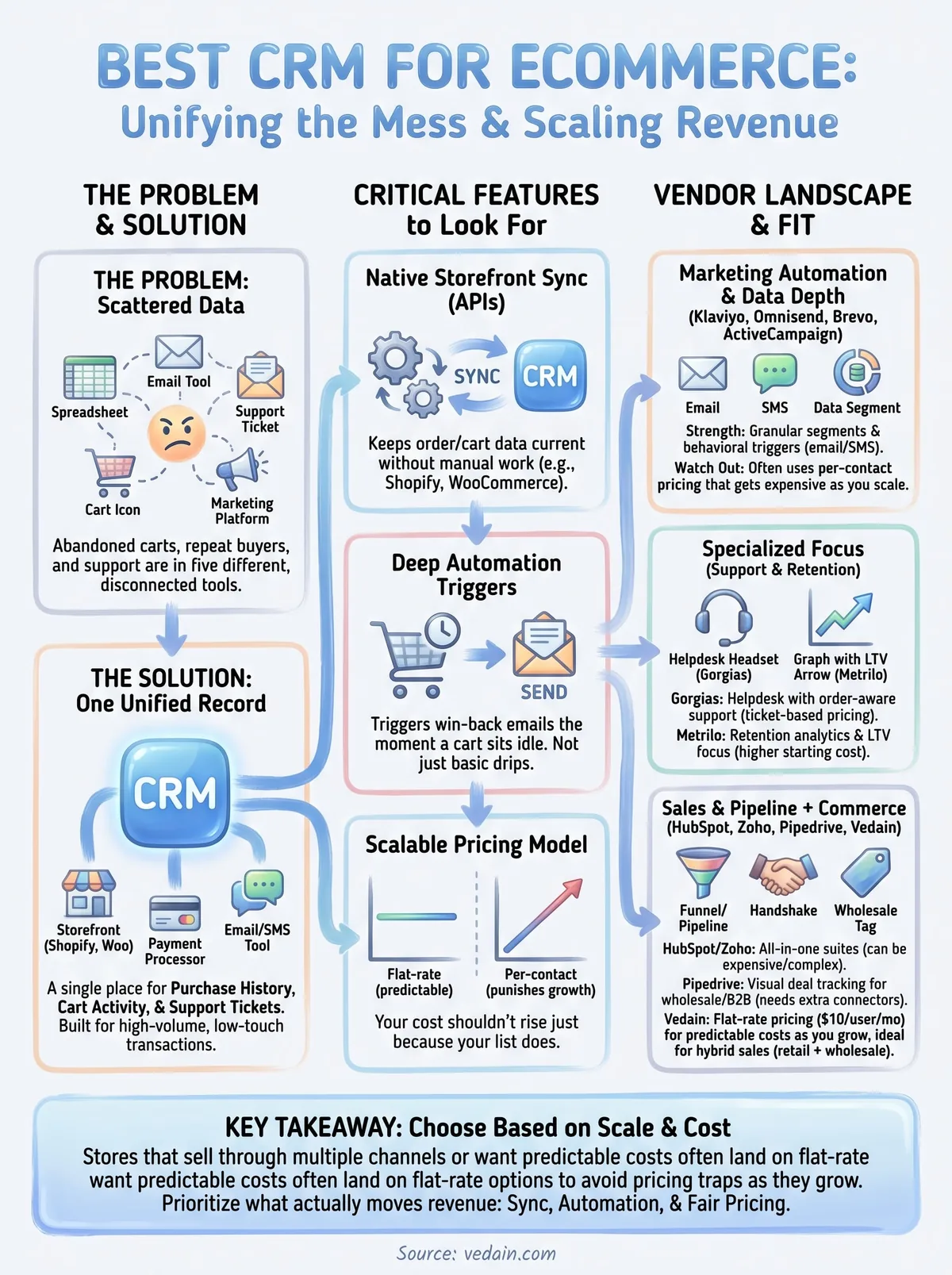
An ecommerce CRM is software built to track every interaction a customer has with your online store, from the moment they land on a product page to the day they become a repeat buyer. Unlike a generic address book or spreadsheet, it connects to your storefront, payment processor, and email tools so purchase history, cart activity, and support tickets all live in one record. When you search for the best CRM for ecommerce, you're really looking for a system that understands buyer behavior specific to online retail, not just a place to store phone numbers.
Traditional sales CRMs, the kind built for B2B teams closing six-figure deals over months, don't map well onto ecommerce. A sales rep working a lead through discovery calls and proposals operates on a totally different timeline than a shopper who adds three items to a cart and checks out in ninety seconds. Ecommerce CRMs are built around high-volume, low-touch transactions, which means they lean heavily on automation, segmentation, and behavioral triggers instead of manual pipeline stages.
How it differs from a marketing platform
Many tools marketed to online stores blur the line between CRM and email marketing platform, and that confusion trips up a lot of buyers. A pure email marketing tool sends campaigns based on list membership. A true CRM tracks the full customer record, including support history, order value, and lifetime spend, and lets your whole team, not just marketing, act on that data.
An ecommerce CRM earns its name by tracking the full customer relationship, not just the next email send.
What ecommerce CRMs actually track
Here's what separates a store-ready CRM from a repurposed sales tool:
- •Order and purchase history synced automatically from your storefront platform
- •Abandoned cart and browse behavior to trigger win-back sequences
- •Customer lifetime value calculated from repeat purchase patterns
- •Segmentation by purchase behavior, not just demographics or signup date
- •Support ticket history tied to the same customer record as sales data
Owners of stores on Shopify, WooCommerce, or BigCommerce typically adopt these platforms once manual tracking in spreadsheets or basic email tools stops scaling, usually somewhere between 500 and 2,000 orders a month. At that volume, you can't manually tag which customers bought which SKU or manually calculate who's worth a loyalty discount. The right CRM does that math for you and surfaces it in a dashboard instead of a buried export file.
Some platforms on this list, like Klaviyo and Omnisend, started as email marketing tools and grew CRM-like features. Others, like Vedain and HubSpot, started as sales CRMs and added ecommerce integrations. Neither approach is automatically better, but knowing which lineage a tool comes from helps explain its strengths and gaps, which we'll break down platform by platform below.
2. What to look for in a CRM for ecommerce
Picking the best CRM for ecommerce comes down to a handful of criteria that actually move the needle on revenue, not just checkbox features. Before you compare vendors, get clear on what your store needs at its current order volume and where you expect to be in twelve months, because switching platforms later costs time and customer data you don't want to lose.
Core criteria that matter
Start with native storefront integration. A CRM that requires a third-party connector or manual CSV imports to sync order data will always lag behind one built with direct Shopify, WooCommerce, or BigCommerce APIs. Next, check automation depth: can the platform trigger a win-back email the moment a cart sits idle for an hour, or does it only support basic drip sequences? Finally, look at how pricing scales. Many platforms charge more as your contact list grows, which punishes you for succeeding.
The right CRM should get cheaper per customer as your store grows, not more expensive.
Underneath the feature list, weigh implementation time and support quality. Some platforms need a developer to configure custom fields and workflows properly, while others let a non-technical founder get running the same afternoon. Verify whether email deliverability tools, like warmup or authentication setup, come included or cost extra, since a CRM that can't reliably land in inboxes undermines every campaign you build on top of it.
3. Vedain CRM
Vedain built its reputation as a flat-rate sales CRM, and it's earning a spot on this list because that pricing model solves a real ecommerce headache: platforms that charge more as your contact list grows. Every user pays $10 per month for the full feature set, whether you're tracking 500 customers or 50,000, which matters once your store scales past the free tiers competitors dangle upfront.
Key features
- •Deal Pipeline with a visual Kanban board for tracking wholesale or B2B orders alongside retail
- •Email Integration with two-way Gmail and Outlook sync so support and sales share one inbox history
- •Workflows, a no-code automation builder for abandoned cart follow-ups and repeat-purchase sequences
- •Email Warmup that improves domain deliverability over 21 days, built in at no extra cost
- •AI Agent Marketplace with 30+ agents for data enrichment and content generation
Flat, all-inclusive pricing means your CRM cost stays predictable even as your customer list grows.
Best for
Vedain suits small to mid-sized online stores that sell through multiple channels, like a Shopify storefront plus wholesale accounts, and need one system tracking both without paying separate platform fees for each. It also fits teams migrating off HubSpot or Salesforce who got tired of feature gates locking automation behind higher tiers.
Pricing
Vedain charges $10 per user per month, flat, with every feature included. There's no separate tier for automation, email warmup, or reporting, and no credit card required to start a trial. Setup typically takes under five minutes.
Limitations
Vedain doesn't offer native product-catalog syncing the way commerce-specific platforms like Klaviyo do, so stores relying heavily on SKU-level browse behavior may need a lightweight integration alongside it.
4. Klaviyo
Klaviyo started life as an email and SMS marketing tool, and that heritage still shows in how deeply it reads customer data. It plugs directly into Shopify, WooCommerce, and BigCommerce, pulling purchase history and browse behavior into segments you can act on within minutes of setup. For stores that live and die by campaign performance, Klaviyo's data depth is hard to match, even if it stretches the definition of a traditional CRM.
Key features
- •Predictive analytics that estimate customer lifetime value and churn risk
- •Deep segmentation built on real-time purchase and browsing data
- •Pre-built flows for abandoned cart, browse abandonment, and post-purchase upsells
- •SMS and email combined in one automation builder
Klaviyo turns raw storefront data into segments you can message the same day you connect it.
Best for
Brands that treat email and SMS revenue as a core growth channel, not just a nice-to-have, get the most out of Klaviyo. It fits stores already running on Shopify that want granular behavioral targeting without stitching together separate marketing and CRM tools.
Pricing
Klaviyo prices by contact list size, starting free for under 250 profiles and climbing steeply from there. A list of 10,000 contacts with email and SMS active can run several hundred dollars monthly, and costs keep rising as your list grows, which works against stores trying to keep customer acquisition costs predictable.
Limitations
Despite strong marketing muscle, Klaviyo lacks true sales pipeline management and team permission controls you'd expect from a full CRM. Support teams and wholesale sales reps won't find much use for it beyond viewing customer profiles, and the per-contact pricing punishes exactly the growth you're trying to achieve.
5. HubSpot CRM
HubSpot built its name as an all-in-one sales and marketing platform, and its CRM core still ranks among the most polished on the market. It connects to Shopify and WooCommerce through native integrations, syncing order data into contact records alongside email opens and website visits. For stores already juggling marketing, sales, and support teams, HubSpot's shared record system cuts down on the app-switching that plagues smaller, single-purpose tools, which is why it keeps showing up in searches for the best CRM for ecommerce.
Key features
- •Contact timeline showing purchases, emails, and support tickets in one view
- •Marketing Hub integration for segmented campaigns tied to purchase behavior
- •Custom deal pipelines for wholesale, B2B, or high-ticket order tracking
- •Free CRM tier with core contact and deal management included
HubSpot's strength is bringing marketing, sales, and support onto one shared customer record.
Best for
Growing ecommerce brands running parallel B2B and retail channels benefit most, especially teams that already use HubSpot's marketing or service tools and want everything under one login. It also suits stores with dedicated marketing staff who need campaign-level reporting beyond basic email metrics.
Pricing
HubSpot's free tier covers basic contact and deal tracking, but ecommerce-relevant automation lives in paid tiers. Marketing Hub Professional starts around $800 monthly for the features most online stores actually need, like advanced workflows and reporting, a steep jump from the free plan's limits.
Limitations
The pricing gap between HubSpot's free and professional tiers catches many stores off guard. Meaningful automation, custom reporting, and higher contact limits sit behind paywalls that scale fast, making HubSpot expensive for stores that outgrow the free tier quickly.
6. Salesforce Commerce Cloud
Salesforce built its reputation on enterprise sales, and Commerce Cloud extends that muscle into online retail with a platform designed for brands running complex, multi-region storefronts. It connects to the broader Salesforce ecosystem, so order data, service cases, and marketing campaigns all live inside the same infrastructure that powers Fortune 500 support desks. That depth comes at a cost in both price and complexity, which makes it a fit for a narrower slice of ecommerce businesses than most tools on this list.
Key features
- •AI-powered product recommendations driven by Einstein, Salesforce's built-in machine learning layer
- •Headless commerce architecture for brands running custom storefronts alongside standard templates
- •Unified order management across web, mobile, and in-store channels
- •Deep Service Cloud integration for support tickets tied to purchase history
Commerce Cloud rewards scale and complexity, which means smaller stores pay for infrastructure they'll never fully use.
Best for
Large retailers with multi-channel operations, dedicated IT teams, and six or seven figures in annual revenue get the most value here. Brands running separate storefronts across regions or currencies, and needing case management alongside commerce, fit this platform better than a single-store startup would.
Pricing
Salesforce doesn't publish flat rates for Commerce Cloud. Instead, pricing runs on a percentage of gross merchandise value, plus platform and implementation fees that commonly start in the tens of thousands annually. Custom quotes require a sales call, which itself signals this isn't built for lean, self-serve setups.
Limitations
Understanding the true cost before signing a contract is difficult, since GMV-based pricing scales unpredictably alongside your sales growth. Implementation typically requires developers or a Salesforce partner agency, stretching setup timelines to weeks or months rather than the same-day launches smaller CRMs offer.
7. Zoho CRM
Zoho built one of the broadest software suites on the market, and its CRM sits at the center of an ecosystem that includes inventory, invoicing, and a dedicated commerce platform called Zoho Commerce. That breadth appeals to store owners who want one vendor handling sales, accounting, and customer data instead of stitching together five separate subscriptions. Zoho CRM connects to Shopify through native and third-party integrations, pulling order history into contact records alongside email and support interactions.
Key features
- •Zia AI assistant that scores leads and predicts which customers are likely to reorder
- •Multichannel messaging combining email, live chat, and social media in one inbox
- •Custom modules for tracking SKU-level purchase data alongside standard contact fields
- •Zoho Commerce integration for stores that want their storefront and CRM under the same login
Zoho's real advantage is the surrounding suite, not the CRM module by itself.
Best for
Stores already running other Zoho products, like Zoho Books or Zoho Inventory, get the most value here since data flows between apps without extra connectors. It also fits budget-conscious founders who want CRM, help desk, and basic ecommerce tools bundled under one company rather than paying separate vendors for each function.
Pricing
Zoho CRM starts around $14 per user monthly on the Standard plan, with ecommerce-relevant features like advanced automation and analytics locked behind Enterprise tier, which runs closer to $40 per user monthly. Zoho Commerce itself carries a separate subscription fee on top of the CRM cost.
Limitations
Running multiple Zoho apps together often means paying for several subscriptions to unlock the full ecommerce workflow, which erodes the suite's reputation for affordability. New users also report a steeper learning curve navigating Zoho's dense settings menus compared to leaner, single-purpose CRMs built specifically for online retail.
8. Pipedrive
Pipedrive built its name on visual pipeline management for sales teams, and that simplicity carries over well to ecommerce brands running wholesale or B2B channels alongside retail. Founders who find HubSpot or Salesforce overwhelming often land here because the interface prioritizes deal tracking over sprawling feature menus. Pipedrive connects to Shopify and WooCommerce through third-party integrations rather than a native build, which means order data syncs but takes an extra setup step most competitors on this list skip.
Key features
- •Visual Kanban pipeline for tracking wholesale orders, custom quotes, or recurring B2B accounts
- •Email sync with two-way tracking for Gmail and Outlook
- •Automation builder for follow-up emails and deal-stage triggers
- •Revenue forecasting based on deal probability and pipeline stage
Pipedrive's clean pipeline view suits stores selling through sales conversations, not just checkout carts.
Best for
Ecommerce brands running a hybrid sales model, like a Shopify storefront paired with wholesale accounts negotiated over email, get the most value here. It also fits small teams that want straightforward deal tracking without wading through marketing automation they'll never touch.
Pricing
Pipedrive starts at $14 per seat monthly on the Essential plan, with automation and email sync features arriving on the $34 Advanced tier. Reporting and revenue forecasting sit higher still, on the Professional plan at $49 per seat monthly, which adds up fast for teams that need more than basic pipeline views.
Limitations
Questions about native ecommerce depth come up quickly once you dig in. Pipedrive lacks built-in cart abandonment tracking or product-catalog syncing, so stores relying on behavioral triggers need a separate marketing tool running alongside it. The tiered pricing structure also gates useful automation behind upgrades, undercutting the platform's reputation for simplicity.
9. Omnisend
Omnisend built itself specifically for online stores, skipping the generic marketing-tool approach and designing every feature around Shopify, WooCommerce, and BigCommerce workflows from day one. It reads more like a marketing automation platform than a full CRM, but its native commerce integrations run deeper than most general-purpose tools on this list, pulling order status, product data, and customer segments together without third-party connectors.
Key features
- •Pre-built automation workflows for cart abandonment, welcome series, and post-purchase upsells
- •Product picker that pulls live catalog images and prices directly into email campaigns
- •SMS and email combined in a single automation builder with unified reporting
- •Customer segmentation based on purchase history, total spend, and product category
Omnisend earns its ecommerce label by building every workflow around the storefront, not around generic email lists.
Best for
Small to mid-sized stores running Shopify or WooCommerce and wanting marketing automation that understands product data out of the box fit Omnisend well. Founders who don't need pipeline management or team permission controls, but do need reliable cart-recovery and upsell sequences, will find the setup faster than most CRM alternatives.
Pricing
Omnisend offers a free plan capped at 250 contacts, with paid tiers starting around $16 monthly for 500 contacts and climbing based on list size, similar to Klaviyo's model. SMS credits are billed separately from email, adding another variable cost as your campaigns scale.
Limitations
Stores expecting a true CRM will find Omnisend thin outside marketing. There's no deal pipeline, no team-level permission structure, and no support-ticket tracking tied to customer records. Like other contact-based pricing tools, your monthly bill grows automatically as your subscriber list grows, regardless of how many customers actually convert.
10. Brevo
Brevo, formerly known as Sendinblue, built its reputation on affordable email marketing before expanding into a fuller CRM and automation suite. It connects to Shopify and WooCommerce through native plugins, pulling order data into contact profiles alongside email and SMS activity. Founders who outgrew basic newsletter tools but don't want Klaviyo's steep per-contact pricing often land here, since Brevo prices by email volume sent, not list size, which changes the math for stores with large but infrequently emailed customer bases.
Key features
- •Unified marketing platform combining email, SMS, and WhatsApp campaigns in one dashboard
- •Sales CRM module with basic deal pipeline and contact scoring
- •Automation workflows for cart abandonment, order confirmations, and win-back sequences
- •Transactional email API for order receipts and shipping notifications
Brevo's send-based pricing rewards stores with large lists that email infrequently, flipping the usual CRM cost model.
Best for
Stores with large customer lists but modest email frequency benefit most from Brevo's pricing structure. It also suits founders who want marketing, transactional email, and a lightweight CRM under one login without paying separately for each function, particularly those searching for the best CRM for ecommerce on a tight budget.
Pricing
Brevo offers a free plan covering up to 300 emails daily, with paid tiers starting around $9 monthly based on send volume rather than contact count. The CRM and sales pipeline features require the Sales Platform add-on, which carries its own separate subscription fee.
Limitations
Brevo's CRM module feels noticeably thinner than its marketing tools, lacking the segmentation depth Klaviyo or Omnisend offer for purchase-based targeting. Stores needing granular team permissions or advanced reporting will find themselves bumping into ceilings that dedicated sales CRMs handle more comfortably.
11. ActiveCampaign
ActiveCampaign built its reputation on marketing automation before layering in a full sales CRM, and that combination lands well for ecommerce brands that want behavioral triggers and deal tracking under one roof. It connects to Shopify, WooCommerce, and BigCommerce natively, pulling order history and site behavior into the same contact record your sales team already works from. Store owners comparing the best CRM for ecommerce often shortlist ActiveCampaign because it treats automation as a core feature, not an upsell.
Key features
- •Site and event tracking that logs product views and cart activity for automation triggers
- •Predictive sending that times campaigns based on when each customer typically opens email
- •Deal pipeline with contact scoring tied to purchase and engagement history
- •Split automation testing for comparing win-back sequences against each other
ActiveCampaign blends marketing automation and deal tracking tightly enough that most stores skip a second tool entirely.
Best for
Mid-sized stores running complex automation across email, SMS, and sales follow-up benefit most, especially teams that outgrew simpler tools like Mailchimp but aren't ready for Salesforce-level complexity. Founders who want granular behavioral triggers alongside actual deal stages, rather than choosing one or the other, fit this platform well.
Pricing
ActiveCampaign starts around $15 monthly on the Starter plan for a small contact list, with automation depth and CRM features unlocking on the Plus tier near $49 monthly. Pricing scales with contact count, so a growing list pushes your bill up steadily even without adding paid seats.
Limitations
Navigating ActiveCampaign's interface takes longer than most competitors on this list, since the automation builder offers so many branching options that new users often need a few weeks to build confidence. Contact-based pricing also means your costs climb automatically as your subscriber list grows, regardless of how many of those contacts actually convert into paying customers.
12. Gorgias
Gorgias built itself as a helpdesk platform for online stores, and it earns a place on this list because customer support data belongs inside your CRM strategy, not off to the side in a separate ticketing tool. It connects natively to Shopify, plus BigCommerce and Magento, pulling order details, shipping status, and purchase history directly into every support ticket so agents never have to switch tabs to answer a "where's my order" question.
Key features
- •Shopify-native ticket view showing order history, subscription status, and past tickets in one panel
- •Revenue attribution that tracks sales closed through live chat and support conversations
- •Macros and automation rules that resolve repetitive tickets like refund requests without agent involvement
- •Voice and SMS support built into the same inbox as email and live chat
Gorgias treats support tickets as sales opportunities, not just cost centers to minimize.
Best for
Brands where customer support doubles as a sales channel, especially stores with subscription products or frequent pre-purchase questions, get the most value from Gorgias. It also suits teams that already track leads elsewhere but need order-aware support baked into their day-to-day.
Pricing
Gorgias starts around $10 monthly for a Starter plan capped at 50 tickets, with the commonly used Basic plan running near $60 monthly for 300 tickets. Pricing scales by ticket volume rather than seats, so busy support queues push costs up fast during sale seasons.
Limitations
Anyone expecting a full deal pipeline or lead scoring will hit walls quickly, since Gorgias skips sales-side features entirely and offers no email campaign builder. Ticket-based pricing also means a single viral product launch that floods your inbox can spike your bill unexpectedly, which makes budgeting trickier than flat-rate alternatives.
13. Metrilo
Metrilo built itself around a simple idea: ecommerce brands need analytics and retention data baked into their CRM, not bolted on as an afterthought. Founders searching for the best CRM for ecommerce with a heavy focus on customer retention analytics tend to land here, since Metrilo connects natively to Shopify and WooCommerce and calculates lifetime value, repeat purchase rate, and cohort behavior automatically. Unlike marketing-first tools on this list, Metrilo treats every email campaign as a revenue experiment you can measure against actual purchase data.
Key features
- •Cohort retention analysis showing how customer value changes over weeks or months after first purchase
- •Email marketing built on purchase data, segmenting by order history and product category
- •Customer profiles combining orders, emails, and on-site behavior in one timeline
- •Revenue reporting broken down by campaign, product, and traffic source
Metrilo answers the retention question most CRMs skip: which customers are actually worth keeping happy.
Best for
Growing stores obsessed with repeat purchase rate and customer lifetime value, rather than just campaign open rates, get the most from Metrilo. It suits teams that already have decent order volume and want retention data driving marketing decisions instead of guesswork.
Pricing
Metrilo starts around $119 monthly for stores with up to 10,000 contacts, positioning it well above budget tools like Brevo or Omnisend. Higher tiers scale with contact volume and add advanced reporting, pushing the cost past $200 monthly for larger lists.
Limitations
Questioning whether Metrilo fits a lean budget matters here, since its pricing sits noticeably higher than comparable ecommerce tools without offering deal pipelines or team permission controls. Small stores just starting out will likely find the analytics depth outpaces what they actually need at their current order volume.
Finding the right CRM fit for your store
Eleven platforms, eleven different strengths, but the decision usually comes down to one question: does your store need marketing muscle, support integration, or actual sales pipeline management? Klaviyo and Omnisend win on campaign depth, Gorgias owns support, and Salesforce fits brands with the budget for enterprise complexity. None of that helps if you're a lean team drowning in per-contact pricing that punishes growth.
Stores that sell through multiple channels, mix retail with wholesale, or just want predictable costs as they scale keep landing on flat-rate options for good reason. You shouldn't pay more per month just because your customer list grew. That's the whole case for choosing the best CRM for ecommerce based on what it costs at scale, not what it costs on day one.
If transparent pricing and full features from the start sound right for your store, try Vedain CRM free and see if it fits before you commit.
Related reading
Frequently Asked Questions
What is the best CRM for ecommerce businesses?
The best CRMs for ecommerce in 2026 depend on your primary need: Klaviyo — best for email/SMS marketing automation integrated with Shopify/WooCommerce. HubSpot — best for combining ecommerce data with inbound marketing and customer service. Zoho CRM — best for ecommerce teams needing full sales pipeline plus customer support. Shopify's built-in CRM — adequate for small stores, limited for B2B. Vedain — suitable for B2B ecommerce or wholesale distributors with a sales team. Pure-play ecommerce (DTC) → Klaviyo; B2B ecommerce with a sales team → HubSpot or Vedain.
Does HubSpot integrate with Shopify for ecommerce?
Yes. HubSpot integrates natively with Shopify through the official HubSpot-Shopify app, syncing: customer records, order history, product data, and abandoned cart events. Once connected, HubSpot can trigger automated emails for abandoned carts, post-purchase follow-up, product review requests, and win-back campaigns for lapsed buyers. The integration is free to connect but requires HubSpot Marketing Hub Starter ($800/month) for full automation. For Shopify stores doing $1M+ revenue, HubSpot's ecommerce automation pays for itself in recovered carts.
What CRM features do ecommerce businesses need?
Ecommerce CRM must-have features: (1) Order and purchase history linked to customer records. (2) Customer lifetime value (CLV) calculation and segmentation. (3) Abandoned cart triggers and automated recovery emails. (4) Post-purchase sequences (thank you, review request, upsell). (5) RFM segmentation (Recency, Frequency, Monetary value) for campaign targeting. (6) Integration with your ecommerce platform (Shopify, WooCommerce, Magento). (7) Customer support ticket history alongside purchase history. (8) Revenue attribution by campaign and channel.
Is Zoho CRM good for ecommerce?
Zoho CRM is good for B2B ecommerce and wholesale distributors that have a sales team managing accounts. It integrates with Shopify, WooCommerce, and Zoho Commerce, syncing order data. For DTC/B2C ecommerce with high volume and marketing-automation-first needs, Klaviyo or HubSpot are more purpose-built. Zoho's strength is combining ecommerce data with full CRM functionality — deal management, territory assignment, and detailed reporting — which matters for wholesale B2B but less so for direct-to-consumer stores.
Can I use Vedain CRM for ecommerce?
Vedain CRM is best suited for B2B ecommerce or businesses with a dedicated sales team managing wholesale or enterprise accounts. It's not designed for high-volume DTC ecommerce with thousands of individual customer transactions. For a company selling products to business clients (distributors, resellers, corporate buyers), Vedain's pipeline, contact management, and email automation at $10/user/month work well. For selling directly to consumers at scale, use an ecommerce-native tool like Klaviyo alongside a simple customer service desk.
What is the difference between ecommerce CRM and regular CRM?
Ecommerce CRM vs regular CRM differences: Ecommerce CRM stores transaction data (orders, products, returns, abandoned carts) linked to each customer; regular CRM stores deals and sales conversations. Ecommerce CRM segments by purchase behavior (CLV, frequency, product category); regular CRM segments by deal stage and company profile. Ecommerce CRM triggers automations from shopping events (cart abandonment, post-purchase); regular CRM triggers from pipeline events (deal stage change, activity). Many platforms (HubSpot, Zoho) span both — but true ecommerce power comes from purpose-built tools like Klaviyo for marketing and Gorgias for support.