This article gives you nine templates you can actually use, ranging from simple spreadsheet trackers to visual pipeline boards built for Kanban-style management. Each one fits a different stage of growth, whether you're mapping your first funnel or replacing a messy system that's outgrown a single tab in Google Sheets.
Below, you'll find templates for lead capture, deal tracking, email sequences, and reporting, plus notes on when each one makes sense. A few are static documents you fill in by hand. Others, like the Kanban pipeline view inside Vedain, update automatically as deals move forward, so your funnel stays accurate without manual upkeep. Pick the format that matches how your team actually sells.
1. Vedain CRM deal pipeline template
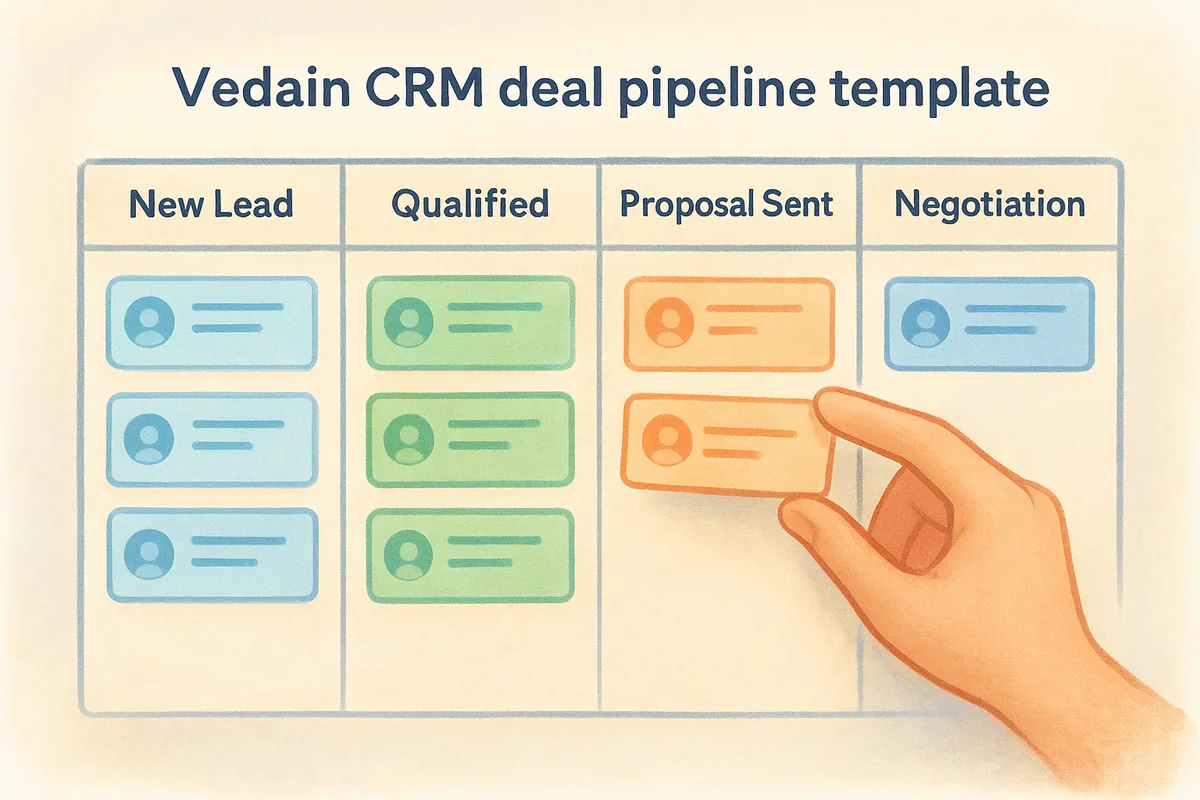
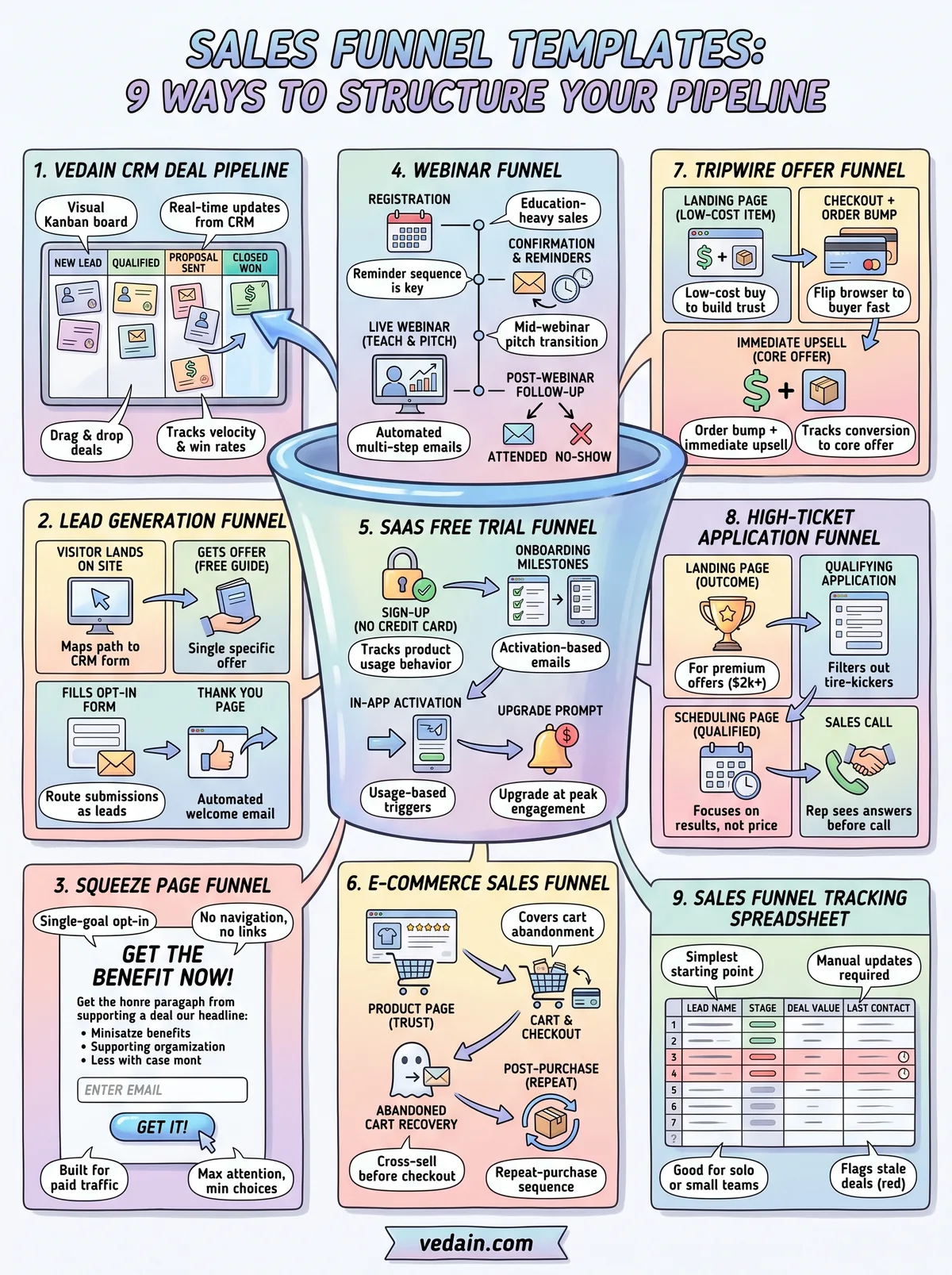
The Vedain CRM deal pipeline template is a visual Kanban board for deal tracking already built into the platform, not a spreadsheet you copy and adjust. You drag deals across stages like New Lead, Qualified, Proposal Sent, Negotiation, and Closed Won, and the board updates in real time as your team works. Unlike a static template, this one connects to your actual contact records, email history, and deal values, so what you see on the board reflects what's actually happening in your pipeline.
How it works
Setting up the pipeline takes minutes, not hours. You create custom stages that match your sales process, add deals with values and close dates, and assign owners. Each deal card shows key details at a glance, contact info, last activity, deal value, so reps don't need to click into every record to know what's next.
- •Create pipeline stages that reflect your actual sales cycle
- •Drag and drop deals as they move forward or stall
- •Attach notes, emails, and tasks directly to each deal card
- •Filter the board by owner, stage, or deal value
- •Track conversion rates between stages automatically
A pipeline template only earns its keep when it updates itself as deals move, not when you have to update it.
Since the board pulls from live CRM data, you don't maintain two systems, a tracking sheet and the CRM itself. Reports on pipeline velocity, win rates, and stage duration generate straight from the same data you're already entering by dragging cards.
Who it's for
This template suits sales teams who've outgrown spreadsheet tracking but don't want the setup overhead of enterprise CRM software. If you're managing more than a handful of deals at once, or multiple reps need visibility into the same pipeline, a shared visual board beats a sheet that only one person keeps current. It also works well for teams switching from tools like HubSpot or Pipedrive who want the same Kanban-style workflow without the pricing complexity that comes with tiered plans.
Pricing
Vedain's deal pipeline template ships with every account at $10 per user per month, with no separate charge for the pipeline feature, automation, or reporting tied to it. There's no free tier that locks the Kanban board behind a paid upgrade, and no cap on how many deals or stages you build. You can check what's included on Vedain's plan and pricing page and test it with a free trial that doesn't require a credit card, so you can map your actual pipeline before deciding whether to keep it.
2. Lead generation funnel template
A lead generation funnel template maps the path from a stranger landing on your site to a filled-out form sitting in your CRM. It typically covers four stages: traffic source, landing page, opt-in form, and thank-you page with a follow-up trigger. Most templates come as a wireframe or flowchart you can build in a tool like Figma or Canva, showing where each element sits and what copy goes where, rather than a live, connected system.
How it works
Building one starts with defining the offer, a free guide, discount code, or demo request, that gives visitors a reason to hand over their email. The template lays out the landing page structure headline, subheadline, form fields, and call-to-action button, then maps what happens after submission. Good templates also flag where to add tracking, so you know which channel actually drove the conversion.
- •Define one specific offer per funnel, not a generic "contact us" ask
- •Keep form fields to name and email only; every extra field drops conversions
- •Route submissions straight into your CRM as new leads, not a spreadsheet you export later
- •Trigger an automated welcome email within minutes of signup
A lead generation funnel only works if the form feeds directly into a system that can act on the lead immediately.
Once a lead opts in, the template usually hands off to a lead capture form builder connected to your CRM, like Vedain's lead forms feature, so the contact gets created and scored automatically instead of sitting in an inbox.
Who it's for
This template fits marketing teams and solo founders running top-of-funnel campaigns, paid ads, content offers, or webinar signups, who need a repeatable structure for every new campaign. It's less useful once you're deep into sales conversations, since it stops at the opt-in and doesn't track deal progress after that.
Pricing
Most lead generation funnel templates are free, distributed as downloadable wireframes or Figma files from marketing blogs and design communities. Paid versions inside lead generation software tools typically run $25 to $100 per month depending on the platform's page-hosting and automation limits.
3. Squeeze page funnel template
A squeeze page funnel template strips the lead generation concept down to one screen with a single goal: get an email address, nothing else. There's no navigation menu, no links to other pages, and no distractions competing with the opt-in form. Among sales funnel templates, this is the leanest one you'll find, built for a single decision point rather than a browsing experience.
How it works
The template usually consists of a headline that states the benefit, a short block of supporting copy, an image or short video, and a form asking for just an email address. Everything above the fold pushes toward one action.
- •Headline stating the specific benefit, not a vague tagline
- •One supporting paragraph or three bullet points, nothing more
- •A single form field for email, sometimes with a first name field
- •One button, with copy that names the action, not just "Submit"
- •No exit links, no header navigation, no footer menu
The fewer choices you give a visitor, the more likely they'll make the one choice you want.
Designers typically build these in Figma or Canva first, then hand the layout to a developer or a page builder like Unbounce or Leadpages for the live version. The template itself is just the blueprint, not the hosted page.
Who it's for
Squeeze pages suit paid traffic campaigns where every visitor costs money and you can't afford a page that lets attention wander. They also work well for lead magnets, an ebook, a checklist, a free tool, promoted through a single ad or email link. Teams running broader brand awareness campaigns should skip this format since it offers no room for storytelling or product education.
Pricing
Most squeeze page templates are free downloads from design blogs or template marketplaces like Canva, which offers a free tier and a paid Pro plan around $13 per month. If you need the page live and connected to email capture, expect to pay for a landing page builder separately, typically $30 to $90 per month depending on traffic volume and the number of pages you host.
4. Webinar funnel template
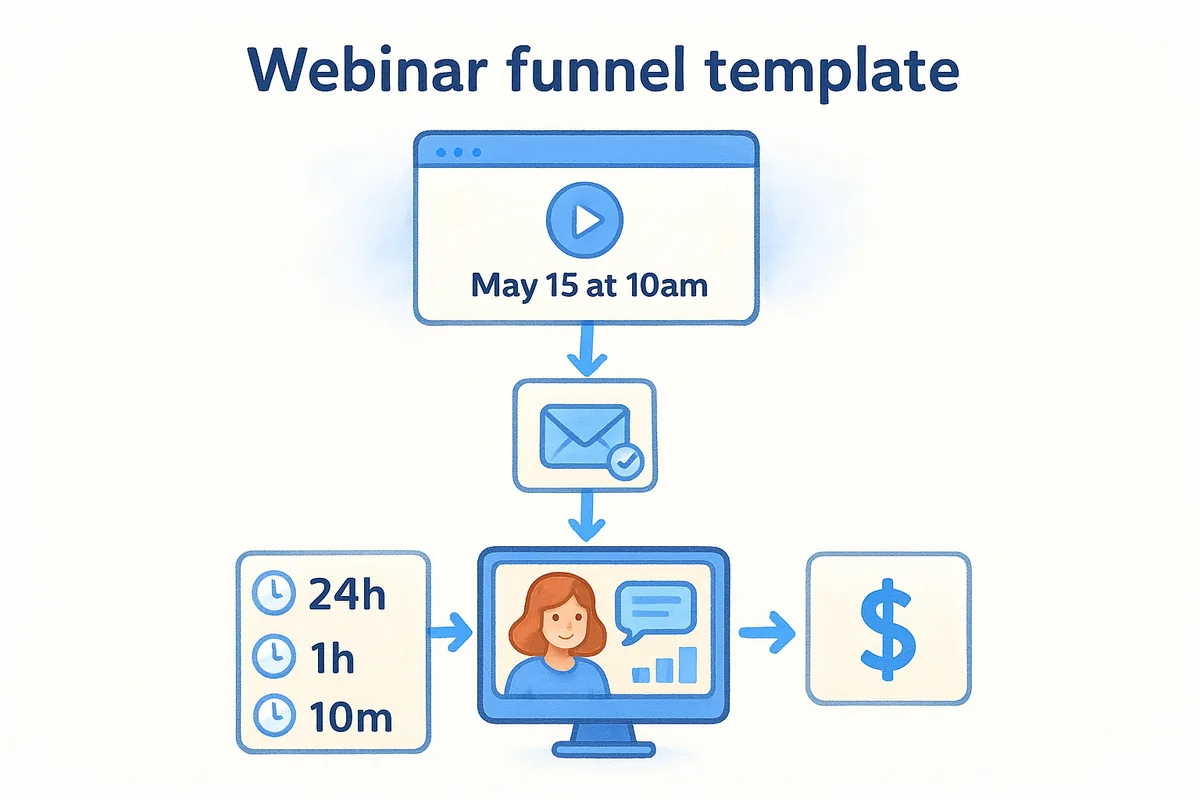
A webinar funnel template maps the sequence from registration to live event to post-webinar sales pitch. It typically covers five stages: registration page, confirmation email, reminder sequence, the live or automated webinar itself, and a follow-up offer for attendees and no-shows alike. Among the sales funnel templates built for education-heavy sales, this one carries the most moving parts, since it has to keep people engaged across days, not seconds.
How it works
Registrants land on a page promising a specific outcome, then get dropped into a reminder sequence, usually three to five emails or texts spaced across the days leading up to the event. During the webinar, the template flags where to place the pitch, typically two-thirds through, after the teaching content builds enough trust to ask for the sale.
- •Registration page with date, time, and one clear promise
- •Confirmation email with calendar invite and replay link
- •Reminder sequence sent 24 hours, 1 hour, and 10 minutes before start
- •Mid-webinar transition slide moving from teaching to pitch
- •Post-webinar follow-up split by attended vs. no-show status
A webinar funnel lives or dies on the reminder sequence, since most registrants forget the moment they sign up.
Automating that reminder sequence matters more here than in any other funnel type. A tool with multi-step automated email sequences, like Vedain's email campaigns feature, handles the timing without someone manually scheduling each send.
Who it's for
This template suits consultants, coaches, and B2B software teams selling anything that benefits from a demonstration or teaching moment before the ask. It works less well for low-cost, impulse purchases, where asking someone to block 45 minutes on their calendar is a bigger commitment than the product itself justifies.
Pricing
Webinar funnel templates themselves are usually free, offered by webinar platforms as onboarding resources. The real cost sits in the webinar software, typically $50 to $150 per month for tools that handle registration pages, live streaming, and automated replays at scale.
5. SaaS free trial funnel template
A SaaS free trial funnel template maps the path from sign-up to paid conversion, covering the sign-up page, the onboarding sequence, in-app activation milestones, and the upgrade prompt that turns a trial account into a paying customer. Unlike a marketing funnel that ends at a form submission, this one tracks behavior inside the product itself, so the template usually includes a checklist of activation events, not just page layouts.
How it works
The template starts with a low-friction sign-up form, often just email and password, since asking for a credit card upfront kills trial starts. From there it defines the activation milestones that predict a paid conversion, like inviting a teammate or completing a first project, and maps an email or in-app message triggered by each one.
- •Sign-up form with minimal fields and no credit card requirement
- •Welcome email sequence tied to product milestones, not a fixed calendar
- •In-app prompts nudging users toward the activation event
- •Usage-based email triggers for trial accounts that stall
- •Upgrade offer timed to peak engagement, not just trial expiration
A free trial funnel converts on behavior, not on the calendar, so the best templates trigger emails off product usage instead of a fixed day count.
Because these triggers depend on usage data, teams often route trial signups straight into a CRM with a no-code workflow builder, such as Vedain's workflows builder, so a stalled account gets a nudge without a rep manually checking login logs.
Who it's for
Software companies running product-led growth motions get the most out of this template, especially teams using a CRM built for SaaS trials and expansions where the product sells itself once someone experiences the core feature. Founders bootstrapping their first SaaS product also lean on this format since it forces a clear definition of what "activated" actually means before writing a line of onboarding copy.
Pricing
Most SaaS free trial funnel templates come free from onboarding software vendors as part of their content library. Running the actual funnel costs more, since product-usage tracking and in-app messaging tools typically run $100 to $300 per month once you're tracking more than a few thousand trial users.
6. E-commerce sales funnel template
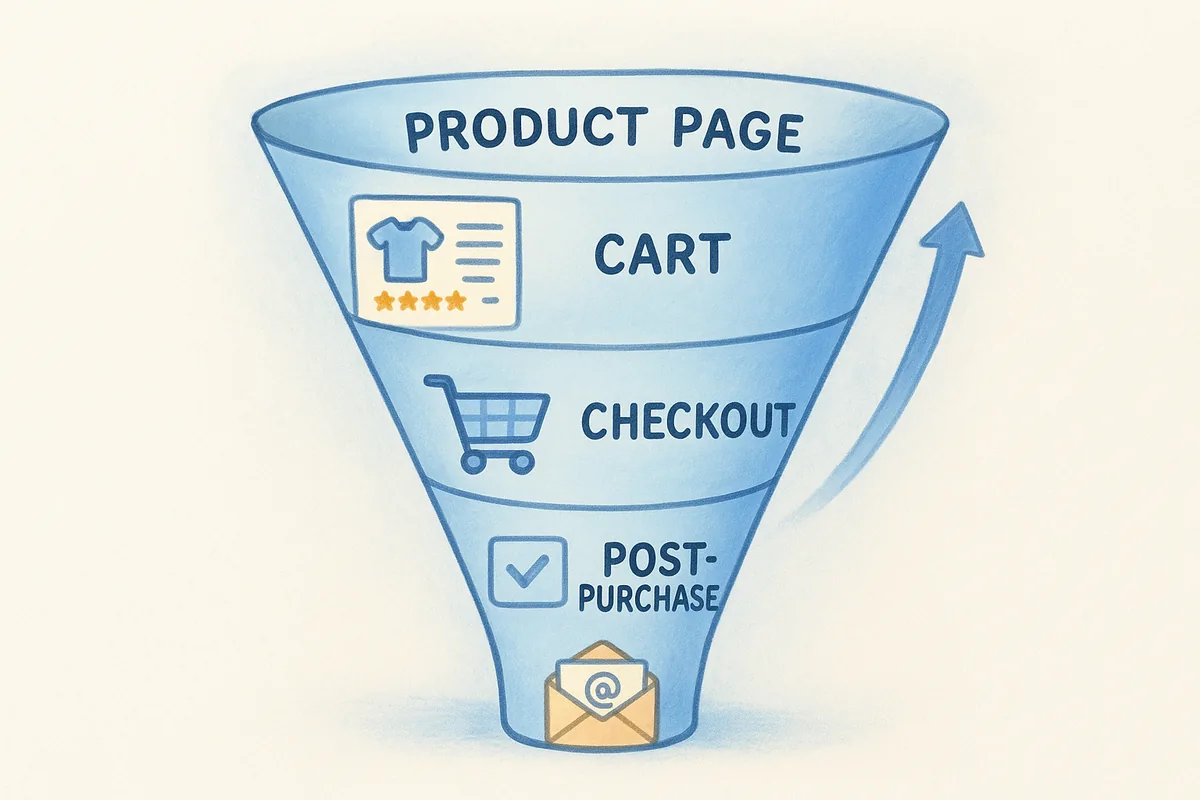
An e-commerce sales funnel template tracks a shopper from product page to checkout to repeat purchase, covering the stages a store actually loses money on: cart abandonment, checkout friction, and post-purchase silence. Unlike lead-gen templates that stop at an opt-in, this one has to account for cart abandonment recovery, since most online stores lose 60% to 80% of carts before checkout completes, according to the Baymard Institute.
How it works
Building one starts with mapping four checkpoints: product or landing page, cart, checkout, and post-purchase follow-up. The template flags where shoppers drop off and what recovery message fires at each point, so an abandoned cart doesn't just disappear.
- •Product page with trust signals: reviews, shipping cost, and return policy visible upfront
- •One-page or two-step checkout, since every extra page loses shoppers
- •Abandoned cart email sent within 1 hour, then again at 24 hours
- •Post-purchase email sequence covering shipping updates and a repeat-purchase offer
- •Upsell or cross-sell prompt shown before checkout, not after
A checkout funnel that doesn't recover abandoned carts is leaving its most qualified traffic on the table.
Most templates also map a repeat-purchase sequence, since returning customers cost far less to convert than new traffic. A sequence built with multi-step automation, like Vedain's email campaigns feature, handles the abandoned cart and win-back emails without a marketer manually watching cart data.
Who it's for
Online stores selling physical or digital products get direct use out of this template, particularly ones running paid traffic where every abandoned cart represents wasted ad spend. It suits teams with enough order volume to justify automated recovery emails, smaller stores with a handful of monthly orders may find the setup overkill.
Pricing
Most e-commerce funnel templates come free from platforms like Shopify or BigCommerce as onboarding resources, and it's worth comparing the best CRM options for ecommerce stores before you commit to one stack. Running the actual recovery emails costs more, email marketing tools built for e-commerce typically charge $20 to $100 per month based on subscriber count and send volume.
7. Tripwire offer funnel template
A tripwire offer funnel template maps the path from a low-cost, high-value purchase to a bigger sale that follows right after. The core idea: sell something priced at $7 to $27 that's nearly impossible to say no to, then use that first purchase to build trust and momentum toward your actual core offer. Among sales funnel templates, this one exists specifically to flip a visitor from browser to buyer before they've had time to overthink the decision.
How it works
The template starts with a landing page pitching the tripwire item, a mini-course, a template pack, a single tool, priced low enough that the decision feels risk-free. Right after checkout, the template routes buyers to an order bump or upsell page pitching the higher-priced offer while the buyer's card is still warm.
- •Landing page selling one low-cost item with a clear, specific outcome
- •Checkout page with an order bump for a complementary add-on
- •Immediate post-purchase upsell page for the core offer
- •Downsell page for buyers who decline the upsell
- •Email sequence nurturing tripwire buyers who didn't take the upsell
A tripwire funnel works because buying once, even for a few dollars, makes the next purchase decision easier.
Tracking which tripwire buyers convert to the core offer matters here, since that ratio tells you whether the low-cost item is actually qualifying buyers or just attracting bargain hunters. A CRM with custom fields, scoring and smart filters for leads, like Vedain's leads and contacts management, lets you tag tripwire buyers and track that conversion path over time.
Who it's for
This template suits course creators, coaches, and info-product sellers who have a higher-priced core offer but need a low-friction way to convert cold traffic first. It works less well for service businesses without a genuinely useful low-cost product to sell upfront.
Pricing
Tripwire funnel templates typically come free from course-platform vendors like Kajabi or Teachable as onboarding content. The order bump and upsell functionality usually requires a paid page-builder plan, generally $40 to $80 per month depending on traffic and page count.
8. High-ticket application funnel template
A high-ticket application funnel template maps the path from cold interest to a booked sales call for offers priced well above impulse-buy range, usually $2,000 and up. Instead of a checkout button, the template routes prospects through a qualifying application, then a scheduling page, then a live sales call. Among sales funnel templates, this one exists to filter out tire-kickers before a rep ever spends time on the phone.
How it works
The funnel starts with a landing page pitching the outcome, not the price, since high-ticket offers sell on results and access, not features. From there, prospects fill out an application form asking about budget, timeline, and current situation, information a rep needs before agreeing to a call at all.
- •Landing page focused on outcome and social proof, not pricing
- •Application form with qualifying questions on budget and readiness
- •Automatic disqualification message for prospects who don't fit
- •Scheduling page shown only to qualified applicants
- •Pre-call reminder sequence to cut no-show rates
A high-ticket funnel makes money by saying no to the wrong prospects just as much as by saying yes to the right ones.
Once someone qualifies, the handoff to a rep matters more than any page copy. A CRM that captures application answers as contact records, like Vedain's leads and contacts management, lets a rep review budget and timeline notes before the call starts instead of asking the same questions twice.
Who it's for
This template suits consultants, agencies, and B2B services selling offers that require a real conversation before purchase, coaching programs, done-for-you services, enterprise software with custom pricing, which is why many of them run on a CRM for proposals and retainers. It doesn't fit low-cost products or anything a customer expects to buy without talking to a human first.
Pricing
Application funnel templates are typically free, shared by coaches and agency owners as swipe files or included with course platforms. The application form and scheduling tools usually run $20 to $50 per month combined, though many teams get by using free tiers from tools like Google Forms and a scheduling app until volume justifies paying.
9. Sales funnel tracking spreadsheet template
A sales funnel tracking spreadsheet template is the format most people picture when they search for sales funnel templates: a Google Sheet or Excel file with columns for lead name, stage, deal value, and last contact date. It's the cheapest way to get organized, and for a solo founder or a team of two, it might be all you need for the first few months.
How it works
Rows represent individual leads or deals, and columns track the fields that matter to your process, source, stage, value, owner, next action date. Conditional formatting usually flags stale deals in red so nothing sits untouched for weeks without anyone noticing.
- •One row per deal, never per activity, or the sheet becomes unreadable fast
- •Columns for stage, value, source, owner, and next follow-up date
- •A separate tab summarizing totals by stage for a quick pipeline snapshot
- •Conditional formatting that flags deals untouched for 14+ days
- •A locked template tab you duplicate for each new sales period
A spreadsheet only tracks a funnel; it never moves a deal forward on its own, someone has to open it and update it every day.
That manual upkeep is the spreadsheet's biggest weakness. Every field update, every stage change, every note depends on a rep remembering to log it, and the moment two people share one sheet, version conflicts start creeping in.
Who it's for
Spreadsheets suit solo founders, freelancers, and very small teams tracking a handful of deals at a time, where the overhead of a full CRM doesn't make sense yet. They fall apart once a second or third rep needs shared visibility, since nobody wants to fight over who's editing the file. At that point, the same tracking logic works better inside a live tool like Vedain CRM, where stage changes update automatically and every rep sees the same board without emailing a file back and forth.
Pricing
Spreadsheet templates cost nothing. Google Sheets and Excel Online are both free, and most sales blogs give away pre-built funnel tracking templates as lead magnets. The real cost shows up later, in the hours your team spends manually updating a file that a CRM would keep current automatically, which is the moment most teams start comparing sales funnel software tools.
Putting your funnel template to work
Pick the template that matches where your funnel actually breaks down, not the one that looks most impressive in a demo. A squeeze page fixes a traffic problem, a tracking spreadsheet fixes a visibility problem, and neither one helps if your real issue is deals stalling after the first call. Most teams need more than one of these nine formats working together, a capture page feeding leads into a system that tracks them through close, which is where the difference between a pipeline and a funnel starts to matter.
Static templates get you started, but they stop being useful the moment a second rep joins or your deal count outgrows a single tab. That's the point where a live pipeline beats a document you have to remember to update. If you're at that stage already, skip the spreadsheet rebuild and start your 14-day Vedain CRM trial instead, no credit card required, and see your funnel running in minutes rather than another afternoon spent formatting rows.
Frequently Asked Questions
What is the best free sales funnel template for small businesses?
HubSpot offers the best free sales funnel template with their free CRM tier, including pre-built pipeline stages and visual funnel analytics at no cost. While Pipedrive ($11/month) and Freshsales ($15/month) provide more advanced templates, HubSpot's free version is ideal for startups needing basic funnel structure without investment. Zoho CRM also offers a free plan with customizable funnel templates, though HubSpot's interface is generally more user-friendly for beginners.
How do I create a sales funnel template in Salesforce vs HubSpot?
Creating a funnel template in Salesforce requires custom configuration through the setup menu and Apex coding, making it more complex than HubSpot's drag-and-drop template builder. HubSpot allows you to build funnel templates in minutes without coding, while Salesforce's enterprise flexibility comes at the cost of steeper learning curves and higher pricing ($165/month minimum). For rapid deployment, HubSpot is faster; for enterprise customization, Salesforce provides more control.
What sales funnel template should I use for B2B lead generation?
A multi-stage B2B funnel template with awareness, consideration, decision, and negotiation stages works best for lead generation, which Pipedrive and HubSpot both provide out-of-the-box. Vedain CRM offers specialized B2B templates with lead scoring built-in, while Zoho CRM ($20/month) provides industry-specific templates for enterprise sales. Freshsales and Salesforce also support B2B funnels, but HubSpot's integration with marketing automation tools makes it the most comprehensive solution for B2B pipeline building.
Can I use the same sales funnel template for multiple products or services?
Yes, most CRM platforms allow you to create dynamic funnels adaptable to multiple products by using custom fields and pipeline branches. HubSpot, Pipedrive, and Zoho CRM all support multi-product funnels through customizable deal stages, though Salesforce offers the most granular control through custom objects. Freshsales provides template cloning features allowing you to quickly replicate and modify funnels for different product lines without rebuilding from scratch.
What is the difference between a sales funnel template and a sales pipeline template?
A sales funnel template tracks customer journey from awareness to purchase (top-to-bottom conversion view), while a sales pipeline template manages active deals through specific stages (stage-to-stage progression view). HubSpot and Pipedrive use these terms interchangeably, but Salesforce distinguishes between them with separate tools—funnels for reporting and pipelines for deal management. Zoho CRM and Freshsales combine both concepts into unified templates that serve both tracking and forecasting purposes.
How often should I update my sales funnel template based on performance data?
Review and update your sales funnel template quarterly or whenever win rates drop below 20% or sales cycle length increases by 30%, using built-in analytics from HubSpot, Pipedrive, or Salesforce. Most CRM platforms provide performance dashboards showing which stages need optimization—HubSpot's free tier includes basic funnel analytics, while Vedain CRM and Freshsales offer advanced predictive insights. Zoho CRM's AI-powered recommendations suggest stage adjustments automatically, reducing manual review cycles.