This list answers a specific question: which platforms handle donor management and volunteer coordination well, without forcing you into a five-figure contract or a maze of paid add-ons. We looked at pipeline visibility, email automation, reporting, and how fast a small team with no IT department can actually get running.
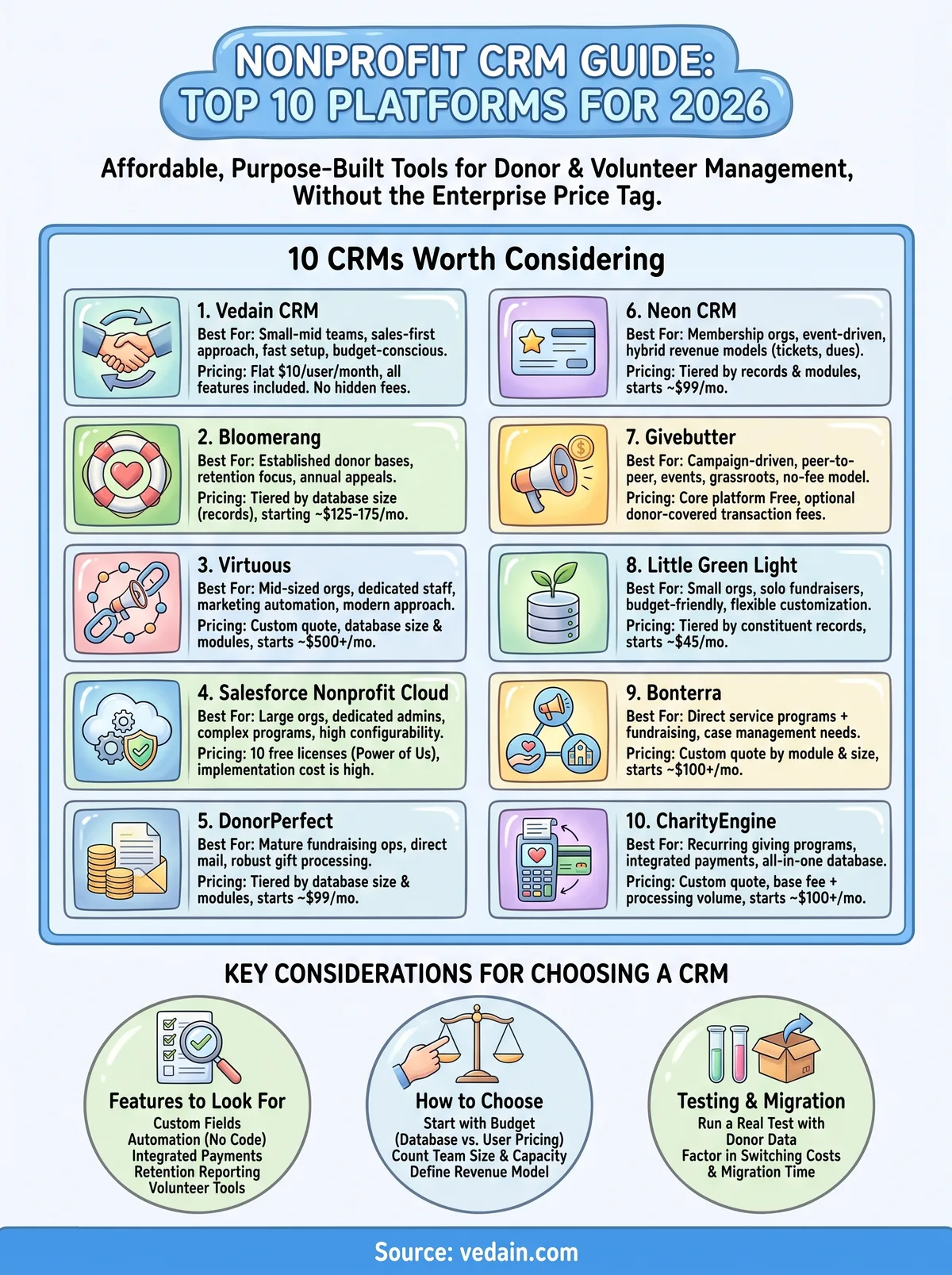
Below you'll find ten CRMs worth considering in 2026, from purpose-built donor platforms to flexible sales CRMs like Vedain that nonprofits are adopting for their transparent flat pricing and no-code automation. Each entry covers who it fits best, what it costs, and where it falls short, so you can match the tool to your organization's size and budget instead of guessing.
1. Vedain CRM
Vedain wasn't built exclusively for nonprofits, but that's part of its appeal. It's a general-purpose sales CRM that many mission-driven teams have started using because it gives them everything a purpose-built donor platform offers, minus the inflated per-user pricing that comes with "nonprofit edition" software. If your organization runs fundraising campaigns the way a sales team runs a pipeline (leads coming in, follow-ups needed, deals moving through stages) then Vedain's structure maps onto donor cultivation surprisingly well.
Key features
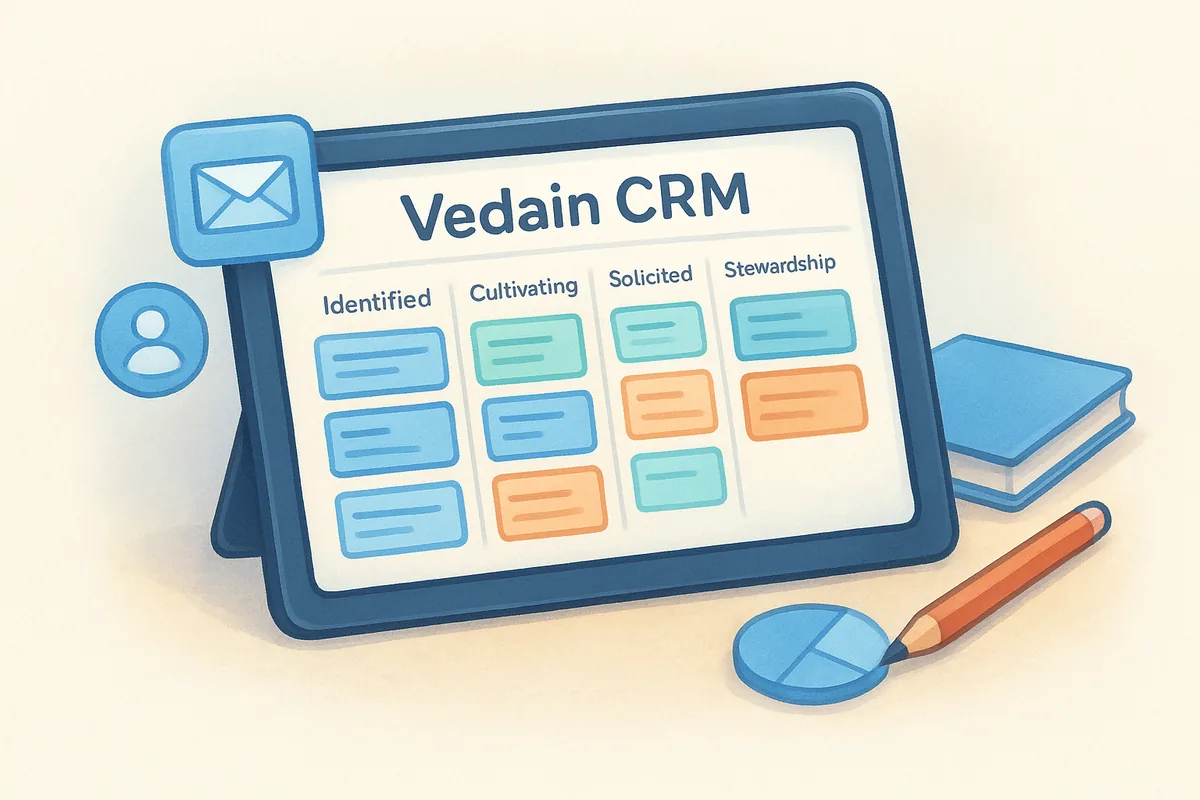
The deal pipeline works as a donor cultivation tracker out of the box. You can rename stages to match your fundraising process (Identified, Cultivating, Solicited, Stewardship) and drag donor records through a visual Kanban board instead of digging through spreadsheet tabs. Email integration syncs two-way with Gmail and Outlook, so every conversation with a major donor or grant officer lives on their contact record automatically.
- •Lead Forms capture website donations and volunteer sign-ups directly into contact records with custom fields
- •Email Campaigns send multi-step donor stewardship sequences and event reminders automatically
- •Workflows automate thank-you emails, task assignments, and follow-up reminders with no code required
- •Email Warmup protects deliverability so donor appeal emails don't land in spam
- •Custom Dashboards track fundraising totals, campaign performance, and volunteer activity in one view
- •AI Studio lets you describe a feature in plain English (like a matching-gift tracker) and have it built into your CRM
A CRM built for sales pipelines turns out to be one of the most affordable ways to run donor pipelines too.
Team permissions are granular down to the module level, which matters when you've got volunteer coordinators who shouldn't see financial giving history, or board members who only need reporting access. You can lock down exactly who sees what without paying extra for an "enterprise" tier.
Best for
Small to mid-sized nonprofits, particularly those with under 50 staff and volunteers, who need donor tracking, campaign automation, and reporting but don't want to pay for a specialized platform's overhead. Organizations already comfortable thinking in terms of pipelines and deals, or ones transitioning off spreadsheets for the first time, tend to onboard fastest. Grassroots organizations and small foundations running lean also benefit since there's no dedicated admin required to manage the system.
What it's not built for: complex grant management with multi-year restricted fund tracking, or organizations that need deep integration with accounting systems like Blackbaud Financial Edge. If that's your situation, a nonprofit-specific platform further down this list may fit better.
Pricing
Vedain charges a flat $10 per user per month with every feature included. There's no separate tier for automation, no upcharge for email sync, and no cap on contact records. Compare that to nonprofit CRMs charging based on database size or requiring a paid add-on for automation, and once you look at what each CRM charges per seat side by side, the savings add up fast for a five-person development team.
You can try Vedain CRM free for 14 days and have a donor pipeline running the same afternoon.
2. Bloomerang
Bloomerang built its reputation on donor retention, and it shows in almost every feature. Unlike sales-first CRMs, Bloomerang was designed from day one around the idea that keeping an existing donor costs far less than acquiring a new one, so the platform surfaces retention metrics front and center instead of burying them in a custom report.
Key features
Every donor record includes a generosity score, a proprietary metric that flags who's likely to lapse based on giving history and engagement patterns. That alone sets it apart from most generic CRMs, which leave you to build that logic yourself.
- •Constituent timelines showing every touchpoint (donations, emails, event attendance) in one scrollable view
- •Volunteer tracking with hours logged and shift management built in
- •Email marketing with templates designed for appeals and newsletters
- •Interactions module for logging phone calls and meetings by staff and board members
Retention-focused reporting is Bloomerang's real differentiator, not just donor tracking.
Reporting leans heavily toward retention and lapsed-donor analysis, which fits organizations that run annual appeals and want to know exactly who stopped giving and when.
Best for
Mid-sized nonprofits with an established donor base who prioritize retention over acquisition will get the most value here. Organizations running annual galas, membership programs, or recurring giving campaigns tend to lean on the generosity score heavily. Smaller grassroots groups without much giving history yet may find the retention tools underused at first.
Pricing
Pricing scales with the number of records in your database rather than a flat per-user rate, which means costs climb as your donor list grows regardless of team size.
Request a quote directly, since published tiers shift based on your specific record count and add-ons like volunteer management.
3. Virtuous
Virtuous positions itself as a "responsive fundraising" platform, built around the idea that donors give more when they feel personally connected to your mission rather than treated like a line item in a database. It's a newer entrant compared to Bloomerang or DonorPerfect, but it's picked up serious traction with mid-sized nonprofits that want marketing automation baked directly into their CRM instead of bolted on through a third-party tool.
Key features
Automation is where Virtuous separates itself from older nonprofit platforms. You can build donor journeys that trigger based on giving behavior, like an automatic thank-you sequence for first-time donors or a re-engagement campaign for anyone who hasn't given in six months.
- •Marketing automation with segmented email journeys tied to donor behavior
- •AI-powered insights that flag major gift potential and predict lapse risk
- •Volunteer management integrated into the same contact record as giving history
- •Online giving pages and peer-to-peer fundraising tools built in
- •Grant tracking for managing deadlines and reporting requirements
Virtuous bets that automated, personalized donor journeys convert better than static appeal blasts, and its feature set backs that bet up.
Reporting includes pre-built dashboards for retention, growth, and campaign performance, so you're not starting from a blank report builder every time leadership asks for numbers.
Best for
Mid-sized nonprofits with dedicated development staff who want to run sophisticated, behavior-triggered donor campaigns get the most out of Virtuous. Organizations already comfortable with marketing automation concepts, or teams migrating from a combination of Mailchimp plus a basic CRM, tend to adopt it fastest since it consolidates both functions. Smaller organizations without a full-time fundraiser to manage the automation logic may find the setup more involved than they need.
Pricing
Virtuous doesn't publish flat rate cards. Pricing depends on your database size, the modules you add (like volunteer management or grant tracking), and typically starts higher than entry-level nonprofit CRMs.
Budget time for a sales call and demo, since pricing isn't posted publicly and varies by configuration.
4. Salesforce Nonprofit Cloud
Salesforce built its name on enterprise sales software, and Nonprofit Cloud is essentially that same engine repointed at fundraising, program management, and grantmaking. It's the most powerful platform on this list by a wide margin, but that power comes bundled with the kind of configuration overhead that scares off smaller teams. If your nonprofit already runs on Salesforce for other operations, or you have IT staff who can handle admin work, it's worth a serious look. If not, the learning curve alone can eat months of staff time.
Key features
The platform ships as a customizable base you build on top of, not a finished tool ready out of the box. That flexibility is the whole appeal for larger organizations with complex program structures.
- •Fundraising management with donor pipelines, recurring gift tracking, and grant management modules
- •Program management tools for tracking outcomes across multiple service delivery sites
- •Marketing Cloud integration for segmented, multi-channel donor communications
- •AI-powered insights (Einstein) surfacing donor giving patterns and major gift predictions
- •Extensive app marketplace through AppExchange for specialized nonprofit add-ons
Salesforce Nonprofit Cloud rewards organizations with the staff to configure it, and punishes those without one.
Reporting is genuinely best-in-class once configured, with custom dashboards that can cross-reference program outcomes against fundraising data in ways most competitors can't match.
Best for
Large nonprofits and organizations with dedicated Salesforce administrators, multi-program service delivery, or complex grant compliance requirements get real value here. Teams without technical staff or a consultant on retainer typically struggle with implementation timelines stretching past six months, and are usually better served by leaner alternatives to Salesforce.
Pricing
Salesforce offers ten free licenses through its Power of Us program for qualifying 501(c)(3) organizations, which sounds generous until you factor in implementation costs.
Check eligibility through Salesforce.org before assuming the free tier covers your needs.
5. DonorPerfect
DonorPerfect has been around since the 1990s, and it shows in both directions: the platform covers nearly every fundraising scenario a nonprofit could throw at it, but the interface still feels dated compared to newer entrants like Virtuous or Givebutter. It's a workhorse rather than a showpiece, and plenty of nonprofits stick with it for a decade or more once they've built their processes around it.
Key features
Gift processing sits at the core of DonorPerfect, with support for recurring donations, matching gifts, and tribute giving all handled natively rather than through a bolted-on module. That depth matters for organizations running mature annual giving programs with multiple payment types to reconcile.
- •Constituent relationship tracking across donors, volunteers, and board members in one database
- •Event management for galas and fundraising events, including ticketing and table assignments
- •Direct mail integration for organizations still running physical appeal campaigns
- •DonorPerfect Marketplace with 100+ add-on integrations for accounting, email, and analytics tools
DonorPerfect trades modern polish for sheer configurability, which is exactly why long-tenured development directors keep renewing it.
Reporting includes a large library of pre-built templates, though customizing beyond those templates often requires help from support or a paid consultant.
Best for
Established nonprofits with mature fundraising operations, particularly those running direct mail alongside digital appeals, tend to get the most value here. Any organization evaluating a crm for nonprofits built specifically around gift processing complexity, rather than general contact management, should put DonorPerfect on the shortlist. Newer or smaller organizations without existing giving history may find the interface more cumbersome than the feature set justifies.
Pricing
DonorPerfect prices by database size and module selection rather than a flat per-user rate, similar to Bloomerang.
Get an exact quote through their sales team, since add-ons like event management and online giving pages typically cost extra.
6. Neon CRM
Neon CRM markets itself as an all-in-one platform for nonprofits that also run earned-revenue programs like membership dues, ticketed events, or camp registrations alongside traditional fundraising. That combination makes it a fit for organizations whose revenue doesn't come purely from donations, think community centers, arts nonprofits, or membership-based associations that need a crm for nonprofits built to handle mixed income streams in one system rather than stitching together separate tools.
Key features
Membership management sits at the center of Neon's design, with automated renewal reminders, tiered membership levels, and dues processing handled natively. That's a meaningful difference from donor-only platforms that treat membership as an afterthought.
- •Event registration with ticketing, session tracking, and capacity limits for conferences or camps
- •Donor and member management combined in a single searchable database
- •Volunteer management with shift scheduling and hour tracking
- •Online forms for donations, registrations, and applications, all customizable without a developer
- •Email marketing with segmentation based on giving or membership status
Neon CRM earns its keep with nonprofits that sell tickets and memberships as often as they solicit donations.
Reporting covers both fundraising and membership metrics side by side, which saves the manual work of reconciling two separate systems at year-end.
Best for
Organizations running hybrid revenue models, particularly membership associations, cultural institutions, and nonprofits with regular ticketed events, get the clearest advantage from Neon. Groups that rely purely on donation-based fundraising with no membership or event component will find plenty of unused functionality sitting in the platform.
Pricing
Neon CRM prices in tiers based on contact records and feature sets, with membership and event modules bundled into higher tiers rather than sold flat.
Request a demo to see exact pricing for your record volume, since published starting rates rarely reflect the full feature set most organizations end up needing.
7. Givebutter
Givebutter started as a free peer-to-peer fundraising tool and grew into a genuinely capable crm for nonprofits that still leads with its no-fee giving pages. It's the most approachable platform on this list for smaller, digitally native organizations that raise money through crowdfunding campaigns, events, and social sharing rather than traditional major-gift cultivation. If your fundraising strategy leans on Instagram links and peer-to-peer campaigns more than direct mail, Givebutter fits naturally.
Key features
Campaign pages sit at the center of the product, letting supporters set up their own fundraising pages tied back to your main campaign in minutes. That peer-to-peer structure turns individual donors into recruiters without any extra setup work on your end.
- •Donor and contact management with activity history tied to campaigns and events
- •Text-to-give and QR code fundraising for in-person events and galas
- •Built-in ticketing for fundraising events, including seating and add-on items
- •Automated receipts and thank-you emails triggered on every donation
- •Team fundraising leaderboards to gamify peer-to-peer campaigns
Givebutter turns everyday supporters into fundraisers, which is a different growth engine than most donor CRMs even attempt.
Reporting stays simple and campaign-focused rather than offering deep constituent analytics, which matches the platform's lighter-weight positioning.
Best for
Small to mid-sized nonprofits running crowdfunding-style campaigns, walkathons, or giving days will get the most out of Givebutter. Grassroots organizations without a dedicated development staff also do well here, since the platform requires almost no training to launch a campaign. Organizations needing deep major-gift tracking or complex grant management should look elsewhere on this list.
Pricing
Givebutter's core platform is free to use, with revenue coming from optional donor-covered platform fees on transactions rather than subscription costs.
Check their published fee structure before launching a large campaign, since payment processing costs still apply regardless of the platform fee.
8. Little Green Light
Little Green Light built its reputation on being the budget-friendly workhorse of nonprofit software, favored by small shops that need real donor tracking without the enterprise price tag or the steep learning curve of platforms like Salesforce. It's been around long enough to have a loyal following among one- and two-person development teams who value flexibility over flashy dashboards, and the company has stayed intentionally lean rather than chasing every new fundraising trend.
Key features
Customization is the platform's real strength. You can build your own fields, tags, and constituent categories from day one, which matters if your nonprofit tracks something unusual, like grant-funded program participants alongside traditional donors.
- •Unlimited custom fields and tags for tracking donors, volunteers, and program participants in one database
- •Moves management for tracking cultivation stages on major donor prospects
- •Integrated online donation forms with recurring giving support
- •QuickBooks and Constant Contact integrations for accounting and email marketing
- •Volunteer tracking with hours logged against specific programs or events
Little Green Light proves a nonprofit CRM doesn't need a big price tag to handle serious donor complexity.
Reporting relies on a flexible query builder rather than pre-built dashboards, which rewards nonprofits willing to learn the tool but can feel slower for teams wanting instant answers.
Best for
Small nonprofits and solo development directors managing everything themselves will find the most value here, especially organizations that outgrew a spreadsheet but aren't ready for enterprise pricing. Teams that want a modern, polished interface with automation baked in, similar to what Virtuous or Vedain offer, may find the design feels more utilitarian than they'd like.
Pricing
Little Green Light prices by the number of constituent records rather than by user seat, which keeps costs predictable even as staff turnover happens.
Confirm your record count before signing up, since crossing a tier threshold mid-year bumps your monthly rate automatically.
9. Bonterra
Bonterra formed when several nonprofit software companies (including Social Solutions and EveryAction) merged under one brand, and the resulting platform reflects that history: it's really a suite of tools for case management, fundraising, and advocacy rather than a single unified product. Larger nonprofits running both direct service programs and fundraising campaigns tend to find the combination useful, since most competitors on this list handle one or the other well but not both.
Key features
Case management sets Bonterra apart from donor-only platforms. Programs that track client outcomes, service hours, or grant-funded interventions get a dedicated module instead of a workaround built from custom fields.
- •Fundraising and CRM tools inherited from the EveryAction acquisition, covering donor tracking and email campaigns
- •Case management for social services, workforce development, and community programs
- •Advocacy and organizing tools for petition drives and legislative campaign tracking
- •Grant and outcomes reporting built for funder compliance requirements
- •Volunteer management integrated across both fundraising and program modules
Bonterra suits organizations doing direct service work and fundraising under one roof, not just nonprofits chasing donations.
Reporting spans both fundraising metrics and program outcomes, which matters when a single grant funds both a service and its related fundraising appeal.
Best for
Mid-size to large nonprofits running direct service programs alongside active fundraising, particularly those with grant compliance and outcomes reporting obligations, get the clearest value. Organizations that purely fundraise without a service delivery component will find much of the case management functionality sitting unused.
Pricing
Bonterra doesn't publish flat pricing, and quotes vary heavily depending on which modules (fundraising, case management, advocacy) your organization needs.
Expect a multi-step sales process, since the merged product line means your rep will need to scope out which legacy modules actually fit your use case.
10. CharityEngine
CharityEngine bundles donor management with payment processing under one roof, which sets it apart from most platforms on this list that hand off transactions to a third-party processor. The company runs its own merchant services, so gift processing, reporting, and constituent records all sit in a single database instead of syncing across separate systems. That's a meaningful pitch for nonprofits tired of reconciling a payment gateway against a CRM that only half-talks to it.
Key features
Payment processing built directly into the platform is the headline feature here. Every donation, whether recurring, one-time, or event-based, posts straight to the constituent record without an integration layer in between.
- •Integrated payment processing with no third-party gateway required
- •Recurring gift management with automatic failed-payment recovery and card updater tools
- •Peer-to-peer fundraising pages for campaigns and events
- •Online donation forms with customizable branding and embedded giving
- •Reporting suite covering gift history, campaign performance, and donor retention
When payment processing and donor records live in the same database, reconciliation stops being a monthly chore.
Automation extends to failed-payment recovery, a detail that matters more than it sounds since recurring gift attrition from expired cards quietly drains revenue at most nonprofits without anyone noticing until year-end.
Best for
Nonprofits that run heavily on recurring giving programs and want payment processing consolidated with donor records, rather than managed through Stripe or a separate merchant account, fit CharityEngine well. Organizations already frustrated by reconciling gift data across two systems will notice the difference immediately. Smaller groups without significant recurring revenue may not need the payment-processing depth this platform emphasizes.
Pricing
CharityEngine doesn't publish flat rate cards, and pricing typically factors in processing volume alongside a base platform fee.
Get a quote that includes processing rates, not just the platform fee, since the two combine to determine your real monthly cost.
11. Key features to look for in a nonprofit CRM
Getting past a sales pitch requires knowing which features actually move the needle for a mission-driven team. Every platform on this list claims to handle donors, but the details of how they handle them (reporting depth, automation flexibility, pricing structure) determine whether your staff adopts the tool or quietly reverts to spreadsheets six months in.
Donor and constituent tracking should sit at the core of any crm for nonprofits, with the ability to log every gift, email, and event attendance against a single record rather than scattered across disconnected tools, and it helps to know what a modern CRM should actually do before you compare vendors. Look for custom fields that let you track what actually matters to your mission, whether that's grant restrictions, volunteer certifications, or program eligibility.
The best nonprofit CRM is the one your staff actually opens every day, not the one with the longest feature list.
Automation deserves particular scrutiny, since manual follow-up is where small development teams burn the most hours, so look for triggers and actions you can set up without writing code. Prioritize platforms offering these capabilities without forcing you into a premium tier:
- •Automated donor communications for thank-you emails, tax receipts, and lapsed-donor re-engagement
- •Workflow builders that trigger tasks or emails based on giving behavior, no developer required
- •Recurring gift management with failed-payment recovery built in
- •Reporting dashboards covering retention, campaign performance, and fundraising totals in one view
- •Volunteer coordination tools if your organization relies on unpaid staff for programs or events
Pricing transparency matters just as much as the feature list itself, and it pays to understand where CRM plans hide their real costs. Many nonprofit-specific platforms price by database size, which sounds fair until your donor list grows and your bill climbs with it regardless of team size. Flat, per-user pricing like Vedain's $10/month model avoids that trap entirely, letting a growing donor base scale without a corresponding jump in software cost.
Security and permissions round out the essentials, particularly for organizations juggling board members, staff, and volunteers who each need different levels of access to sensitive donor and financial data.
12. How to choose the right CRM for your nonprofit
Start with your budget, not the feature list. A crm for nonprofits priced by database size looks affordable at launch, then quietly climbs as your donor list grows past a few thousand records, even if your team stays the same size. Decide upfront whether flat per-user pricing or tiered database pricing fits your growth trajectory better, since that single decision often outweighs which specific features a platform offers.
Count your actual team size and technical capacity next. A five-person shop without dedicated IT staff will struggle with Salesforce Nonprofit Cloud's configuration overhead no matter how powerful the reporting looks in a demo, so judge how long a CRM actually takes to learn before you sign. Match the platform's complexity to who's actually going to log in and use it daily, not to the largest team you might hire someday.
Choose the CRM your team will actually use every day, not the one that impresses in a sales demo.
Define your primary revenue model before comparing platforms side by side. Organizations built around recurring giving programs need strong payment processing and failed-card recovery, while groups running membership dues or ticketed events need something closer to Neon CRM's hybrid revenue handling. Peer-to-peer and crowdfunding-heavy nonprofits should weight campaign tools over deep constituent analytics.
Run a real test before committing to a contract, ideally alongside a structured checklist for picking a CRM. Import a sample of actual donor records, not demo data, and have your team log a week of real activity:
- •Can staff find a donor's full giving history in under 10 seconds?
- •Does the automation builder handle your actual thank-you and follow-up sequences?
- •Are reports exportable in formats your board and auditors expect?
- •Does support respond quickly when something breaks mid-campaign?
Finally, factor in switching costs honestly. Migrating donor history off a legacy platform takes real staff hours regardless of which system you land on, so read through what a CRM rollout involves step by step and weigh that one-time cost against years of ongoing subscription fees. A cheaper monthly rate rarely offsets a migration nobody budgeted for.
Finding the CRM that fits your mission
No single platform on this list wins outright. Bloomerang and Virtuous reward organizations with mature donor programs and staff to run them. Salesforce and Bonterra fit large, multi-program nonprofits with technical capacity. Givebutter and Little Green Light serve lean, budget-conscious teams well. Vedain CRM sits in a different spot: a flat $10 per user, every feature included, and a setup fast enough to run a donor pipeline the same afternoon you sign up.
If your nonprofit is tired of database-size pricing that punishes growth, or tired of paying extra for automation and email sync that should be standard, that's worth testing directly rather than taking on faith. The fastest way to know if it fits is to try it with your own donor data, not a demo script.
See what $10 per user, every feature included actually costs your organization, and compare it against the database-size quotes on your desk.
Frequently Asked Questions
What is the best free CRM for nonprofits?
HubSpot offers the most comprehensive free CRM for nonprofits with unlimited contacts and basic automation features at no cost. Zoho CRM also provides a free tier that nonprofits can use, though it's limited to 3 users and 10,000 records. For organizations seeking completely free options, Salesforce's Nonprofit Cloud and Microsoft Dynamics 365 offer special nonprofit pricing starting at significantly reduced rates compared to commercial versions.
How much does Salesforce cost for nonprofits compared to regular pricing?
Salesforce provides up to 10 free licenses for eligible nonprofits through its 1-1-1 Model, plus 50% discounts on additional licenses, making it substantially cheaper than the standard pricing of $165+ per user per month. This nonprofit discount model is more generous than competitors like HubSpot or Pipedrive, which don't offer dedicated nonprofit pricing. Zoho CRM and Vedain also provide nonprofit discounts, though typically less extensive than Salesforce's program.
Which CRM is easiest to use for small nonprofits with no technical staff?
HubSpot is widely recognized as the easiest CRM for nontechnical users due to its intuitive interface and extensive free training resources specifically designed for nonprofits. Zoho CRM also offers user-friendly design with good implementation support, though it has a slightly steeper learning curve than HubSpot. Pipedrive and Vedain are more sales-focused, so they may require more technical setup compared to nonprofit-specific solutions like Salesforce's Nonprofit Cloud.
What features should a nonprofit CRM have for donor management?
A nonprofit CRM should include donor segmentation, gift tracking, donation history, and automated thank-you communications—all features found in Salesforce Nonprofit Cloud and HubSpot. It should also support multi-currency transactions for international giving and integration with fundraising platforms like GiveWP and Donorbox. Zoho CRM and Vedain offer these capabilities, though Salesforce provides the most specialized nonprofit-specific tools like constituent relationship management designed specifically for donation workflows.
Can nonprofits integrate their CRM with email marketing and accounting software?
Yes, most modern CRMs support integration with email marketing and accounting tools—HubSpot, Salesforce, and Zoho all integrate with Mailchimp, Constant Contact, and accounting software like QuickBooks. Pipedrive and Vedain offer similar integration capabilities through Zapier and native connectors. For nonprofits, Salesforce Nonprofit Cloud has the most pre-built integrations specifically for donation management and constituent communication tools.
Is Salesforce or HubSpot better for nonprofit volunteer management?
Salesforce Nonprofit Cloud is specifically designed for volunteer management with built-in volunteer hour tracking and engagement features, making it the stronger choice for this function. HubSpot CRM can manage volunteers through custom fields and workflows but lacks dedicated volunteer management tools that Salesforce provides out-of-the-box. Zoho CRM offers volunteer management capabilities through customization, while Pipedrive and Vedain are primarily sales-focused and require significant custom development for nonprofit volunteer tracking.