This guide answers that search directly by ranking the CRMs that fit how construction crews actually sell and manage jobs. We looked at pipeline visibility, mobile usability on job sites, and how each platform handles quotes, follow-ups, and client communication without forcing you into a bloated enterprise setup. Pricing transparency mattered too, since contractors don't want feature gates buried behind a sales call.
Below you'll find nine tools worth considering in 2026, including Vedain CRM, built around flat, all-inclusive pricing and a visual deal pipeline that mirrors how contractors move projects from lead to signed contract. Each entry covers what the platform does well, where it falls short, and who it's actually built for, so you can pick a system that fits your crew size and budget instead of paying for someone else's enterprise features.
1. Vedain CRM
Vedain CRM tops this list because it strips away the pricing games that make small construction outfits overpay for basic pipeline tools. Every plan costs $10 per user per month, and that single price unlocks the entire platform, no locked-away automation, no per-seat email sync fees, no "contact sales" wall hiding the features you actually need to run bids and follow-ups. For a five-person crew tracking three active projects and a dozen open estimates, that flat rate matters more than a flashy feature list.
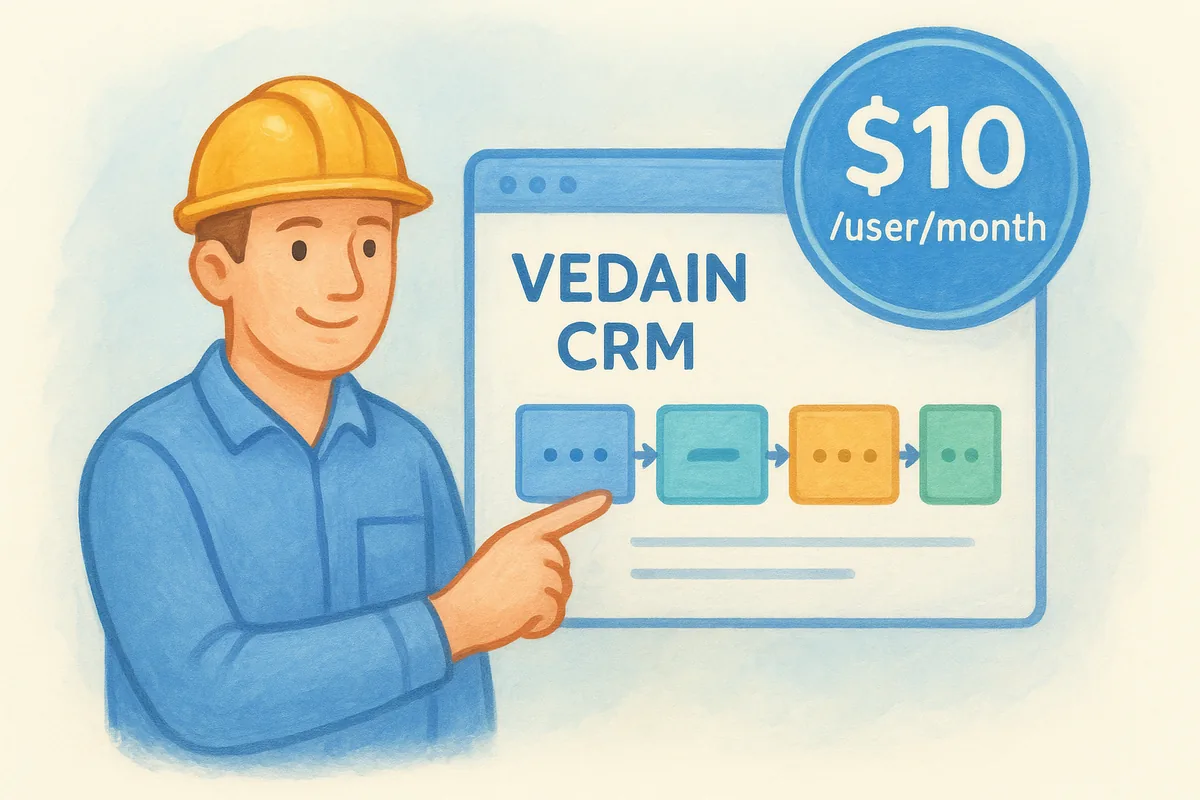
Flat, all-inclusive pricing means your CRM bill doesn't grow every time you add a feature you already assumed was included.
Key features
Vedain's visual deal pipeline works like a Kanban board, so you can drag a bid from "estimate sent" to "contract signed" the same way you'd move a job through phases on a whiteboard. Beyond the pipeline, the platform includes:
- •Two-way Gmail and Outlook sync, so client emails about change orders land right on the deal record
- •No-code workflow automation for follow-up reminders after a bid goes cold
- •Custom fields for job site details, permit status, or subcontractor assignments
- •Lead capture and tracking forms you can drop on your website for quote requests
- •Custom dashboards and reports to track which lead sources actually turn into signed jobs
Best for
Small construction businesses and remodeling contractors who want a CRM built for construction companies that handles the sales side, leads, quotes, follow-ups, and pipeline tracking, without paying for the project management bloat of construction-specific software they'll only use partially. Teams already living in Gmail or Outlook will notice the sync setup takes minutes, not a week of IT back-and-forth. If your crew has outgrown a spreadsheet but doesn't need scheduling software with punch lists and daily logs, this fits the gap.
Pricing
Vedain charges a single flat rate of $10 per user per month, with every feature included from day one. There's no free tier, but you can start a trial without a credit card, and setup typically takes under five minutes. Check current details on the Vedain CRM pricing page, or see how CRM software pricing compares across vendors.
2. monday CRM
monday CRM built its reputation on colorful, customizable boards, and that flexibility carries over well to construction sales tracking. Contractors who like building their own columns for permit status, bid stage, or crew assignment tend to enjoy the visual freedom here more than in rigid, pre-built CRM templates. It's a solid pick for anyone comparing options for the best crm for small construction business who wants heavy customization over out-of-the-box simplicity.
A CRM that lets you build your own columns only helps if your team actually has time to build them.
Key features
monday CRM gives you customizable pipelines, automation recipes for follow-ups, and integrations with tools like Gmail, Outlook, and Zoom. Dashboards pull data across boards, so you can see bid status and revenue forecasts side by side. Mobile access lets field staff update deal stages from a job site, though the interface can feel cluttered on smaller screens.
Best for
Owners who already use monday.com as a CRM for project boards and want their sales pipeline in the same ecosystem. It suits teams comfortable building their own workflows rather than following a fixed structure, and it works best when someone on the team enjoys tinkering with automation rules.
Pricing
Plans start around $12 per user per month on annual billing, with a three-seat minimum, and advanced automation features require higher tiers. That pricing structure pushes small crews toward paying for seats they may not need.
3. Pipedrive
Pipedrive built its name as a sales-first CRM, and that focus shows in how cleanly it handles a construction pipeline. Contractors who've tried heavier platforms often land here because the visual deal board feels intuitive without a steep learning curve. It's a fair middle ground for teams that want more structure than a spreadsheet but less complexity than full construction management software.
A CRM that takes a week to learn isn't saving your sales team any time.
Key features
Pipedrive centers on a customizable sales pipeline with drag-and-drop deal stages, activity reminders that nudge you to follow up on cold bids, and email sync for Gmail and Outlook. Its automation builder handles repetitive tasks like assigning new leads or triggering a proposal template. Reporting covers win rates and deal aging, useful for spotting which estimates stall before signing.
Best for
Small sales-focused teams who want a clean, activity-driven pipeline without extra project management clutter. It suits contractors who close a moderate volume of deals and need clear visibility into where each bid sits, rather than crews needing scheduling or job-site documentation built into the same tool.
Pricing
Plans start around $14 per user per month on annual billing for basic features, with email automation and advanced reporting locked behind the $39 and $59 tiers. That gap pushes cost-conscious construction teams toward paying more just to unlock features Vedain includes at its flat $10 rate.
4. HubSpot CRM
HubSpot CRM shows up on nearly every list of sales tools, and its free tier is genuinely usable for a two- or three-person crew just starting to track leads. The catch for growing construction businesses is that the free plan stays basic, and the moment you want automation, custom reporting, or more than a handful of email sequences, you're pushed into HubSpot's paid Marketing or Sales Hub tiers, which price by contact volume rather than seats.
A free CRM tier is only free until your lead list grows past the limit that triggers an upgrade.
Key features
HubSpot's core CRM includes contact and deal tracking, a visual pipeline board, email templates, and basic reporting at no cost. Paid tiers add workflow automation, custom deal properties for job type or square footage, and deeper analytics on which marketing channels generate signed contracts. Integrations cover Gmail, Outlook, and a wide app marketplace, so it connects to most tools a small office already runs.
Best for
Solo contractors or two-person outfits testing whether a CRM helps before committing budget, plus teams that already use HubSpot's marketing tools and want everything under one login. It's less practical once your contact list and automation needs outgrow the free tier's limits.
Pricing
The free plan covers basic contact and deal tracking indefinitely. Paid tiers start near $20 per month for a single seat and climb quickly as you add marketing automation, contacts, or additional seats, often surpassing $500 monthly for small teams, as this breakdown of what HubSpot costs per user shows.
5. Procore
Procore built its name as full construction project management software, and its CRM-style lead tracking exists mostly as an add-on to that bigger system. It's a fit for outfits that already run projects through Procore's scheduling, budgeting, and document tools and want lead tracking in the same place, rather than a business searching specifically for sales pipeline software. Compared to a purpose-built CRM, the sales side here feels secondary to the platform's real strength: managing active jobs.
A construction management platform can track your leads, but that doesn't make it a sales tool built for closing deals.
Key features
Procore centers on project management modules covering budgeting, scheduling, RFIs, and document control, with a lighter opportunity-tracking layer for bids and prospective clients. It connects field data to office reporting, so a superintendent's daily log can tie back to a client-facing project. Integrations cover accounting software and design tools more than email or marketing platforms.
Best for
Mid-size to larger construction firms already running multiple active jobs who need project management first and sales tracking second. It's a poor fit for a small crew still closing its first handful of deals each month, since the platform's depth adds overhead that outpaces what a lean sales process needs.
Pricing
Procore doesn't publish flat pricing and instead quotes custom contracts based on annual construction volume, often running into thousands of dollars yearly, well above flat per-seat CRM pricing.
6. Zoho CRM
Zoho CRM offers one of the deepest feature sets on this list, and that's both its appeal and its problem for a small construction crew. The platform packs in AI predictions, territory management, and dozens of customization options, but unlocking most of that depth means climbing through Zoho's tiered pricing, which can leave a five-person outfit paying for modules built for enterprise sales departments.
A CRM with a hundred features only helps if your crew has time to configure the ten you actually need.
Key features
Zoho's customizable pipeline stages let you match deal tracking to how you actually quote and close construction jobs, from initial site visit through signed contract. The platform includes email sync with Gmail and Outlook, workflow automation rules for follow-up reminders, and Zia, Zoho's AI assistant, which flags deals likely to stall. Reporting dashboards break down conversion rates by lead source, useful for spotting which referral channels bring in real jobs.
Best for
Contractors comfortable investing setup time upfront, and teams that want a CRM they can eventually stretch toward marketing automation or customer service modules as the business grows past pure sales tracking.
Pricing
Zoho's paid plans start around $14 per user per month billed annually, with automation, AI features, and advanced reporting reserved for tiers above $23 and $40, pushing small teams toward costs well past Vedain's flat $10 rate, which is why many crews look at Zoho CRM alternatives with better pricing.
7. Jobber
Jobber built its reputation among home service businesses like plumbers, electricians, and landscapers, and small remodeling or handyman-style construction outfits often land here for the same reasons. The platform blends light CRM functions with scheduling, quoting, and invoicing, which suits a solo operator or small crew that wants one tool instead of separate apps for sales and job management. Compared to a dedicated CRM, the deal pipeline feels thinner, but the job scheduling and quoting workflow covers ground a pure sales tool doesn't touch.
A tool built for scheduling technicians will always feel like a sales tool second and a dispatch tool first.
Key features
Jobber centers on client and job management, letting you convert a quote directly into a scheduled job and then an invoice without re-entering data. It includes a basic client communication log, automated appointment reminders, and a client hub where customers can approve quotes online. Mobile apps let field crews update job status and collect signatures on-site, which matters more here than deep pipeline reporting.
Best for
Small remodeling, handyman, or service-based construction businesses that need quoting and scheduling more than a structured sales pipeline, though a simple lead management tool may cover the sales side better. It fits owner-operators juggling both sales calls and job dispatch without a dedicated office staffer.
Pricing
Plans start around $39 per month for a single user, with team plans running higher per additional seat, and advanced features locked behind the top Grow tier.
8. Buildertrend
Buildertrend positions itself as an all-in-one construction management platform, and its CRM features exist to support that bigger workflow rather than stand alone. Contractors already running estimates, scheduling, and client communication through Buildertrend get a built-in lead tracker, but teams shopping specifically for construction sales software often find the pipeline view thinner than what a dedicated CRM offers. It works best when you want one login for the entire job lifecycle, not just the sales conversation.
Bundling your CRM into a project management suite only pays off if you actually use the rest of the suite.
Key features
Buildertrend's lead-to-project pipeline tracks prospects through bid stages and converts won deals directly into active jobs with scheduling and budgets attached. It includes client portals where homeowners can view project updates and approve change orders, plus email templates for proposals. Reporting focuses on job profitability more than sales conversion metrics, reflecting the platform's project-management roots.
Best for
Remodelers and home builders who want sales tracking bundled with scheduling, budgeting, and client communication in a single system. It suits teams willing to adopt Buildertrend's full workflow rather than just the CRM layer, since the pricing reflects the entire platform, not a standalone sales tool.
Pricing
Buildertrend charges based on custom quotes tied to company size and feature needs, typically starting near $199 per month, well above flat per-seat CRM pricing for teams that only need lead and deal tracking.
9. JobNimbus
JobNimbus started as a roofing-specific tool before expanding to general contractors, and that roofing DNA still shows in how it handles photo documentation and material tracking alongside sales. It combines a basic CRM pipeline with job management features like task boards and document storage, aiming at contractors who want one app for both the sales call and the job that follows. Teams researching construction crm software often shortlist JobNimbus for its middle-ground approach between a pure sales tool and a full project management suite.
A CRM built for roofers can work for other trades, but you'll notice which workflows were designed first.
Key features
JobNimbus offers a customizable sales pipeline, contact management, and a mobile app that lets crews snap job site photos and attach them directly to a project record. Automation handles task assignments and follow-up reminders, while a workflow builder maps out steps from lead to completed job. Reporting covers sales activity and job status, though it leans simpler than dedicated CRM analytics.
Best for
Roofing contractors and general construction crews who want sales tracking paired with lightweight job documentation in a single mobile-friendly app. It suits field-heavy teams more than office-based sales staff, since the interface prioritizes photo capture and task boards over deep pipeline reporting.
Pricing
Plans start around $25 per user per month, with automation and advanced reporting reserved for the higher Advanced tier, pushing small crews toward costs well past affordable CRM software with flat, all-inclusive pricing.
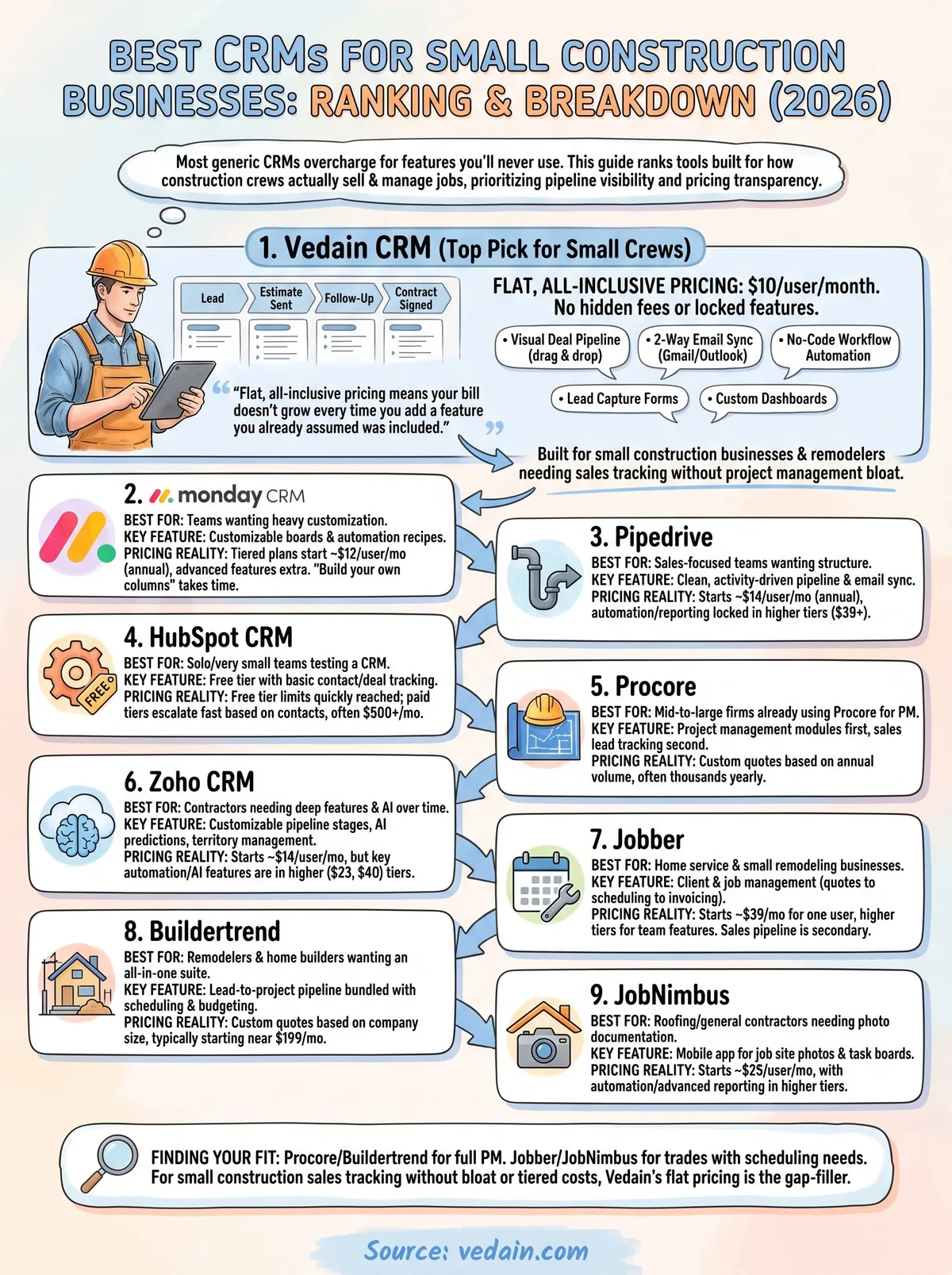
Finding the right fit for your crew
Most of the tools on this list solve a real problem for a specific type of contractor. Procore and Buildertrend make sense once you're running multiple active jobs and need scheduling tied to sales. Jobber and JobNimbus fit trades where quoting and job documentation matter as much as pipeline tracking. But if you're a small construction business that just needs a clean way to track leads, quotes, and follow-ups without paying for modules you'll never open, the flat pricing model matters more than a long feature list, as this 9-step checklist for choosing a CRM lays out.
That's the gap Vedain CRM fills. One flat rate covers the pipeline, email sync, automation, and reporting a small crew actually uses, without the tiered upsells that inflate bills on Zoho, Pipedrive, or HubSpot as you grow. Try Vedain free for 14 days and see how fast your crew can get quotes moving through a real pipeline.
Frequently Asked Questions
What is the best CRM for a small construction company?
The best CRM for a small construction company in 2026: Vedain ($10/user/month) for general contractors needing affordable pipeline management with custom fields for bid tracking. HubSpot (free to $90/user) for construction companies generating leads through marketing. JobNimbus ($25-85/user/month) for residential roofing, siding, and remodeling contractors needing photo documentation and job costing. Buildertrend for home builders needing full project management + CRM. For a 3-10 person GC team, Vedain or HubSpot Starter covers the basics at the lowest cost.
What CRM features do construction companies need?
Construction CRM must-have features: (1) Long-cycle pipeline stages (lead → estimate → bid → negotiation → contract → project). (2) Custom fields for job type, bid amount, project location, and contract value. (3) Contact management for multiple stakeholders per project (owner, architect, GC, sub). (4) Document storage for estimates, RFQs, drawings, and contracts. (5) Activity tracking for site visits, meetings, and phone calls. (6) Proposal or quote tracking with version history. (7) Mobile access for reps and project managers on-site. (8) Integration with accounting (QuickBooks, Sage).
Should a small construction business use a general CRM or a construction-specific tool?
Use a general CRM (Vedain, HubSpot, Zoho CRM) if: you primarily need to track bids and client relationships without built-in project management. Use a construction-specific tool (JobNimbus, Buildertrend, CoConstruct) if: you need photo documentation, job costing, scheduling, subcontractor management, and client portal all in one. General CRMs cost $10-50/user/month; construction-specific tools cost $25-200/user/month. For sales-focused teams, a general CRM with custom fields works fine. For teams managing full project lifecycle, construction-specific software adds more value.
How do construction companies track bids in CRM?
Construction companies track bids in CRM by: (1) Creating a 'Bid' pipeline stage between 'Estimate Sent' and 'Awarded'. (2) Adding custom fields: bid amount, bid date, decision date, competitors bidding, and bid success probability. (3) Attaching bid documents to the deal record. (4) Setting reminder tasks for bid follow-up (1 week, 2 weeks, 1 month after submission). (5) Logging the outcome (won/lost + reason if lost). Over time, this creates a bid win-rate database by project type, client type, and competitor — invaluable for improving future bid strategy.
Can Zoho CRM work for construction companies?
Yes, Zoho CRM works for construction companies, particularly those with 5-50 employees doing commercial or specialty contracting. Zoho CRM supports custom modules (create a 'Projects' or 'Bids' module alongside Deals), document storage, multi-stakeholder contact linking, and integration with Zoho Books for invoicing. The Zoho Enterprise tier ($40/user/month) adds process automation via Blueprint — useful for enforcing bid approval workflows. For construction companies already using Zoho Books for accounting, Zoho CRM is a natural addition with native integration.
What is the ROI of CRM for small construction businesses?
ROI of CRM for small construction businesses: A typical small GC loses 1-3 bids per month due to missed follow-ups or poor bid tracking — at an average project value of $50,000-500,000, that's $50,000-1.5M in missed revenue annually. A CRM at $50-500/month (for a 5-10 person team) that saves even 1 additional bid per quarter generates 10-100x ROI. The most measurable impact: faster response to new leads (first contact within 24 hours doubles bid success rates), systematic follow-up after bid submission, and visibility into which types of projects and clients have the highest win rates.