
This list answers the question directly: which CRMs actually fit how architecture firms sell and manage relationships. We looked at pipeline visibility for multi-stage projects, email sync for the back-and-forth with clients and contractors, and pricing that won't punish you for adding automation or extra users later.
Below you'll find eight CRMs worth considering in 2026, including where each one shines and where it falls short for design and architecture work, much like our roundup of CRMs for interior design studios. We'll cover setup speed, how each platform handles proposal-to-contract workflows, and total cost once you factor in the features firms actually use, not just the base sticker price.
1. Vedain CRM
Vedain built its pricing model around a simple idea: charge one flat rate and include everything, which turns out to be a great fit for architecture firms tired of paying extra for automation or storage caps. As a crm for architects, Vedain handles the long, multi-stage sales cycles typical of design-build proposals, from first client inquiry through contract signing, without forcing you into a higher tier to unlock the pipeline stages or email features you actually need.
How it works for architecture firms
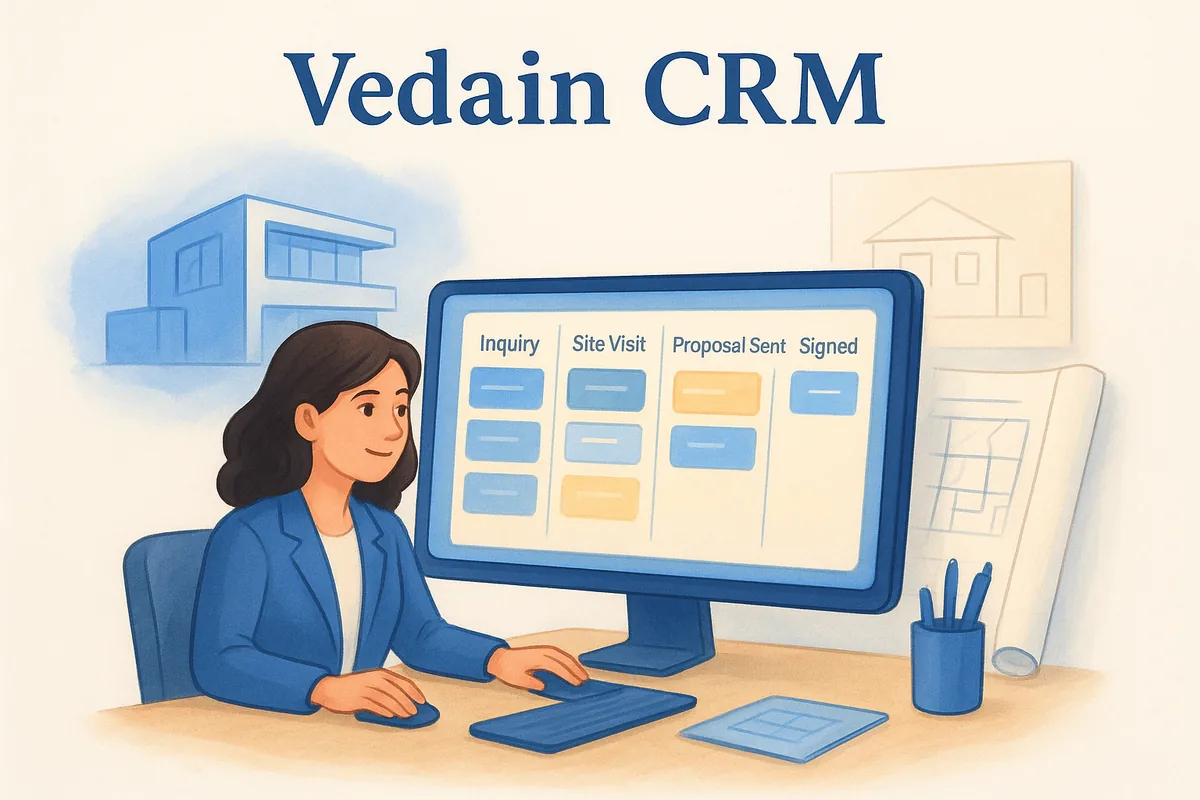
Firms set up a deal pipeline with custom stages that mirror their actual process, such as Inquiry, Site Visit, Proposal Sent, Contract Review, and Signed. The Kanban deal board gives principals a visual read on which projects are stalling and which are close to closing. Custom fields let you track project square footage, budget range, or permit jurisdiction right on the deal card, so nothing lives in a separate spreadsheet. Because email integration syncs both directions with Gmail and Outlook, every client thread attaches automatically to the right deal, which matters when a project spans six months of back-and-forth with clients, contractors, and consultants.
A CRM only earns its keep when every client email lands on the right deal automatically, not when someone remembers to log it.
Who it's best for
Vedain suits small to mid-sized architecture practices, typically 5 to 50 people, that want pipeline visibility without hiring an admin to manage the software. Design-build teams juggling multiple concurrent projects benefit most, the same way a CRM built for construction firms handles overlapping jobs, since the workflows automation builder can trigger follow-up tasks when a proposal sits untouched for a week. Firms currently paying for HubSpot or Salesforce tiers just to get automation or reporting often find Vedain covers the same ground at a fraction of the cost.
Key integrations
Vedain connects natively with Gmail and Outlook for two-way email sync, plus lead forms you can embed directly on your firm's website to capture inquiries. The marketplace adds 30+ AI agents built into the CRM for tasks like enriching contact records or drafting follow-up content, and LinkedIn automation lets business development staff keep a steady posting cadence without extra tools.
Pricing
Vedain charges $10 per user per month with nothing gated, all-inclusive. That single price covers the Kanban pipeline, email sync, workflow automation, email warmup, custom dashboards, and the AI Agent Marketplace, with no feature gates and no required credit card to start a trial.
2. Pipedrive
Pipedrive built its reputation on visual pipeline management, and that same simplicity translates well to architecture firms tracking projects from first consultation to signed contract. As a crm for architects, it's a solid pick if your firm wants a clean deal board without a steep learning curve, though you'll pay more once you add the automation and reporting features architecture teams tend to need.
How it works for architecture firms
Firms build custom pipeline stages, such as Discovery, Concept Design, Proposal, and Contract, then drag deals across as projects progress. Activity reminders nudge project leads to follow up after site visits or client meetings, which helps avoid the dropped-ball problem common in firms juggling ten projects at once. Email sync exists but lives behind higher-tier plans, so smaller firms on the entry plan often end up copying client emails manually into deal notes.
A pipeline tool only helps if the plan you can afford actually includes the features your team relies on daily.
Who it's best for
Pipedrive suits solo architects and small studios that want a straightforward visual pipeline without much configuration. Business development leads who prioritize simplicity over deep customization tend to prefer it over heavier platforms like Salesforce.
Key integrations
Pipedrive connects with Gmail, Outlook, and Google Calendar, plus a marketplace of add-ons for proposal software and e-signature tools like DocuSign.
Pricing
Plans range from $14 to $99 per user per month. Email sync, workflow automation, and advanced reporting all sit behind the pricier tiers, so firms comparing what Pipedrive's tiers cost next to one flat rate often pay two to three times more per seat.
3. HubSpot
HubSpot markets itself as an all-in-one growth platform, and plenty of architecture firms adopt it because the free tier looks appealing at first glance. As a crm for architects, it offers strong marketing tools, but the CRM itself gets expensive fast once you need the sales automation and reporting that firms actually rely on for tracking long design contracts.
How it works for architecture firms
Firms set up deal pipelines to track projects from lead to signed contract, and HubSpot's contact timeline logs every email, call, and meeting note in one place. Marketing Hub integration lets firms run email nurture campaigns to past clients or referral partners, which suits firms that lean on repeat business and word of mouth. The catch is that meaningful automation, like triggering a task when a proposal goes cold, requires the paid Sales Hub tiers, not the free CRM.
A CRM that's free to start can still end up costing more per user than a paid one, once you need the features that actually run your pipeline.
Who it's best for
HubSpot suits firms already running HubSpot Marketing Hub for content and email campaigns, since the CRM and marketing tools share the same contact records. Larger firms with dedicated marketing staff get more value here than small studios focused purely on project delivery.
Key integrations
HubSpot connects with Gmail, Outlook, Slack, and hundreds of marketplace apps, plus native e-signature and meeting scheduling tools.
Pricing
The free CRM covers basic contact and deal tracking. Sales Hub Professional runs roughly $90 per user per month, and firms needing marketing automation on top often pay well over $100 per seat once add-ons and contact tier limits are factored in.
4. Salesforce
Salesforce is the name most firms recognize first, and its sheer configurability means you can technically build almost any workflow an architecture practice needs. As a crm for architects, it works best when you already have the budget and staff to customize it, since out of the box it's built for generic B2B sales, not design-build project cycles.
How it works for architecture firms
Firms typically hire a consultant or admin to configure custom objects for project phases, RFP tracking, and proposal stages, since Salesforce doesn't ship with architecture-specific pipelines. Once built, the platform handles complex approval chains well, useful for firms bidding on public sector or institutional work that requires multiple sign-offs. Email sync through the Outlook or Gmail integration works reliably, but setting up automation rules for follow-ups usually means writing flows in the admin console rather than a plain-English builder.
The flexibility that makes Salesforce powerful is the same reason it takes months, not minutes, to get running.
Who it's best for
Salesforce suits larger architecture firms with 100-plus employees, multiple offices, or government and institutional client bases that demand detailed audit trails. Firms without an in-house admin or budget for a Salesforce partner typically struggle to get real value from the platform, which is why many end up weighing lighter CRMs that replace Salesforce.
Key integrations
Salesforce connects with Gmail, Outlook, Slack, DocuSign, and thousands of AppExchange apps, plus deep API access for firms building custom project management bridges.
Pricing
Plans start around $25 per user per month for the entry tier, but firms needing automation and reporting typically land on Enterprise at $165 per user per month, plus separate implementation and consulting costs that often exceed the software fee itself.
5. BQE Core
BQE Core started as time and billing software for professional services firms, the kind of practice a professional services CRM usually serves, and architecture practices make up a big chunk of its user base. As a crm for architects, it leans harder into project accounting than sales pipeline management, which makes it a different animal from the other tools on this list. Firms already using it for invoicing sometimes stretch it to cover client tracking too, but that's not really what it's built for.
How it works for architecture firms
BQE Core centers on project profitability, tracking billable hours, budgets, and phase completion alongside client and contact records. Firms can log proposals and track opportunities, but the pipeline view feels like an add-on bolted onto a time-tracking core rather than a purpose-built sales tool. Where it earns its keep is connecting the business development side to the finance side, so a principal can see which client relationships are actually profitable once fees and hours are counted.
A tool built for billing can track your clients too, but it won't feel like a sales pipeline was ever the priority.
Who it's best for
BQE Core suits firms that want project accounting and time tracking bundled with basic client management, particularly those already committed to its billing workflow. Firms whose main pain point is winning new business, not billing existing projects, usually find the CRM layer thin by comparison.
Key integrations
BQE Core connects with QuickBooks, Outlook, and Gmail, plus several construction-specific document management platforms.
Pricing
Core pricing starts around $25 per user per month for basic modules, with full project accounting and CRM features pushing costs closer to $45 to $60 per user per month depending on the modules selected.
6. Scoro
Scoro positions itself as a work management platform that bundles quoting, billing, and project tracking with a CRM layer bolted on top. As a crm for architects, it appeals to firms that want to see the whole business, sales pipeline, project hours, and invoicing, in one dashboard, rather than stitching together three separate tools.

How it works for architecture firms
Firms track opportunities through a quote-to-project pipeline, where a won deal converts directly into a billable project with budgets and phases already attached. That handoff saves the manual re-entry step common when a separate CRM and project tool don't talk to each other. Time tracking and invoicing live in the same system, so principals can compare quoted fees against actual hours burned without exporting reports elsewhere.
Merging your pipeline and your project ledger sounds efficient right up until you need either one to do something specialized.
Who it's best for
Scoro suits mid-sized firms, roughly 15 to 100 people, that want a single system covering sales, delivery, and billing instead of separate point tools. Firms with a dedicated business development hire who needs deep pipeline automation tend to find the CRM side thinner than what a purpose-built sales tool offers.
Key integrations
Scoro connects with Gmail, Outlook, QuickBooks, Xero, and Zapier for bridging to other apps, along with a REST API for custom connections.
Pricing
Plans run from roughly $26 to $63 per user per month depending on the tier, with the CRM and advanced reporting features reserved for the higher plans, so firms wanting full pipeline automation typically pay toward the top of that range.
7. Unanet
Unanet grew out of government contracting software, and it still carries that DNA into architecture firms doing public sector or institutional work. As a crm for architects, it treats the sales pipeline as one piece of a larger resource planning system, so you get pursuit tracking alongside staff scheduling and project financials rather than a standalone deal board.
How it works for architecture firms
Unanet tracks pursuits, its term for opportunities, from initial lead through proposal and award, with fields built around government RFP requirements like NAICS codes and teaming partners. Firms bidding on federal or municipal contracts appreciate that the system already speaks that language instead of forcing you to build custom fields from scratch. The tradeoff is that private commercial work, the kind most residential and boutique firms chase, feels like a secondary use case bolted onto a public-sector core.
A CRM built for government pursuit tracking will always feel foreign to a firm chasing private residential clients.
Who it's best for
Unanet suits firms with a public sector practice, particularly those doing federal, state, or municipal work where proposal compliance and teaming agreements matter as much as the sales pitch itself. Firms with no government client base rarely find enough value to justify the learning curve.
Key integrations
Unanet connects with Microsoft Outlook, QuickBooks, Deltek's GovWin for lead sourcing, and various resource planning tools common in the AEC (architecture, engineering, construction) sector.
Pricing
Unanet doesn't publish flat rates. Firms typically pay custom quotes based on module selection and headcount, with government-focused CRM and project modules often landing well above $50 per user per month once implementation is included.
8. Monograph
Monograph was built specifically for architecture firms, and that focus shows in how it frames a project pipeline around design phases instead of generic sales stages. As a crm for architects, it leans heavily toward practice management, staff utilization, and fee tracking, with the client relationship side treated as one part of a bigger operational picture rather than the main event.
How it works for architecture firms
Firms track leads and proposals through stages that map to real design work, like Schematic Design and Construction Administration, so the pipeline already speaks architect. Time tracking and staffing forecasts live in the same system, letting principals see whether a busy pipeline actually matches available staff hours before committing to new work. Email logging exists, but it's manual rather than the automatic two-way sync you get from CRMs with proper Outlook integration built around sales workflows first.
A CRM built by architects for architects still has to prove it can run a sales pipeline, not just a project schedule.
Who it's best for
Monograph suits small to mid-sized firms, typically under 40 people, that want practice management and light business development tracking in one place. Firms whose main challenge is winning new work through active outreach, rather than managing capacity on projects already signed, often find the CRM layer too thin.
Key integrations
Monograph connects with QuickBooks Online, Gmail, and Outlook for basic email visibility, plus a handful of AEC-specific time tracking and payroll tools.
Pricing
Monograph charges roughly $26 to $38 per user per month depending on the tier, with practice management features included but deeper CRM automation largely absent compared to sales-first platforms.
Choosing the right CRM for your firm
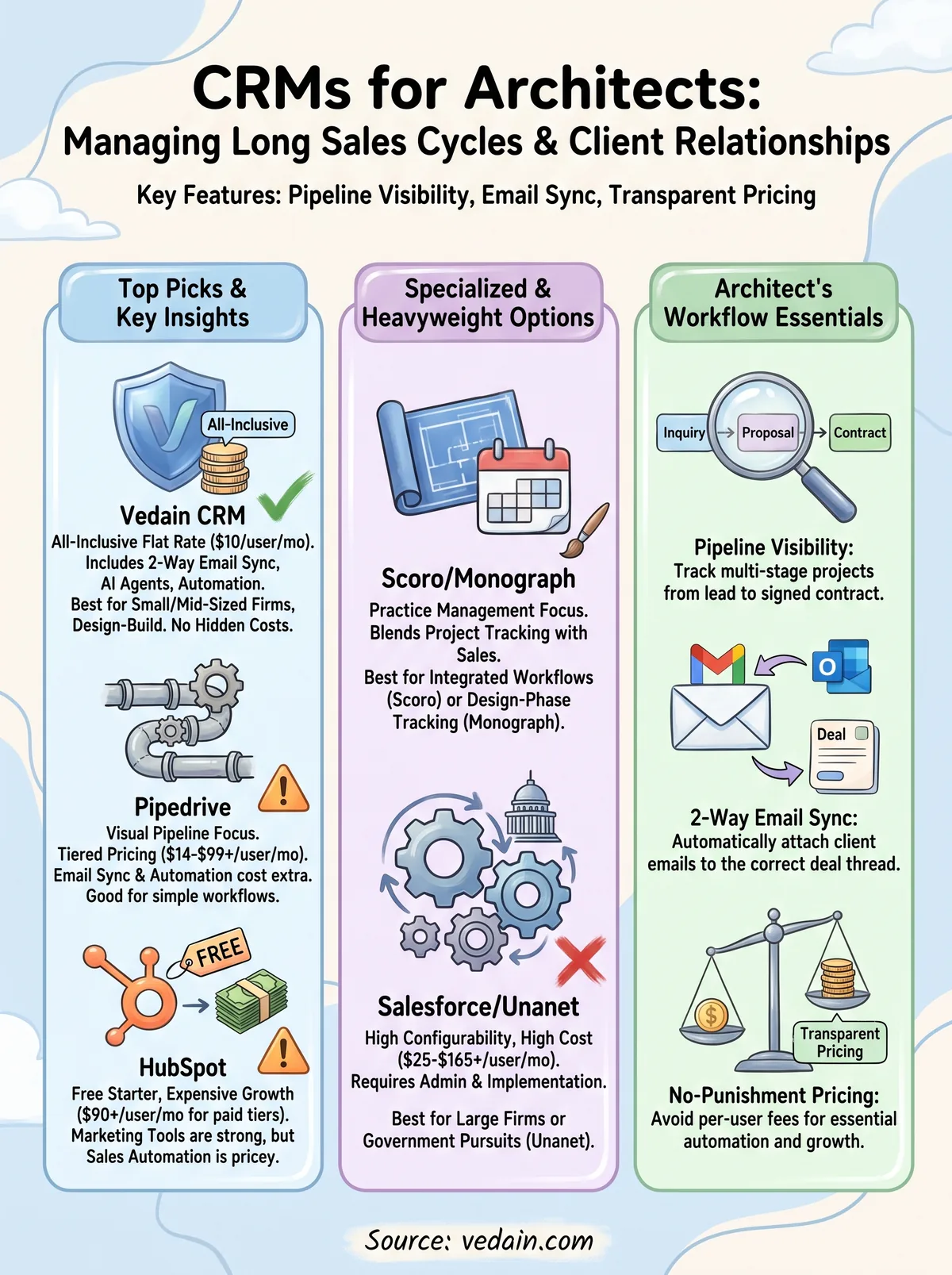
Match the tool to your actual workflow, not the brand name you recognize. Purpose-built platforms like Monograph or Unanet make sense if your firm lives inside government pursuits or design-phase staffing. Heavyweights like Salesforce only pay off once you've got the budget for a consultant to configure them. For most small and mid-sized practices, though, the winning combination is pipeline visibility paired with email sync and pricing that doesn't punish you for growing your team or turning on automation.
Vedain checks those boxes without the tier games that inflate your bill on Pipedrive, HubSpot, or Scoro once you need the features architecture firms actually use daily. One flat rate, every feature included, no surprise upgrade prompts six months in.
If you're ready to see how a crm for architects should actually work, start a free Vedain trial and set up your first pipeline in under five minutes.
Frequently Asked Questions
What is the best CRM for architecture firms in 2026?
The best CRM for architecture firms depends on your budget and needs, but Vedain and HubSpot are top choices for 2026. Vedain offers specialized features for architectural projects starting at $99/month, while HubSpot provides robust project tracking and client management at $50/month for its Starter plan. Both platforms outperform Salesforce and Zoho for smaller to mid-sized architecture practices due to their simpler interface and architecture-specific workflows.
How much does CRM software cost for architects?
CRM pricing for architects ranges from $50 to $300+ per month depending on features and company size. HubSpot starts at $50/month, Pipedrive at $14.90/month for basic plans, Vedain at $99/month for architecture specialists, Zoho at $18/month, and Salesforce at $165/month for Professional edition. Most offer per-user pricing, so total costs increase with team size.
Can Salesforce work for architecture project management?
Yes, Salesforce can work for architecture project management, but it requires significant customization and has a steep learning curve for most architecture firms. Salesforce Professional edition costs $165/month and is better suited for large enterprises than smaller practices. For architecture-specific needs, Vedain, HubSpot, or Pipedrive offer better out-of-the-box functionality at lower price points.
Is Zoho CRM good for architects?
Zoho CRM is affordable for architects, starting at $18/month, but lacks specialized architecture workflows compared to Vedain. Zoho offers strong customization capabilities and integrates well with other Zoho products, making it suitable for firms seeking an economical solution. However, HubSpot and Vedain provide more intuitive interfaces specifically designed for architectural project tracking and client management.
What features should architects look for in CRM software?
Architects should prioritize CRMs with project timeline tracking, client communication tools, proposal generation, and drawing/blueprint storage capabilities. Vedain excels in these areas with architecture-specific templates, while HubSpot offers excellent client relationship management and pipeline tracking. Pipedrive and Salesforce provide strong sales pipeline management, though they require customization for architecture workflows, and Zoho offers customizable fields but less specialized features.
Which CRM integrates best with architecture software like AutoCAD?
Vedain and HubSpot offer the best native integrations with architecture software tools, including AutoCAD compatibility through APIs and third-party apps. Salesforce and Zoho also support integrations through Zapier and custom development, but require more technical setup. Pipedrive has limited architecture software integration options, making it less ideal if you need seamless AutoCAD or Revit connectivity.